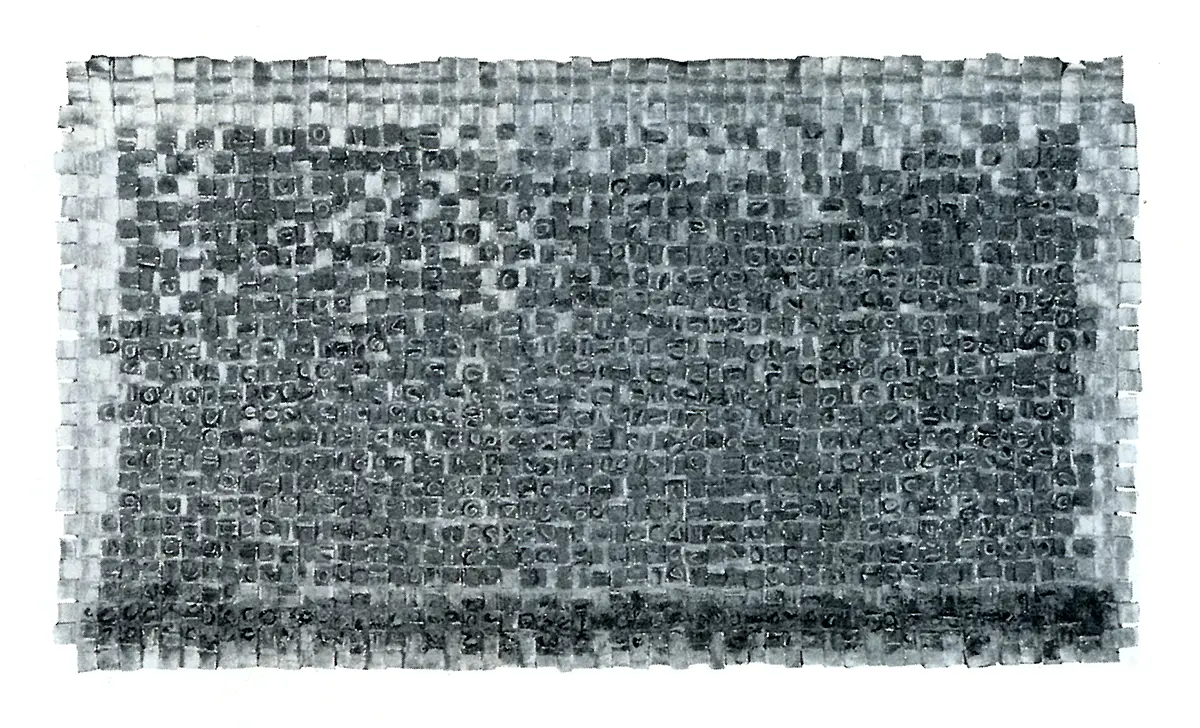
After a prolonged absence,1 Olga de Amaral presented a monumental exhibition of textiles at the Museum of Modern Art of Bogota, sponsored by Seguros Skandia, which covered the “four periods” that are woven together in her creative process as a whole. It is clear that the weft, warp, and fiber—essential elements in the elaboration of her textiles —form the conceptual basis of her research, which reflects both a refined sensibility and a sense of arduous discipline.
This exhibition clarified how the techniques and materials used by the artist lead to the construction and development of a language, since each of her periods is preceded by intentions of a conceptual and expressive kind that make her tapestries intensely meaningful surfaces, as Galaor Carbonell showed in his book entitled Olga de Amaral, Desarrollo del lenguaje.2 Three objectives can be identified: a geometrical intention, characteristic of her production in the 1960s; an expressive intention, reflected in a good deal of her work from the 1970s; and finally, a reflective intention, from the 1980s up to the present.
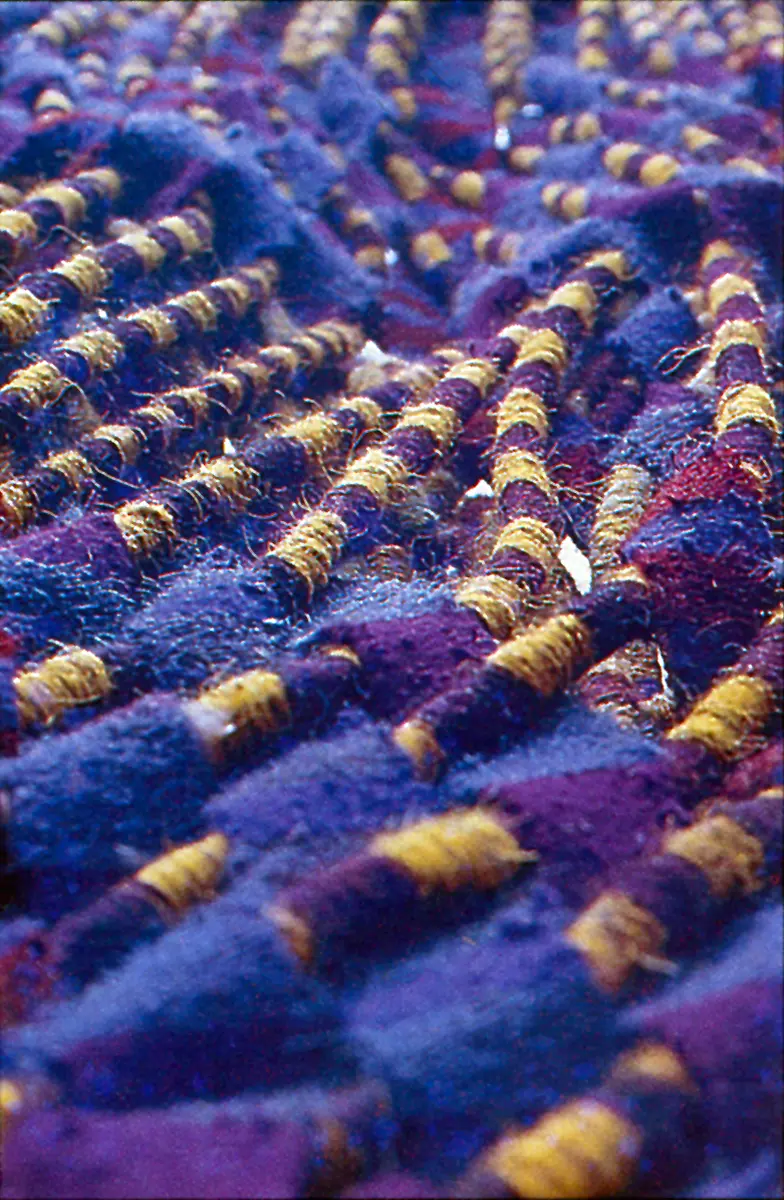
From the 1960s, there has been a clear desire to experiment in her work, which, through color and geometric structure, has tried to break the two-dimensional nature of the tapestry, creating openings or transparencies which emphasize the vertical nature of the warp, an essential feature in the development of her later production.
During the 1970s, the so-called “second period”, the work of Olga de Amaral moved away from the geometric style which gave order to color, and developed an expressive intention that was in part embodied in the links between the textile and the landscape. On the one hand, there is the physical fact of the landscape, color, texture, and extension; on the other, are the affective values which, in her case, associate landscape with memory that reflect the decisive elements in the shaping of her sensibility. It is this sensibility that gives rise to this intensely rich period of experimentation. Throughout this decade, as Galaor Carbonell points out, the language of Olga de Amaral achieves full maturity, creating its own vocabulary (use of new materials, new fibers, exuberance of color and pre-woven elements); at the same time, certain decisive elements appear that define the identity of her proposal: the interaction of the tapestry and the wall and, from the wall, the architectural space; verticality and by extension the lack of gravity leading to the three-dimensional nature of the textile work.
The relationship between her textile art and architecture was emphasized throughout this exhibition, so that the other concepts seemed to flow from that relationship. The architecture of the Museum, with its grey open concrete walls and the relationship between the exhibition areas and the empty spaces, staircases, and windows, features which are frequently detrimental to other exhibitions, here proved to be rewarding. This relationship, within the artist’s creative process, becomes explicit in the Textile Walls,3 works done with pre-woven elements bound with a braided fabric whose structure and volume create the idea of weightlessness, establishy an unusual relationship between the graceful fall of the tapestry and the rigidity of the architectural wall, either when the work extends directly from the wall or hangs floating in the empty space; in both cases, the artist fully achieves her objectives.4
This concept of verticality and weightlessness was illustrated in the exhibition by two pieces, which can be seen as two different attempts to capture the three dimensions. Gran maraña paramuna,5 from the 1970s, is a monumental work that seems to mark the climax of her expressive intention. The strength of this work, as well as its size, encompasses a number of elements in its structure, which seem to reflect an arduous process of researching ways of knotting the fiber, the use of prewoven materials, the combination of color, and the form of the tapestry, which in this work loses its rectangular format. The three-dimensional aspect is reflected in a very thick kind of knotted material hanging in space, effectively creating a tangle of very dense fibers that eloquently bears witness to the quality of the weaving and the textural quality of the fibers.
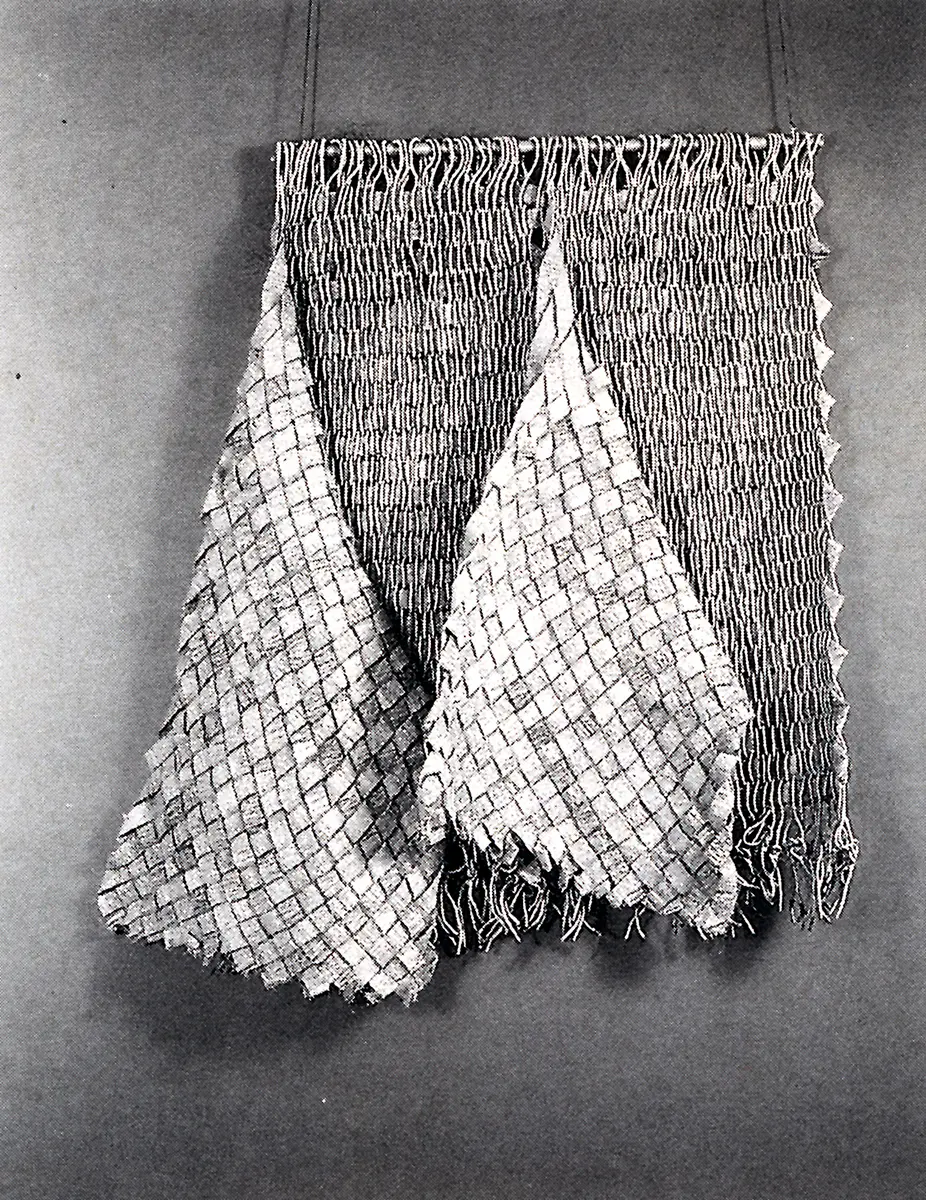
This three-dimensional quality appears in a very different manner in Vesture in stone masonry (1977), a smaller monochrome work (135 x 100 cm.) which illustrates how the investigation of ways to combine vertical (warp) with horizontal elements (weft) and the quality of the knotting can create a variety of textures which determine the quality of the planimetric surface, leading to the emergence in space of “another” kind of textile.
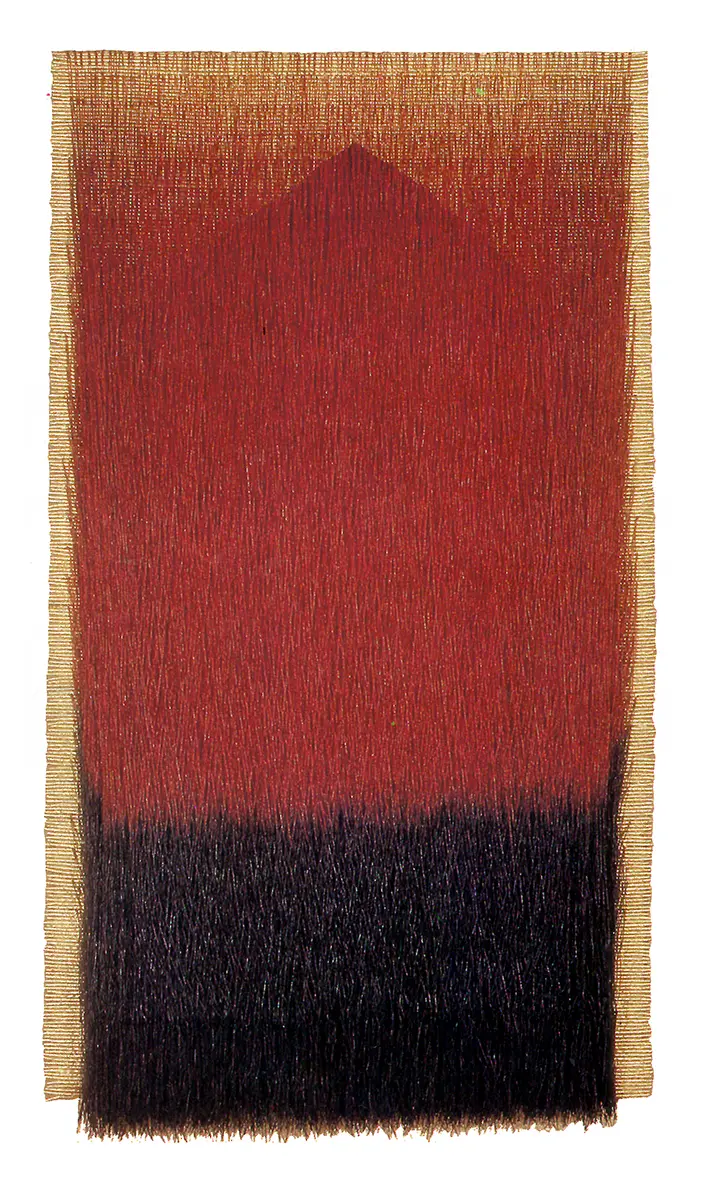
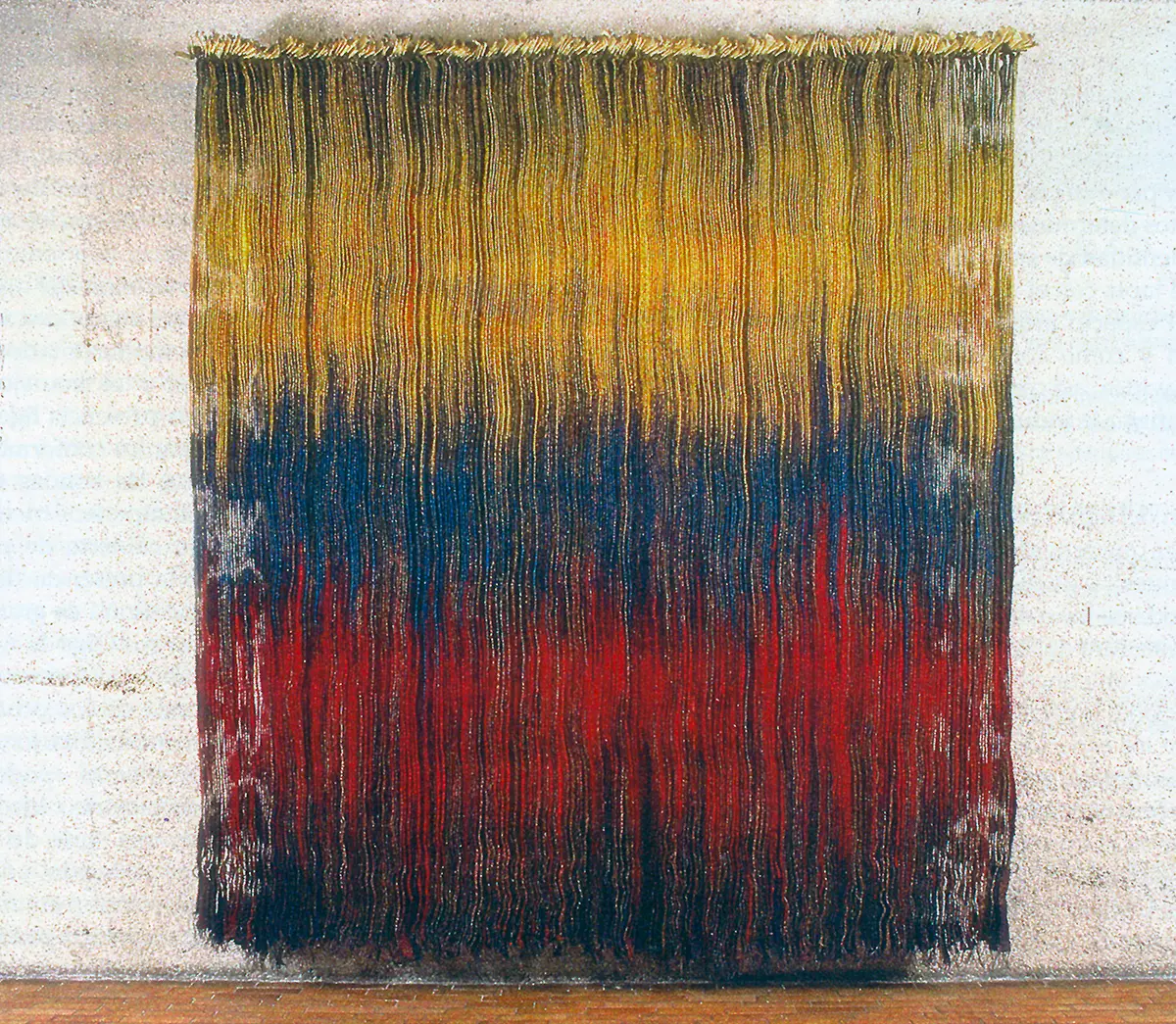
The weightless, transparent presence of the tapestry in space, an idea which to a large extent characterizes the artist’s research during her second period, is reflected in many of the works from the early 1980s, including Fiber Mural (1983) and Colombian Flag (1984), one of the most impressive pieces in the exhibition. This work can be read as a transposition of the interests predominant in the 1970s alongside those that were to emerge during her third period: the transparence and presence of gold.6 Here transparency and weightlessness act as complementary concepts: the vertical structure and handling of color accentuate a soft, loose and tenuous presence, which seems to emerge as an effect of light; the woven bands making up the tricolor surface hang from a fabric covered with gold leaf, heralding the presence of a new material in her work that will to a large extent be explored in her research in the following years.
During the 1980s, this search appears to focus on a meditation which might be said to have led to certain issues of a more pictorial nature. This meditation began with a series of very small-format works in which the fiber and the weaving entered a phase that appeared to raise questions about their plastic and conceptual values; this is clear in such works as Whitewashed Traces (30 x 30 cm). There is a clear presence of gold as an element that will give new meaning to the surface and whose symbolic value will enhance and transform the artist’s creative work.
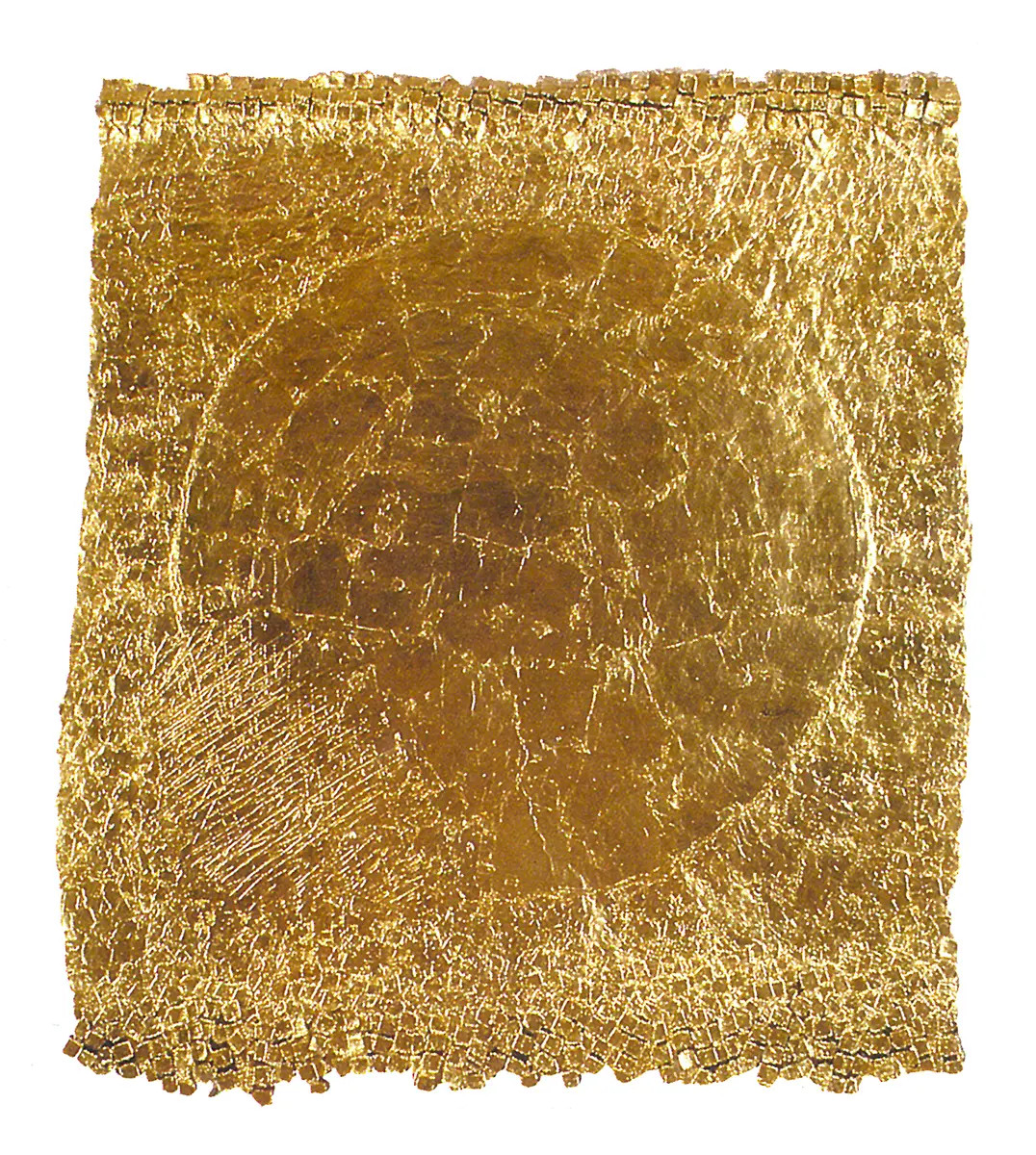
From this time on, when there was a clear change in intention from an expressive to a reflective mood, three main topics of investigation can be identified: an interest in gold surfaces, that leads to two classes of works, those such as Lunar Baskets, Moments and Alchemies, with their shot textile weaving in which the pictorial values are evident, along with a direct use of pigment on the tapestry which creates changing chromatic effects depending on the light and the place of the spectator. Another example of this interest in gold surfaces is to be found in the Suns (1993), where verticality disappears. The six suns are square, with a geometric interplay between the circle and the square, creating a static form where a dialogue appears between the woven surfaces covered in gold leaf, but where the woven structure is still apparent, and other surfaces that are more compact, richer, and denser in texture, in which the woven elements remain almost hidden. The result is a kind of confrontation, or dialogue, between the woven material and the pictorial texture.
Secondly, there is the permanent search for surfaces which allude to the pure language of the fiber, where pure linear structures predominate and where through the crossed, vertical, or descending line of the fabric persists in the concepts of transparence both in terms of a half-open surface that allows light to pass through it and color, the tonalities of which change because of the superimposition of fibers. This is the case with such works as Enthronements, The Ceremonial Curtains, and The Moons.
Thirdly, there is the series entitled Tablets and Doors, where the woven fabric forms a rigid surface. These works reveal a new concept of geometry, which, unlike the geometrical interplay of the early period, is based on the variation of rhythms and forms and is now of a minimalist type. The effect is of an eminently conceptual work; however, in contrast to the proposals of minimalist and conceptualist art, Olga de Amaral does not abandon the search for meaning or fail to give full importance to intuition, emotion, and sensibility.
There is in these three research themes a reflective intention which characterizes her production from the 1980s up to the present. It is a reflection that converts her previous work into a rich material, a “substance”7 which is now re-worked to give the fabric, fiber, and color a sacred symbolism which recalls the magnificence and mystery of ancient rites, or the richness of a colonial past whose vestiges remain in architectural or religious expressions.
This sacred presence, forcefully and through a new form, strengthens the desire for communication, which has motivated Olga de Amaral through her work, in which each of the elements used has had a conceptual and meaningful value, threads that have been woven into one of the most important works of Colombian art.
The vision that structured the exhibition and architecture of the Museum complemented the nature of the work presented, making the event a memorable one. The catalogue, too, is excellent, admirably reflecting the spirit which has imbued the “four periods” of the work of Olga de Amaral.
NOTES
1. The last individual show by Olga de Amaral in Bogota dates back to the early 1980s in the Tempora Gallery. Since then, her work has been on show abroad, and only occasionally has it been seen in Bogota, during the National Salons.
2. Olga de Amaral, Desarrollo del lenguaje (University of the Andes, 1979); in this study, the late Galaor Carbonell, critic, teacher, and artist, makes a detailed analysis of Amaral’s work, which is related to constructivism as well as certain features of abstract expressionism.
3. Woven Walls was the title of a one-woman show by Olga de Amaral at the Luis Angel Arango Library in Bogota in 1969.
4. In the catalogue accompanying the show, Olga de Amaral refers to the proposals defining each of her “fourperiods”. Speaking of the 1970s, she says: “Space hasa lot to do with tapestry. My tapestries belong to walls, to the space before the wall exists. I want them to be felt as a presence, but I do not want this presence to be seen as an act of intromission. I want them to be almost transparent, weightless...”
5. Gran maraña paramuna is a very important work within Amaral’s production, as pointed out by Galaor Carbonell (op cit.) and Eduardo Serrano in the catalogue presentation, as a work in which the artist restructures the scale of the woven fabric.
6. In referring to the period from the 1980s to the 1990s, Amaral noted: “If 1 could accomplish a dream with my tapestries, it would be to do a completely transparent work. In a certain sense, gold is like that, it begins to disappear...”
7. “After twenty-five years, there are so many things that you find. You have assembled your own information for use, but as you use it, you acquire more information. You create substance by using yourself.”
MARTHA RODRÍGUEZ