“Let us only say that what one calls capital is based on the principle that a currency is nothing but time put on reserve and at one’s disposal. It doesn’t matter whether it be afterward or beforehand about what is called 'real-time.' Real-time is but the moment at which time, preserved as currency, is realized. What is important, for the capital, is not the time already invested in goods and services, but the time still stored in stocks of 'free' or 'fresh' currency, since the latter represents the only time that can be used towards organizing the future and neutralizing the event." Jean-François Lyotard, "Le temps, aujourd’hui," in L’inhumain - Causeries sur le temps, Galilée, Paris, 1988.
Collecting, disassembling, and reconstructing, these three gestures tirelessly performed in Jac Leirner’s process are based on a time-related concept of capital. Money saving for some, material accumulation for her. Yet all accumulation means time saved for the future and therefore, an attempt to control. This glance cast upon the world is weighed down with interest: contemplation is soon followed by action and the idea of time is offered up to pragmatic determination.
The object certainly possesses memory. In 1987, Leirner’s lungs served as witnesses to an aesthetic experience that could ultimately be included in the body art tradition. A whole series of works (Lung) was built from 1.200 up Marlboro packs smoked over three years. The matter: smoke in ellipsis. The artist added two of her lungs taken over a three-year period. Such an attitude reminds us of Roman Opalka’s process where duration is materialized in painted numbers ascending on boards that blanch in the light of elapsed time, accompanied by a picture of the artist taken in the same position with the same shirt.
Very conceptual, if it were not for the fact that the pieces that make up the Lung series are set at the fringe of the abstract image. In this case, material identification is less explicit. Plastic ribbons enmeshed, stacks of shining paper, cellophane envelopes, and price stamps constitute an entire collection of fragments agglutinated into families, taken from amorphous situations, and becoming both support and surface.
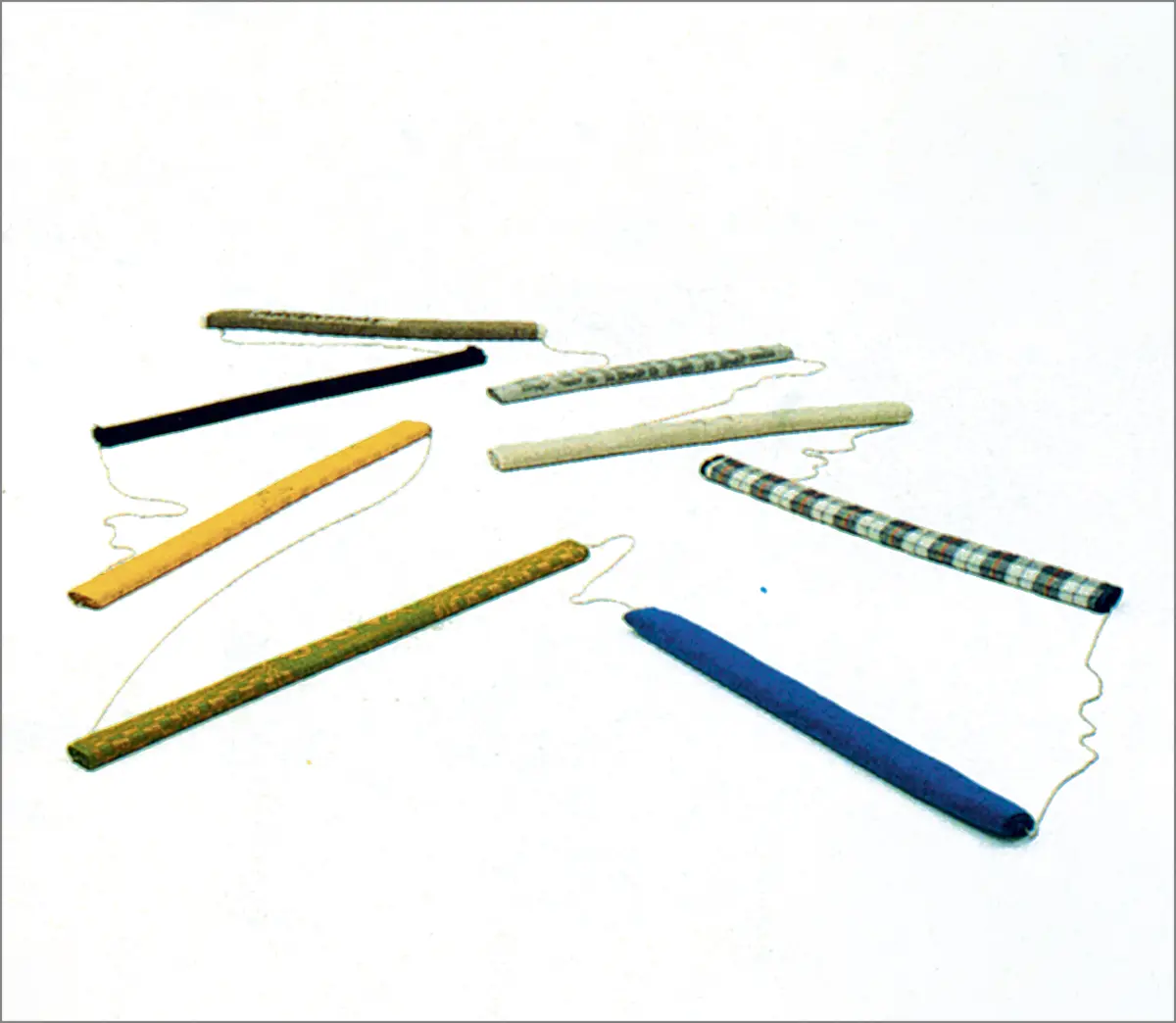
The yoke of an awareness of time’s inexorability is also found in The Error (1988). To persist in making knots upon knots, upon new knots, clearly indicates a construction of time. But the thread of Ariadne arrives nowhere and never. A colorless polyurethane ribbon wandering in the labyrinth, or the umbilical cord entangled with itself is a distinct intention of discussing the displacement of the art locus.
Leirner, like Penelope, made three unique pieces, bound to situations of constraint and incongruity: initially titled The Error in the Landscape, they can be placed under the table, above a tree, or on the seat of a car. The string represents a state of transition, a suspension of the artist’s usual production. So many symbolic values of the knot (its tight fastening, joining, articulation, use as a unit for measuring speed, symbol of center and rupture) countless quantity, suggest a mythical recall of origins. Furthermore, Leirner did in fact make her “free fall into the void” at Malmö, Sweden, in 1991. Her body attached by an elastic rope, she performed a rite of initiation —the bungee—, by diving from the height of seventeen stories.
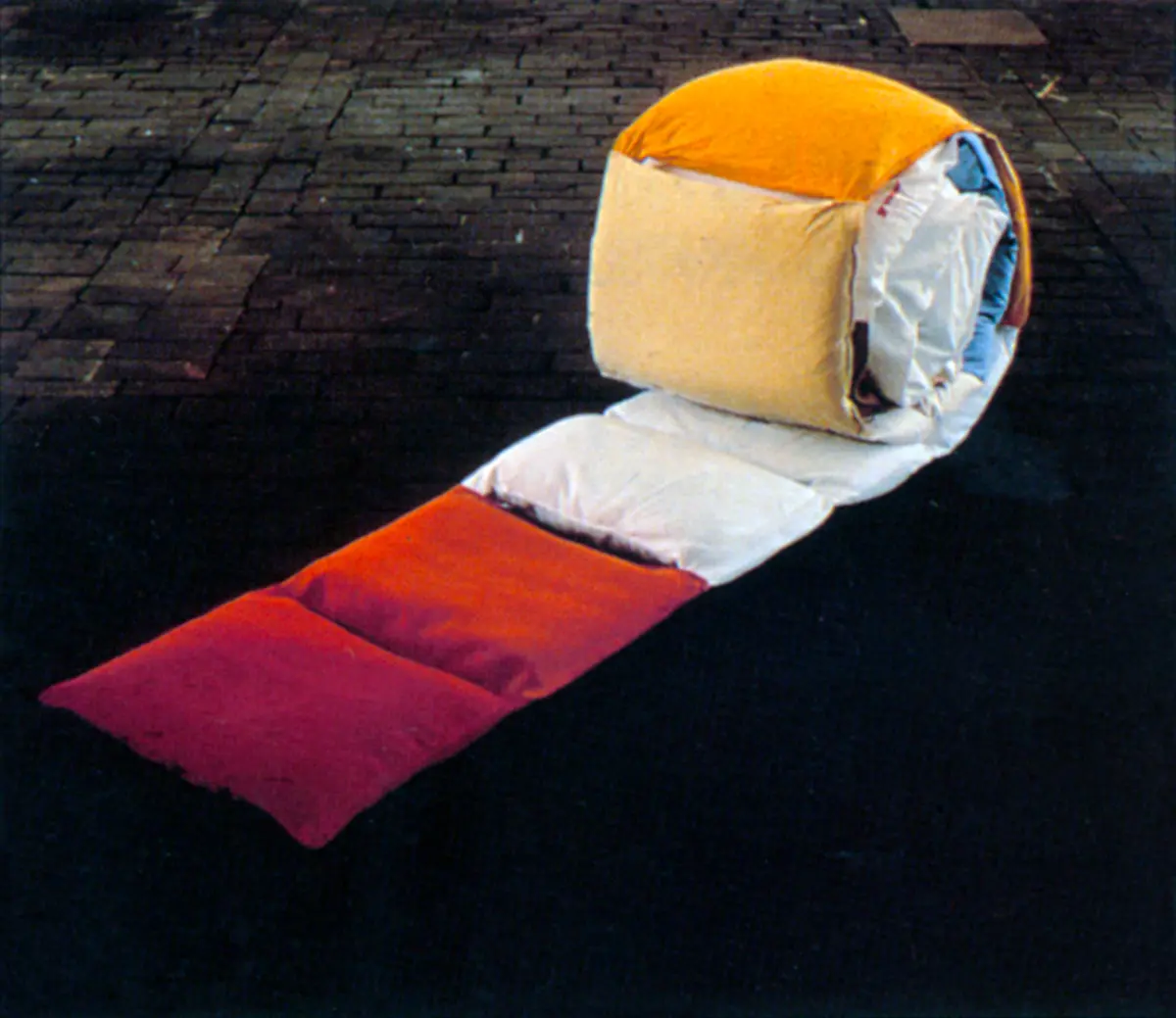
If the fact of seizing an object of consumption indicates the presence of a memory tom away from its mother tongue, there are, however, materials unmarked by someone else’s gesture. This can be seen in her shopping bags, in most of the airplane blankets and toilet kits, and evidently in the air sickness bags. But it is in her construction of the Overleaves (1991), made of virgin paper money, that Leirner made a very significant course shift. To present new bills, devoid of history, was to reveal the extent to which the artist had detached herself from the affective values of pop art. The appropriation in itself ceased to translate into an ethical will. More than updating the signs of consumption, Leirner, as a sculptor, found herself in search of material.
And here we are at the heart of the question, of what precisely seems to be Leirner’s singular contribution to the overdeveloped pop art debate: her attachment to formal research. There is in her a strong intention of engaging in dialogue with her precursors, who announced the notion of critique sculpture. An object withdrawn from circulation, from its anonymity, totally displaced, becomes working material on the same grounds that a marble block serves the sculptor and that Klein-blue was added to the range of existing colors. Thus, it is possible to say that the concept of support has not only modified the traditional idea of art (a public-work rapport) but also the relations of decision between the author and his or her creation.
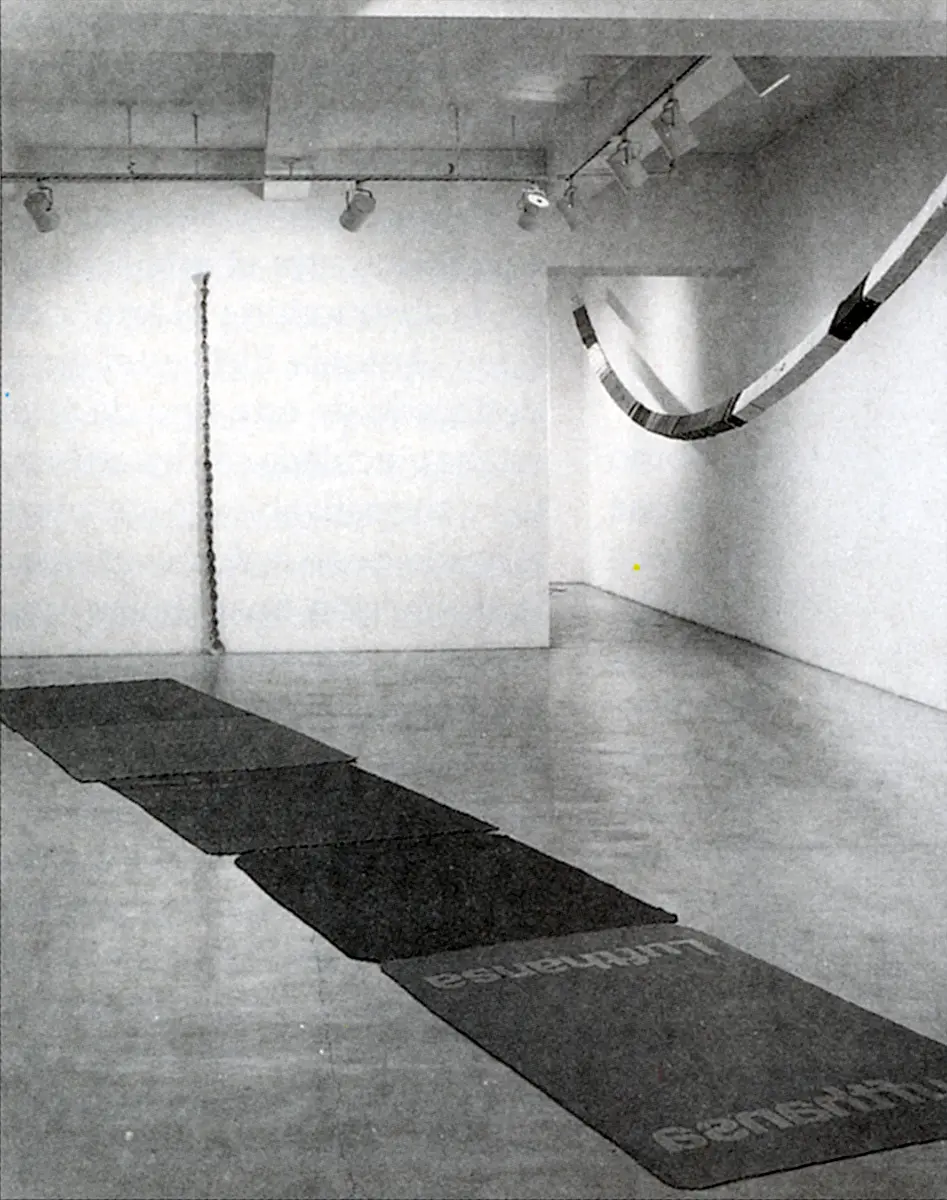
Leirner also stands out in the great spaces that demand a questioning of loci, another reference in the axis scaled to the centers that devour cultural spectacles. Her Viewpoints installation at the Walker Art Center described long, sinuous lines, straight against the wall on the floor. As a time sequence, the line gathers force and becomes logic. Yet we must feel the poetry emanating from the Phantoms white paper series. Of a solid, block-like appearance, speaking of absence, of a lack of inscription and memory, they are deprived of official value, of a sacred, affirmative writing —just as the Overleaves are despoiled the by thousand—fingered touch that grazes, kisses, and venerates the capital. Both Phantoms and Overleaves are witnesses to the vertigo of a hollowing currency, the capital of international stock exchanges. The poetry of absence destabilizes the subject and Leirner does nothing but repeat Plato’s lesson: “(...) for these poets create but phantoms and not real things."
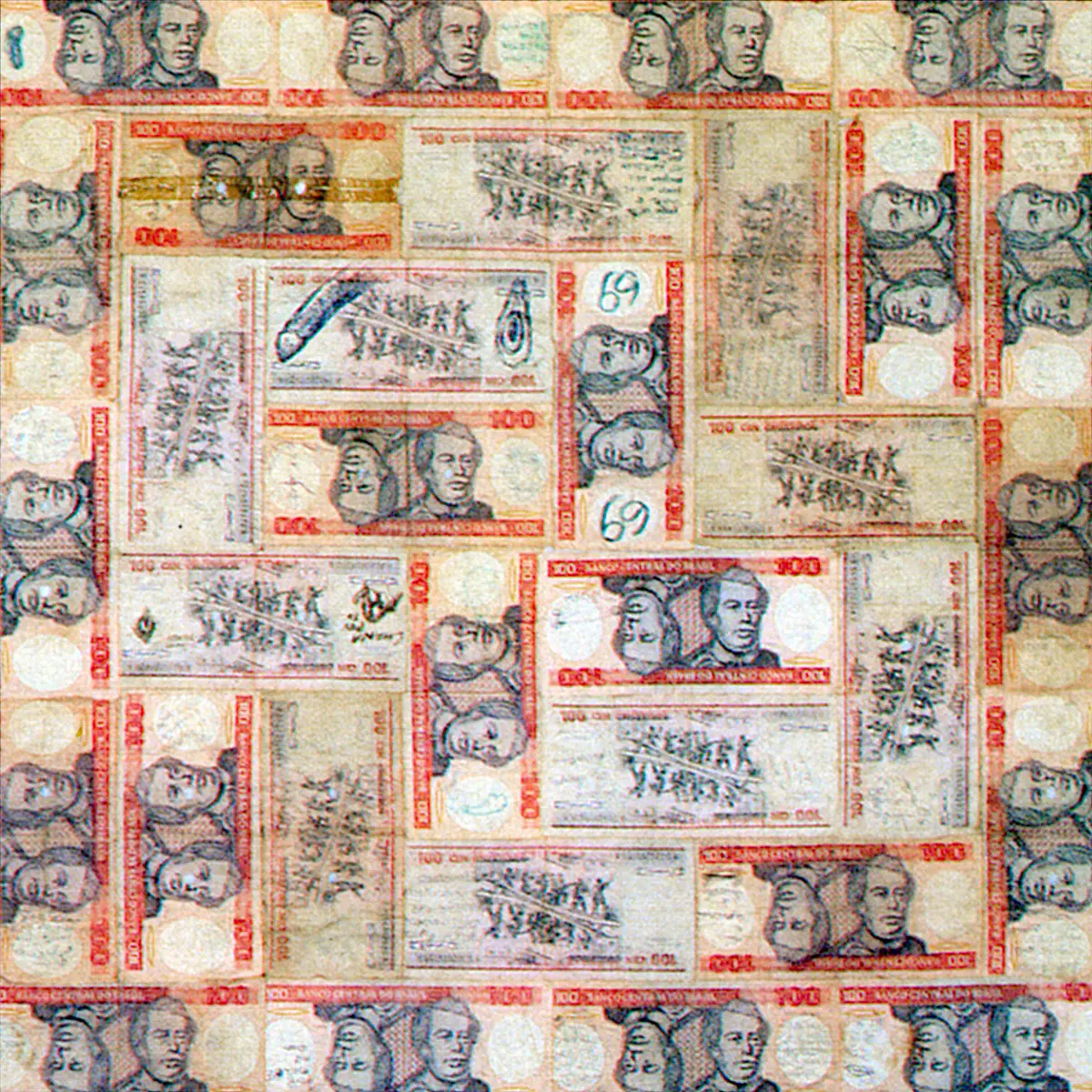
Marxist critique would have identified it as an allegory of dispossession, the consequence of the Brazilian inflationary economy where even true banknotes find no stable price. Yet the extent of Leirner’s critique does not apply to notions of economic history. Moreover, there is in her an adherence to the value system of the art object. Contrary to Duchamp, who did not take his career very seriously and gave away most of his production to his friends, Leirner is a professional. We must, therefore, address the problem of the idea of property and consumption. Are they subversive or the accomplices of contemporary art?
The artist describes herself with the image of the turtle’s walk. Her time is that of certainty, of minute expended actions, of ever-bearable perseverance. The things that pile up in her study will inscribe their destiny in the mythology of appropriation and added value. The paper money, the Marlboro packs, the shopping bags, and the airplane objects —wandering from hand to hand and specifically belonging to no one place or nation, so many nomadic signs gain a topology. Leirner takes them out of circulation and inserts them in the art circuit in an apparently wholly Dadaist gesture.
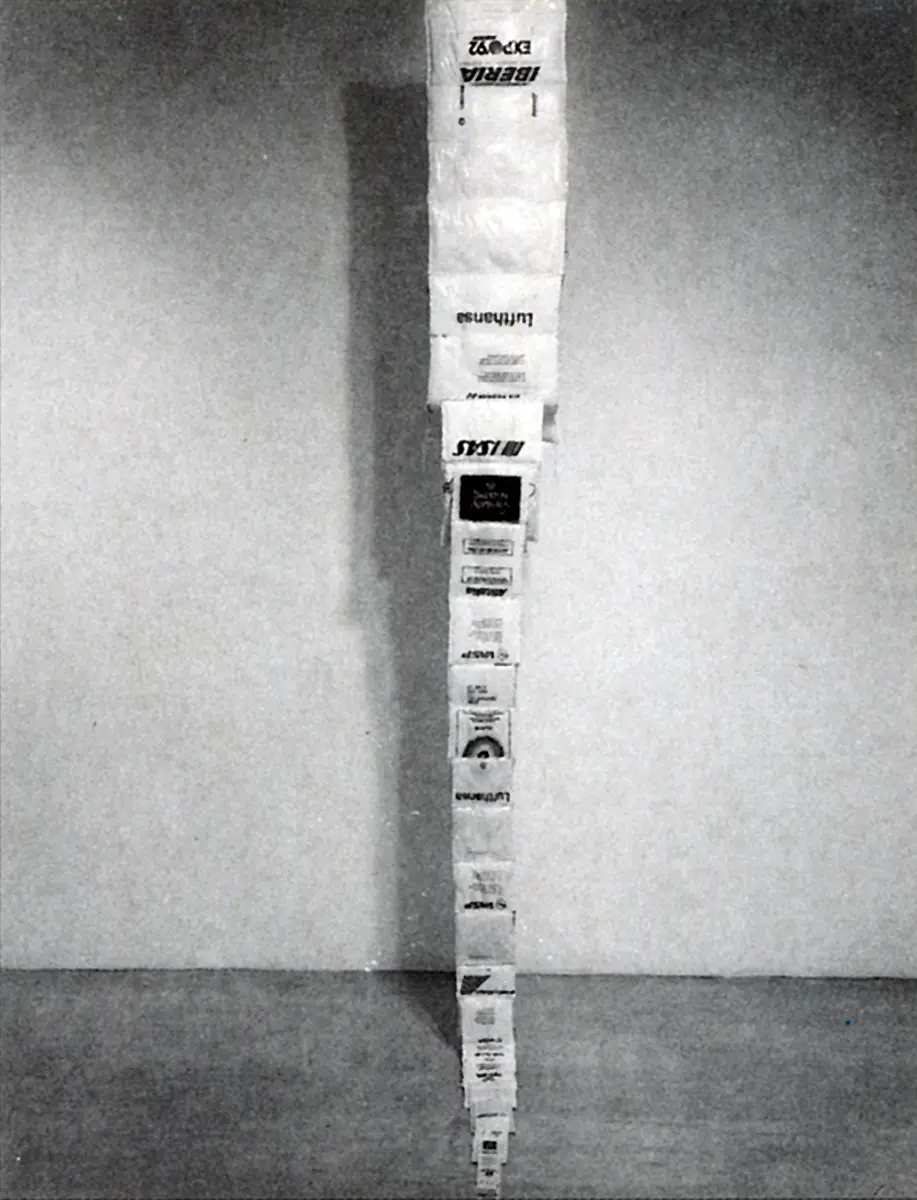
There are similarities, although Leirner’s dialogue also involves institutions. In 1991, when she was a resident at the Oxford Modem Art Museum, before going on to the Minneapolis Walker Art Center, the artist developed a strictly conceptual work. It entailed collecting the labels of the Walker Art Center exhibitions from 1960 to 1992, the labels of the museum’s collection, and the envelopes of the correspondence between the public and the institution (the sculpture To and From, which reminds us of a flat column molecular structure, also included the postal exchanges with the Oxford MoMA). Here time actually plays a determinant part, the time one sees unfolding in a chronology of artistic events. “The choice —she says— Is totally subjective. It is the material that elects me." Duchamp, however, proposed exactly the opposite, i.e. an objective choice, the choice of the neutral (in the readymade). Duchampian critique attacked the rigidity of the museum institution and proposed resistance: enter not the power game. Yet Leirner’s work stresses the fact that there has been a consolidation of the art exchange markets over the past eighty years.
This is the name of the game: to invest in a banal used object with value. And when we talk about sickness bags, found aboard all kinds of airlines, we find the spirit of irreverence characteristic of the early century avant-gardes. (We must still trust her: Are the paper-money graffiti truly anonymous? Has she really smoked those cigarette packs? Has she stolen those ashtrays? The gesture of authenticity is in check: Is it the artist who leads the game or is it history? A science of ambiguity rules and its appreciators are its accomplices).
Once what is real is counterfeit, fraud, vice, and transgression become the moral (let us remember that the title of the airplane objects series is Corpus Delicti [Material Evidence]). Leirner creates relational systems bound to provide inert objects with existence. It is through the manipulation of many airplane blankets, in huge quantities, that a truth can emerge. This demon of collections sets in motion the exercise of comparing, i.e. the identification of differences and similarities, allowing an upside-down judgment of an element deviated from its anticipated destination. Beyond its industrial vocation, the mere link of a chain of meanings (inflation, massification, the media, the theft of ideas, the lack of morale) allows us to identify a problematic lieu between the essence of things and our perception of their state in a working space —art, where everything is not only allowed but exasperated.
There is a principle of articulation between the literal sense (the object in its context) and the figurative sense (the unique object, that “error” on the artistic scene) that produces a movement of exchange. Leirner seems to cling to the notion of genre to establish her property systems. Proximity, a gathering agent, weaves a wide purifying net. Side by side with similarities and differences, the artist amplifies the former to extract a total body from uniformity. The cumulative effect is often hypnotic and capable of anesthetizing critical spirit. The artist’s adherence to excesses is beyond suspicion.
Compulsive communication is one of the characteristics of time today. In fact, the extreme definition of the material, almost didactic in its appreciation, shamelessly displays the object’s front and back, with hardly any concession to chance and freedom of manifestation (except the One Hundred banknotes, covered with anonymous graffiti but which also carefully abide by a series division and selection of many genres: erotic, childish, and so on). The absence of particularities generates an enormous substitution possibility. Such allegoric machines, once on the road, will nevertheless come back to feed on the capital system of paper money: the airplane objects replace the shopping bags, which already replaced the cigarette packs.
But this dimension of the future poses a problem given its programmatic vocation. There is an interest rate in the determination to collect and group by genre. Methodical aspects prevail, as if we were in a social biology laboratory. Such displacement flows are actual migration movements. A value migration in the case of the One Hundred cruzeiro notes (the Portuguese word for one hundred is a homophone of the word without, i.e. deprived of wealth) a measurement unit veering dangerously towards non-existence (the name of the Brazilian currency may change three times a year; just so that we believe in it, the cruzeiro has nowadays the adjective real appended to it). In a country that knows the freezing of personal savings and an inflation rate over 2000% a year, the more cruzeiros we hold the less they are worth. Money is eroded. The underlying irony in Leirner’s process lies in the veneration of a new standard measure, the artist's gesture. It is as though she worked with the “Duchamp-Klein” currency, guaranteeing the cult of museums, collectors, and great international exhibitions.
Capital, the body of Jac Leirner’s process, belongs to a typical post-modem Time-parted, accumulated, and newly reconstituted process. It reminds us of the phrase of Longinus, from his treaty on the Sublime: “The fact of working from distinct parts, a gathering together that brings them to unity, gives more to the number the aspect of a body." This time mode is the repetition mode (so dear to conceptual art) and the memory mode (although we have seen determination). Hence the notion of work in progress in the thought of this artist, who apparently takes so long to do the same thing.
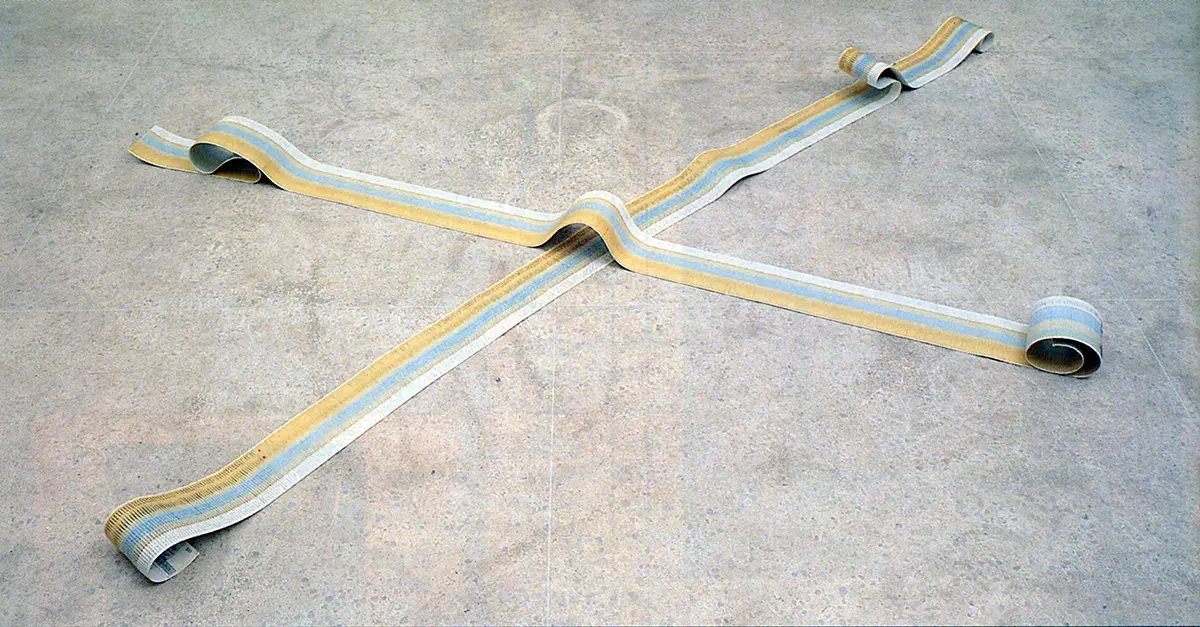
For there are always new cigarette packs to smoke, new shopping bags to collect, and so on. The knots also play a repetition role. There is no break nor possible measurement. Quantity is a needle that provokes a feeling of impotence as Kant demonstrated with the notion of the “mathematical sublime." Before the numbers of a geometric progression, Leirner listens to the irrepressible waves of mass production, and here she is totally absorbed by the logic of the material. A logic in the strict sense, for if the undulating line of one hundred notes is blue and yellow, there is no added pigment, although the gradual and subtle decomposition of a banknote may speak of watercolors. In conclusion, Leirner conceives her language as an almost paradoxical crossroad between object quantity and unicity, between Time’s parted and tyrannical body and the meeting of a number of whatever things with the history of contemporary sculpture.
Translation: Alberto Dwek.
LISSETTE LAGNADO