
Ivonne Pini
The exhibition Ante America showed that the current proposals being made in Latin American art generate in the public a new way of looking at things. It would be interesting to hear the viewpoints of the artists who participated in the show as well as of theorists on whether there has been a change in the way creators appropriate their context and, if so, in what ways.
Ticio Escobar
There is a new way of relating to one's surroundings, a re-examination of sensibility, a constant interplay between production and thought. Modernity has led to an acceleration of thought and its influence, to the point that there is a suspicious coincidence between theory and practice.
Never before have both coincided so much on so many fundamental points raised by the criticism of modernity: the abjuration of macro-narrative and the old subject, the fashionable interest in fragmentation and folding, the rejection of the avant-garde... It can be seen in debates when people ask whether or not we are post-modern. I do not know to what extent art can be post-modern. Post-modernity is a sensibility, a method of analysis, a sense of unease, a spirit of the times, a way of looking at the world, which generates a number of possibilities, an entire horizon, an episteme, as Foucault would say.
The fact that there are no overriding standards in a certain sense closed the self-referential cycle of modernity. Since there are no rulings to which reference can be made, there was greater leeway for the artist to give free rein to sensibility. But this was only a matter of appearance. A large part of modernity continues to move like an avant-garde process, like what happened after modernism. Latin American art began to encompass and express major problems with greater ease, as if it had broken free of countless shackles. Like any ambiguous cultural period, postmodernity creates favorable conditions for people to express themselves, although many others are desperately trying to become fashionable. I am tired of popular altars and votive figures, although there are very important artists who do such works.
Post-modern art, by trying to question modern discursiveness, has become a meta-discourse. A new discourse constructed on that of modernity. In many cases repertoires and forms of modernity are taken up, but without the cynicism; imagination or strength to restructure them in new ways. It seems important to me to create a scene in which the image can regain its rights. To some extent art continues to be a strong commitment with itself, as an unmasking language. I believe that art has a profoundly modern meaning, it continues to work the significant to reveal new things. It works from that painful twisting which characterizes language when it reaches a breaking point and gains access to an occult truth, beyond things and the mannerism of what we call post-modernity.
The scene continues profoundly modern, despite the flirtation between significant and sign. We are modern, but we want to see what the new sensibility is, the tresspaser who breaks some barrier, something beyond or before what we were looking for. I believe that many languages have acquired maturity and that more philosophical, more ironic languages have been taken up. In this respect one aspect of modernity has been fulfilled - the use of elements which had been left behind in the marathonic race of the avant-garde.
Gerardo Mosquera
One of the profits of post-modernity is this new freedom that Ticio mentioned, which has been very useful to us in Latin America for various reasons. One of these is the demise of the mad pursuit for originality by modernism, which affected Latin American art by requiring us to follow the centers. It is true that we often took what came out of those centers and tried to re-invent it, and much of this re-invention has been as fruitful as the original inventions. Today we know that originality is not so important, at least in the sense of change as a paradigm: this is one of the myths of modernity.
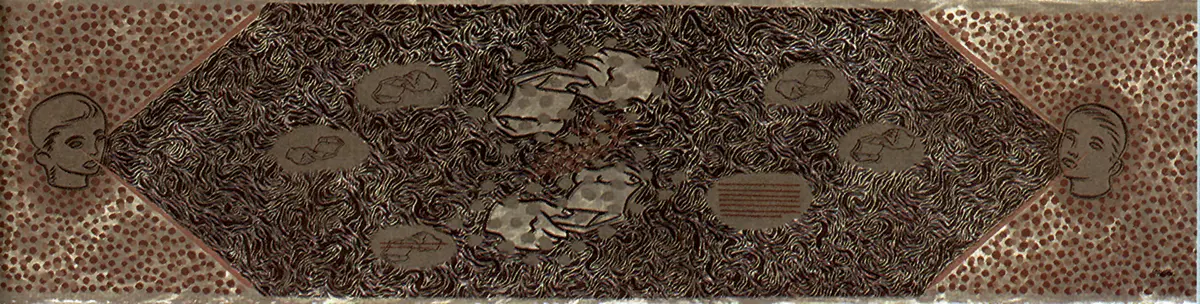
Our new awareness has made us looking more closely at ourselves, act more within our own things, becoming calmer. Furthermore, the problem of "otherness" has taken us back to the enormous number of "others" which co-exist in Latin America, stimulating an interest in aspects of our culture which had not been touched upon - because of the risk that we might be accused of not being modern - or which had been looked at only from the standpoint of the modern movements, with the focus being placed outside rather than within ourselves. Bedia is a classic example of this change.
At the same time, there has been a greater diversification of languages and poetics which reflect our real diversity. We can see this in the complex work of Capelan, where discursive aspects are very important: it is a work about images, the construction of identity, the search for memory, exile...
Frederic Jameson
Since I am not an art critic, I should like to make some individual rather than general comments. First of all, I would like to say that Ante America is an extraordinary exhibition, one of the most important I have ever seen. I am not sure that at the abstract level there are many differences with North American post-modernism. However, the way in which image-taking appeared in several of the pieces - a technique that we can find in North American post-modernism - appeared to me more interesting here, and I wonder why this was so. Perhaps it is because the reality itself is more interesting. Another example is the isolation of certain objects, which were in a sense highlighted without any background. This is a characteristic of post-modernism in general and can be seen in North American art. So it is not so much the way of doing things which is different, but rather the context.
The effect is particularly powerful as regards sacred and archaic elements. This is a very interesting subject and North American artists have also worked along these lines - for example Smithson or the artists gathered together in Lucy Lippard's book Overlay. It is something systematic which has come out of post-modernism: to take up a new position on all these questions.
In other words, we can find the same materials being used by North American artists, and this is another analogy.
But the effect produced by the artists in Ante America is much more powerful and extraordinary. The problem lies in the fact that I am basing what I say on the belief that there is a kind of set of overall post-modernist techniques, which function both here and in North America. So we have to look for differences elsewhere, although I am not sure where. It is very interesting for me that a new overall way of doing things- whether installation, video art, or whatever - can produce results which can definitively be seen as different.
Mosquera
There is not so much a formal difference between what we can see in Ante America or Latin American art and what is being done in the mainstream centers. There is a difference in content, meanings, poetics, and culture. A fundamental feature of identification here is the fact that artists from the main centers have used cultural elements from non-Westem traditions. This has been the case from Picasso down to Beuys.
Picasso proceeded without the slightest knowledge of the meanings and functions of the masks which he used as a model: his approximation was essentially formal. Beuys was a kind of "educated primitivist" - to use Luis Camnitzer's words - and he had studied anthropology.
His approach as an artist to these cultures was an erudite one. The difference which I believe exists in the case of Latin American artists is that in using cosmovisions, languages, values and other elements from non-Western traditions, they do so within their own culture, working with elements from their own imagination, their way of looking at the world, including their everyday life.
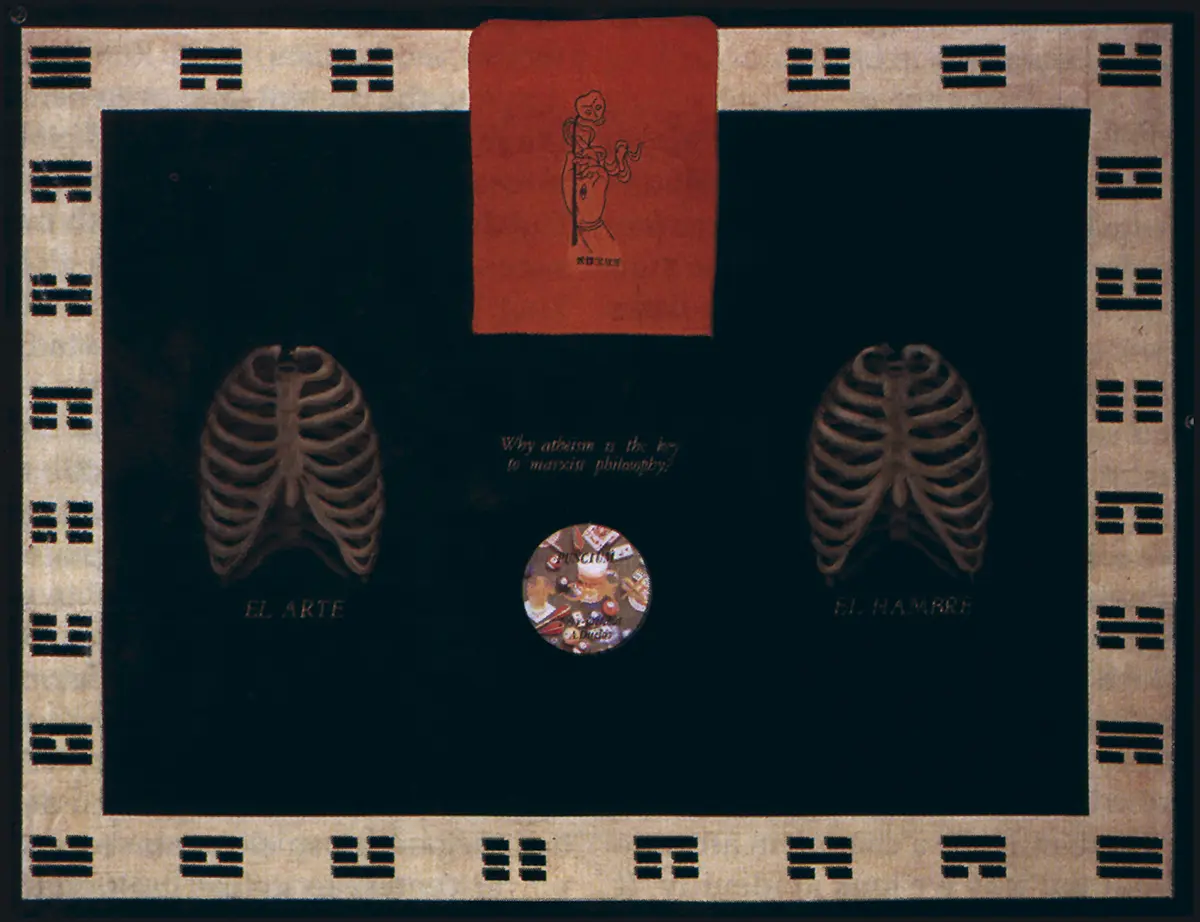
There is an epistemological difference. Although there are often formal similarities, a closer analysis reveals the existence of very different positions. Beuys used "primitive" elements in a sense to break out of his own culture, in the search for other paradigms. But the artists represented in Ante America and others do this they similar path to take themselves deeper into their own culture. This is a fundamental difference.
Jameson
What you say makes a lot of sense.
Carlos Capelan
What I find most interesting about post-modernism is that it has been able to take discourse out of the hands of art history and pass it over to anthropology.
I am interested in the existence of a global project, in knowing how the power centers look at the planet within a pluricultural context and how they look at themselves. I am interested in expressing the social condition from which I have come (the lower middle class in the Rio de la Plata region).
Anthropological discourse explains to me much more clearly than an aesthetic analysis the definition contained in the perceptive subject - which we call the power centers, and which defines us Latin Americans as belonging to the periphery. This situation may well determine much of what we are doing. All the history of Western modernity is the history of the establishment of the "other" (Gauguin, Picasso...) and, in the process, the acquisition of a series of attributes to compensate for the spiritual weakness of this Western "I", which is hegemonic and economically powerful. And so this "I" tries to become the "other" and tries to appropriate the characteristics of "primitivism" in an attempt to become purer, to have an origin.
Why so much about identity when no-one seems worried about it? The obsession comes from paternalistic attitudes towards us. It is as though we had to convince them of what we are. I do not have to convince anyone. At all events, we convince ourselves.
Mosquera
They also go out to the periphery to try to grab hold of the last bastion, the last gods, the last mask which to compensate for the spiritual void.
Capelan
When we on the periphery assume our otherness, we are establishing an otherness which differs from the description of us made by the power centers. From this otherness we conceive a self which is perceptive to the world and we globalize: in this way we can have a dialogue it the centers. Those of us who are gathered here are not interested in matching the projects of the mainstream. We are interested in generating languages which will describe the immediate landscape that surrounds us. Perhaps we too are also "educated primitives". It is good to be a primitive like Pepe Bedia. We "others" too have the right to be so, but in a different way.
Jose Bedia
This entire situation is unfair, based on a vision emanating from the Western power centers. No one recognizes our right to assimilate and appropriate things that are ours, although they did so and became the paradigm of so called avantgarde art, which in many cases is simply a recycling of things that belong tous. For example, no-one has accused Keith Haring of being influenced by the molas of Panama (a kind of indigenous embroidery); but if a Panamanian artist decided to base his art on these textiles, he might well be accused of copying Haring. We have to put an end to this kind of situation and establish our real rights.
Arturo Duclos
An important point is that if we are "enlightened", we are so by virtue of the "other" and at the same time by virtue of anthropological discourse, post-structuralist discourse... In my own work and in that of other participants in Ante America, we find the aspect of recycling, of acquiring and reclothing information, the capacity of creating a new discourse from some other standpoint.
It is the most perverse form, which gathers information, appropriates it, and reconditions it to emit a totally new message, which calls into question the function of the other and at the same time that of the mainstream.
Martin Lopez
I grew up in a paradise island. Man arrived on my island around the year 500...then came the Spaniards, who. brought the Africans... and then Jews, Lebanese, Arabs... a mixture of different cultures. What is my identity? What does it mean to be Dominican? It is to be universal. I do not consider myself as American, Latin American or European. I am not concerned by this kind of thing. I am a being, an existence developing within a space, a sky, a sea, air... sensitive and being able to recreate all sorts of perceptions.
I have never considered the question of post-modernity as being of great importance. What am I within the established aesthetic movements and what role have I played in their development? I do not believe that I am a post-modernist. I absorb everything that comes to me in the form of information and knowledge, and then I reject some things and adopt a position...
For example, modernism has come to be such an element of destruction that man has annihilated his ecology within the span of one century. Post-modernism should be seen from the standpoint of a reconstruction of values, of respect for the environment, the integrity of mankind, freedom. Moreover, I do not see any great differences from the existential concerns of such artists as Bosch, Da Vinci... who also made an enormous contribution to modernism. Perhaps they are the true pre-moderns, drawing up plans which took man towards greater development. The same concern about death, destiny, finding the unexpected...
Mosquera
What Martin has said about destiny and identity is part of this new awareness that we might call post-modern.
Discourse on identity has raised many problems. For example, there is a story by Borges in which a character asks another: "What does being a Colombian mean?" The other replies: "An act of faith". In the context of our times, this is a cynical remark. But so-called post-modern anthropology has done away with this cynicism because it interprets reality more as a process of collective and conscious construction based on specific general interests, rather than as a matter of essences, tradition, a mythical past which is there and that determines how this identity will develop. This does not mean that it is a totally mental attitude. They are cultural processes conditioned by experience, although they are also voluntary acts.
Pini
The fact that Latin America continues to be seen as a totality concerns me. We have not understood that there are common identity elements, but these are the result of contradictions and obvious differences between one region and another. We continue to accept a discourse which is external to ourselves, from those who see us as a whole.
We are easier to classify this way. I am thinking about the exhibitions that are organized outside the continent and which look at us from afar. They show exoticism, folklore... a kind of art tourism where we Latin Americans behave in a prescribed manner. There must be a change in attitude about the way we look at identity. It is not that we have lost interest in the theme or in post-modernity. If you are European, then you are not worried about your identity, because its been already solved. The problem arises when you look at it from here and try to make generalizations*.'We do not talk about the art of all Europe... But we do say "Latin American art". What is done at one or the other end of the continent seems to be the same and use similar parameters. We should accept that we are different; such an acceptance will lead to greater understanding and help us identify the elements that actually exist and form ties between us.
Bedia
Why so much about identity when no-one seems worried about it? The obsession comes from paternalistic attitudes towards us. It is as though we had to convince them of what we are. I do not have to convince anyone. At all events, we convince ourselves. Furthermore, I do not have to be a paradigm of Cuban and Latin American identity.
People live their identity in a natural way, every day, without asking questions about it. They act it out and draw strength from it. I do not have to convince them. Perhaps none of us is a paradigm of this.
Capelan
The power center defines itself in as much as it defines the periphery. To the extent that it says: "you do not belong to our group". The entire history of modernism, from Rembrandt down to the present, and even before, is a matter of local identity and global message. Rembrandt is profoundly Dutch, he has a very deep Dutch message and his reflections are of a global kind. When we reflect on our own identity we are accused of being provincial and too local.
They represent themselves and ourselves in their own terms. We see ourselves according to their patterns. Anthropologists talk about a crisis of representation. Anthropology is the history of the Western super ego which defines the "other". But all this belongs to the past. Ever since McLuhan we know about global modernity. The "other", which had always been defined, began to use elements from the power centers to define itself and to engage in a double or triple game. The strategies of those on the periphery have become more complete, more subtle, more elaborate...
Pini
Alejo Carpentier said that one of the characteristics of Latin America is that our reality is not totally finished, that there are countless elements which we can take up and work on, and that to some extent we are like a stock of images which have not yet been explored.
Capelan
I do not see why Latin Americans have to use the same strategy, the same structure to define what we are... We are pluri-cultural. We do not have to define ourselves within the construction of a national subject from the West. Let us do something more heterogenous, more tolerant, more inter-communicative...
Mosquera
The categories of hybridization, cross-breeding and synchretism have become the great and total paradigm of Latin American culture. They seem to me to be very useful categories, although in using them we must remember that there is another concept which characterizes us and of which we are dramatically ignorant: multiculturalism.
We refuse to recognize it because the creole bourgeoisies respon-sible for educating our nations always used the concept of synthesis to mask the real stratification of the conglomerates which were forming. From the moment that the hegemonic group says: "we are hybrid, cross-bred", it means: "however white, rich and dominant, we also include the Indians, the blacks... all the strata of society". This seems to me to be a fallacy, an absolutely ideologized concept of power, because large groups in Latin America not only do not participate in national projects, but are not even recognized under the nationality of the country within whose frontiers they live. Unlike what happens in Africa and Asia, here it is very difficult for us to accept that we are multicultural.
Celia Sredni de Birbragher
One of the qualities of Latin American art is its independent creation, its individual capacity to create as a need, as a pleasure, in a way which is not so tied to the market, as occurs in the large power centers. It is a capacity for creation and sensitivity, conditioned by the complexity of the Latin American world.
Lopez
I am doing works that are not called art, unclassifiable. For this reason I decided to call myself extra-modern.
We are not in a period of post-modernity, but one of extra-modernity, where we assimilate all currents: "primitivism", magic, the ancient, the modern, the future... perhaps this should be our goal: to see the tomorrow.
Jose Bedia
Cuban artist, living in Miami, Florida.
Carlos C a p e la n
Uruguayan artist, lives in Lund, Sweden.
Arturo Duclos
Chilean artist, lives in Santiago.
Ticio Escobar
Paraguayan art critic, lives in Asuncion.
Frederic Jameson
Art critic and writer from the United States
Martin Lopez
Dominican photographer, lives in Santo Domingo.
Gerardo Mosquera
Cuban critic and writer. Winner of a
Guggenheim Foundation scholarship. Lives inHavana.
Ivonne Pini
Profesor at the National University of Colombia.
Executive Editor of Arte en Colombia/Art Nexus.
Celia S. d e Birbragher
Editor and Publisher of Arte en Colombia