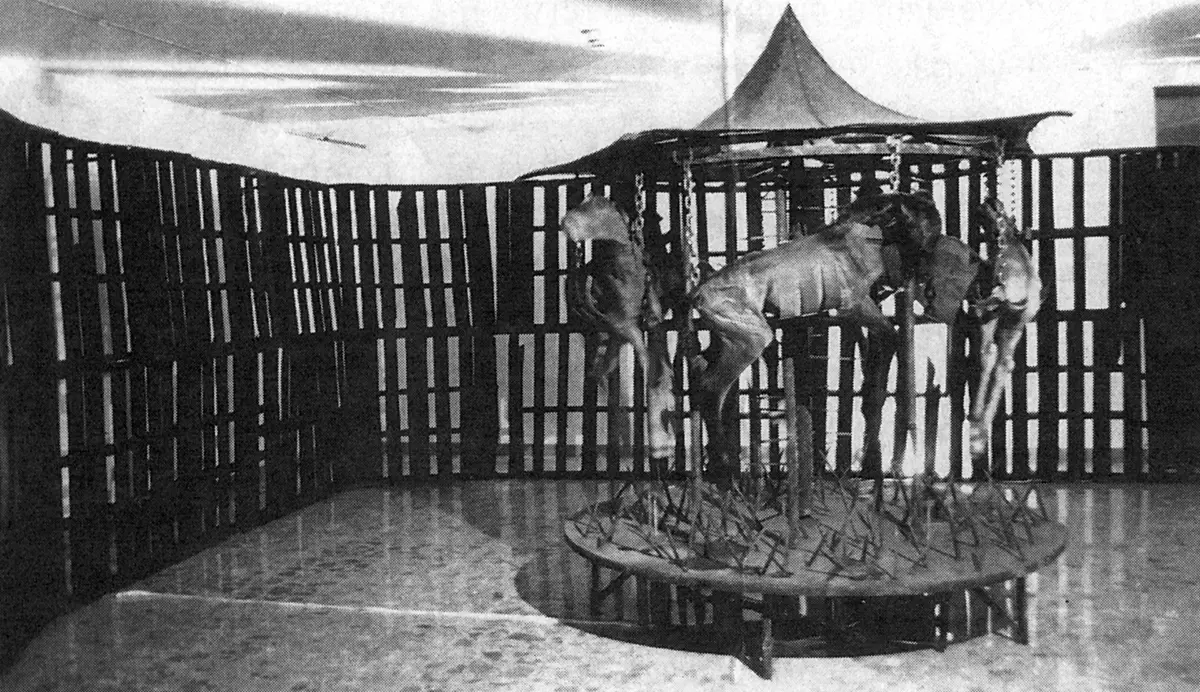
Mexican art scene during the 1970s was the number of artists working in groups. Indeed, art historians might even be inclined to over-estimate the importance of the phenomeno, to the detriment of artists working individually. For a number of reasons (for example, media exposure changes in social conditions), few of these groups survived the decade and even less others were established in the 1980s. One of the few groups which did e mer-ge at this time was the Semefo Group, the name of which is an acronymfor the Mexican institution where autop-sies are carried out and where there is a morgue (forensic medical service). Semefo works mainly with perfor-mances, montage, ins-tallations and environments which reflect its fascination with the changes in organisms once they have died -which have ceased to exist but whose existence cannot be denied. The group’s most recent work -and the largest in dimension- is the Lavatio Corporis environment, which was presented at the Carrillo Gil Museum of Art. It was made up of horse carcasses -some placed on wincing metallic structures which both suppor-ted and imprisoned them, others on a fast moving carousel or rounda- bout -as well as horse heads sectioned and preserved in blocks of plastic resin and juxtaposed alongside metallic sculptures (which were perhaps too convencional). The lighting was dim and the pieces enclosed by a fence of black painted wooden stands.
Expressly designed for presentation in this museum, Lavatio Corporis had its iconographic and stylistic origins (or pretext) in Orozco’s dramatic image Los Teules IV(1947), which dealt with the European invasion of the Mexican territory in the XVIth century, a work to which the environment clearly referred. In this way, Semefo established a link between the Orozco connotations of the Museum (whose collection contains many works by the master) and the expressionist period through which the group is passing. There is no doubt that its members are part of the great expressionist current in contemporary art which runs from last century with increasing force down to the present: there is for example its preference for aesthetic options based on what is tragic, terrifying, sinister, nefarious, horrible, grotesque and brutal. Their work hits us, moves us, wounds us: rather than seduced, we are trapped by their vision, which emphasizes the dangers, anguish, pain and upheavals of the present (although it also alludes to Orozco’s vision of the invaders of the time of European expressionism in the Americas). It is a current which inter mittently interests many Latin American artists, as well as artists from other regions, duringthe increasingly frequent periods of crisis.
The enormous number of young persons who flocked to the opening of Lavatio Corporis confirms that the success of Semefo is not only based on the spectacular nature of its work, but on the satisfaction of artistic needs in a sector of the population which, although receptive and rather passive, can fulfil its cultural aspirations with up to date versions of an objectual expressionism, rather than with works, like those of Orozco -which are also full of death and violence. They sense that they are part of something new, of belonging to a community which can use vandalism as a means of ex-pressing its understandable de-mands and sense of resentment. In short, they are a Mexican version of a global generational phenomenom.
CARLOS - BLAS GALINDO