The most recent exhibition by Guillermo Kuitca in New York included a series of works entitled The Tablada Suite. The name «Tablada» comes from a Buenos Aires suburb where one of the main Jewish cemeteries in the city is located. Kuitca appropriated the public space of the cemetery as an emblem for a series of public institutional structures that silently determine our spacial location within the urban environment. Thus a series of works was made up of plans of a clearly architectural nature in which the textual information has been su ppressed and the building or place depicted has been stripped of its surroundings and thus of its specific space and time, its history. In this way, Kuitca de-contextualizes the des- cribed infrastructures, paradoxically deflating a language with markedly rationalist connotations and precision - that of architecture - with an absence of local information that would allow the visitor to incorporate himself into this space represented as just one more number, a unit or architectural symbol which in most cases is merely a point Urban anonymity and standardization are reinforced in these works through the absence of any characteristic titles. Like the subjects who in «real» life inhabit these spaces, these works have no specific names and are identified only by Roman numerals. This way the frontier between the abstract space of the surface and the real space we live in collapses in these paintings. Kuitca creates an intersticial space in which, as in his previous works (maps of cities, plans and interiors of appartments) the public space and the private space of the subject are revealed to be ficticious constructs or at least totally interdependent ones determining the other and vice versa. Furthermore, the repetitive and serialized unity present at the formal level through the representation of series of chairs, beds, graves, shelves, steps, etc. is echoed in the conception of The Tablada Suite in a series of ten paintings.
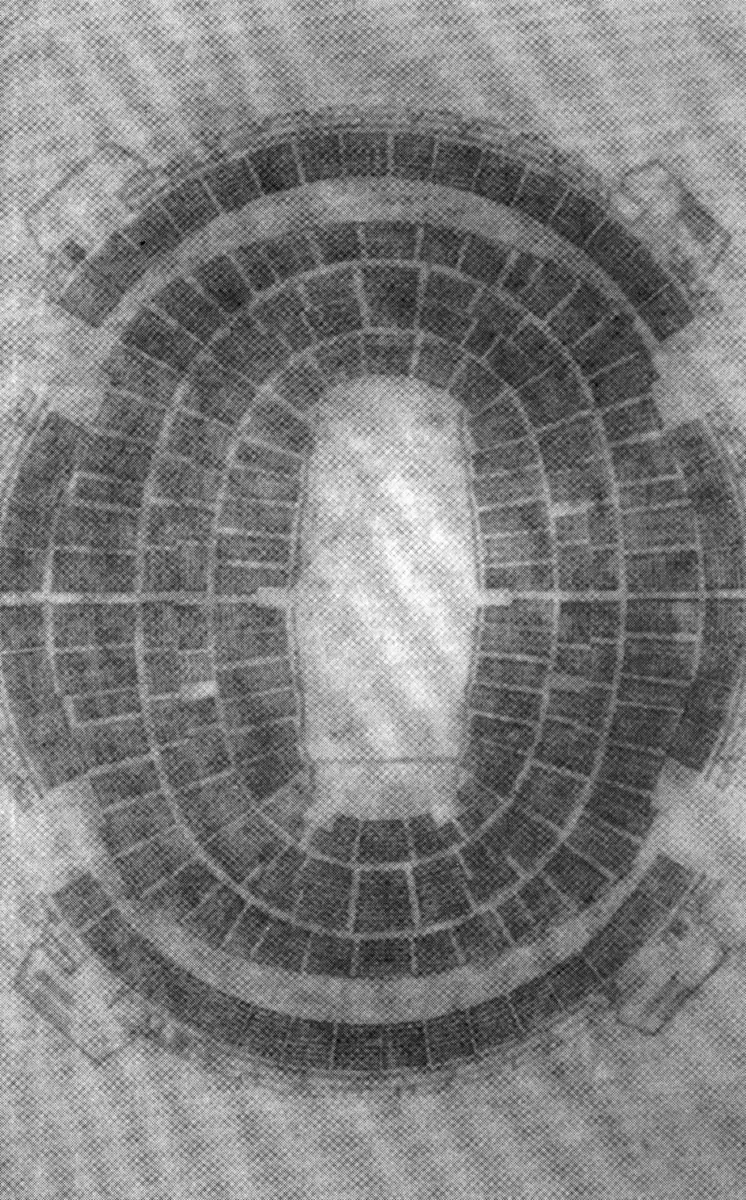
But Kuitca makes another kind of transgression in these works that at first sight seem to be about control and power. In fact maps or plans are «instrumentalized images» of cities or infrastructures regarding which the subject assumes a position of control vis-a-vis the supposed «totality» of the representation. As Thomas McDonough has pointed out, plans are structured in a way analogous to the «descriptive» discursive mode, which strives to mask its successive nature and to present it as redundant repetition, as though everything were present at the same time, as though the object were always visually present, fully visible(l). But the «ideal» abstraction of the plan does not occur in this series of works in which a prison, a stadium, and defined finish characteristic of plans.
A careful analysis of this series of works reveals the presence of technical strategies used by Kuitca in the past. Like the constant interruptions in his maps, there is a corporal, tactile quality here that contrasts with the delicate drawing and a shaded effect achieved by the use of graphite. The presence of his hands, and probably his arms also as he moved over the surface of the canvas to carry out the work, produces an atmosphere around the solid structure depicted which contrasts with the tactile quality. There is thus an interesting interplay between solidity and atmosphere, objectivity and subjectivity, public space and private perception which challenges the paradigms for depicting urban space and our perception as subjects within that space. In the final analysis, the specificity demanded by these places is neutralized by their representation in the form of plans. The subject takes its place, any of the many places repeated; and so it is through the functionality of the plan that the standardization of the individual is' produced.
As in the maps of cities, where the continuity of the space depicted was transgressed and fractured by the contingent dispersing of sectors, frontiers, routes and coordinates, The Tablada Suite is characterized by a certain kind of blindness. A kind of connection was established in the maps between the representation of space and the everyday and contingent action of the subject in that space. An «opaque» space in the absence of the map in its full visual dimension leads to a partial representation. In this new series, it is through the presence of touch that Kuitca seems to be speaking to us of blindness. The metaphor is produced at two levels. First, the absence of specific and individual features is replaced by the seriali- zation of the model and its repetition, the use of a standardized structure which is easily recognizable by someone who lacks the visual acuity to see particularities. Second, at the formal level, the traces left by the artist on his work suggest a blind person spreading his hands out to touch, to caress, to feel, to perceive and protect himself. The hand of the blind person always precedes, and in these works it collapses with that of the draughtsman. Blindness cancels out what makes representation possible (vision), the difference between the body in the strict sense of the word and the su-pplement(2). It is to the confined world of the blind person, isolated in the darkness of the mind, between ima-ginary walls against which he uses his hands and nails, what these works refer to. And it is precisely in solitude, absence and anonymity that the true anguish of these works is to be found. But as Kuitca himself once said, «it is to the idea of solitude in the midst of so many people and places « that the work also alludes. The daily irony of being surrounded by solitude, converting ourselves into yet another unit in a series in which the elements are interchanged indiscriminately as they occupy the empty structure of the space shown on the map. An empty space, repetitive, devoid of history and memories which only the spectator can activate.
NOTES
IjThomas F. McDonough, «SituationistSpace», October, No. 67, Winter 1994, MIT Press, Boston, pp.59-77.
2)Jacques Derrida, Memoirs of the Blind. The Self-Portrait and other Ruins, University of Chicago Press, Chicago and London, 1992, p.ix.