It was with great enthusiasm and pleasure that we were able to visit, during the months of June and July in the Sextante Gallery, the Project Bogota, the most recent work by Gustavo Zalamea in which the artist presented pictorial themes, maquettes, serigraphy and printed materials. All these media were used to raise a number of coherent questions about the urban, social and artistic space of the capital city, Bogota.
There are not many artists who can interpret with a critical and direct eye all the problems of our urban environment - in this case the bloody and painful history through which the city has passed and will continue to pass - and who can separate the grain from the chaff of chaos in which we live day after day.
Zalamea uses fiction in his images that lead us towards a painful analysis of the aesthetics of urban deterioration, of what we are and what we are doing to solve the chaos. Zalamea is not an artist who is locked in his own ivory tower, producing beautiful things which have nothing to do with the world outside. On the contrary, he is immersed in events, his analytical eye sees beyond appearances and with the power of denunciation penetrates into the very essence of the city, which he exalts.
In Project Bogota, Zalamea offers a synthesis of much of his previous work, interests and skills. The city and political themes have been a constant feature of his production: in the past, it was something which was assumed within a passive setting of architectural references and poetic inspiration; now the images are unreal and superim
pose two realities, creating a critical awareness through the construction of utopic scenes. At the thematic level, he has strengthened his passion for the city and invites us to work towards making Bogota a more human city. His call is of an ethical, critical and poetic nature, a restoration of the human scale. Bogota is victim of anti-pla nning, where growth has become uncontrollable and where there is no logic nor law capable of imposing any organization.
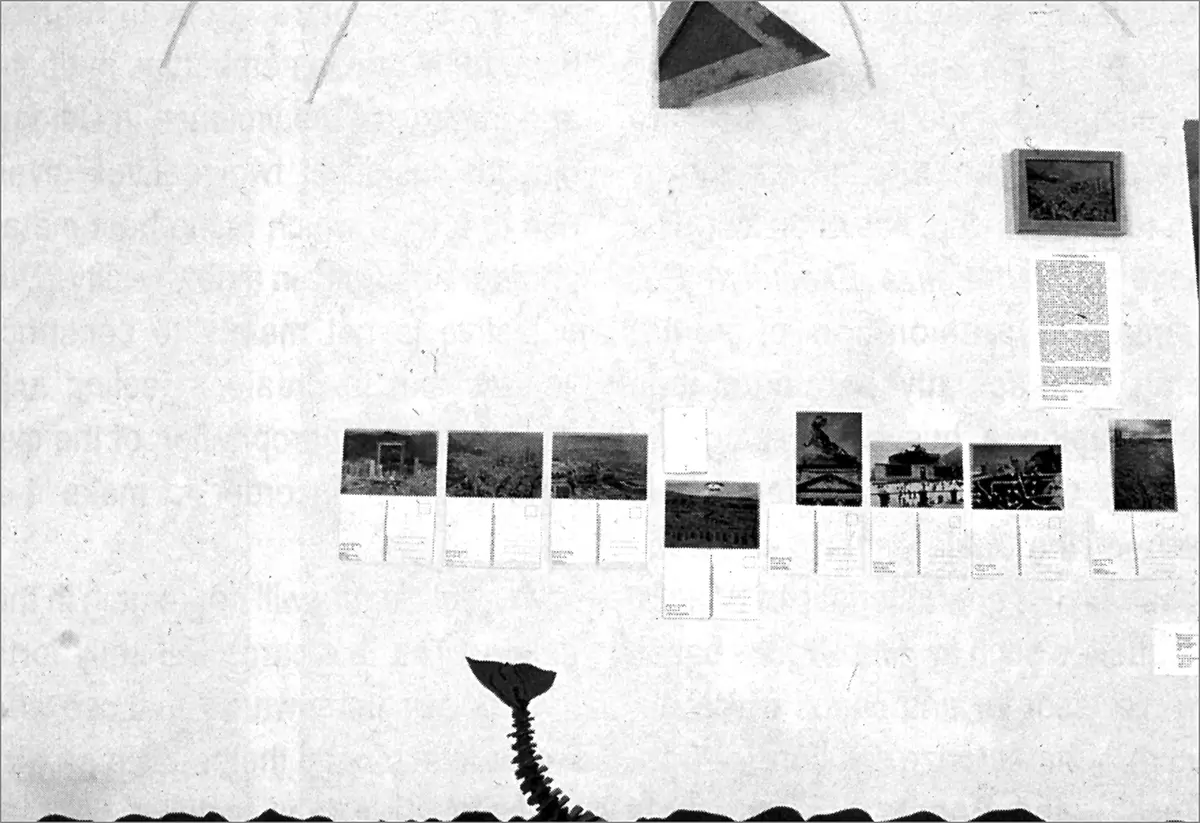
By combining media used in his earlier work with concepts taken from contemporary circumstances, as well as symbols filled with aggression and madness, Zalame elaborates, defends and gives outward expression to the artist’s condition, whose role is to communicate and anticipate the meaning of this universe with its demented lack of organization. These skills and ideas are complemented by the artist’s deft handling of graphic images, a technique which he acquired during his work as designer with the newspaper La Prensa (and other newspapers in the I980s). Here everything has meaning, everything is inter-related, everything is assembled like a puzzle. Zalamea uses painting, serigraphy, object-images and maquettes to help him project his cry for help through the city. Project Bogota also comes in the form of «postcards» to the spectator, with their user-friendly format that rapidly reaches a wide public.
Zalamea has always - and in various ways - expressed his commitment to the city, politics and society. This show presented the ideas with which he constructs realities and unrealities, a conscience which is poetic, political and educational and seeks to invade the city creatively, supplanting the chaos with an utopian vision. Zalamea is right when he says that artists should not only promote such an environment or limit themselves to proposing alternative forms of consumption outside the conventional ones, but try to create projects that will have some effect on the future order of things. By structuring, defining forms and ordering, the artist has the power to construct a different and better reality, the commitment to search out, with the means at his disposal, artistic and communicative processes which can help us weave the fabric of a true city. This is not only a task for the architects and urban developers. If the city dies, artists will be amongst the first to disappear with it.
In this context, the remark of Giulio Carlo Argan, which was placed at the beginning of the description accompanying the show, was very appropiate: The city is no longer the bearer of values but of news; it is no longer an historical construction but a system of information manipulated according to fleeting opportunism.
With great clarity and force, Zalamea analyzes the present situation of civic anguish and impotence: it his here where he hopes, through art and by art, to recover what has been lost. The piece entitled Feliza Executive Bus became a premonition of something that actually happened-men kindnapping a bus and raping two women passengers. In Homage to Melville, the whale symbolizes the excess which is characteristic of Bogota. Maquettes such as Shipwreck- based on the disorder and chaos which habitually characterize sessions of Congress - and Bogota are extremely inventive examples of the artist’s conceptual capacity. The montage of the show highlighted the different facets of the city captured in such works as Squadron, Traffic Jam, St. and Monserrate, Sea in the Square.
The photomontage proposals for the postcards are consistent and precise images of the catastrophe and chaos besetting those who venture to walk through public places. No artist has taken the city more seriously than Zalamea, who constantly weaves together the activities of both artist and critic. Few artists have his capacity to create works which, in a fully conscious conception of the role of the artist, combine visual strength, ideological content and militant intentions. Photomontage for Nevelson looks ahead to
artistic encounters, Bolivar Square flooded by the sea embodies the pain and tragedy of the violence in Colombia: the fusion of two realities gives rise to a third which is the best metaphor for absurdity in a new reality. The objective is not merely to construct images, but to create a feeling and desire for the appropriation of the city by the citizen in order to make it a beautiful place.
Project Bogota will not remain in the gallery. The postcards will sally forth into the streets, towards all those who would like to have them. It is a project which will grow and develop as other artists join in the creation and diffusion of the images.
MARIA TERESA GUERRERO