The retrospective show entitled Jose Bedia: Where I come from, organized by the Institute of Contemporary Art of the University of Pennsylvania, was presented at the Center for the Fine Arts, in Miami, during the months of July, August and September. In addition to the works shown at Philadelphia, this exhibit included some pieces belonging to local collections, such as Moana tiene bilongo (1992) (Carlos and Rosa de la Cruz), (1993) and All the Fauna (1994) (Jerry M. Lindzon). The show also comprised two additional installations: Angola- Havana(1994) and The Migrant’s Song (1994), the later being specially created for the New York space of the Center for the Fine Arts.
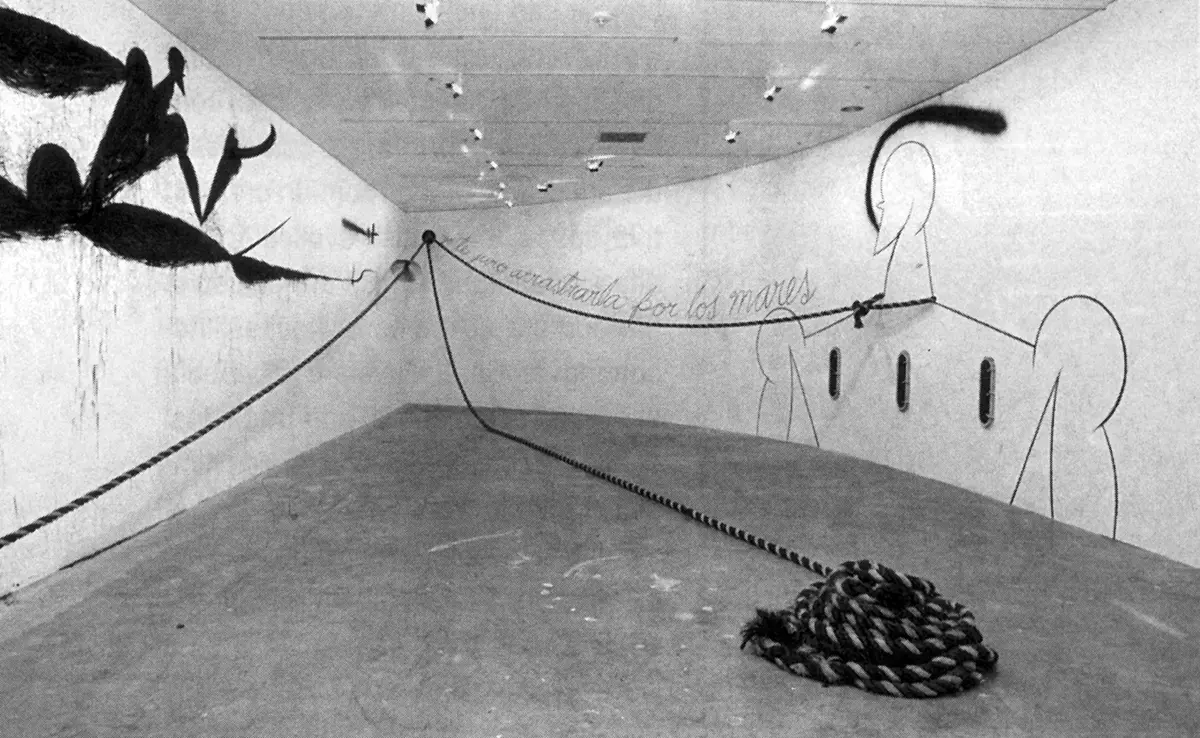
Continuing with his series of installations done specially for this room (1), Bedia redesigned the gallery to bring it into line with the needs of his work. The east and north walls dissapeared behind a provisional concave wall, which forms a corner with the south wall of the room. In creating this space, the artist evokes to the altars of santeria, which are placed in the corners of rooms of houses. According to Carol Damian (2), Bedia uses the corner as a non-traditional space and deliberately distances himself from the Western forms of presenting and seeing art; in this case, the installation, like the altars, should be seen from the front, since there is no way of walking around it, because of its confined position.
The title of the work is inspired in an old Cuban song which, according to Bedia, his mother used to sing to him. Physically, the work has three axes marked by three thick ropes which start from the same focal point at the back of the room. The first rope extends along the south wall and ends up tied to the base of a rusty spring, the second crosses the gallery and ends up becoming rolled on the floor, creating a spiral; the third rope extends over the concave wall and ends up around the neck of a figure appearing on the wall --perfectly integrating the two and three dimensions of the work. At the pictorial level there are two figures painted on the south wall, one lying down and the other in the act of leaping. The figures have three dimensional objects hanging from them (one is carrying the propellor of an airplane and the other a horn in his erogenous zone). At the back of the same room there is a small wooden airplane with a little puff of smoke coming out of it. On the concave wall there appears a torso with blacks moke coming out of the mouth, similar to that of the airplane, with three hatchways on its breast. Opposite the torso appears the words «Yo te juro arrastrarla por los mares», which are taken from the song mentioned earlier (3).
The symbolism of this work is enormous and enhanced by the many references to Jose Bedia’s life and philosophy. The use of three ropes, for example, recalls the ritualism of the number three (furthermore the installation has three figures and three hatchways). The three ropes also evoke the idea of a triangle, which symbolizes spiritual objects such as a mountain or an Indian «teepee». The exclusive use of white and black colors also refers to the "palo monte" initiation ceremony, where the dark bodies are daubed with white chalk and, once initiated, tattooed generally on the chest and on the shoulders (the presence of the hat-chways on the torso’s chest may also be related to this ritual). The three dimensional objects have different meanings: the horns represent power and masculinity; the ropes, the propellor and the little airplane evoke a journey (not only in the sense of the migrant’s journey but a spiritual journey), which has been transformed in our century by technological progress, particularly in transportation and communications. As Monica Amor has said, there is no single truth in Bedia’s work: there is no single territory, no single history (4). The multiple readings characteristic of his work are more impressive than ever in The Migrant’s perhaps because of the actual dimension of the installation, the space in which it is exhibited and the historical moment we are living.
NOTES
(1). Alfredo Jaar, Art N, No.42; Eugenio Dittborn, Art Nexus, No. 13.
(2). Interview with Carol Damian, July 1994.
(3). Carol Damian, ibid.
(4). Monica Amor: Jose Bedia, Art Nexus, No. 13, p.97.
FRANCINE BIRBRAGHER