The lack of truly critical basis for discussions on aesthetics almost always leads to sterile attitudes. To say that water-color art is out of date is not so much a critical attitude as a demostration of ignorance. The fact that it is a favorite medium for Sunday artists and other honest people who live from their folkhnc prints does not mean that water-color art is unable to embody a valid aesthetic proposal. We need only to recall the names of Klee, Feininger, Marin, amongs others, to realize that such prejudice is devoid of any critical validity.
Such is the case with the so-called water-color tradition in Antioquia, a label invented to justify the lack of imagination of regional pseudo- artists, amateurs unable to go beyond mere anecdote - because old masters like Humberto Chavez, Pedro Nel Gomez, Eladio Velez were able to make wise use of the medium in accordance with their own aesthetic principles. The rapid, cerebral brush stroke of Pedro Nel Gomez is one thing, and the objective vision of Chavez is another - to say nothing of what Debora Arango achieved in her large water- color works in which she masterfully captured features of the pop languages and even the trans-vanguard. What is lamentable is that this misguided discussion between avant-garde and re- gionalist artists has robbed this living tradition of water-color art of any critical appreciation.
This Salon was based on a new critical perspective in an attempt to revitalize our inertia and highlight new contributions and experiences. Fortunately, the Salon had a very positive effect, without any radical positions being adopted by the jury or attempts being made to defend a single line of work, something which has often been a marked feature of some regional salons in the past. This time, instead of fashionable trends and tendencies, what materialized in the end was quality.
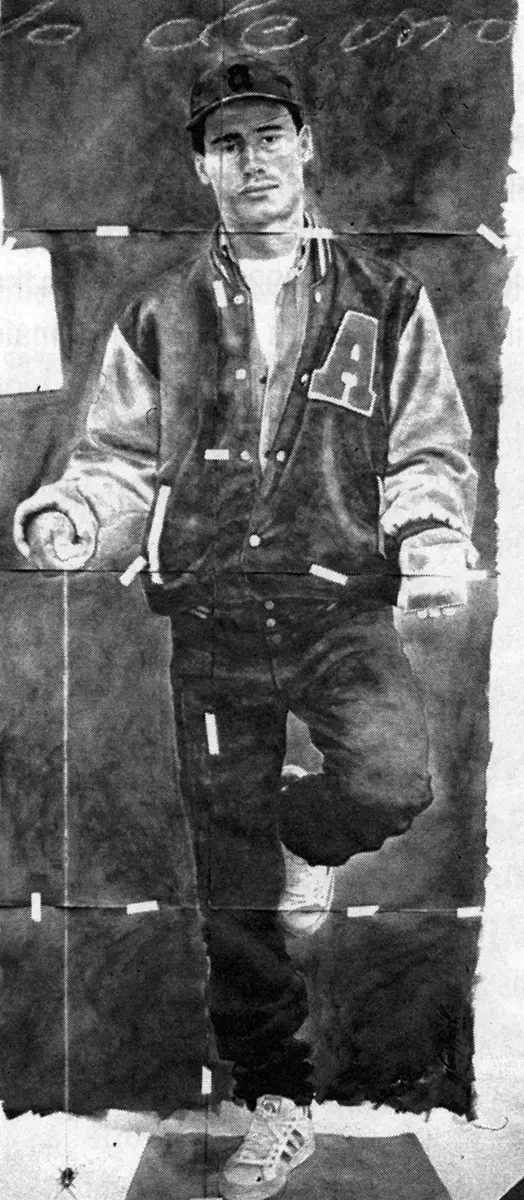
The quality in a still-life or a landscape. Post-modern tolerance? The first prize awarded to Mario A. Arroyave was for a work measuring 2.15 by 1.15 meters, entitled Where is Juan Becquet? A typical youth from one of the neighborhoods of Medellin, already immortalized in the film of Victor Gaviria, a youth whose life, disappearance or death are matters of con- jecture-since thousands and thousands have lived and died in absurd wars. The impact of the work is achieved not only through the serene use of color and the way in which it shows the exceptional qualities of the protagonist, but in its powerful symbolism, that might have become mere anecdote in the hands of someone else.
The second prize, a diptych by John Mario Ortiz, was an effective trompe I’oeil dividing up the vision of the floor tiles of a room and creating a poetic which confirmed the superfluous nature of any discussion on so-called supports. The support in this case referred finally to an image of infinite references encompassed by memory and a sense of longing.
The third prize went to Horizon Line, by Fernando Arroyave, a plaintive scene of ruins in which disaster seems to have lost its ability to create emotion and pain - becoming something, as in Blade Runner, which is simply «there».
A Bosco without the hysterical lacerations of the bad expressionists. An image that like the sketch of some stage set reveals a contemporary view, a contemporary proposition.
A delicate landscape by Jaime Carmonia highlighted this new approach in which the hackneyed theme of bucolic landscape is de-constructed in the composition of the scene, which is clearly artificial but also extremely refined.
Is not all this an achievement? I mean, in the sense that young artists, using a clearly traditional medium fatally associated with folkloric themes, were able to make a contribution in which their experience of life, their experience of the world and history decisively led to a new content, opening up the way to a set of new codes.
It was a confirmation that the vitality of a proposal does not lie in the empty illustration of passing fashion, but in the ability to construct a new vision.
DARÍO RUIZ GÓMEZ