"History doesn't repeat
itself, but rhymes".
Mark Twain
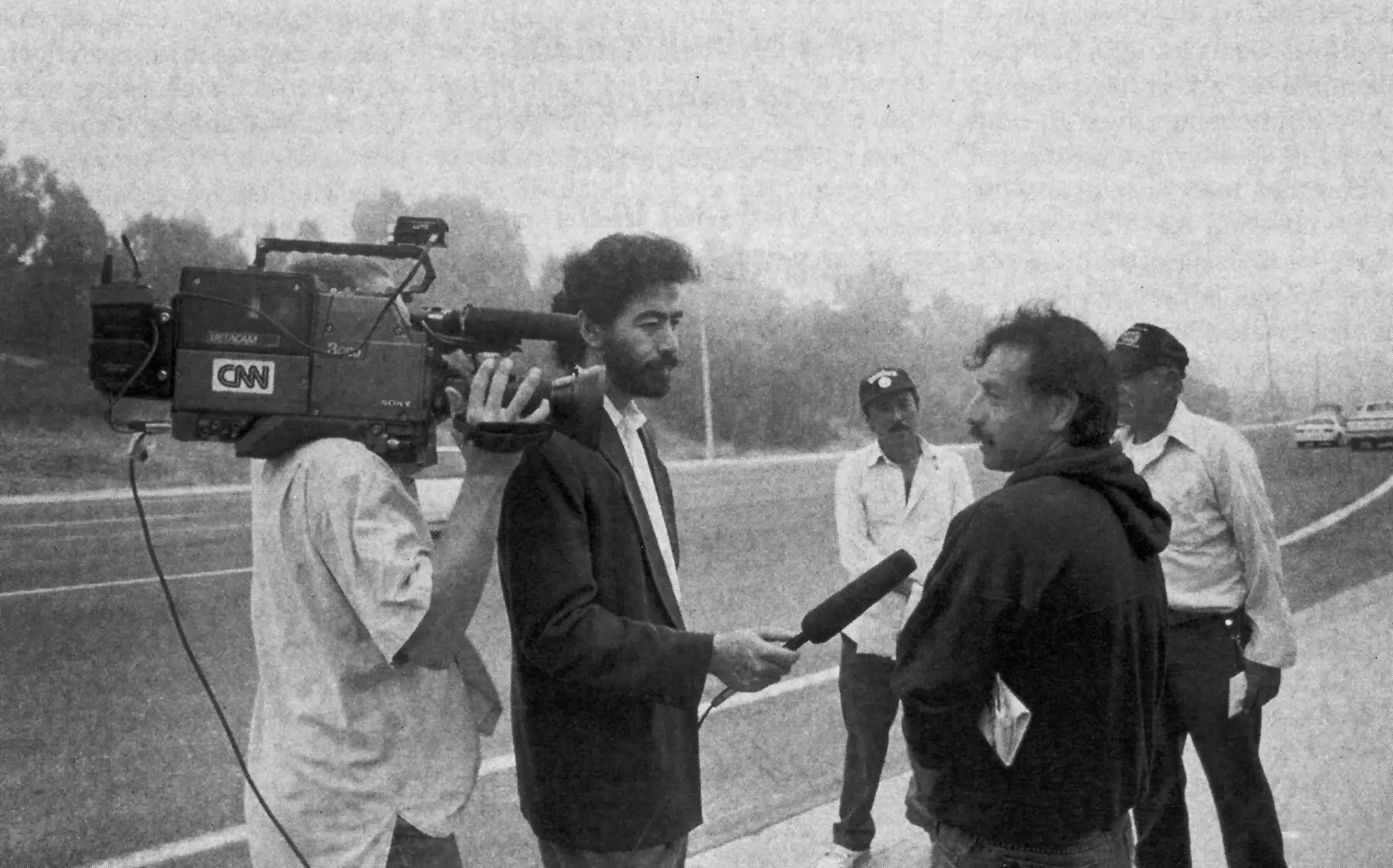
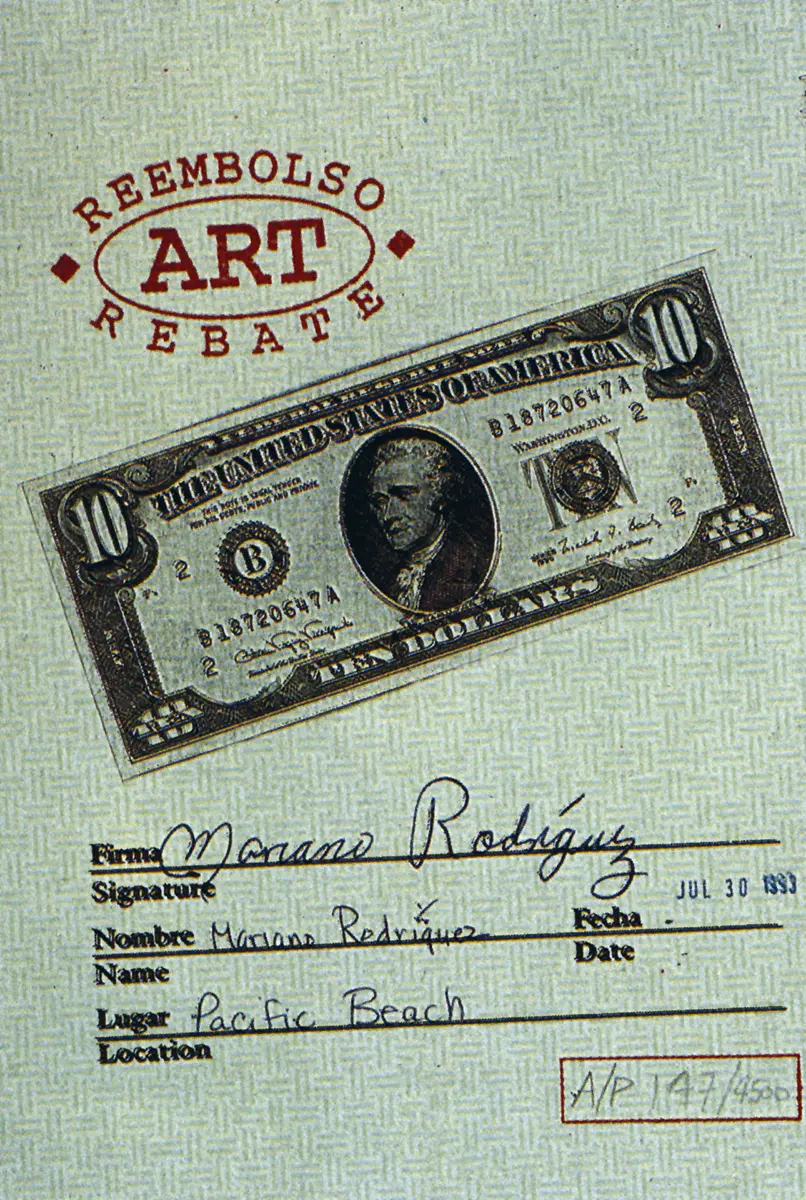
The recent scandal over Arte Reembolso/Art Rebate, an artwork by David Avalos, Louis Hock and Liz Sisco, rhymes with two US histories: the bitter fight during the past several years over freedom of expression and the proper role of government in relation to art —an internal battlefront, if you will; and, that of the increasingly fervent sense of "usness" (what Jameson might call a neo-ethnicity) in response to the "themness" of immigration into the country— a cross-border battlefront by definition. As a cause celebre, Arte Reembolso ascended to a level of notoriety almost never achieved in the us by art works with no images of genitalia or Christ. It made it onto the front page of both the New York Times and the Washington Post, and received extensive coverage on network TV and national radio. Arte Reembolso consisted of the distribution, over a period of several weeks last summer, of a total of $ 4,500 ($10 per person) to undocumented workers in San Diego, at places where the workers congregate to wait for day jobs -street corners, parks, public places that are well-known both to them and to the San Diegans, who cruise them in search of cheap labor.
Each worker was required to sign a receipt, and they received, along with the money, a piece of paper explaining that 'This ten dollar bill is part of an art project that intends to return tax dollars to taxpayers, particularly undocumented taxpayers. The Arte Reembolso acknowledges your role as a vital player in an economic community indiferent to national borders". As a public gesture, Arte Reembolso invoked the thousands of Mexicans who live in Tijuana and who work, legally, in San Diego, paying taxes but receiving no social benefits and who are, therefore, the cheapest of labor forces.
The project was commisioned as part of an exhibition "La Frontera " /The Border which was, in turn, part of a much larger project, Dos Ciudades ("Two Cities") a series of exhibitions and "relations" between San Diego and Tijuana inspired by the Border Art Movement centered in that region, and designed to create a new dialogue between Mexican and US cultures. As a collaboration between the community-based Centro Cultural de la Raza and the San Diego Museum of Contemporary Art, Dos Ciudades was an important institutional accomplishment. (This in itself was also a source of real friction, with some artists accusing the Museum of opportunism in jumping onto the Border Art bandwagon). Money for the project came from a variety of sources, including major private foundations and the federally-funded US National Endowment for the Arts. As a result of the Arte Reembolso controversy, the NEA money allocated for that part of the project was revoked.
As a border town, San Diego is an inherently dual and divided terrain. Its population is made up of both people who typically do feel entitled and safe to complain about encroachmentson liberty, and those who typically do not. The volatile frontline dynamic, overheated lately by an increasingly uncontrollable border, economic deterioration on both sides of it, NAFTA,etc., has become the vehicle through which many artists in the city work.
The border, equally a political and cultural issue, has opened into a category of contemporary art production and consumption, fostered initially by activist groups like the Border Art Workshop/ TallerArteFronterizo (BAW/TAF) and, more recently, mainstreamed by major museums and public art projects. A few individuals have built reputations too large to fit within the old stereotypes of Chicano marginality, including Premier Border Artists Guillermo Pena (recipient of a Mac-Arthur Foundation Fellowship) the US equivalent of a Nobel Prize and nicknamed the”genius grants”) and Amalia Mesa-Bains (formative in the development of the Chicano cultural movement and also now a Mac Arthur Fellow). A nascent Chicano middle class ("Chuppies) disrupts cultural cliches of an agricultural, poor, Aztecified, mural-bound population.
The institutional entrenchment of Border Art as an international category and as cultural ambassador is perhaps most succinctly symbolized by the mostly Chicano exhibition which represented the US at the last Istanbul biennial.
Indicative, however, of the eternally conflictive nature of the US mainstream's opening to Latino culture, this exhibition was first sponsored by and then censored by the US Information Agency (part of the State Department) because of its frank anti-imperialism. The public money promised by the USIA was replaced at the last minute by private foundations, and the exhibition was presented without modification.
What had been made quite clear, though, was that while the US official cultural machinery was interested on signalling its acceptance of "minority" cultures through public sponsorship, it would do so only if any aspect of that culture which defined itself in conflict with the mainstream was eliminated.
Art Rebate insisted not on the maintenance of an open"expressive space but rather on the use of it for active moral and political engagement. It seems plausible that it was this radicalism that made the project so difficult for the art world to support.
In order to understand the censorious reaction to Arte Reembolso, the immediately apparent overtones of xenophobia and racism must be expanded to include recent trends in US ethnic politics, which have been casting favorable gloss on the idea(l) of cultural pluralism ("multiculturalism), and also the art world's reaction to radicalism and the insertion of "difficult" political themes into its content. Arte Reembolso was attacked on various grounds: in the political sector, it was denounced (repeatedly) by a local congressman as an insult to "middle class respect for a dollar and what one has to do to earn it". In letters to newspaper editors, some (Anglo) San Diegans complained about the indignity of public funds being given to noncitizens while countrymen were out of work, and also reacted badly to the implicit accusation that they are not "sensitive" to the issue of the migrants.
Longstanding class antagonisms between artists and "ordinary people" were revived in the service of the polemics against the artwork. In fertilizing this tumid soil Arte Reembolso also became a source of resentment among various people inside the US arts community, who saw it as crass grandstanding which played into the hands of the ongoing political attacks which have decimated confidence and dollars in the country's art scene. Interestingly, and ironically, opposition to Arte Reembolso also fueled anti-government sentiment among those who saw it through the boondoggle lens of outrageous government waste.
And, finally, the piece became yet another occasion on which the extremely thorny question about government's proper role vis-a-vis the arts was raised. Most of the attacks against it which were construed as defenses of government funding for art implicity or explicity attacked Arte Reembolso both as a bad apple and as the result of selfish, anti-social discontent.
Did the piece succeed? It was meant to point out the truth about the economic contributions made by undocumented workers. But it fueled an already vicious backlash against those migrants by allying them with another higly unpopular cause, that of controversial contemporary art. In their rebuttal, the artists relied on the unconvincing argument that they are not contributing to anti-immigrant feeling since the piece insisted that undocumented workers have had a positive effect on the US economy.
As a strategy, does Arte Reembolso really make any sense? It alienated sectors of the art community (which want to quarantine these bad behavers from the rest of the profession), and thus seems to set back even the tiny gains made in recent years toward the development of a common agenda for the arts. Who was Arte Reembolso for?
Was it aimed at the indifferent Anglo population, preaching at them? Was it directed to the undocumented workers, intended to make them feel appreciated or supported? Was the target the politicians who make and remake border policies according to slight whiffs of political change and discontent? Does it matter whether this is "good" or "bad" artwork? To whom? Perhaps a better question would be that to whom the work should have to answer. After protracted national debate about artists' rights to "free expression" which largely failed to address the matter of what that expression was for Arte Reembolso insisted not on the maintenance of an "open" expressive space but rather on the use of it for active moral and political engagement.
It seems plausible that it was this radicalism that made the project so difficult for the art world to accept. While it was the center of heated and voluminous debate, the intentions, methods and effects of Arte Reembolso remained largely unexplored as a result of the parochialism of the debate.
As was pointed out by a reader of the San Diego Union Tribune, while the work focused on presenting the fact "that undocumented workers contribute more than they take from society coverage did not focus on that question. It focused instead on the funding of the project, presuming, without evidence, that, the monies were being misused".
Additionally, evaluation of the piece in aesthetic terms has been curiously missing, largely replaced by vociferous political debate. In 56 pages of news clippings, only three pieces established an aesthetic viewpoint. Even Hugh Davies, the director of the San Diego Museum of Contemporary Art, initially avoided commenting on the work as art, telling the press that the museum had no opinion regarding the quality of the art work. (Davies did later publish a strongly worded defense of the piece).
It is ironic, in the event of controversy, such art works become political instead of aesthetic objects, despite their intention to politicize the arts arena. This conversion has several meanings. Paradoxically, while not particularly "successful" within the artworld, Arte Reembolso did replace power in that realm effecting a much more public terrain, thereby conveying to the artwork a measure of political success. At the same time, officials received new roles: as Avalos pointed out, "the politicians are acting like performance artists while we're trying to be political".
A local newspaper editorial aptly observed that "the controversy, coupled with the media documentation, is itself the art".
In these terms, the piece was problematic in that it became, in the eyes of the press, an unintended symbol of the hand-out. In an atmosphere already saturated with propagandistic characterizations of Mexican immigrants as lazy freeloaders, the symbolic act of giving them money tended to reinforce this impression. And as regards multiculturalism's inclination toward the exotified ennoblement of "others", the project cast its Mexican recipients into much less resplendent persona when they used the cash to buy tacos on the street. The first problem was handled by reducing the number of rebates given at any one location, thus lessening the appearance of a welfare line.
Still, as an artwork Arte Reembolso achieved moments of real serendipity. Its deadpan humor follows in the spirit of earlier collaborations between Avalos, Sisco, Hock and various other artists in the city. These previousworks, for example, have included a (1988) poster placed on the sides of public buses in the city proclaiming "Welcome to America's Finest Tourist Plantation" (a play on San Diego's claim to being the finest tourist city), surrounded by photographs of brown hands occupied in menial labor. Some people, on both sides of the Arte Reembolso joke, caught the spirit, including cash recipient Domingo Santiago who was quoted in the New York Times as saying "it's strange, because people don't usually give us money". According to curator Patricio Chavez, one local official was moved by the piece to propose that all future NEA money be reallocated to hire 600 more border guards a response which, in its grandiose absurdity, struck some observers as a brilliant, and entirely inadvertent, coup de grace.
Finally, as was pointed out by San Diego Union-Tribune art critic Bob Pincus, Arte Reembolso was a crucial element of La Frontera exhibition. Since the Border Art movement has not been primarily concerned with galleries and museums, but with public spaces, it would have been an unconscionable taming of the movement to keep the whole of La Frontera project safely ensconced behind walls.
Arte Reembolso clearly hit a nerve. There was an unmistakable sense of anger at ingratitude "biting the hand that feed" which accrued to both the artists and to the Mexicans. In the midst of the cult of multiculturalism, the project underscored the fact that "Latin America" means something very different at the border than it does in the MOM A. Seen from the border, Latin America is not a (magnanimously valorized) artistic tradition interpreted parallel to the noble achievements in the North. It is primal, unwashed scurrying Mexicans with bands of children stealing across the border, stealing jobs, stealing "American" security.
In that sense, Arte Reembolso was an effective remedy to the misplaced sense of progress that has accompained most Anglo evaluations of the trajectory of Latin American and Latino art into the (money-making) mainstream.
Arte Reembolso also made an important and absurd contribution through the potential addition of "grants which might benefit illegal aliens" to the list of artistic themes which have been targeted as not suitable for federal support. This list, which previously in eluded only works ..."that depict or describe... sexual or excretory activities or organs, or religion or religious symbols", has come to serve as a kind of barometer for the limits of tolerance in the US public arena, and has been revised over the past few years to include new populations and issues as the mood of the moment demands. Looked at more broadly, it could be said that these artists have, as their real output, the creation over time of a climate in San Diego is highly sensitized by previous controversies and debates, and which is therefore increasingly reactive to new sources of stimulation.
The artistic climate in San Diego is certainly extraordinary and unique, both because of the vehemence and stamina of its political/public/ collaborative art movements and because of the extent to which that radical ink has rubbed off onto more placid institutions.
With multiculturalization, the US art audience has become accustomed to the experience of the foreign, even learning to savor it for its exotic scent. Foraging abroad on an increasing incidences, it invites the unknown into home institutions, even if is always enabled in the familiar. It is worth noting as an aside that this has also enabled northerm capitalism to reach places to which it had hitherto been denied access however, is a process too inexorable and too demonized to be fielded by ideals alone. By polemicizing the region where the country must, for reasons of geography, confront headon what the multiplying of identity means, this and other Border Art projects have stripped much of the beneficent rhetoric off of a process which is infinitely more complex and compromising. Avalos, Hock and Sisco have pointed out that "the 1990s government funded remake of The Border cashes in on fear, racism and scapegoating". What Arte Reembolso has done is to "...use the border as a theatrical backdrop for a drama that has its primary purpose the arousal of public disgust at public policy".
The Arte Reembolso incident is interesting because it lies midway between the ongoing US controversies surrounding, on the one hand, public funding for art and the right to freedom of expression and on the other, the growing Latin American population in the country and its alleged effects on everything from jobs to morals. It calls attention to the shadow economy in which the ideals of plural culture are defeated by banal realities, something that everyone would rather not talk about.
Somehow it seems absolutely appropriate that, at the largest border in the world between the First and Third Worlds, there are continual irritating reminders of another truth.
Rachel Weiss:
Curator and critic based in Boston, and Director of the Arts Administration Program at Lesley College.
RACHEL WEISS