
With regard to the exhibition of the art of Beatriz Milhazes at Galeria Ramis Barquet, Paulo Herkenhoff describes her way of painting. After establishing the color, the application of the great decorative pretexts is made on a translucent plastic surface. From whence it is detached, after drying as a film. It is removed as a skin, alive and vibrant, to be finally transported to the canvas as a decel transfer. To this are added the backgrounds; and the volds and complimentary areas are retouched, and details are finalized.
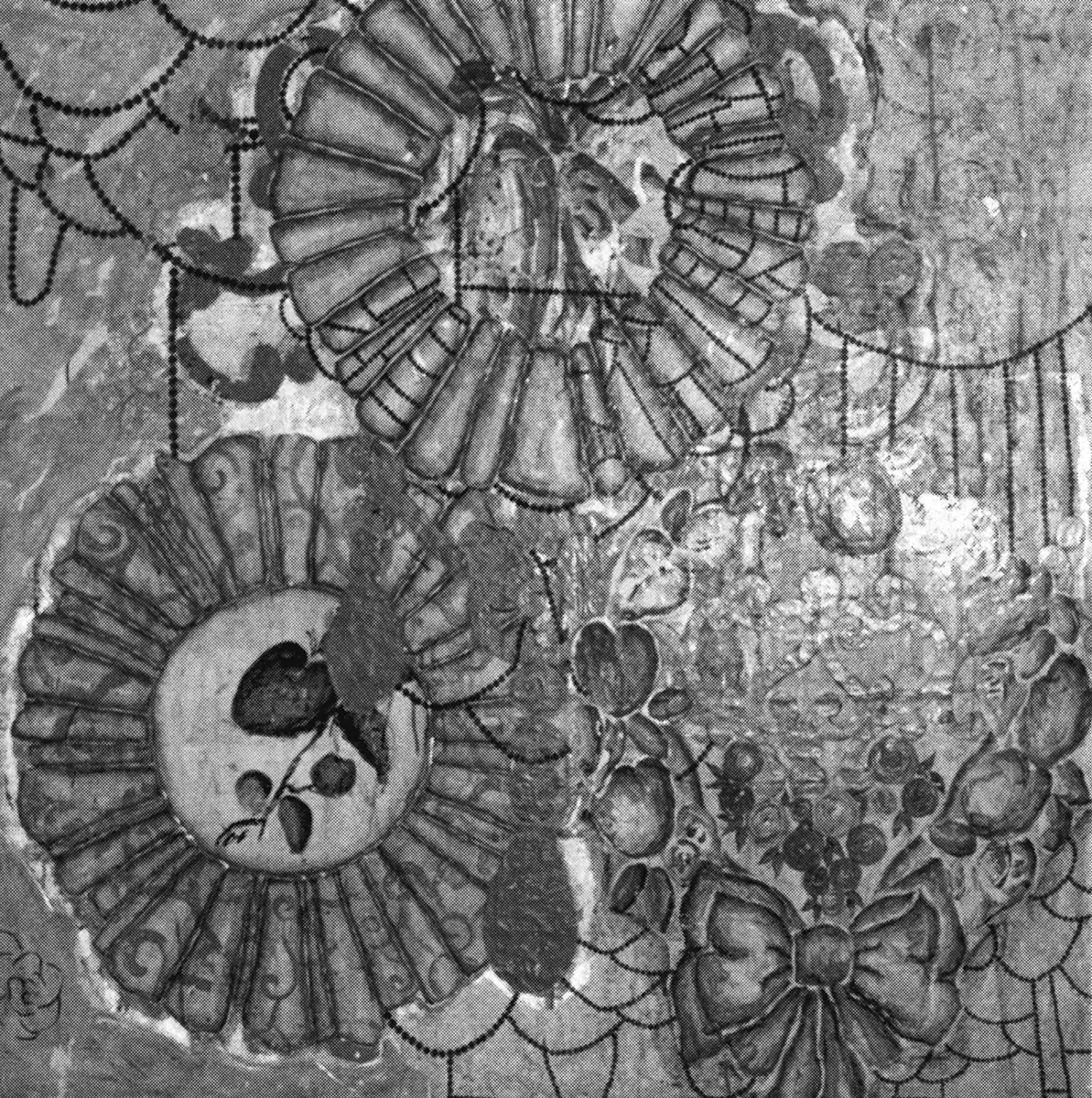
Such is her creative process, gradual and loving, as if each painting already existed in fragments and she had only to mend it to restore its glow. This is why Milhaze’s works seem so precious, at the same time fragile and resistent, like something we inherited from a lady of another generation and refuse to discard because in its very preservation lies its beauty.
While another Brazilian artist, Jac Leirner, chooses for her works objects from a new, commercial, urban world, Milhazes fills her canvas with images that suggest an intimate space, one that is domestic, feminine, and old. Strands of pearls, fans, flowers, mirrors, ribbons, pins and lace; all are repeating circular forms that answer each other in the delicately balanced compositions. They hover between movement and stillness, mimicking the mechanics of a clock in one painting, the bodice of an old dress in another.
The nostalgic aura of these works is also due to the background on which all this pictorial activity takes place. With the same care with which she paints circles of lace, the artist treats the backgrounds so that they resemble worn surfaces. In addition to the transparency technique, she creates effects of dripping paint and wrinkled canvas, as well as small nicks on the paint which reveal undercoats of a different color. We can imagine staring at the walls of an old house that have been endlessly painted and covered in wallpaper until, abandoned, they start to peel. In Milhazes’ paintings, it is as if we could still discern the marks on the wall left by a hanging mirror and the secent of flowers in a vase.
There is nothing old or nostalgic about Milhazes’ palette, however. The hues and combinations she chooses may be strong or unexpected --pinks, and aquas- or more subtle -ochres and greens-, but always vibrant. Indeed, a visit to the exhibition recalls a view through a kaleidoscope-one discovered in an antique stand among china and old silk.
PAOLA SADA