«lt’s cool, let’s go in again,» exclaimed a little girl to her friends when she came out of the Sensorial Labyrinth, constructed on the third floor of the Museum of Modern Art. Unfortunately, the author, Carlos Cruz Diez, was not present - he had to leave for Caracas and Paris, after three weeks of intense activity in Santo Domingo. The artist often takes children as examples of the purest and freshest reactions to «different» art. Through a moment of pyscho-sensorial re-encounter with childhood, he invites adults to free themselves of the «block caused by cultural conventions" when looking at his proposals on color. Thousands of people, accepting this invitation or guided by their own instincts, have enjoyed and continue to enjoy the works of this Venezuelan master, in the Museum and outside at the «Molino$ Dominicanos» warehouse buildings.
It was the final part of a marvellous adventure. Carlos Cruz Diez, who is the great-great nephew of the hero of the Dominican Republic, Juan Pablo Duarte, had never visited the country until 1992, during this first visit to Santo Domingo, where he fell under the charm of its people. Cruz Diez conceived a project for donating a work to the country. He first thought about a gigantic physichrome of flowers - similar to that which he did for Medellin. He inspected several walls and monuments and finally decided to convert the «Molinos Dominicanos» warehouse silos into «Chromo- interferent cylinders", using those of La Gaira in Venezuela as a precedent.
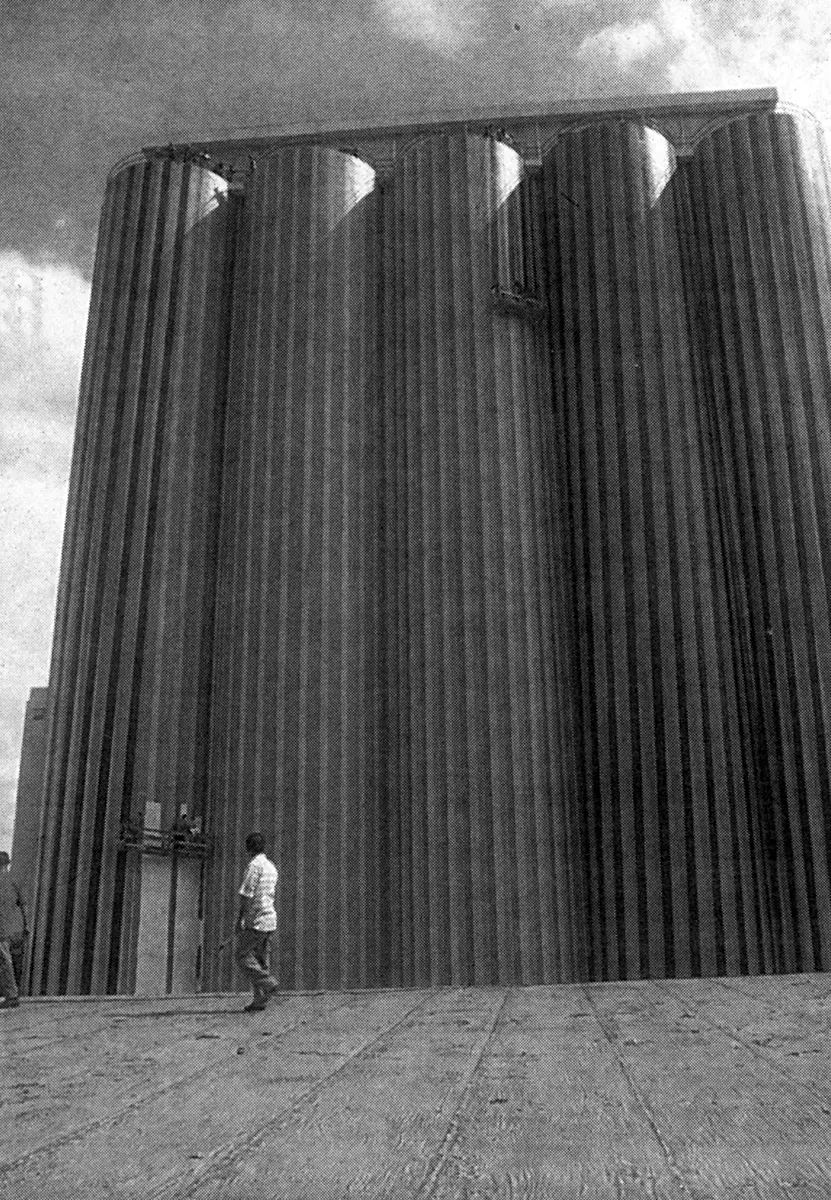
On his return to Caracas, he prepared a project with maquettes and Plans on his second visit to Santo Domingo , and with the support of the Ambassador of Venezuela, Maria Clemencia Lopez Jimenez --a lover of culture-- a meeting was organized with the executive officers of the Dominican Corporation of State Enterprises (CORDE), which owned the assets confiscated from the dicatator Trujillo - now public domain - including the «Molinos Dominicanos*. The project received enthusiastic support and, to the suprise of everyone, within a few days the metamorphosis of the silos began. Other trips by Cruz Diez and his son, work by two engi-neers, a master builder, 55 painters and decorators, more than 1,500 gallons of paint - from another State enterprise together resulted in the creation of an immense three-dimensional «polyptych» mural. This was the first project of its kind in the Dominican Republic - where there is no kinetic art but with only a few weeks delay the work was completed with the desired optical results.
The towers of the warehouse, an massive, anonymous industrial building which was so ugly that many people said it ought to be pulled down, were suddenly transformed into an architectural attraction, with a pictorial geometry that is fascinating with its chromatic mutations. Both the inhabitants of this district - part of the old city, on the banks of the River Ozama, and a working class neighborhood - and the press and art circles were amazed by the transformation of the surroundings and the quality of the work - which is the only contemporary, monumental and open air art work in the city. Moreover, it is an example of urban renovation... although of course there are not many cases which can boast the participation of Cruz Diez and his virtuoso art.
As a new form of visual communication for community life, the work provides the «man in the street* - who feels and savors it - with a perception of form and above all color which he had hitherto never experienced. The enormous iridescent modules - I28 kilos and II,200 square meters of wall -are «a sufficient and effective artistic event for commu-nication with and action on other men*, «color in continous mutation creating autonomous realities*, as the artist himself says in his Reflections. In Santo Domingo, where muralism is in need of renewing its ideas, it marks the triumph of color as language, combining line, volume and space, geometrical composition and polychrome rhythm, real and virtual images, the optical effects and combinations that change as the spectator moves around the work.
But Cruz Diez wanted to do something more - something that on a different scale would help explain chromatic phenomena, the silo «event» (a term which he frequently uses). He thought about bringing an exhibition from Venezuela or France, but the insurance costs were too high and in any case this would not provide the didactic element which he was seeking. He therefore decided to do a show in situ, especially executed for the occasion with the assistance of a team of students and young artists. The project was headed by the architect Julio Marichal. The exhibition would be called Metamorphosis of the Ephimeral and would consists of alternating plywood, metal, cardboard and paper panels on the constructive chromatic pattern of the physichrome. A «sensorial labyrinth* would take visitors along an intricate corridor, where tactile contacts and sensations, noises and sounds, winds, violent illumination and a saturation of reds and blues would stimulate the spectator’s «raw perceptions* and produce a sort of catharsis.
All sorts of delays and problems arose... Fortunately, the BHD Bank provided the necessary funds for the purchase of materials. Cruz Diez spent twelve hours a day on the third floor of the Museum of Modern Art which was converted into an experimental workshop. The project was a genuine collective enterprise, in which the master worked with more than 70 collaborators, including 25 artists (almost all young). It was something that had never been seen in Santo Domingo before. Within two weeks the twelve enormous panels were ready, with their chromatic and inductive effects that changed as the spectator went around them. The project included a Sensorial Partition and a Deconditioning Labyrinth. Cruz Diez emphasized the provisional and experimental nature of the works and their contribution to art education: they were not intended as perfect and final works in the normal sense of the term.
It was an unforgettable experience for all concerned. For most, the “sensitive geometry* and the pure color, stripped of any narrative content, offered a new and impressive vision, pointing forward to the art of the year 2000, although their origins went back to the I960s. Carlos Cruz Diez will probably return to Santo Domingo with otherv proposals. However, if we can con-tinue to organize artistic events in the country with the same enthusiasm and creative potential, under the guidance of other mentors with similar energy, then a great contribution will be made to the development of dynamism, creativity and international cooperation.
MARIANNE DE TOLENTINO