Since Jorge Gumier Maier took over as director of the art section of the Ricardo Rojas Cultural Center - which depends on the University of Buenos Aires - it has become an alternative space for presenting the work of artists outside the official circuits (although not opposed to them). One of these artists is Feliciano Centurion (Paraguay, I962), who has lived in Argentina since I974, and a representative, along with Miguel Harte, Marcelo Pombo and Sebastian Gordin, amongst others, of the «light» aesthetics of the I990s. In this show, Centurion explored themes on the construction of gender categories in contemporary thought.
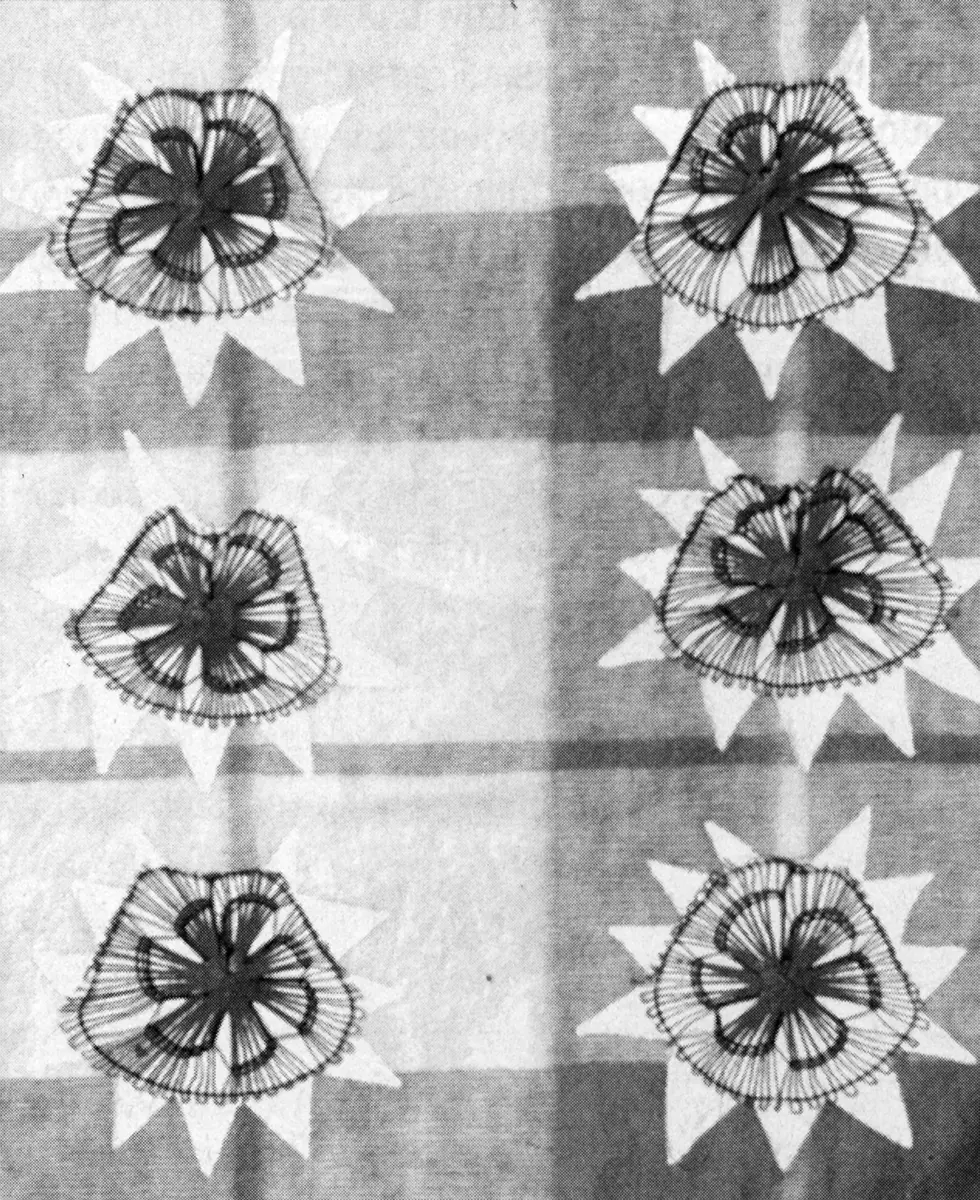
As is characteristic of his work, he uses manufactured wool blankets as a support. At his artistic beginning he painted them, but now he sews little pieces of hand-made fabrics and table cloths on them. Star fish, tentacles, octopi and daisies are repeated in a kind of natural zoo-botanical reserve, fantastic and exhuberant, a silent task carried out by the persons who populate his personal world. The table cloths were woven by the grandmothers, mothers and aunts of his own friends: Aurora Varela - Ariel’s grandmother, Gelucha - Ana’s aunt, Mama Yolanda, Dona Josefina and a host of other industrious women, seamstresses and house wives.
Centurion evokes the domestic rites of his childhood in Paraguay, the interwoven nature of a society that preserves habits and customs such as cooking recipes or nandutf weaving, which are transmitted from generation to generation by mothers and grandmothers.
Through his use of repetition, he superimposes weft upon weft, where the manual nature of the textile contrasts with the industrial process used in the support.
It is an analytical operation which places domestic hand weaving in a different context. The lack of prejudice allows the artist to depict, from a male perspective, a characteristic language in the network of gender associations, linked with the female tradition: the decorative and ornamental nature of the work, the protective function of the blankets and the role played by subjectivity, sentiment and emotion.
Centurion is following a path first opened up in the mid-1980s by artists such as Robert Kushner and Thomas Lanigan-Schmidt, members, amongst others, of the North American Pattern and Decoration group.
With the apparent innocence of a banalized aesthetics, Feliciano Centurion’s work is an explicit declaration that what is personal is also political, thus giving legitimacy to the private domain in the debate on contemporary art.
LAURA BATKIS