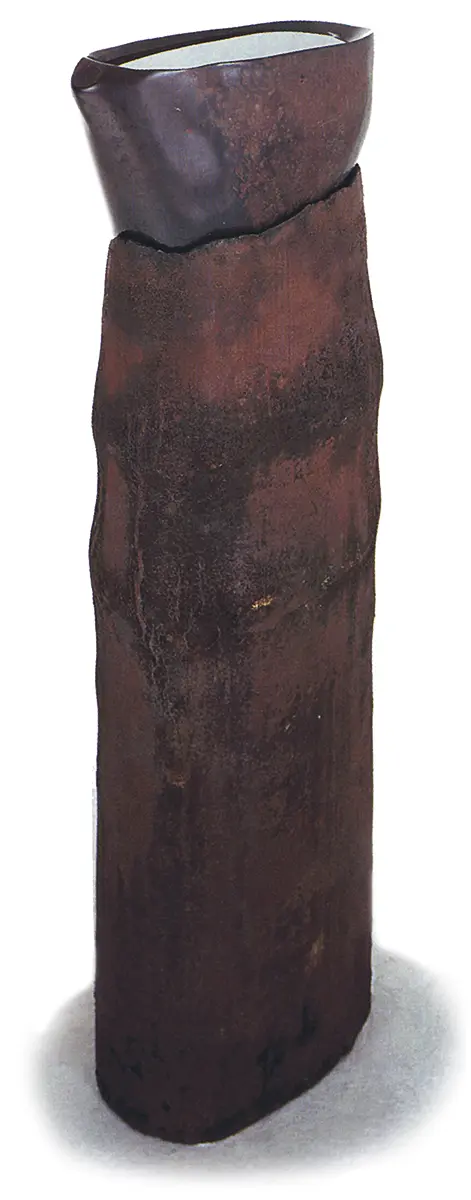
First there was the interplay between abstraction and figuration; then his interest in lost landscapes that are remembered only in an unconscious manner and recuperated with forms which are not devoid of certain automatism; this in turn gave way to a more pictorial language, with more emphatic concern for color, texture and line. The recognizable reference is lost and replaced by three-dimensionality.
In this review of Hugo Zapata's work(l), from his early screenprints down to his sculptures, there is a guiding thread throughout all his production: his interest in surface, in organic materials and the presence of a rationality which is close to the world of geometry.
The early interest in screenprint
Zapata's first works in screenprint (1973) reflected his interest in gestuality, fluctuating between abstraction and a more explicit portrayal which included self-portraits (1975). Gradually the reference to immediate reality became less marked, giving way to surfaces on which he worked more geometrical lines and reinforced the use of color. This stage included such works as Rites and Rituals, a series of screenprints which he started at the end of the 1970s(2), and which, along with his following works entitled The Elements and Stelae, at the beginning of the 1980s, closed the cycle of screenprints and drawing. Zapata's work now began to emphasize the idea of tying, volume and glazing based on primary colours, with surface predominating over drawing in the later series.
The initial gestuality gave way to more controlled, less automatic forms. Although Zapata never totally separated himself from reality, he seemed to use objects to rediscover them, to find a language allowing them to be reassembled. It is interesting to note here how everything became surface with texture, surfaces trying to escape and flee, playing with elaborate chromatic structures to formalize proposals that refer to both reality and dream. In these works (beginning of the 1980s) which progressively moved away from two-dimensionality, there appears an interest, which Zapata will reaffirm in his sculptures, in the confrontation between geometry and free forms, with organic references that try to connect up with nature.
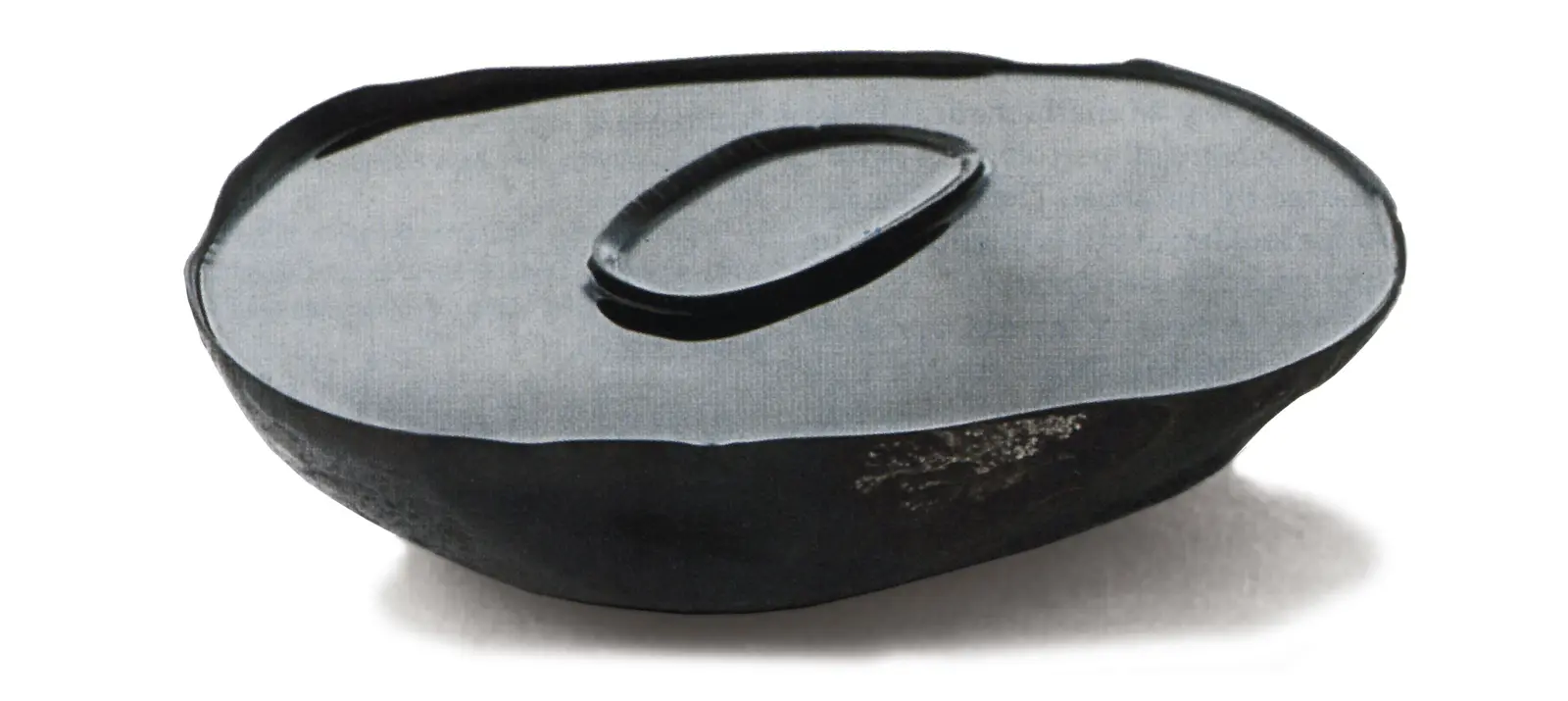
His first attempt to move towards three dimensions was with the creation of his Boxes, at the beginning of the 1980s. Nature and human artifice combine in these metal boxes, which are very well finished, with minerals, stones and fossilized wood. The break with two dimensions is not complete, however, since the objects are meant to be seen from the front, and the box continues to function as a kind of limit.
Once again, containment and gesture are present. The bronze boxes are related to the landscape and frame it in an attempt to establish a link between the real and an invented environment.
The materials
Zapata first began his experiences with stone at the Department of Geology in the National University. His attraction to this material was reinforced his discovery of Chinese monoliths --the Stelae— on which traditional texts of a philosophical nature are engraved, veritable "tablets of law". A trip to China brought him into contact with these works, which in a way were already present in his prints. One feature that particularly caught his attention was the way in which they modified the landscape, becoming the visible trace of the passing of time, without forgetting those left by man's interventions on these enormous stones(3).
Working with different kinds of materials, Zapata gradually came to realize that what he was interested in was the memory which these stones held. The rock opened up a quarry of inexhaustible possibilities, although it took him years to discover this.
First he visited a number of sites in Colombia, including the Titiribi mines in the Guajira region, volcanic zones of the western and central mountain ranges, slate and shale from Rio Negro (Department of Cundinamarca), near the town of Pacho. Here, in the places where there was iron and where smelting works had been set up, he found a material which was to be a key element in his sculptural work: rocks which were difficult to extract and which had be transported hundreds of kilometers on mules to reach his studio.
Zapata considers these rocks sensual elements, both in sound and texture, as well as in color. Although they can be manipulated, revealing geometries, brilliance and volume, they need to be respected, since they retain the marks of the passage of time. His encounter with these rocks was not a matter of chance: I feel I am going to seek out and make my own choice, rediscovering the forms which lie hidden in them and which are inherent to them(4). Thus when he assembles them with glass, metal or water, he does not adulterate their organic structure: he exploits to the maximum their irregularities, oxidation and internal geometry.
This appropriation of nature, along with the assemblage of the above-mentioned materials, is complemented by the use of advanced technology – allowing him to make just the right cut, achieving continuous polished surfaces.
Once again, Zapata brings into play the rationality-intuition relationship which has governed all his work.
This concern is quite clear in his small format sculptures - as in his series Reflection (1987-88), in which marble, glass and bronze are assembled in an harmonious relationship. They are objects intended not just for looking at, but for touching, for establishing a direct and sensorial relationship.
From small format to monumentality
Along his small format sculpture, Zapata has also designed and made works for public places. These works reflect concerns already present in his early prints and in his first attempts at three dimensionality such as the Boxes. Landscape can be captured and marked out, and the relationship between real and created landscape once again becomes paramount.
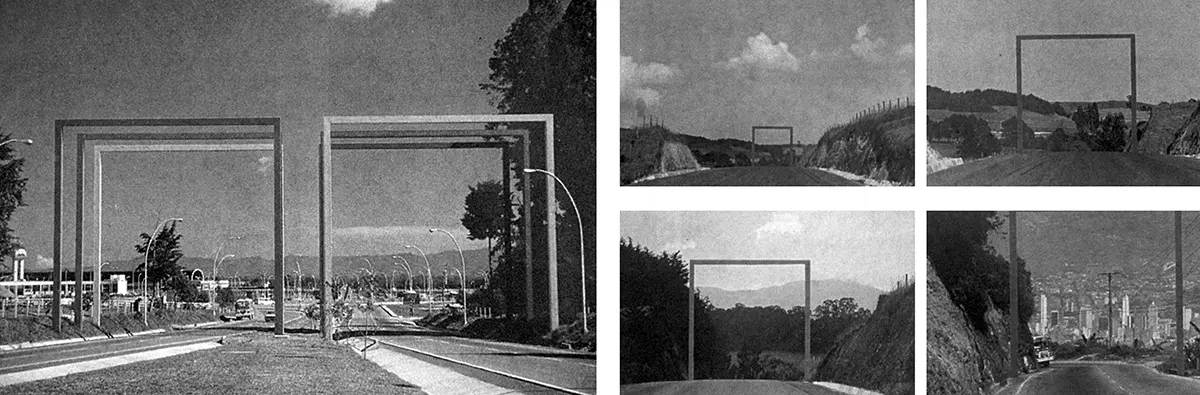
Let us mention a few of these public projects by Zapata. The first was Porticos (1984) at the Jose Maria airport in Cordoba, near Medellin. It is executed in sheet iron and reflective paint, each of the six geometrical structures with clear minimalist references measuring 18 meters high. The work is an unusual form delimiting the landscape, which becomes an undeniable object of contemplation. The work is intended to be a frame for the nature that is seen through it.
A similar attitude is evident in another project, Cota 1535 for the Nutibarra Hill (1986): the intention once again is to rediscover the setting through the tracing of an enormous red line of pre-dyed cement which goes around the hill. The work becomes a balcony for viewing the city.
The tendency towards the use of minimal elements and the rationality of the geometric form which characterizes these works changed in Zapata's subsequent public sculptures. In 1987, with his Stelae, constructed in the gardens of an insurance company building, Zapata returned to his interest in the passage of time. Using marble and glass, he constructed enormous blocks of stone (10x8 feet) where it can be seen how water modifies and perforates them. Zapata has said that the idea of this block of sculptures is to show the memory of water, the mark which water leaves on rocks which have taken centuries to form. Between the cuts in the rock, there is green coloured glass, which changes with the different light, revealing the effects of the water. It also reflects all the outside movement (5).
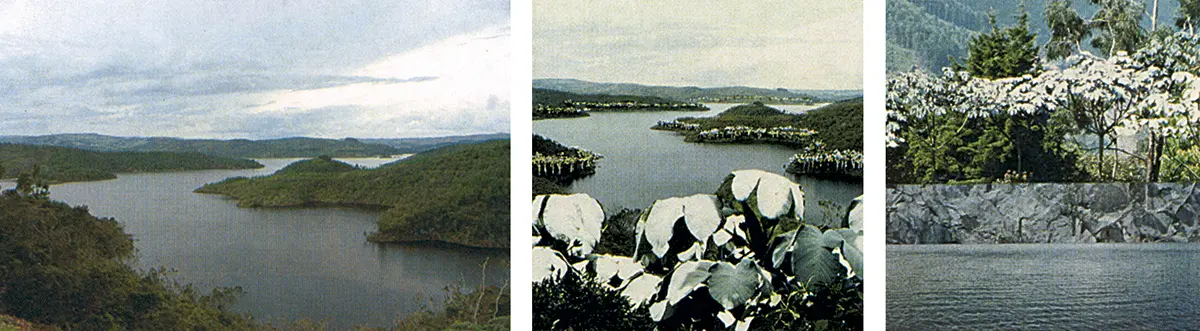
In 1989 his Paths project (still in construction), continued this search and won the Rionegro 11 Artwork competition. The work uses three elements: ground batholite to build a white road 44 miles long around the second element, the water of the dam around which the sculptural project is set; and silver yarumo trees, also extending over 44 miles (6) . Using materials found in situ, Zapata's objective is to place a frame around the mirror of water: trees, earth, water and sky as mathematical lines, lines which are all perceived in nature and used by the artist. The work is not just for looking at but is intended to be experienced, to be penetrated.
One of his most recent urban projects is Between Waters (1991), erected in a shopping mall in the city of Medellin.
Two basic elements underlie these enormous taluses each measuring 123 feet: Zapata's obsessive interest in the Colombian landscape and the memory of the ceremonial fountain of Lavapatas (7) . The material used was once again slate, with some 40,000 tonnes being collected for the selection of the cuts used in the work. Water is pumped regularly over the uneven surface of the material, which is full of texture and different mineral elements, creating chromatic variations and unusual sounds as it cascades over the irregular inclined walls. It is the artist's desire to create a more direct sensory experience through the relationship between nature and the urban environment. It is a backwater, a space in which what is important is movement.
Without distancing himself from the characteristic features of contemporary sculpture, Zapata seems to be exploring local materials in his search for a re-encounter with his own environment, and his own cultural and geographic reality. He expresses what he sees as the essence of his work as follows: I believe that my work is only possible through living together with the beings and elements that make up my environment, each sound, each presence, each material which allows me to interact. To communicate with something which can be transformed and materialized into a new being, with its own memory and energy. The traces, the signs, the undeciphered codes are perhaps the elements that most motivate my research and questioning, my desire to construct these things which are material but which really do not exist as precise and resolved entities. They are diffuse, nebulous, they cannot be seized, they are unreal, although their weight, form and character make them part of reality (8).
NOTES
1) Born in 1945 in Quibdo, Colombia.
2 ) Zapata won the Medal of the University of Chile at the Valparaiso Biennial, Chile, in 1979 with one of these works.
3 ) lnterview with the artist in Bogota in November 1993.
4 ) Extracts from the above-mentioned interview.
5 ) 4 / rescate de la piedra, article published in the newspaper El Mundo, Medellin, 13 October 1987.
6 ) 4 0,000 yarumo trees have already been planted; the artist’s target of 60,0 0 0 is expected to be reached by the year 2000.
7) This ceremonial fountain is the work of the San Agustin pre-Columbian culture (San Agustin is located in
what is now the Department of Huila, Colombia).
8) Text by the artist in the exhibition catalogue Hugo Zapata: Naos, pilas y ojos de agua, Garces Velazquez
Gallery, Bogota, 1993.
Ivonne Pini:
Profesor at the National University of Colombia. Executive editor of Arte en Colombia.
IVONNE PINI