Three years after it presented a survey of the art of Oaxaca, Museo de Arte Contemporaneo de Monterrey has devoted its entire space to works from perhaps the only other Mexican state with a comparable history of artistic activity: Jalisco. In this case the exhibition does not go as far back as the pre- Columbian period, but concen-trates on the nineteenth and twentieth centuries in order to attempt to show, within the confines of a single exhibition, the contribution of Jalisco to modern painting in Mexico.
The question raised by some observers -including two of the authors of the catalogue- is whether it is valid to group together artists separated by generations just because they happe-ned to be born or live in the same state. To speak of painting from Jalisco may not make much sense, but then again titles such as «Mexican» or «Latin American* painting may sound just as arbitrary, especially today and in the light of such exhibitions as the Museum of Modern Art’s Latin American Artists of the Twentieth Century.
Arbitrary as the classification may be, it is Nonetheless Valuable if \Ne Consider it is one way, among many, of looking at the history of Mexican art; a specific period and region at a time instead of the impossible task of taking it in all at once. In the end, it is not so surprising to find common elements and sensibilities, customs, and religio-sity characteristic of life outside the capital, according to Carlos Monsivais, or as Alberto Ruy Sanchez suggests, a kind of pervasive melancholy. Whatever the case may be the question we should ask is perhaps not «Why an exhibition on Jalisco?, but «Why so many great talents from Jalisco?
Such talent is evident even in the anonymous portraits of the early-nine- teenth century, of which the most memorable are those of women and children. The nuns look like queens, the women look like nuns, and the children look like adults. A particularly moving portrait is that of Doha Maria Ana Josefa de Villasenor, painted to commemorate the day she entered a convent. The woman appears not in religious habit but wearing jewelry and a finely embroidered dress, in a strange and ironic nineteenth-century version of the debutante picture. The true gems of the painting of this period, however, are the portraits of Jose Maria Estrada, together with Bustos the Mexican master of this genre. His figures dominate the space of the painting in a striking and elegant way, while the peculiarities of each face are highlighted against the flat, dark backgrounds, creating in some cases the effect of a religious icon. Children are also prominent in Estrada’s work, dressed up in almost theatrical clothes and holding curious toys. Some of these children’s portraits are variations upon the genre of
child death and represent deceased children in life. The various anonymous alter pieces, or small ex-voto paintings, mounted together on a single wall, are noteworthy for the kind of compositional simplicity and brilliant constrasts of color that we find in Estrada. Of these, one of the best examples represents the Virgen de la Soledad de Guadalajara, almost like a graphic work or a Matisse cut-out in its effect.
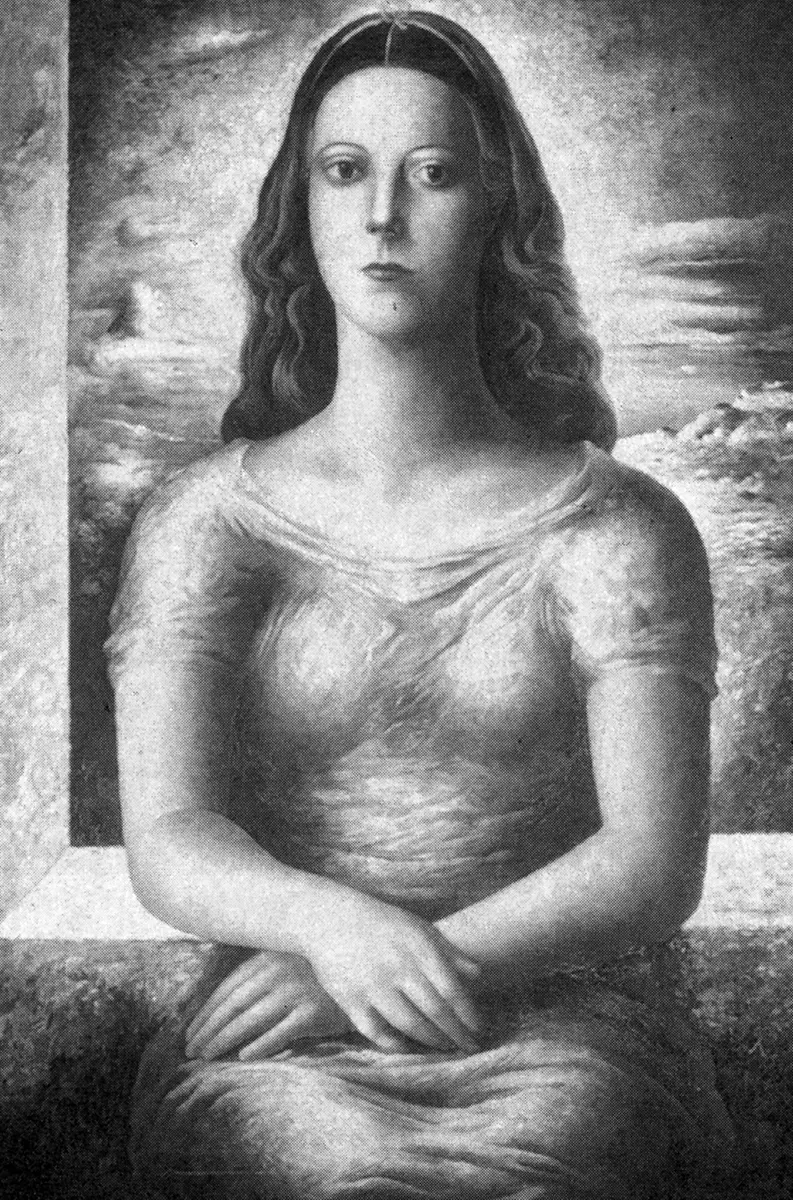
In the part of the exhibition devoted to this century, the portrait takes on a fantastic hallucinatory tone, with a cue from Ensor and Schiele, in the work of Amado de la Cueva and Jose Luis Figueroa; with Jesus Guerrero Galvan it becomes classicist and idealized. The section on Dr. Atl includes an impressive series of paintings of the Paricutin volcano, while the one on Orozco -naturally the most heavily- represented artist- contains what is possibly the single greatest attraction of the show; a polyptych on masonite entitled The Feast of the Instruments, finished in 1945 and exhibited in a museum for the first time. Bold in its palette and composition, the work combines the monumental quality of Orozcos’s murals with the best of his easel paintings Juan Soriano and Chuco Reyes are also thoroughly represented as independent artists, unconstrained by the parameters of any one movement. The show vividly illustrates the path of Soriano’s career, from the figurative works of the early forties and up to the more abstract creations of the seventies. Reyes’s small paintings on paper continue to surprise us, not only for their expressiveness but also for how they resonate in later generations, as is evident only a few galleries away in the work of Alejandro Colunga.
Of the art of the most recent decades, that of Enrique Guzman and Javier Campos Cabello stands out for its disturbing but exquisitely executed images. They are followed by the very young artists such as Carlos Vargas Pons who, if not yet «masters» can certainly lay claim to the genius of Jalisco that is their heritage.