In his recent exhibition (May-June) at the Weiss-Sori Gallery in Miami, Leandro Soto demonstrated his continued interest in the culture of indigenous people. Like his contem-porary Jose Bedia, this Cuban artist from a society that has de-emphasized religious beliefs and practices has turned to the rich spiritual heritage of so-called primitivies. In this, both Bedia and Soto have followed in the footsteps of Wifredo Lam, all of whose art after his return to Cuba from Europe in 1941 involved a quest for the magic of a living Afro-Cuban tradition.
A member of the pioneering Volumen I group that emerged in the early 1980’s bringing renovation to Cuban art, Soto went to Mexico in 1988 and founded a popular art scholl in the village of Tamulte de las Sabanas in Tabasco, living and working with Chole and Chontal Indians and studying their culture which has deep roots in the pre- Columbian past. This area is after all part of the heartland of the ancient Olmec civilization, one of the mother cultures of the Americas. It is also near the Maya Regions of Chiapas and Yucatan. Already familiar with Afro- Cuban belief systems. Soto was exposed to the language and way of life of indigenous people for whom reality is intertwined with myth and ritual. Accepted by the Indias as one of their own. Soto was soon over-whelmed by a vision of the world very different from that of his past experience
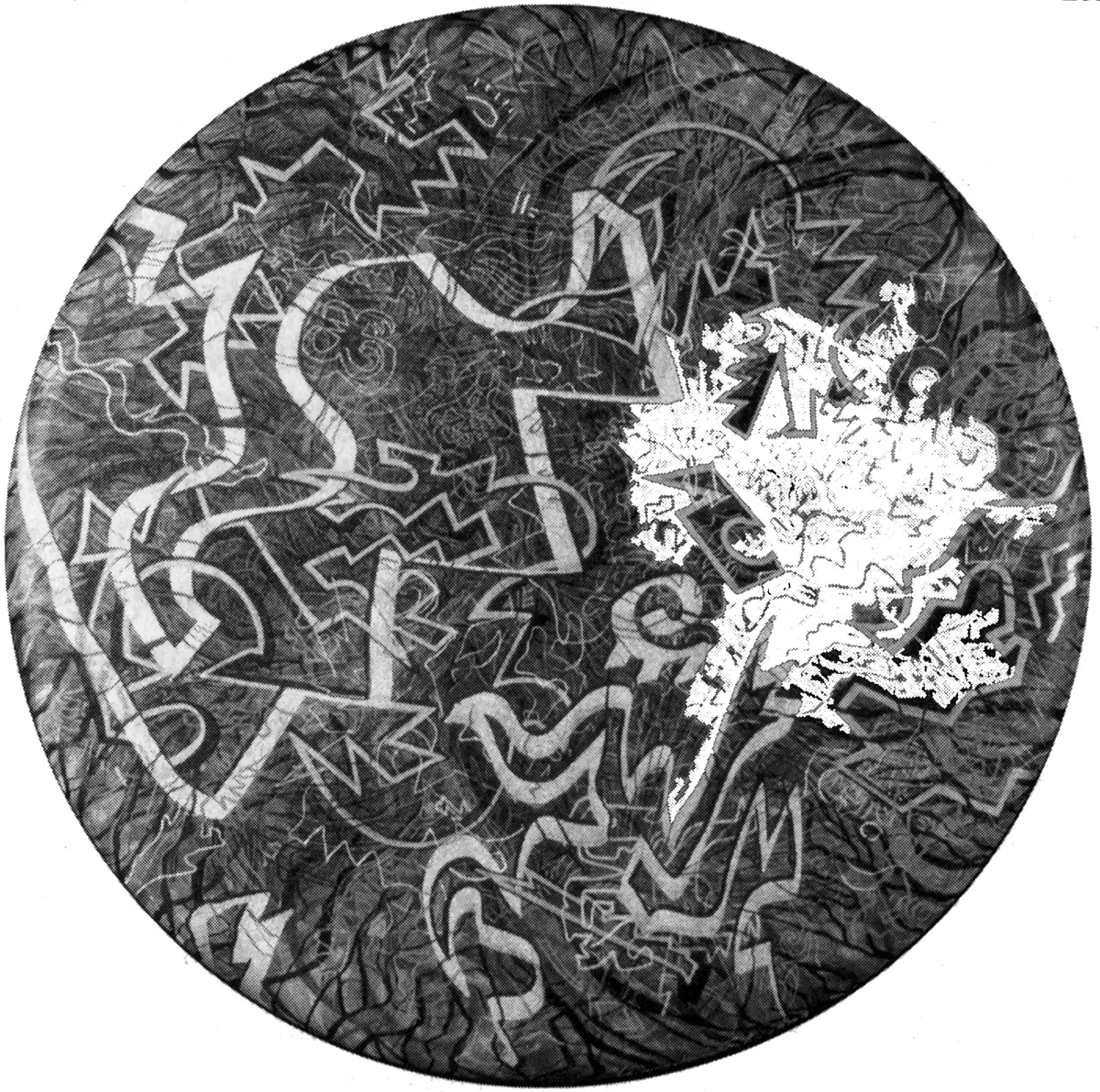
The impact of Mexico was already evident in Soto’s previous solo exhibitions in Mexico and Cuba, but his show at Weiss Sori revealed his successful assimilation and interpre-tation of native American culture in all its splendor. Painted with colorful energized lines that vibrate with Op Art rythms these new works reflected Mexican legends and folk tales, many of which were recounted to the artist by his students and friends in Tabasco. Soto has fully understood the aesthetics of pre-Columbian and contemporary native American cultures. His paintings are two-dimensional, often reductive to the point of abstraction, and echo the linear qualities of the weavings that are today perhaps the principal manifestation of indigenous art throughout the Americas.
In paintings such as Solar dance of three naguales, Nagual and the Story of the Man Who Became a Tiger, Soto examines a fundamental belief pervasive in Mesoamerica since Olmec times: the concept of shamanistic ani- mal/man interconnection and trans-formation. In Olokun, he refers back to_, afro-Cuban myth. Here man is also seen as part of a cosmic whole in which magic, invisible forces and the natural world all participate in the cycle of existence. But Soto, a highly trained artist and set designer, is more than an anthropologist in his documentation of the Native American ethos. Like Bedia and other enlightened artists who use native sources, he insists on a universal, humanistic vision, the result of which is the creation of a unique postmodern style in which line, color and content interact in perfect equilibrium.
Soto’s concerns transcend specific locales or traditions. He deals in archetypes and in the common spiritual threads of mankind. Some of his paintings recall both Buddhist man-dalas and the vortexes of cyclones, both sources of vast energies - one on a metaphysical plane the other on an earthly one.
GIULIO V. BLANC