Oscar Munoz recently presented his first one man show at the LedisFlam Gallery in New York, which included a new version of his well-known Bathroom Curtains and a series of self- portraits entitled Narcissi. Self-portrait is not however the right word. Chance and contingency are too involved in the production process of these works, where subjective volition is annulled by the effect of chance. The artist submerged a sheet of paper in square plexiglass buckets filled with water. Then, using a metal net suspended over the buckets, he drew the image of his face with charcoal, allowing the pigment to fall through the metal mesh into the water and thus onto the paper where it remained until the water evaporated. The result is a work in progress whose final result is more like a work in decomposition and destruction (when the water eva-porates, the paper becomes crinkled and crumpled, and the resulting drawing is all cracked). Thus the “narcissistic transcendence* implicit in the title of the works is transgressed by the formal solution of the exercise. Idealization and the aesthetic canon, which have characterized the Western tradition of the self-portrait have thus been interrupted and the result is a contingent kind of “progress* without any predetermination or rules.
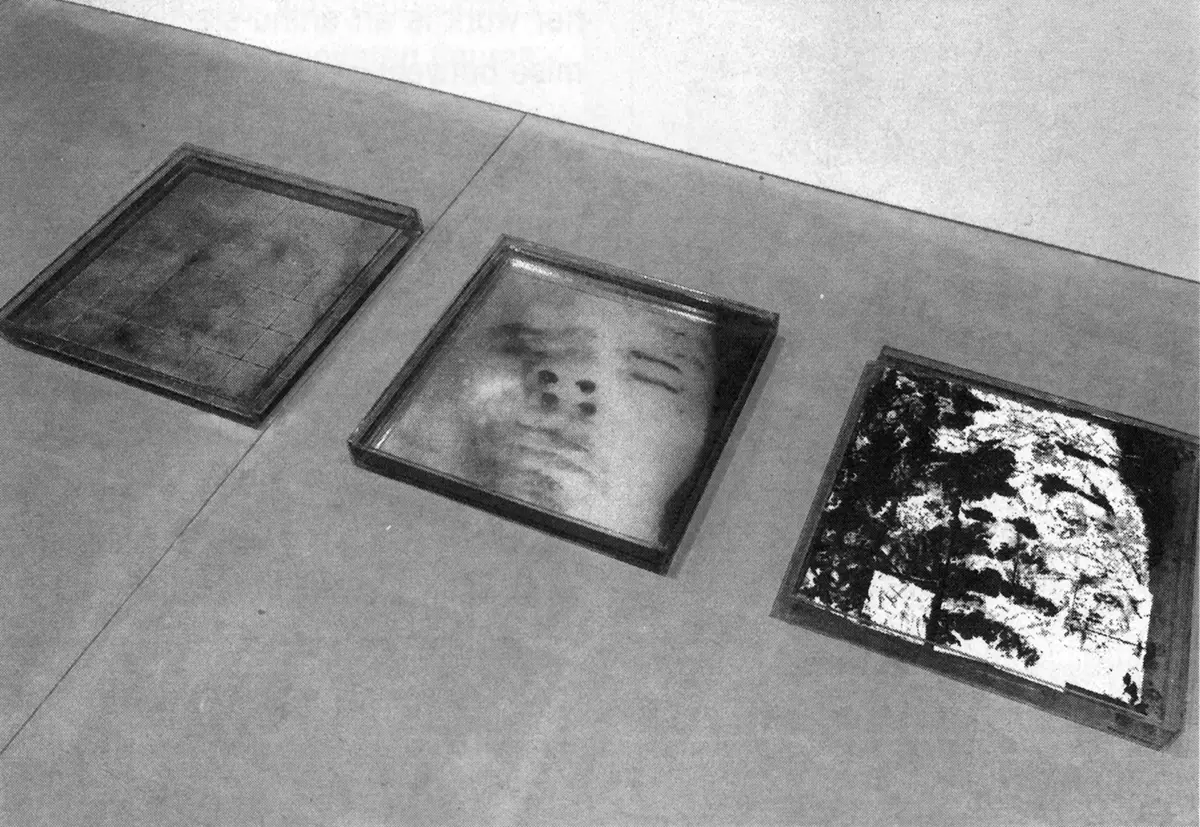
By explicity evoking the Narcissus myth, these works raise a number of associations. There are various versions of the myth: through the use of different materials (the surfaces vary from bucket to bucket) the artist proposes different Narcissi, different processes, each consonant with the respective production conditions. However, in the end, divine punishment imposes destruction and Narcissus, “contemplating his image reflected in the water and despairing at being unable to achieve the object of his desire or satisfy his passion, remains at the water edge until he expires*. In Munoz’s work it is precisely the evaporation of the water which allows the image to become a ruin, a vestige; without the water which gives it life and keeps it floating on the surface, the artist’s image becomes submerged, reaches the bottom and becomes a mere trace. The result is a fractured face which in no way resembles the continuous reflection of a mirror or water. When the water evaporates, the illusion is broken and the continuity disappears: it is here that we can find an interesting relationship between these works and the Bathroom Curtains, where human shadows are recreated in acrylic paint on the plastic surface of the curtains - so that the interstitial space between reality and illusion collapses and gives way to imprecision. The effect produced between the shadows projected on the bathroom curtains and the absent subject (we can see that the shadows are in fact only paint) contrasts with'that produced between the reflection in the water of Narcissus’s face (an illusion) and the reality of his body; however, the effect is similar to that between the reflection in the water of the artist’s face and the absence of his body whose place is now occupied by the spectator of these works.
This raises the question of one of the most conventional stategies in the history of art, that of conceiving the image as a substitute, something replaced and thus compensated by an absence. However, by deflating the object depicted with the ruined image of its “author® through the Narcissus myth and the effective formal solution of these works, they raise certain questions related to the subject as producer and as receiver of these images. The ruin of Narcissus is the ruin of mankind, the subject as producer of representation, the subject which believes that it is producing the world by producing its
representation (Owens, I992). But the representations produced in these works are images in the process of putrefaction, teetering on decay. In the same way, the idea of the pictorial surface as a mirror which reproduces a truth offered up to the spectator is called into question by these fractured reflections where the illusion between reality and representation disappears. Indeed, once the water has evaporated, the resulting images communicate a sensation of fragility, deterioration, decomposition. The operative process through which these images are produced is emphasized and in turn reveals the absence of any ideal or unique solution. As a result, the representations of the subject achieved in these works prove to be contingent; without the constant manipulation of the «author», the apparatus for constructing ideals and illusions (conceived of as truths or episte-mological values) ceases to operate, leading to subjects immersed in space and time which are specific, changing and circumstantial.
More than any other work by Munoz, this series of Narcissi is a sharp critique of the ontological value of representation. It is also part of the post-modernist project which Owens has described as an attempt to undermine the referential status of visual images and their supposed capacity to depict reality as it really is... a reality which is but fiction, produced and sustained only through its cultural representations (Owens, I992).
MONICA AMOR