The work of four decades of intense artistic activity was the subject of a retrospective show entitled Ricardo Carpani: I954-I994 at the «Palais de Glace» National Exhibition Rooms. The show included around I00 works in oil and acrylic, ink drawings, original and reproduction posters from different periods, as well as sculptures.
The exhibition was a major event not only because of the excellent selection and montage, but because of the enormous public it attracted. This was the third exhibition by Ricardo Carpani (I930) in the last decade since his return from just over ten years of exile in Spain. For people around the age of 40, his name is a legend, synonymous with the political and trade union history of his country from the conflictive decade of the I960s.
Born in Buenos Aires, Carpani studied at the Emilio Pettoruti work-shop, and then lived for many years in Paris. His first exhibition in Buenos Aires was in 1957, along with Juan Manuel Sanchez and Mario Mollari. Two years later, with these same artists as well as Carlos Sessano, Elena Diaz, Pascual di Biano and Espirilio Bute, he founded the Espertaco Movement, which although short-lived was very important. In the 1960s a number of murals and illustrations in magazines, books and newspapers - as well as his posters for the «CGT of the Argentinians* made him a popular and legendary figure.
His works from the 1950s are strongly structured, almost geometrical both in painting and drawing: their protagonists are peasants and workers, who are depicted in very large foregrounds which make them look like heroes rather than martyrs. There is a clear influence of Mexican muralism at the interpretational level. An example of this first period is Canero, an oilwork from 1957. In the following years the treatment of color becomes more elaborate, with expanses of rich tones and empasto, as in The Strike (I960) and
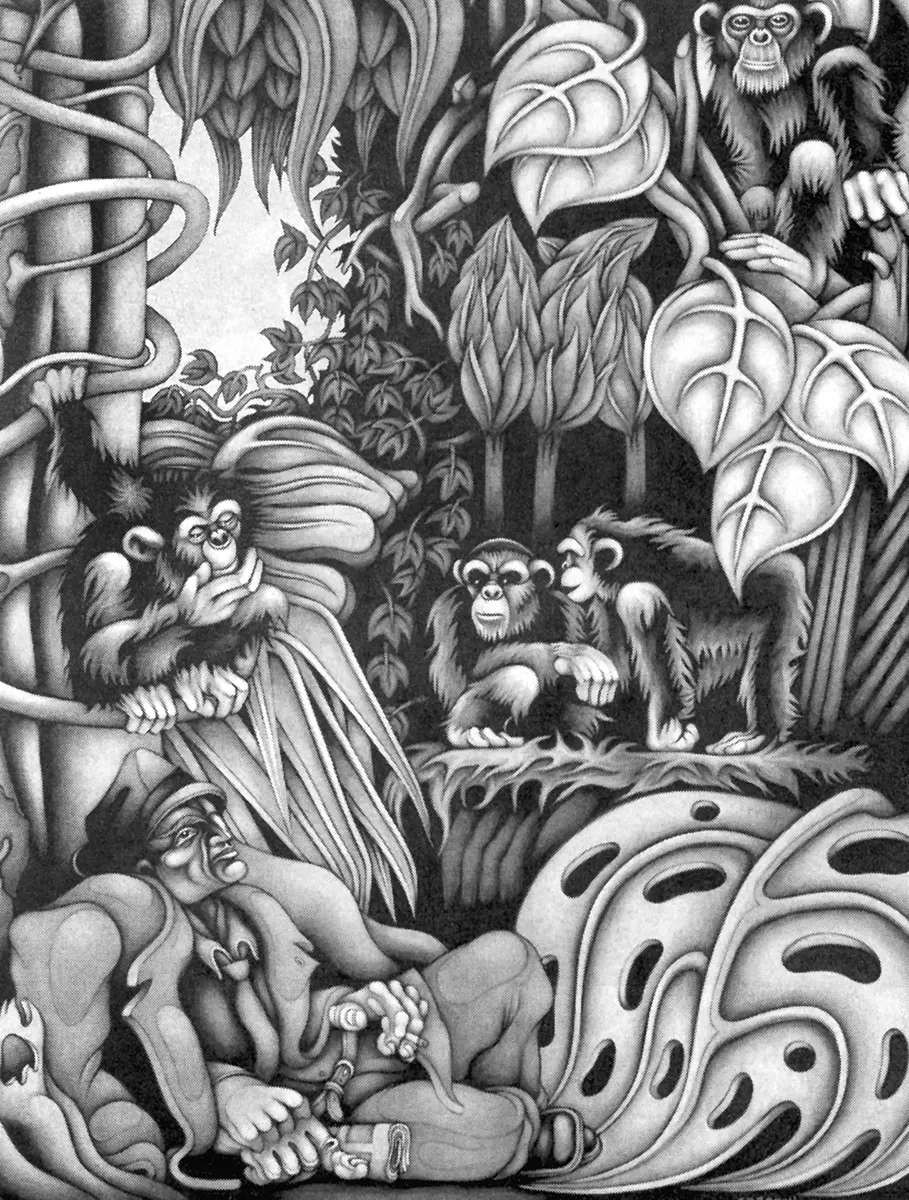
The Unemployed (1964). The same period also includes his illustrations of the epic poem Martin Fierro and the initiation of works comprising a long series entitled The Lovers, where the forms are particularly sensual. In the 1970s the color becomes more contained, perhaps because of his use of acrylic and the renewed emphasis on linework - as can be seen from the new version of Martin Fierro and the works in the Lovers series. A new feature of the 1980s was the introduction of the jungle theme as the setting for a figure from Buenos Aires. The stark works of the earlier years now give way to a baroque atmosphere which extends over the entire canvas, with dynamic forms and varied colors - as in Like the monkey, a large format diptych from 1992.