Before settling in Paris in I976, Saul Kaminer (Mexico City, I952) already knew what he was looking for: he was convinced that art would take him towards the creation of a magical world in which eroticism would be the driving force. Francisco Toledo had already marked out the path and he decided to follow his example in his own adventure. In the Art Capital of the World, Kaminer reaffirmed his roots and found a plastic language that could express his own spirit. In a reaffirmation of his Latin American identity, the young painter turned to ancestral myths, ritualistic practices and primitive beliefs. At the cradle of surrealism, he embarked on his exploration of the magical ima-gination of Latin America.
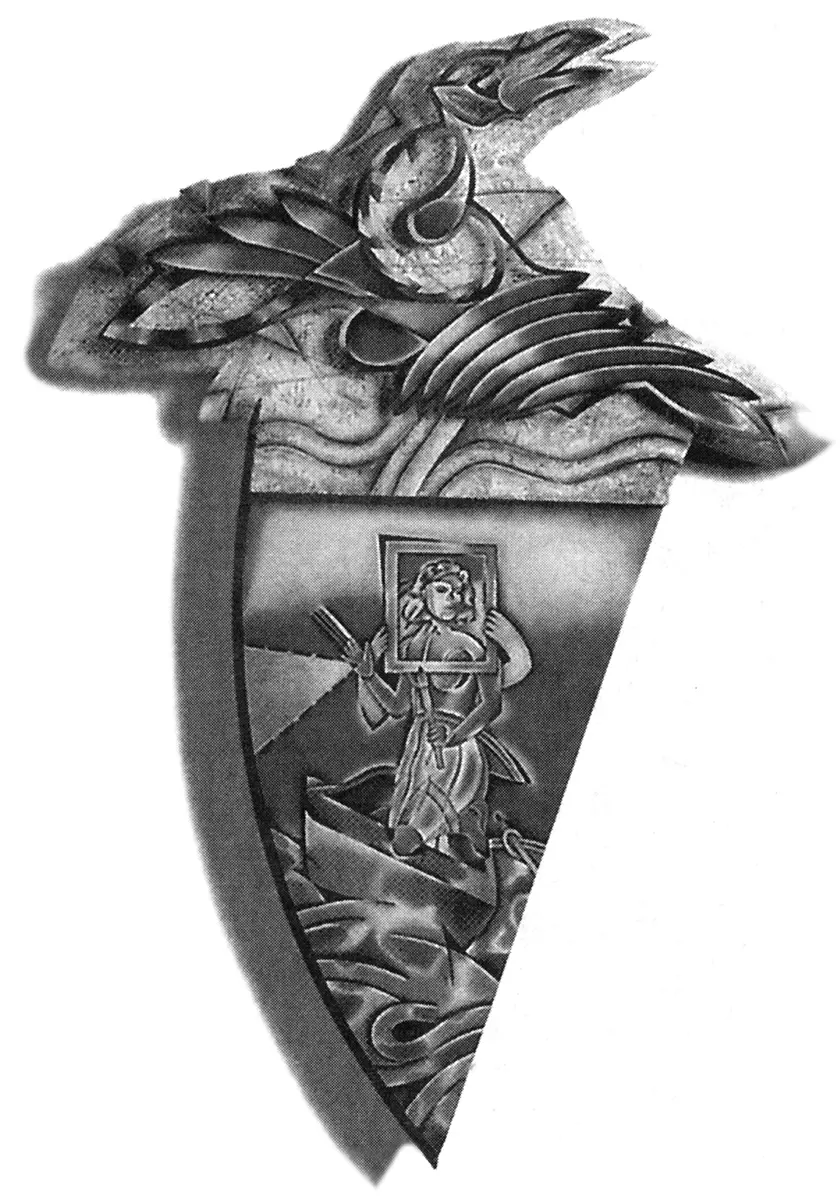
This individual experience soon became a collective one. In Paris, Kaminer met other young Latin Ameri-can painters with whom he immediately identified, since they had similar aesthetic objectives. The result was the Magie- Image group, which over a period of ten years (I982-I992) achieved some important artistic work and presented shows in the Americas and in Europe. The group finally disbanded and its members, with their increasingly individualized languages, followed their
separate paths, although the magic of their homelands remained in each of their works. In discussing the meetings of the group over this ten years, Kaminer has said: In our discussions we clearly maintained that we were not surrealists and that we were to be placed outside surrealism; that our imaginary world came from the magical imagination of Latin America, which has been nurtured in our literature. These two things are very different, because although ourima-ginary world is rooted in baroque Latin American experience, surrealism had its roots in European rationalism and ticism.(I)
This difference established by Kaminer is interesting and deserves analysis. Although they came into contact with surrealist artists in Paris, Kaminer and the other members of the group never belonged to surrealist circles and never accepted such a label becausejt never really fitted them. These artists never set out on a quest for the irrational. On the contrary, they preferred to create, in a very conscious manner, magical universes inspired by the everyday realities of their home countries.
Saul Kaminer has now made his own way and continues each day to construct his own world. His work can be set within the «magical realism» school, a concept derived from the ideas of the Cuban writer Alejo Carpentier in his novel The Kingdom of this World (\949). Carpentier spoke of the «marvellous real» to refer to the extraordinary nature of Latin American reality, both in its nature and everyday life(2). The «marvellous real» sub-sequently gave way to the concept of«magical realism®, which I believe is a more precise term and indeed has been used more frequently in definitions of the literature, and more recently, the plastic arts of Latin America.
The magical worlds, both past and present, of our continent are the key to Kaminer’s painting and entire work. In this respect, he can be compared to some of the great painters of Latin America, such as Rufino Tamayo, Wifredo Lam, Roberto Matta and Fernando de Szyszlo, artists whose universalist vocation never prevented them from reflecting the cultural heritage of their peoples in their works; artists who when confronted with the choice between «identity» o "modernity» , chose the latter, although they never abandoned the former and thus «their work bears the imprint of the land in which they were born»(2). Of all these artists, it is perhaps Lam with whom Kaminer identifies most closely. With him he shares the vision of a primitive world in which everything is possible.
Who and what inhabit this marvellous world? Kaminer’s iconographical repertoire is rich and varied: male and female figures (Adams and Eves in amorous copulation), trees, planes, horses, crocodiles, seals, birds, dogs, snakes, telephones, bulls, candles, virgins... beings and things which coexist in unusual settings, in which the action of nature (fire, rain, lightning and flashes) is present at all times. The poet and critic Alberto Blanco has already pointed out the presence of the elements - water, air, fire and earth - in Kaminer’s work(4). They are there, part of the chromatic harmony (based on earth colors) of a universe outside time, full of eroticism, humor and free from original sin.
NOTES
1) Angelica Abelleyra, Mexico envia a Europa la imagen que quiere ver, interview with Saul Kaminer, La Jornada, Mexico City, 5 July 1993, p.25.
2) Alejo Carpentier, El Reino de este Mundo, La Habana, Editorial Letras Cubanas, 1980.
3) Jorge Alberto Manrique, «ldentidad o modernidad?», in D. Bayon, et.al., America Latina en sus artes, Mexico/UNESCO/Siglo XXI Editores, 1983, p.33.
4) Alberto Blanco, La otra mitad del cielo de Saul Kaminer, in Kaminer. Las cuatro tierras, Mexico City, CNCA/Bancomer Cultural Foundation, 1994, pp.14-17. This is the book-catalogue published for the exhibition entitled The Four Earths, which was presented at in the Palace of Fine Arts in Mexico City (7 April-30 May 1994).
ANTONIO ESPINOZA