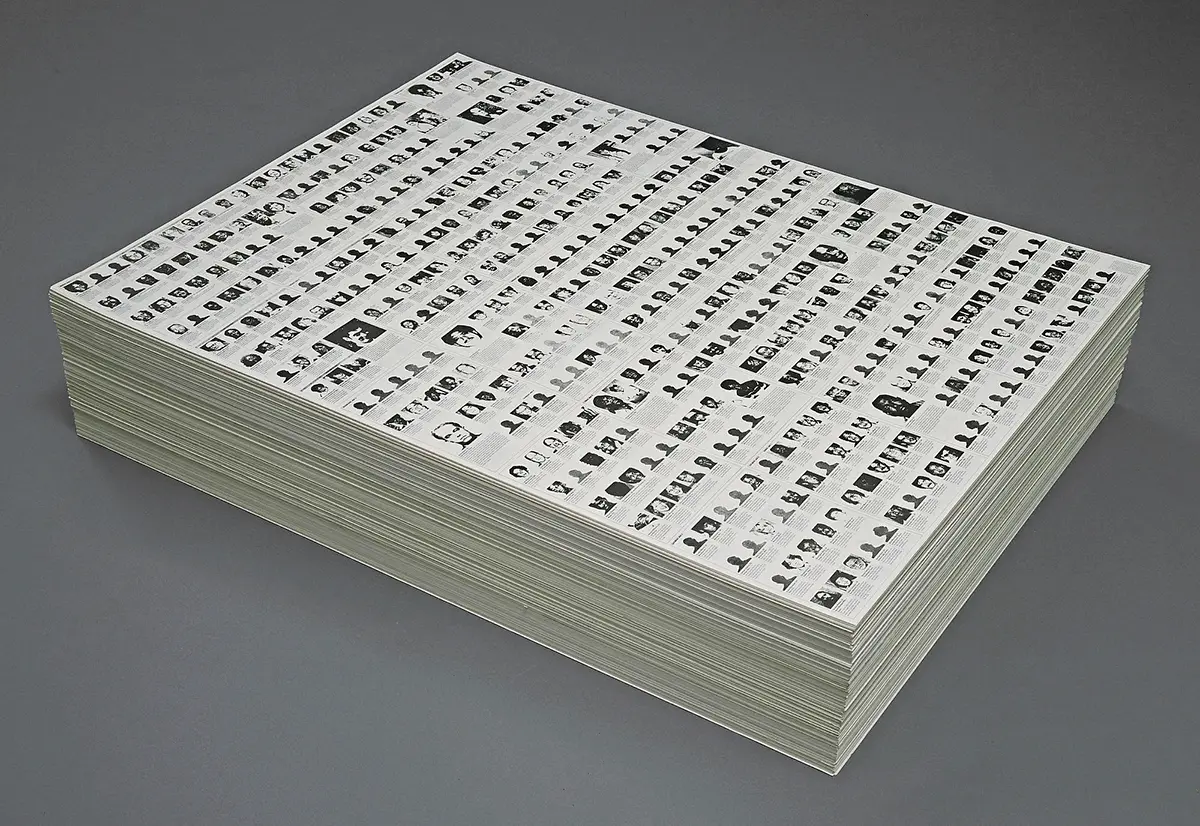
Félix González-Torres is undoubtedly one of the most successful contemporary artists in the United States. Over the last five years, his work has been presented in many of the country's major museums and has been widely shown in Europe (Germany, Austria, France, Sweden). After a small one-man show in the Projects Room of the Museum of Modern Art in New York in 1992, and shows in California, Philadelphia, Wisconsin, and elsewhere in New York, last year, he presented Traveling, the first of two retrospectives for this 37-year-old artist. The second will be at the Guggenheim in New York next February. Traveling was organized jointly by the Museum of Contemporary Art (MOCA), Los Angeles, the Hirshhorn Museum and Sculpture Garden, Washington, and the Renaissance Society at the University of Chicago. The show varied considerably from place to place, responding in part to the needs and conditions of each venue, but mainly as a result of the fluidity characteristic of the work of González-Torres, for whom Traveling not only means visiting and then leaving a place, but changing and sharing. One of the most outstanding features of his work is precisely that state of contingency that points towards events, rather than "works of art" in the Modernist sense of the concept. The stacks of posters, offset prints on paper, which he has been developing since 1988, encompass many of his cultural concerns and display his conception of art as a process rather than an object. These works consist of enormous quantities of individual sheets of paper which at first seem to be solid forms, but which on closer inspection can be recognized as huge accumulations of paper: they seemed rigid due to their careful arrangement exact accumulation, but infinitely fragile when we realize that we are being invited—in a museum, where we have traditionally been told to look, but not to touch—to tear off the top sheet and take it home. The images reproduced on the sheets vary from work to work, but taken individually, each reproduces the same image endlessly. Possessing the work means assuming responsibility for replacing the sheets that visitors to the show take home. In a subtle act of subversion, the artist "gives" us his work subsidized by the Museum or the collector. In this way, he meets the challenge of massive reproduction and transgresses the idea of the work of art as an organic whole.
The idea of a fragment is essential to the understanding of these processes. But not a fragment as part of something, but as a constitutive element which potentially has particular characteristics and which may acquire its own meaning. Thus, each sheet of paper that the spectator takes and recontextualizes according to his own desires and situation articulates new meanings that develop on the way between the museum or the gallery and his apartment, office, bedroom, bathroom, etc. It is precisely when I, as the "interlocutor" of the work, take a sheet of paper from the pile and transform it into a poster which I place above my bed, that a series of meanings, over which neither the artist norther museum has any control, is set in motion.
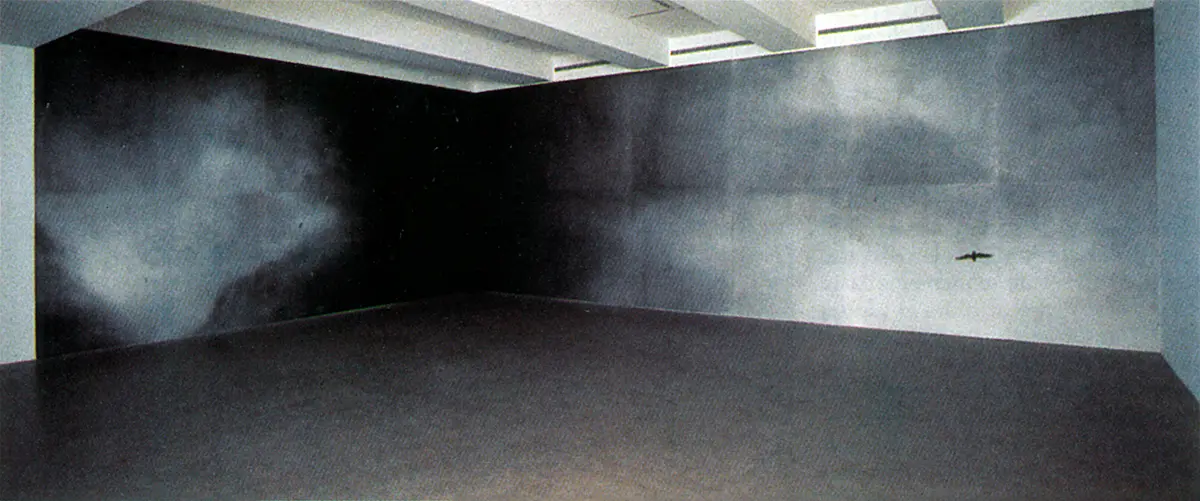
Transgressing the concept of control and promoting conditions that encourage participatory freedom in the symbolic construction of a work are essential features of González-Torres' art. At the structural and formal as well as thematic and conceptual levels, the piles of paper sheets and many other works give thematic expression to the concept of freedom in a very direct manner. Using black and white photographs of clouds, the ocean, the sky over which lone seagulls fly, the artist reproduces fragments of these canonical romantic images of the sublime and, through one of the most conventional reproduction techniques, offset printing, transfers them to his stacks of paper, to immense boards covering walls or commercial billboards scattered throughout the city. But the photographs which provide the basis for these works destabilize the referents, since incommensurate totalities such as the sea or the sky are set within material conditions which deny the illusion created by the horizon by perspective or by a brilliant blue color, techniques which are highly appreciated in oil painting. In this way, the artist deploys a changing displacement of emphasis: he reduces the representative illusion of the object and shares his creative capacity with the spectator. It is no longer the artist with his expensive materials and his finished and framed works who is constructing the meaning of the work, but the artist using everyday techniques who challenges the imagination of the spectator. This spectator more than contemplates, engages in an active process of production of meanings which emerges in the presence of the object but which is recreated each day through interaction with the sheet of paper, a fragment of cloud or sea. Other stacks of paper refer to more political and social themes, such as crime, censorship, information, and the ideological impositions of modern society. In Untitled (1989-1990) at the Hirshhorn Museum, two piles of paper, arranged side by side, reproduced two different sentences: "Somewhere better than this place" and "Nowhere better than this place." The spectator is free to choose one condition or the other and to give the sentence a personal interpretation. At the same time, by having two options, the spectator recreates a third possibility, an imaginary space, which is neither here nor there, where "better" has no fixed meaning, where it is something relative and contingent. How many times have we not said to ourselves: "Sometimes it is better here, and sometimes there." The possibility of synchronizing time and space, in the form of a teleology in which "better" is the goal, is interrupted by a polarity of space (here or there) devoid of temporal linearity.
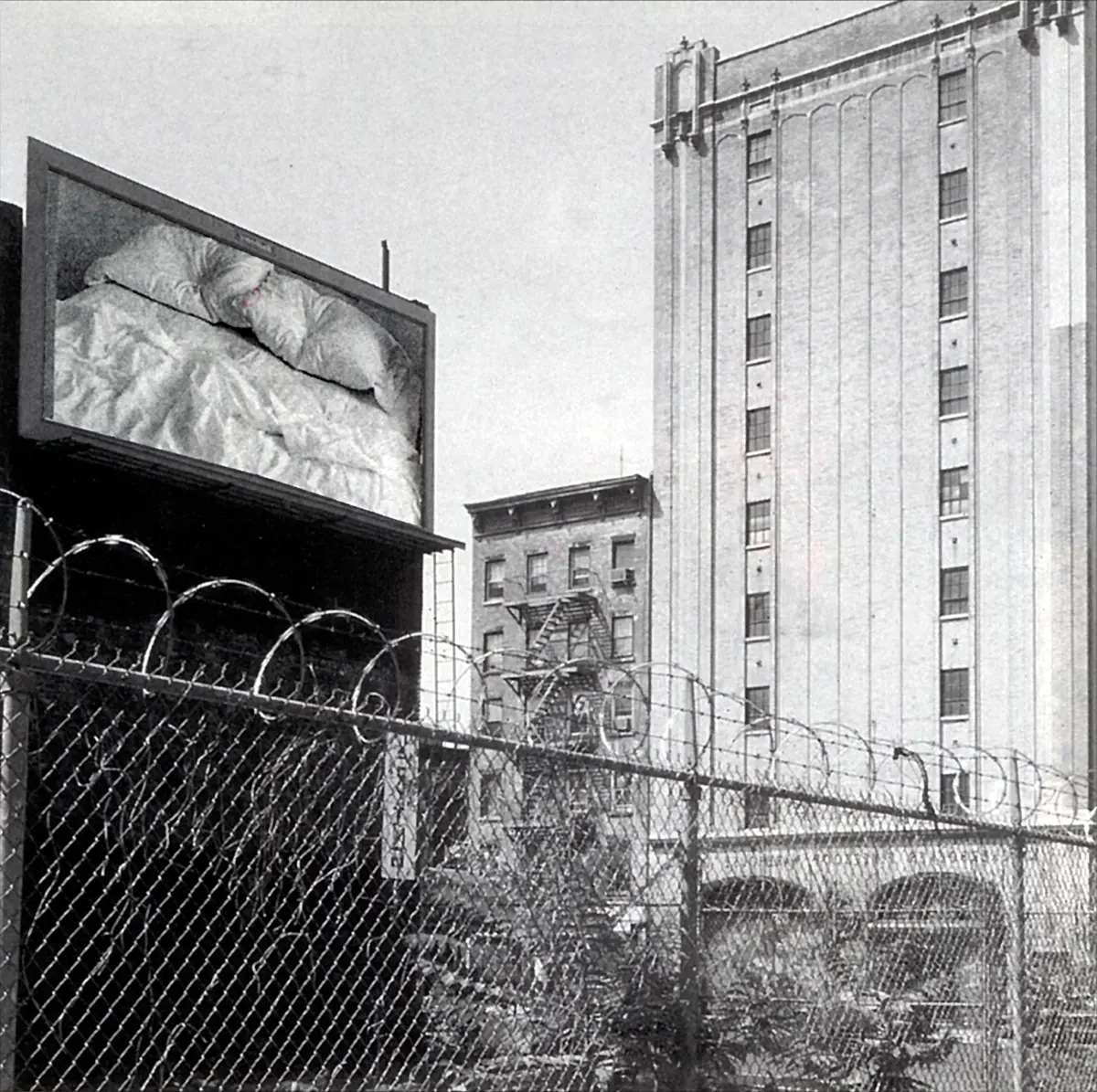
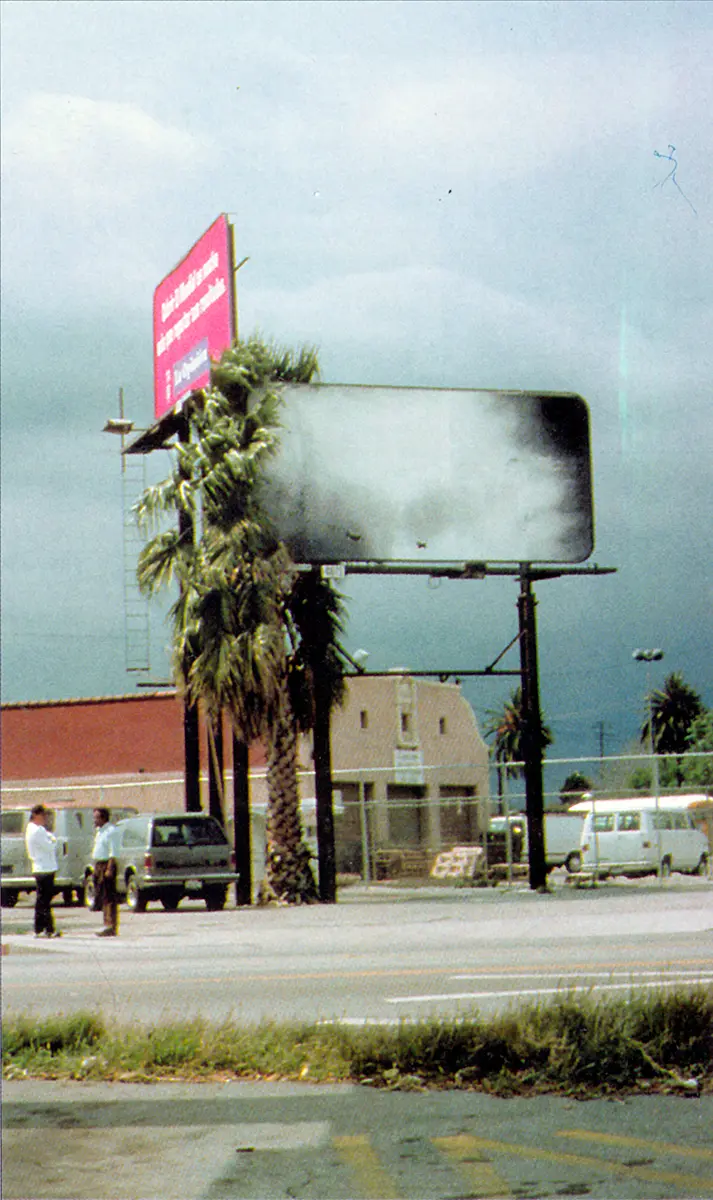
The creation of indefinite spaces, which reject the possibility of absolutes, is one of the best-explored features of Torres-González's work, and certainly the motto of the exhibition. Traveling alludes explicitly to this space between waters, between waters, lands, and skies, where we at times suspend our sense of precise location and find ourselves neither here nor there. In one of the rooms at the Hirshhorn, two billboards covered the back wall. A huge photograph of a sky cut by the flight of a couple of lone seagulls invaded the dimly lit space. A similar motif was used on eight billboards during the show's presentation in Los Angeles. In Chicago, Passport No. 2 (1993) recreated the same cloudy sky, with several seagulls: the work consisted of several piles of little notebooks that imitated the form of a passport, which the visitor could take away with him/her. A passport is a document that regulates our entry and exit from places, which legalizes our visits, limits our horizons, and records our travels. But the substitution of the "passport" sheets by photographs of cloudy skies with seagulls flying aimlessly subverts the meaning of the document and suggests other journeys, those of the imagination, pleasure, and desire, of the body and the mind that cross frontiers without traveling geographical distances. As Victor Turner said in another context, between ordered worlds almost anything can happen, in the interim space between thresholds and frontiers, there exists the possibility of situating oneself outside, not only of one's social, political and cultural position, but outside of all collective positions through which we form part of the historical narrative and of the formulating potentially unlimited series of alternative social arrangements.1 Through the symbolic actions of everyday life, within the periphery of everyday life, we free ourselves from restrictions and deploy the creative imagination through the use of multifaceted metaphors.
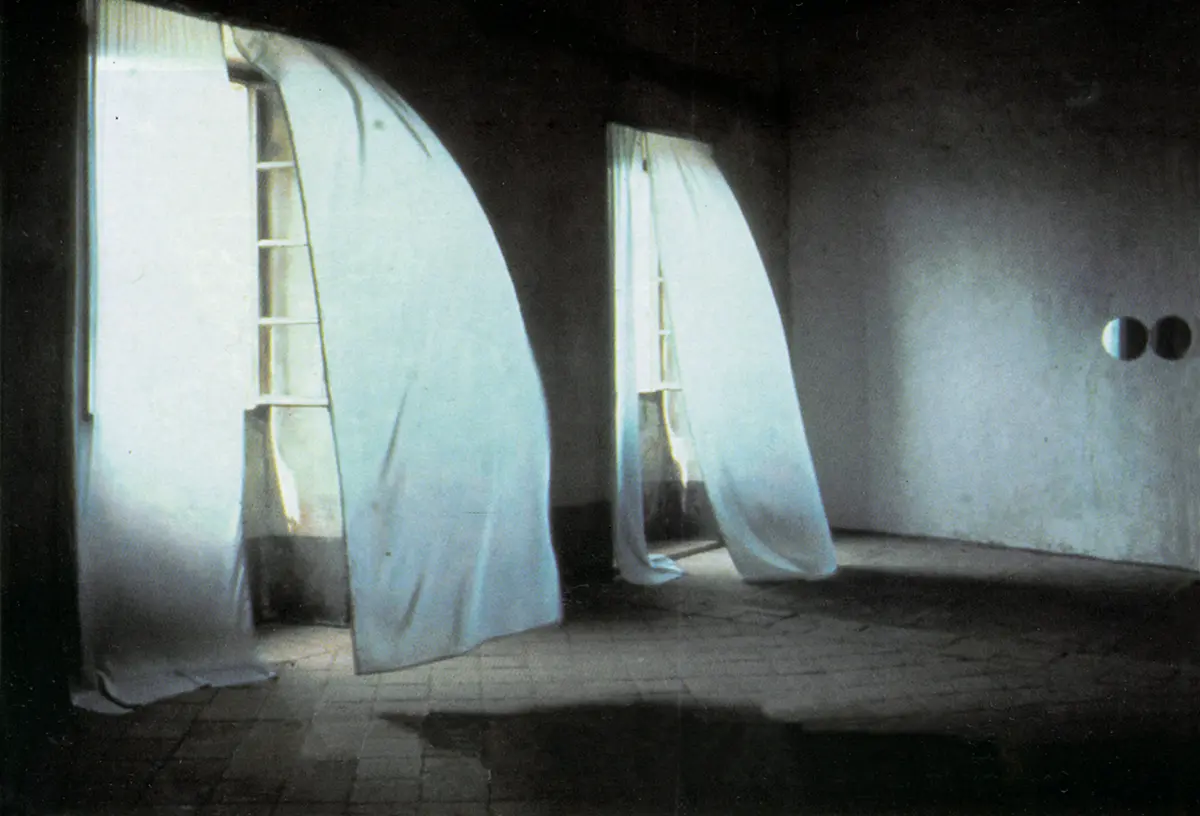
The unleashing of the creative imagination is at the heart of González-Torres' artistic proposal. Memory and personal experience have often been used as the basis for works of art. However, at the level of the reception of a work, memory functions, as I see it, mainly as a basis for articulating a series of references which in turn stimulate the imagination of the spectator. I am thinking, for example, of the piece Untitled (Blue Curtains) (1991), at the Renaissance Society, where the wind entering through the gallery windows blows the curtains and seems to evoke those fleeting moments which make us recall "something" and which project our mind back to the memory (past), mixing with our imagination (present-future). In this way, the artist suspends fixed meanings that explain his work, which thus acquires a multivalued dimension where each spectator constructs their own meaning. Using the model proposed by Paul Ricoeur whereby the imagination restructures semantic fields, we might say that the work is a kind of schema generating itself images. "By schematizing the metaphorical predication, the imagination irradiates in all directions, rekindling previous experiences, stirring latent memories, expanding towards adjacent sensory fields."2 It is this reverberative quality that the artist explores in the "everyday" actions that characterize the work of González-Torres and connect his experience to ours.
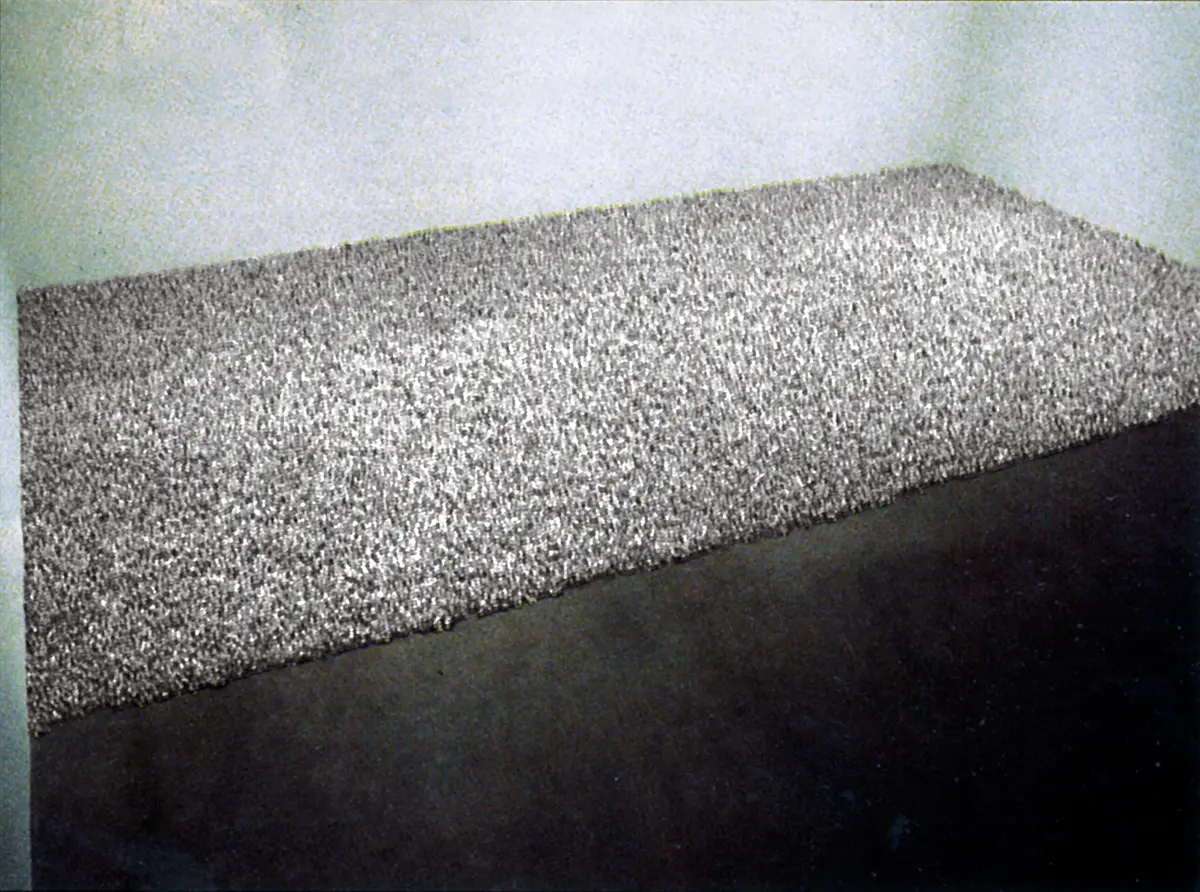
Another series of works, the candy pieces, which Torres-González has been doing since 1990, also appeals to our senses of taste, touch, and sight. These works consist of enormous quantities of candies, which, like the piles of paper or passports, can be consumed by the spectator without any fear that the work will disappear, since it will be replenished. It is in works such as Untitled (Placebo) (1991), made up of 1,500 pounds of candy wrapped in silver paper, presented at the Hirshhorn with abundant light, that the artist's politics of pleasure become explicitly thematized. Upon entering the room, we find ourselves in front of a shining silver surface which immediately catches our attention. As we move towards this mass of light, we discover the tiny wrappings which we soon identify as candy wrappers, and it is very difficult not to smile. The desire becomes more intense as we plunge our hands into the enormous carpet of candies and become conscious of the pleasure of abundance. The effect is a pure delight for the senses: for the eyes, with the interplay of light on the luminous silver paper and the reflections from the intense room lights; for the sense of touch, by infinite contact with the work, which we cannot possess in its entirety even though we are allowed to "touch"; and for the palate, as we eat the sweets. This series of works, more than any other by the artist, denounces the simple consumption of images by involving the body directly in the pleasure of something specific. To some extent, they encompass the concept of jouissance (enjoyment) developed by Barthes in The Pleasure of the Text, where, as Frederic Jameson has pointed out, the dominant ideology of the sentence and the institution is undermined. The merit of Barthes' essay, according to Jameson, lies in the fact that it restores some politically symbolic value to the experience of jouissance: he taught us to read our bodies, and to write with them too. "The libidinal body, as a field and instrument of perception all at once, cannot but be self-indulgent... To discipline it, to give it the proper tasks and ask it to repress its other random impulse, is at once to limit its effectiveness, or even worse, to damage it irretrievably."3 In the work of González-Torres, the concept of pleasure in direct relation to the body acquires particular relevance. As a homosexual artist, González-Torres knows of the limitations and censorships that our society imposes on the sexual act, impositions which try to regulate and control the freedom of the body in its response to the senses. By inviting us to taste a candy in public, in the presence of other visitors, he legitimizes the pleasure of touch and taste within the institutional context of the museum, in a society where taking what we want and tasting a calorieladen candy is something to be shunned. These works remind us that pleasure is finally "the acceptance of life in the body, the reconciliation, albeit momentary, with the need for physical existence in a physical world."4
There is no doubt that González-Torres's work privileges the spectator's participation in its symbolic construction over other considerations. More than a spectator, the visitor enters into a dialogue with each work. Most of the artist's production is untitled, although a word in parentheses suggests meanings related to the artist's own experience, always open and multifaceted. Communication is another of the key elements in González-Torres' artistic proposal. The word portraits are a fine illustration of this aspect of his work, activating the spectator's memory and establishing a communication in which the artist and the spectator exchange roles in the construction of contingent narratives, where there is no absolute truth, but a truth which depends on the "specific sites of enunciation" in which we find ourselves. These works, done on billboards or walls, list public events of a historical kind and private events of a private kind, as well as their respective dates. The enumeration lacks any chronological or spatial order, and the works transgress any kind of linear or narrative logic. In this way, the artist invites the spectator to create his own history with regard to the events listed, a history determined and shaped by the personality of the spectator who thus makes a personal reading of the public and collective events proposed by the artist. By linking a historical moment to the memories of it, which we all have, the narrative becomes a story rather than History. In one of the rooms at the Hirshhorn, on the upper part of a wall, visitors could read, as they went slowly around the room, the words: Red Change 1987/Paris 1985/ President Clinton 1992/Supreme Court 1986/Blue Lake 1986/Güaimare 1957/ Ross 1983/Civil Rights Act 1964/Mariel Boatlifts 1980/White Shirt 1984/An Easy Death 1991 /CNN 1980/Black Monday 1987/Berlin Wall 1989/Great Society 1964/Hollywood 1915/UN 1945/Ver 1978/Dad 1991/Bay of Pigs 1961... The artist intersects the public sphere of a historical event with a private and personal event: a meaningful encounter with his companion Ross in 1983, his death from AIDS in 1991, the relevance of a white T-shirt in 1984, etc. In turn, both spheres intersect with the imagination and memories of the visitor, who recreates a history different from that of the artist. This indiscriminate intersection of public and private domains, enunciators and receptors, subverts the Western myth of self-sufficient subjectivity: we are historical and cultural products as well as individuals with a human and flexible nature. Paul Ricoeur observes that the possibility of historical experience lies in the connection between my temporal sphere and other temporal spheres. These connections are regulated by categories of common action and by the principle of analogy, which allows me to relate to others and allows me to say that the other is a being like myself. However, when these connections become ossified and institutionalized, we lapse into "simplifications, schematizations, and stereotypes" and into the hands of discursive powers which frame our perceptions; it is, therefore, the role of the productive imagination to preserve and identify the self and activate memory in the process of the formation of cultural identity.5
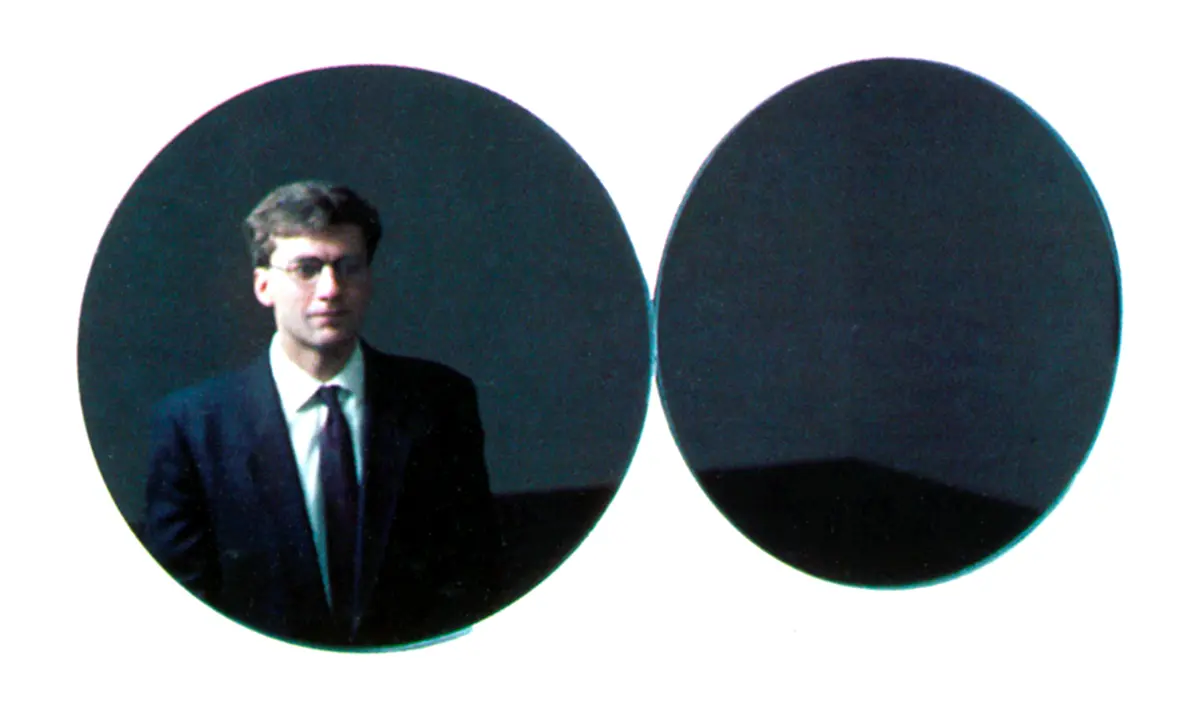
The need for participation for the work to achieve its full effect is the structural thread that connects these word portraits with other works of a more visual nature. Untitled (5 March) No.1 (1991) is made up of two round mirrors into which the spectator is irremediably projected when he looks at the work. It is thus our face which fills the space of representation, the space of the work of art which traditionally depicts something. Along with this work, in one of the rooms at the Hirschhorn, a pile of paper makes two circles reflecting the mirrors placed on the wall. Curiously, this work was called Untitled (Double Portrait) (1991), although, because of the opaqueness of the paper, we could not recognize ourselves. Confronting the work, in this case, means confronting the impossibility of representation. The intertextuality which is established between one work and another refers to the illusory quality of representation and the contingency of the works in relation to the place of the subject who believes that it "produces the world by producing its representation." In this sense, Gonzalez-Torres' work, always dispersed, fragmentary, partial, undefinable, and contingent, points towards what Jean-François Lyotard has called the postmodern sublime. In opposition to the concept of sublimity advocated by Romanticism, the postmodern has abandoned nostalgia to engage in the sublime game of searching for new representations.6 "The postmodern—writes Lyotard—would be that which in the modern invokes the unpresentable in presentation itself, that which refuses the consolidation of correct forms, refuses the consensus of taste permitting a common experience of nostalgia for the impossible and inquiries into new presentations, not to take pleasure in them, but to better produce the feeling that there is something impresentable" (7) From a new perspective, the idea of sublimity problematizes the possibility of representation which is produced within specific limits (according to the subject's position) and is always contingent. In its normal sense, sublimity occurs when the imagination cannot provide a representation that matches the concept. However, in the work of González-Torres, there is no attempt at finding an image for the concept. On the contrary, each of his images is an allusion that does not claim veracity or identification between idea and image, but rather delights in the free interplay of suggesting multiple meanings. At the center of González-Torres' artistic project lies a strong critique of representation as the product of official narratives and institutionalized images. Veracity and univocity have been replaced in his work by communicational processes where the meaning of an image is constructed in a participatory dialogue.
NOTES
1. V. Turner, Drumus, Fields and Metaphors: Symbolic Action in Human Society, Cornell University Press, Ithaca and London, 1974, pp.13-14.
2. P. Ricoeur, ‘Imagination in Discourse and in Action”, in Rethinking Imagination. Culture and Creativity, G. Robinson and J. Rundell (eds.), London and New York, 1994, pp.122-123.
3. F. Jameson, “Pleasure: A political issue”, in V. Burgin (ed.), Formations of Pleasure, London, 1983, pp.5-9.
4. Idem, p.10.
5. P. Ricoeur, op cit., pp.127-128.
6. D. Roberts, ‘Sublime Theories: Reason and Imagination in Modernity', in G. Robinson and J. Rundell, op.cit., pp.175-176.
7. J.-F. Lyotard, The Postmodern Explained, University of Minnesota Press, Minneapolis and London, 1992, p.15.
MÓNICA AMOR