"Everything is gonna be alright" —Bob Marley
The history of art has, to a large extent, been a Eurocentric story. It is a construction “made in the West” which excludes, diminishes, decontextualizes and banishes to bantustans a good part of the aesthetic and symbolic production of the world. It is becoming increasingly urgent—especially for Latin Americans—to deconstruct it in search of more decentralized, integrative, contextualized, and multidisciplinary discourses, based on dialogue, hybridization, and transformation, open to an intercultural understanding of the functions, meanings, and aesthetics of that production and its processes. Some time ago, Etiemble invalidated “any theory which is based exclusively on European phenomena,”1 and his remark has a tinge of urgency in our field.
This article follows the above guidelines. It tries to interpret the work of Wifredo Lam from Africa in the Americas. Since Lam was a paradigmatic artist of Latin American Modernism, such an analysis could be extended to a reading of Modern art in Latin America from Latin America.
I want to look at the work of this Cuban painter less as a product of Surrealism or in terms of the presence of “primitive”. African or Afro-American elements in Modern art, rather than as a result of Cuban and Caribbean culture, and as a pioneering contribution to the role of the Third World in the contemporary world.2 It is a change of viewpoint rather than a different reading. Lam's cultural sources have been fully recognized, although they have always been subordinated to Western avant-garde art; they have never been examined from the point of view of their own effect on that art, in terms of their own particular construction of contemporary “high” culture. The displacement to which I am referring means, for example, that the emphasis would no longer be placed on the intervention of these cultural elements in Surrealism; rather, this movement would be seen as a space in which those elements are given expression outside their traditional sphere, transformed into agents of the avant-garde culture by themselves. This is what Lam must have meant when he said that he was a “Trojan horse."3
This change of perspective does not correspond to a binary displacement. On the contrary, it implies recognition of Western culture as characteristic of the world today, through the global expansion of industrial capitalism, which for the first time integrated the world into a global system centered in Europe.4 Many elements of this culture have ceased to be “ethnic” and have become internationalized as intrinsic components of a world shaped by the development of the West. Art itself, as a self-sufficient activity based on aesthetics, is also a product of Western culture exported to the rest of the world. Its complete definition, moreover, was given only at the end of the eighteenth century. The traditional art of other cultures, as well as that of Western forms from other epochs, was a different production, determined by functions of a religious, representational, or commemorative nature. The current art of such cultures is not the result of an evolution in traditional art: the concept itself was inherited from the West through colonialism.
This new approach to Lam does not imply non-recognition of his academic training, the influence of Picasso and Surrealism, or mean that we no longer consider him as a participant of the Modern movement. He himself once surprised me during an interview when he showed me a picture of his, which was clearly African in appearance, and commented: “You need to have seen a lot of Poussin to do this!” Although the tension of “who devours whom?” is more or less implicit in any intercultural relationship, its processes, even in a relationship based on domination, are, in fact, those of give and take, as Fernando Ortíz has said. The active role of the receiver of foreign elements, who selects and adapts them to new ends, was resolved a long time ago in anthropology by Boas, Lowie, Kroeber, and Herskovits, amongst others. Curiously enough, almost simultaneously, the Brazilian Modernists had proposed as a program the selective “cannibalism” of difference5. It was a difficult enterprise -heralding postmodernism—since it was not carried out in a neutral context but in one of domination, with a praxis which tactically assumes the contradictions of dependency and postcolonial deformations.
The difficulties are many. The reverse of exclusion and silence is tokenization. The centers6 have an enormous capacity for reifying dissidence. Even though Postmodernity introduces a heterogeneous diversification in the center-periphery, hegemony-subordination oppositions, it was imposed and controlled by the center, reproducing its domination. The center, disguised as relativism, “threatens to supplant the periphery in its alternative role”, as Richard7 has pointed out, and to deprive it of oppositional force by integration. The Postmodern interest in otherness is, once again, Eurocentric, a move from the dominator towards the dominated: The Other is always Us. The danger arises that we may deliberately make ourselves “other” in an attempt to satisfy the Western neo-exoticism of difference. In all events, the subordinate cultures must exploit for themselves the possibilities offered by this new situation and the rhetoric of decentralization. One of the unavoidable challenges, more postcolonial than Postmodern, is the transformation to their advantage of the dominant culture, de-euro-centralizing it without depriving it of its capability for contemporary action.
Despite the prevailing structures of domination, the breakdown of totalization which this implies may be, as Kapur suggests, a consequence rather than a description of “a realigned universe” by the praxis of societies hither—to totally displaced.8 This praxis does not consist in a return to a past which predates the globalization brought about by Western expansion, but of the construction of contemporary culture—the ability to act hic et nunc—from a plurality of perspectives.
The intercultural dialogue implicit in Lam's work is an example of the advantageous use of “ontological” diversity in the ethnogenesis of the new Latin American nationalities, of which the Caribbean is paradigmatic.9 Born as a result of creole-oriented, hybridizing processes, they are part of the central Western trunk, although they are also modulated from within by very active non-Western ingredients. European culture lies at its origins and is not something foreign, as it might be in Africa or Asia, divided as it is between its old traditional culture and that imposed by colonialism. Lam could paint in the academic, Cubist, or Surrealistic style within a familiar tradition, even as “second mark.” His contribution was to make a qualitative turn and base his art on those elements of African heritage which are still alive in Cuban culture. To some extent, his work reproduces the plurality characteristic of the Caribbean, centering it on the African component, which determines the profile of the region. He constructs identity by assuming what is diverse from the non-Western angle, providing a rich response to the endemic problems of identity in Latin America, so often lost between Euro-North American mimesis, repudiation of the West, the utopia of a “cosmic race”, or the nihilism of finding itself in the midst of chaos.
This turn in the interpretation of Lam is a response to a new orientation of the discourse of action which is taking place from the periphery towards the center, in which the former ceases to be a reservoir of tradition, leading to a multifocal, multi-ethnic decentralization of “international” culture, along with the strengthening of local developments.10 These processes encourage the dismantling of the history of art as a totalizing and teleological paradigm of Western art, the need for which I noted earlier.
It is surprising that art critics and historians have not seen Wifredo Lam as the first artist to offer an overall vision of the African element in the Americas in the history of gallery art. This fact was an undeniable landmark in art and was the essential achievement of Lam, much more important than what may have been his "Americanist" renovation of Surrealism, Cubism, abstract Expressionism,11 or Modernism in general.
Furthermore, what Lam did for Modernism was to provide it with a new range of meanings, multiplying its scope and using it to turn its perspective within itself, without contradicting it but rather appropriating it, recycling, adapting, resemanticizing. In this sense, he too was the forerunner of the heterodox challenge against Western monism, through readjustment rather than rejection, which is now spontaneously developing along the periphery.
If the Africans participated in the integration of the Caribbean cultures, many expressions of the latter, although not related to African traditions or themes, nor directly in contact with the popular sectors dominated by Blacks and their customs, may have some African chromosome encompassing particular features and tastes which helped determine the particular Caribbean identity. This term, beyond its purely geographical sense, has in practice extended southwards and towards the Pacific to refer to the internal presence in the culture of decisive elements of African origin.
In “cultured” art, we can see, from modern times onwards, certain rhythms, colors, lines, accents, and structures frequent in those works whose Caribbean character is strongly evident. It is very possible that the African origin has played a very active role in the emergence of these features, not so much in stylistic terms, but as the substantial presence of African cultural elements at the heart of their structure. Less in terms of the development of any material expression of such a culture, than through a Promethean intervention of its conscience—that is, through the direct intervention of the spiritual culture of Africa—with its world views, values, orientations, modes of thought and customs—in the ethnogenesis of the Caribbean and, by extension, in the forms in which the new culture is identified and recognized.
Wifredo Lam was the first artist in whom the presence of African culture appears in its own right as a decisive factor of expression. This was the result of a complex process. The son of a Chinese immigrant and a mulatta, Lam grew up in Segua la Grande, where his mother's family, native to that region, must have had a strong influence on his development. His godmother was a priestess in the chapter of Santa Barbara (Changó), which still exists in the town, located in a region with a strong Afro-Cuban tradition. Although Lam was not initiated into santería, he did grow up in contact with it and in an environment marked by African traditions.12 Even if this had not been the case, the African element, to a larger or lesser extent, is present throughout the Caribbean: it is an essential feature of its culture, and the Afro-Cuban tradition is familiar to everyone.
When Lam left Cuba in 1923, he was not seeking the Paris of the avant-garde movement, but the Spain of the Academy. There, he acquired a classical training and earned his living with portraits. Towards the end of the 1920's, he produced some works within the mainstream of Spanish Surrealism, finged with academicism. In Paris, when he arrived in 1938 because of the war, he consolidated himself as a late modernist, with the support of Picasso. His painting from 1938 to 1940,13 although based to a large extent on African masks and geometry, was reminiscent of the style of the artist from Málaga and, in general, of the School of Paris: as a formal resource in the first place, within a “brew” already developed by the latter, an epigonal language made up of a combination of ingredients (synthetic Cubism, Matisse, Klee, etc.). At that time, he also began to develop a passion for the traditional art of Africa and of other “primitive” peoples, although it has been said that this interest was already present in Spain, without having at that time any influence on his work. It was such an important discovery for Lam that he became a permanent collector of such pieces.
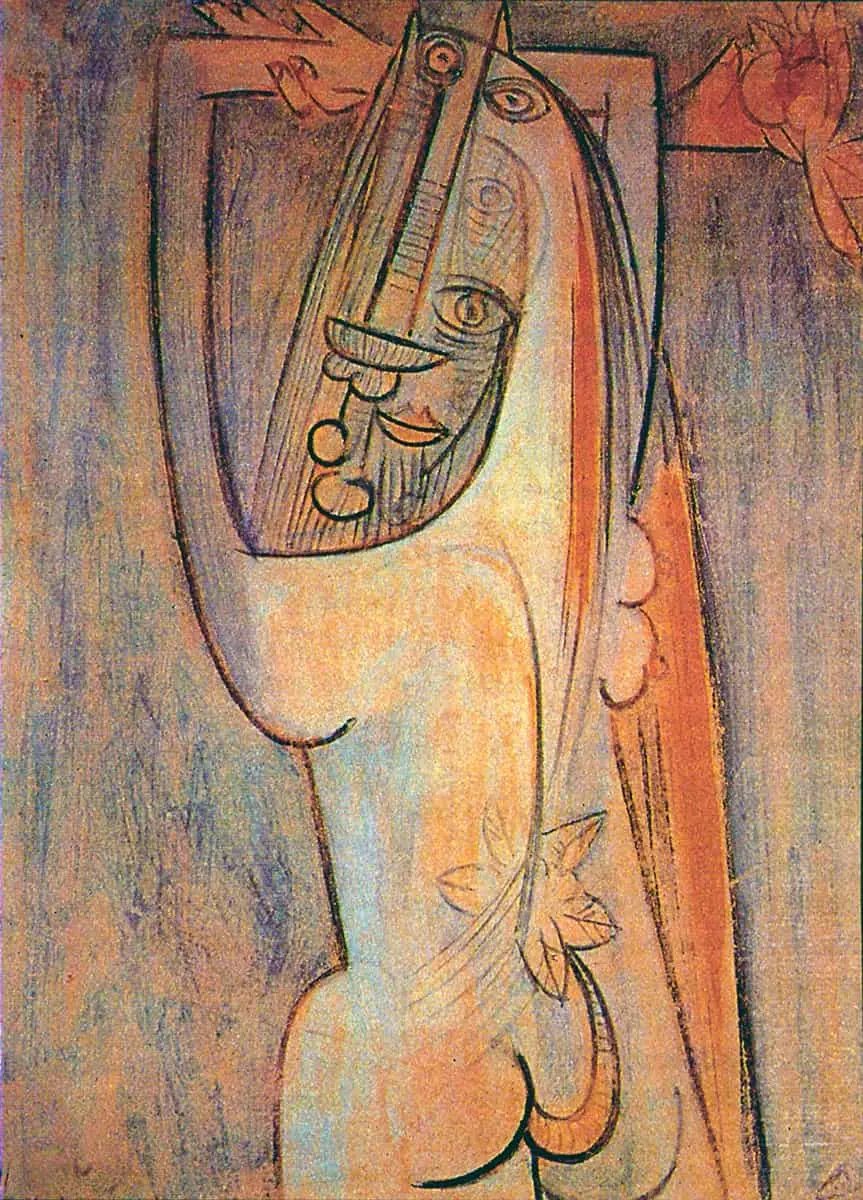
In discussions on the Picasso-Lam intertextuality, the emphasis is usually placed on the tum of the century “black” Picasso, to the detriment of pictures of the beach at Dinard (very different, considered as his most Surrealist works), and a number of oil works and drawings from 1937-1938, that is, one of the lines along which he was working when he met the Cuban. It is symptomatic that the features which most attracted Lam to Picasso would subsequently become, after “mixing”, decisive in his own painting: the African element and deformation as fable-making. Picasso was interested in African art in terms of geometry, as a constructive synthesis of the human image. His most Expressionist or fable-like works were based less directly on African geometry, colder and more abstract-oriented. In Lam, there emerged a kind of link between both elements, a process which was to lead to his own personal kind of expression. It occurred in France, in works dating from 1940, such as Portrait, Homme-Femme, and Symbiosis—the last two titles are significant in terms of what the works intend to communicate: the unity of existence, as we shall see below—and in 1941, such as his illustrative drawings for Breton's Fata Morgana. In these works, the poetics that was to characterize him forth is already apparent. This evolution was undoubtedly connected to his relationship with the Surrealists and their fascination with tribal cultures, although Lam, a loner due to his heterodox background, with its different worlds and poetics, never actually joined the movement. Nevertheless, he began to employ features valued by the Surrealistic visual imagery, such as double eyes, and adopted the pictorial figuration of Julio González, which was to become the basis of his own figuration. He tended to present mythological, fantastic, and yet more carnal figures than his earlier schematized characters from Afro-Cuban geometry. He was interested in the African mask less as a lesson in synthesis—its morphological teaching—and more as an inventive exploit for shaping the supernatural—its mytho-poetical and expressive teaching. Unlike other religious forms of representation, the mask does not simply embody the sacred: it must personify it, make it a moving presence, a physical entity which can be seen and felt. Lezama Lima said that “the mask is the permanence of the supernatural order in the transitory.14 It depicts the supernatural as something natural; it makes real what is wonderous.15 Its design has required enormous amounts of imagination, striving towards the personification of this fantastic actor.
At the time of his arrival in Cuba, Lam seems to have moved towards his final poetics amid many and numerous displacements. The cultural mood introduced by Surrealism had encouraged him to express his own world, the world of his culture, in an exercise of Modernity. His arrival in Cuba marked his encounter with that world in reality, and its overflowing into painting. This arrival did not produce any sense of astonishment at the tropics, but a feeling of belonging.
It was the confirmation of and final encounter with his own space. It was a “return to the homeland”, in the sense of the poem by Césaire Clifford has remarked: “perhaps there's no return for anyone to a native land—only field notes for its reinvention.”16 The work of the Cuban artist is henceforth an achievement which can be seen in this perspective, related to negritude as a conscious and neology of a black paradigm. On the island, the painter rediscovers his cultural universe as a personal artistic universe. The return occurred at the right moment, at a time when he was prepared to do it, given the evolution of his interests. It was a fruitful connection at the right time. Fascinated by African and “primitive” elements thanks to Modern art, he had begun to give outward expression to “African” and “primitive” aspects of himself. This process was defined through his direct contact with Afro-Cuban traditions, in which “Surrealism” was something usual and customary. In Cuba, as Ortiz writes, "the afroid world is in Lam and in all his environment"17 it is not a diffuse feeling, a dream, a sense of longing, or something in a museum. The Cuban folklore specialist Lydia Cabrera played a central role in this process when she helped familiarize Lam with the myths, liturgies, and representations of that world. Lam was also affected by the light and nature. He had come, as Carpentier said, from a “fixed” world to another kind of world, one of symbiosis, metamorphosis, confusion, vegetable and telluric transformations.18 But once again, I should like to emphasize that the key to all these discoveries lies in the fact that it was a recognition of the “Caribbean man”, by someone trained as a Modernist in Europe, without contradictions and giving expression to the various facets implicit in this new experience.
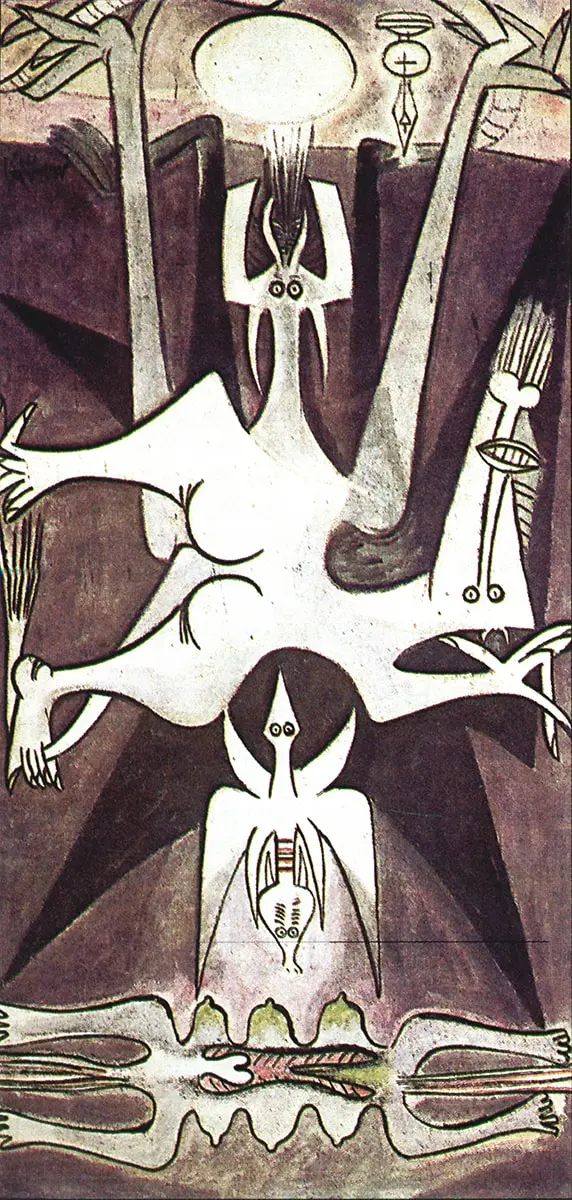
From 1942—when he returned to Cuba—his works became the vehicle for his own and definitive kind of expression, the first vision ever of Modern art from the standpoint of Africa within Latin America. There were formal changes in these works, with the prevalence of a figuration which, although indebted to Cubism, distanced itself from the analytical breaking down of forms, their synthetic reduction, and moved towards invention, with the objective of communicating, rather than strictly representing, a mythology that is still alive in the Caribbean. There is a baroque gathering of natural and fantastic elements in these works, woven into a visual and semiotic texture which has been decodified by Navarro19, whose message is the unity of life, a vision characteristic of the Afro-Cuban traditions, where everything is interconnected because everything—gods, energies, human beings, animals, plants, minerals—is full of mystical force and depends and acts on everything else. In this sense, many of Lam's paintings could be compared to the ngangas of the Palo Monte cult, the recipients of power which structure sticks, leaves, earth, human and animal remains, iron, stones, signs, objects, spirits and deities, into a kind of summary of the cosmos.
Along with this integrated vision or implicit in it, Lam's art, with its fusion of the terrible and the beautiful, the fertile and the malignant, vitality and destruction, embodies a universe which is not regulated by the polarity of good and evil, light and darkness, heaven and hell, God and the devil of the Christian tradition. It is consonant with the plurality of Sudanese polytheism and the traditional Bantu religions, to which the dual conception so dear to the West is totally foreign.
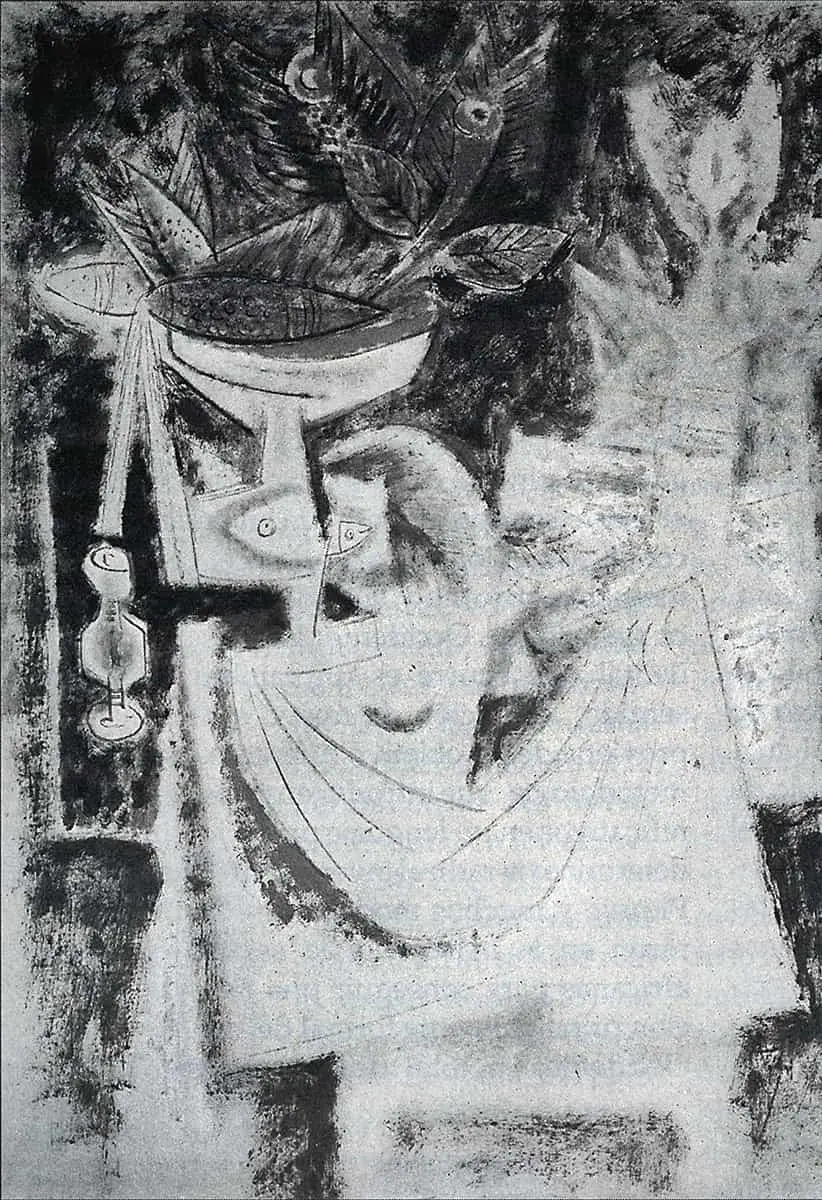
Lam's painting is a “primitive”-modern cosmogony, a recreation of the world centered in the Caribbean, although it uses the devices of Western art and the space opened up by the latter. It is a story of genesis, of the proliferation of life, of universal energy. Ortiz speaks of "living natures"20: the term alludes to a genre established by the Western pictorial tradition (still life), which Lam uses as a reference or artistic structure and at the same time transforms it, because in the worldview implicit in his art, nothing is death but only metamorphosis, because everything is full of an energetic spiritual presence. In this way, Lam came to create Awakening of Still Life in 1944.
There is also a relationship in his discourse with Elegguá. This god, the Brazilian Exu, the Yoruba Eshu-Elegba-ra, the owe-fon Legba, is the only one whose basic image was used almost literally by Lam in almost all his pictures. Elegguá is a “trickster”, the principle of uncertainty, a diachronic figure of change, in opposition to Orula-Ifa, the principle of structure and accumulated wisdom. Elegguá is the master of doors and crossroads; he opens and closes everything, but is unpredictable and mischievous.21 The mutant sense of Lam's painting, where everything seems to change into something unexpected, might be related to this god. Lam's art is also a metamorphosis, “a praise of osmosis”, as he titled one of his paintings. There is also a similarity with Elegguá in the displacement of vision brought about by this art, as a fundamental change in itself, and as the cultural crossroads which it depicts.
This new meaning was the result of a different objective and methodology, which introduced significant changes in language, without the radical invention of a new language. Picasso and many modern artists sought inspiration in African masks and statues, essentially to achieve a formal renovation of Western art, unaware of the context of these objects and their meanings and functions. Lam discovered African and “primitive” art in Picasso and began to use it in the same way. However, under the drive of Surrealism, his own personal world became activated in a way that was to determine a more internal manipulation of those forms. As a Modern artist, Lam abandoned African geometrical forms and began to work with their meanings, in a coherent, natural, and spontaneous manner which had never been achieved before in Modern art.
The “primitive” contents of other cultures are thus introduced into Western painting, giving it a new life. However, being centered in different experiences and perspectives, they also inaugurate the long way to its possible multi-faced transformation—as a meta culture of the contemporary within the complex contradiction of postcolonial developments. Lam filled cubism with the meaning that the movement had ignored in its morphological use of African art, originating in the fulfillment of religious functions. If we compare an “African” figure by Picasso and one by the “Picasso-period” Lam of 1938-1940 with any figure (even similar to these) by the “Cuban” Lam, we can see that the former are geometrical human figures, whereas the latter are mythological entities which are almost never fully individualized. It is not that the painter re-semanticized the African masks, endowing them with their original meanings. There is no strict quotation of specific kinds of masks, given the degree of decomposition, mixing, and processing of the sources, although some, such as the gbon, can still be recognized. The intertextuality here is one of genetics and meaning. Lam was inspired by the semiotic imagination of the masks in an attempt to achieve for himself and within the context of a more personal imagery, what those masks sought: the construction of something fantastic and natural, which was part of an environment and a conception of the world. It was an abstract approximation to the mystical sense which the masks endeavored to express in their contexts, through the necessarily different resources and functions of easel painting and Modern Western-style art, as an autonomous, self-sufficient, “disinterested” activity, an image-based language related to aesthetics. This approach helped him express his vision from within himself and from the African dimension of the Americas.
There is no precise encoding in Lam either, in spite of the fact that his painting is often described as a set of symbols. Lam himself said: “I do not tend to use an exact symbology”22. His reference to Afro-Cuban religious and cultural complexes is always indirect. Very few elements can be identified, except for the effigy of Elegguá, noted above. But not even in this case does the figure appear explicitly related to the powers, myths, rites, or ceremonial space of this deity, except at a very general level. This is true even when the titles refer to specific gods and altars, which would remain totally unrecognizable for any believer, since reinvention takes precedence over description. A stricter symbolic codification appears only in a few large oil works from the second half of the 1940s, such as Eternal Presence23, The Wedding, Belial, Annunciation, which are also characterized by a greater naturalism in the figuration and by their Expressionist aggressivity. Lam merely seeks to transmit, through the tropological devices of Modern art, a world view conditioned by African elements which still live on in his original culture, a general mystical sense which proceeds from them.
This change of vision lies in the internal presence within the culture of the Caribbean of certain general traits of the African conscience: its religious philosophies, its world views, its mythological thought, and ethno-psychologies. An integrated opposition between aristocratic academicism and a dyorian “primitivism” seems to become explicit in these works. An ink from 1943, a beautiful need in the style of a classical Picasso, looks into a mirror which reflects the image of a mythological being. Such pieces are metaphors for the kind of Third World criticism against the West, which is an integral part of his artistic proposal. Interiorized and dissolved traces of this African conscience have been absorbed into the sensibility and imagination of the Caribbean and its special symbolic world. For example, there is the natural way with which mythological thought operates in the Caribbean within the modern conscience, without any contradiction—a feature which extends from Bastide's principle de coupure24 down to “magical realism”. It is not a question of the survival of myths, but rather a natural inclination towards a mythologizing process characteristic of "primitive" thought, this time in contemporary "cultured" creators, capable of focusing the world through the structures of mythological thought, and reflecting a reality where magic and myth are operative aspects within contemporary problems.
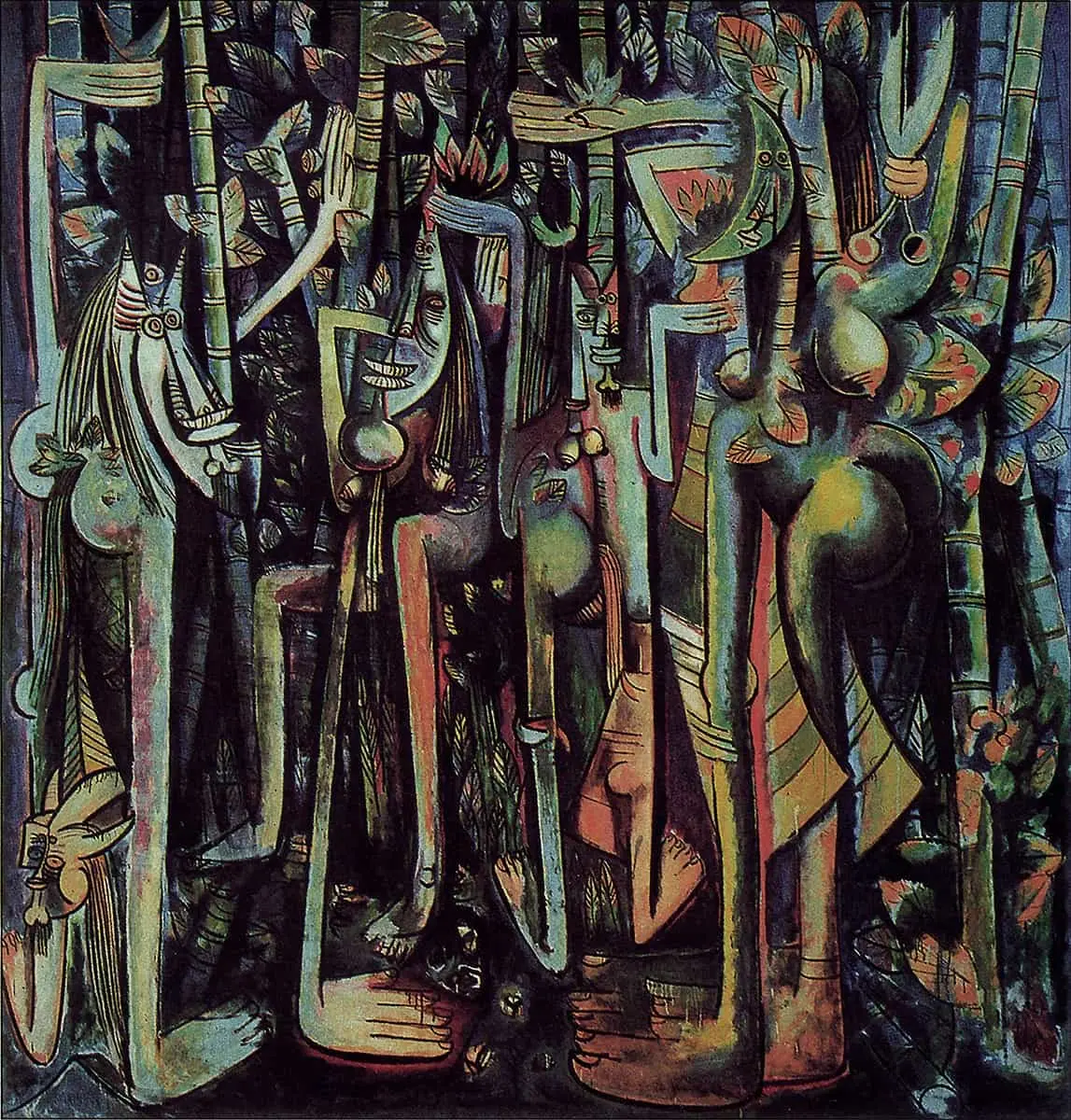
The displacement that occurs in Lam was sometimes proclaimed in a polemical manner. His painting is often very aggressive towards bourgeois good taste, as he himself admitted when he said he wanted to create “hallucinating figures which can cause surprise and trouble the minds of the exploiters”25. Such an ingenious program can only be understood in a figurative sense, as a posture within his own art, as poetics. He had a preference for certain aggressive forms, such as barbed wire, horns, teeth, which sometimes filled an entire picture, as in Escolopendras, grotesque forms alluding to repulsive animals, snake-like forms (gros orteil), like enormous feet, and certain deformities. This attempt to épater le bourgeois in the surrealist manner was essentially a Third World offensive against established taste and, in the final analysis, against the “aristocratic” Western aesthetic. But Lam acted from within the context of Modernity and even classicism, which he never abandoned, but rather reoriented into an opposing dialectic. The anticolonial tone of the scissors held by the character of The Jungle is not an attempt at a utopian break, but a turning and a synthesis which might be endorsed by Modernity, thus creating a non-Western space within the Western tradition, decentralizing it, transforming and de-europeazing it. In fact, Lam's painting, especially that of his “Cuban” period, has few decorative elements, despite its great beauty. Even today, his pictures shock a lot of people. The irony of the fact that the cultured "exploiters" now hang his pictures in their drawing rooms is rather like the problem posed by the glass which is "half full" or "half empty", situations which are both reifications and infiltrations. Such ambivalence and contradictions are part of the postcolonial culture games, particularly those of the immigrant in the power centers, who is absorbed and at the same time transforms from within.
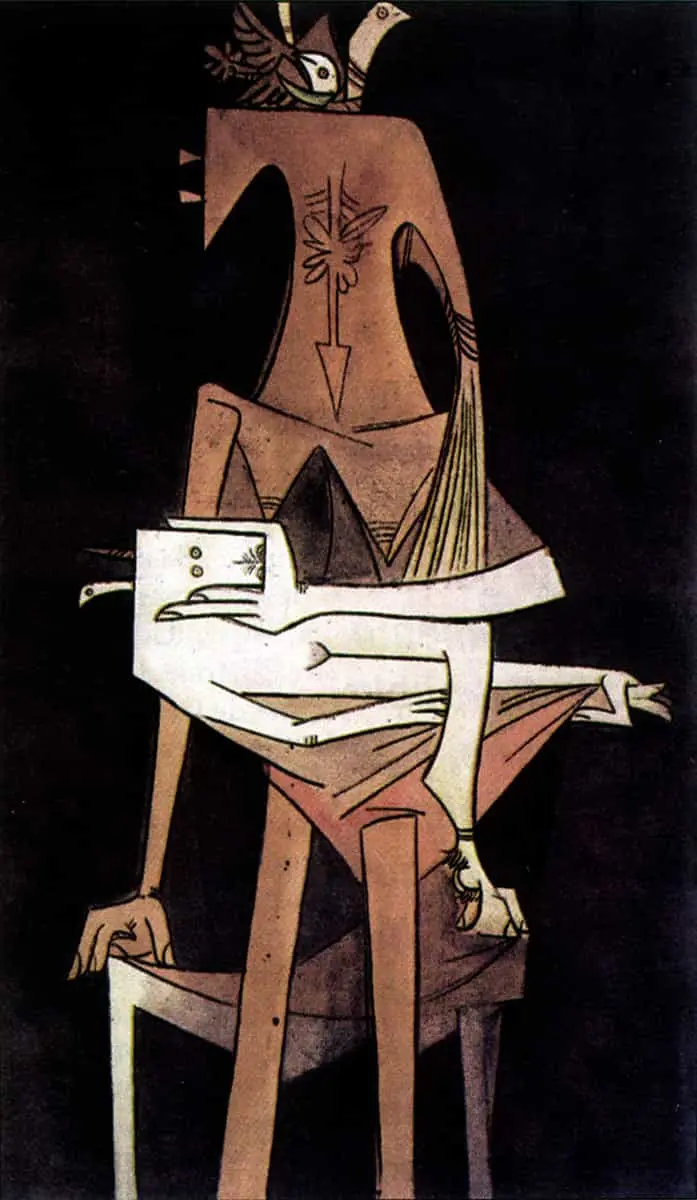
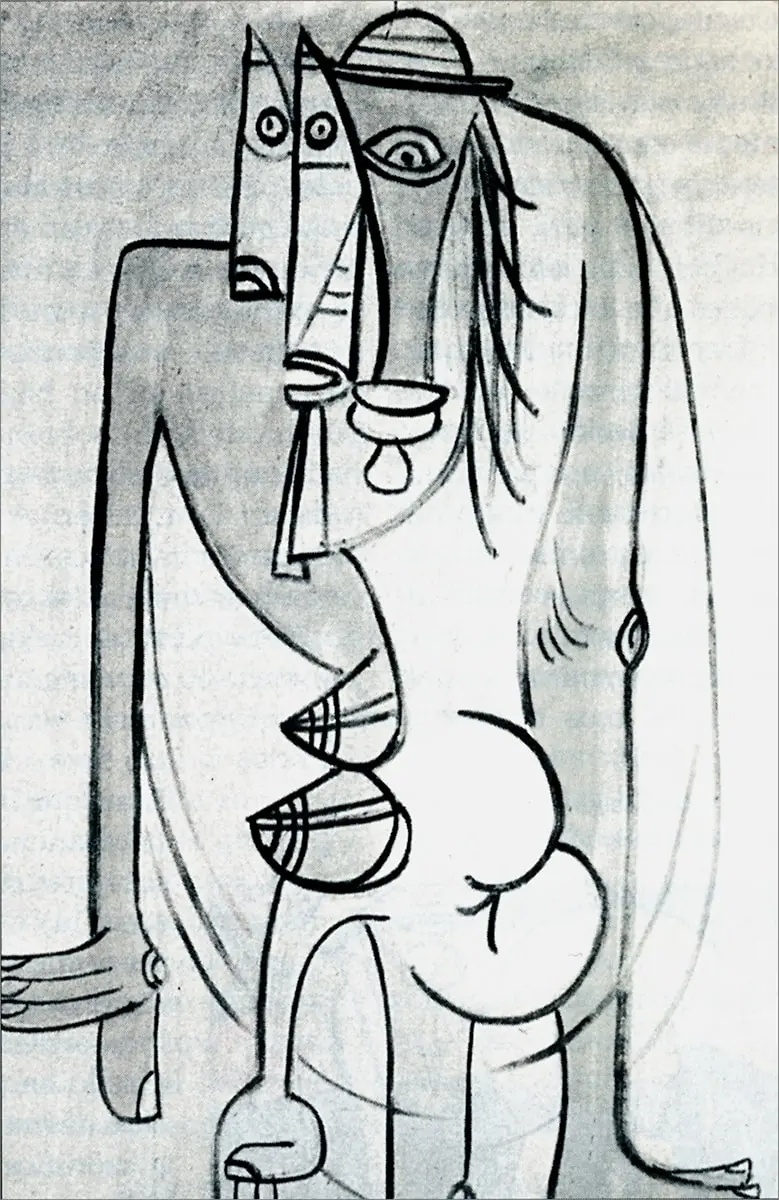
The polemical synthesis is evident in the very concept of certain works: for example, in those dated between 1949 and 1961, which show women sitting in poses reminiscent of academic paintings, with their hands arranged in a conventional expression of "good manners". But these elegant ladies have been painted with the most "savage" mixture of masks, tails, horns, manes, thorns, with all those kinds of animal and plant references which allowed him to create his mythological figures. These pieces can be seen as an allegory of Lam's work and of his aesthetic stand.
We are faced with a pioneering endeavour, afflicted by the contradictions of its own strategy. The permanence of a certain exotism typical of the astonished Western visión of a price, particularly among the Surrealists, and which extends to everything "primitive", aesthetic as "mystery", "magic", "right", "darkness", "fantastic", etc. The work, however, is not itself contradictory, for it assumes the complex contradiction of postcolonial processes—evident in the artist's biography- so that may, together with other Latin American modernists, initiate the long journey toward a possible de-euro-centralizing of Western culture, in the sense of making it a metaculture of the contemporary. Just as Elegguá, his work is at the crossroads.
NOTES
1. Étiemble, Essais de Littérature (Vraiment) générale, Paris, 1974, p.ll.
2. See also G. Mosquera, "‘Primitivismo’ y ‘contemporaneidad’ en nuestros artistas jóvenes", La revista del Sur, Malmó, Year II, Nos. 3-4,1985, pp. 52-55; J. Yau: "Please, Wait by the Coatroom. Wifredo Lam in the Museum of Modern Art," Arts Magazine, New York, No. 4, December 1988, pp. 56-59.
3. Quoted by Max-Pol Fouchet, Wifredo Lam, Barcelona, 1984, p.3l.
4. G. Mosquera, El diseño de definió en octubre, Havana, 1989, pp.27-37.
5. Primitive Art (Franz Boas) is dated in 1972; Revista de Antropofagia was founded the following year, with the first number including Oswald de Andrade’s Manifesto Antropófago. For a critical examination of his program, see Z. Nunes: Os males do Brasil: Antropofagia e a questao da raça, Rio de Janeiro, 1990.
6. "Center", "periphery," and "Third World" are all controversial and problematic terms. I am using them to refer to historically established situations of domination, without any hierarchical or discriminatory implications.
7. N. Richard: "La centro-marginalidad postmoderna", paper presented to the Symposium on Artistic and Cultural Identity in Latin America, São Paulo, 1991.
8. G. Kapur: "Tradición y contemporaneidad en las Bellas Artes del Tercer Mundo", in Debate abierto: Tradición y contemporaneidad en la plástica del Tercer Mundo, Third Havana Biennial, 1989, p. 12.
9. The term "Caribbean" is now used in ethnological theory to refer to a paradigm opposed to monocultural narrative; see J. Clifford, The Predicament of Culture. Twentieth Century Ethnography, Literature and Art, Cambridge and London, 1988, pp. 14-15.
10. G. Mosquera, "Tercer Mundo y cultura occidental", Lápiz, Madrid, Year VI, No. 58, April 1989, pp. 24-25.
11. Through painters like Gorky and Pollock, less by means of surrealist automatism. than of its 'primitive" sensibility.
12. On this crucial aspect of his biography, see A. Nunez Jiménez, Wifredo Lam, Havana, 1982, and Max-Pol Fouchet, ob.cit.
13. For the development of Lam’s painting, see J. M. Noceda and R. Cobas Amato, Wifredo Lam desconocido, catalogue of the Fourth Havana Biennial, 1991, pp. 155-160.
14. J. Lezama Lima, "Homenaje a René Portocarrero", in La Cantidad Hechizada, Havana, 1970, p. 380.
15. So might we say in an allusion to Carpentier, who uses Lam as a paradigm of his concept of the marvellous-real in his prologue to El reino de este mundo (1959), where the idea is expressed for the first time.
16. James Clifford: The Predicament of Culture. Twentieth Century Ethnography, Literature, and Art. Cambridge and London, 1988. p.173.
17. Fernando Ortiz, "Las visiones del cubano Lam," Revista Bimestre Cubana, Havana, Vol. LXVI, No. 1, 2, and 3, July-December 1950, p. 269. This text, which was also published as a monograph under the title of (Havana, 1950), is one of the fundamental interpretations of the painter’s work, and a fine example of the baroque in Cuban prose.
18. A. Carpentier, "Un pintor de América: El cubano Wifredo Lam," El Nacional, Caracas, 1947, reproduced in the catalogue to the exhibition Exposición antológica Homenaje a Wifredo Lam 1902-1982, Museum of Contemporary Art, Madrid, 1982, pp. 77-78.
19. D. Navarro: "Lam y Guillén: Mundos comunicantes", in Sobre Wifredo Lam, Havana, 1986; "Leer a Lam", in the same author’s Ejercicios del criterio, Havana, 1988.
20. F. Ortiz, ob.cit., p. 259.
21. On Elegguá, cf. R. Batide, "Immigration et métamorphoses d’un dieu", Cahiers Internationaux de Sociologie, Paris, 1956, L. Cabrera, El monte, Havana, 1954, J. Elbein dos Santos, "Exu Bara, Principie of Individual Life in the Nago System", in La notion de personne en Afrique noire, Paris, 1973, J. Wescott, "The Sculpture and Myths of Eshu-Elegba", Africa, London, Year XXXII, No. 4, October 1962.
22. See the interpretation of this work by S. Garrigues, "Cultura y revolución en La eterna presencia de Wifredo Lam," in Plástica del Caribe, ob.cit., pp. 183-192.
23. Quoted by Max-Pol Fouchet, ob.cit., p.68. For a different interpretation, see A. Medina, "Lam y Changó" in Sobre Wifredo Lam, op cit., pp. 26-62.
24. R. Bastide, "Le principe de coupure et le comportement afro-brésilien", Anais do XXXI Congresso Internacional de Americanistas, São Paulo, 1955, pp. 493-504.
25. Cited by Max-Pol Fouchet, ob.cit., p. 31.
GERARDO MOSQUERA
Cuban critic and writer. Winner of a Guggenheim Foundation scholarship.