Recently, the Miami Herald published a cartoon showing Castro, left out, peering over a fence at a ballgame among the leaders of the Latin American nations invited to the Miami summit.1 It is a telling image: its commentary was astute and its point of view not surprising, given the orientation of a sector of the community the paper serves, whose interest in Cuba ranges from a past time to a passion, but is ever-present. What does surprise me, however, is the identity of the author. Not his ethnicity, certainly he is a naturalized American of Cuban descent, and he now lives in Miami with his wife and children. It is the way he spends most of his time. By vocation, Julio Larraz is a painter, a master of composition, light, and magical ambiance, so why turn now to political caricature?
It is, in fact, a return, not a turn, and this cycle is a condition to not lose sight of when we are considering Julio Larraz and his primary occupation. Larraz’s quest is a visual voyage with many ports of call. The record he leaves behind is a metaphysical scrapbook of the world he encounters when he "transcends the window" that isolates imagination from waking reality, and the images are constructed with the building blocks of Realism. But to apply that term to Larraz's paintings would be a misrepresentation. Equally inadequate, despite the frequency of their association with the Latin American creative mind, are the labels of Surrealism and Magic Realism, both of which imply more of an ideological program than what is at work in Larraz.2
Larraz skirts the borders of all of these, it is true, but, if the caricatures embody Larraz's powers of interrogation as directed toward the outside world and as processed by his mind, his paintings exist for several different purposes. Some, such as the cloud series of the mid-80s, are studies of the outside world meant to exercise his artistic faculties. By scrutinizing structures and discovering secrets, Larraz introduces what challenges him in his inner vocabulary.
Adventures in painting may constitute the armature of his enterprise, but it is longing and loss that compel the involvement of his imagination in fleshing it out. Larraz has always had the interest and ability to depict the reality of appearances of every environment in which he has found himself. Today, it is largely the realm of the Caribbean, both past and present, that fertilizes his imagination.
Early Years
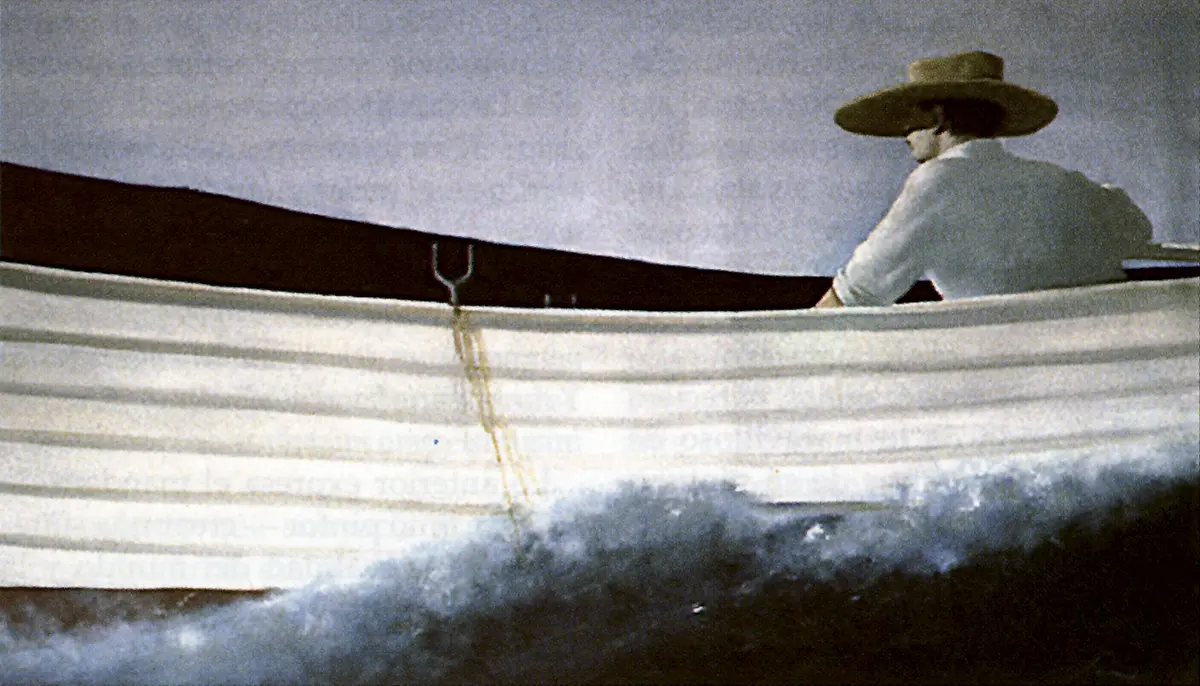
Once we understand the voyage of Larraz's life, nothing about the conflux of forces at work in his art seems confusing. Within his lexicon of leitmotifs, the depictions of maritime refugees refer specifically to his own second birth: his family's urgent flight from Cuba in 1961. Their dramatic expulsion from the one-time paradise of the Havana of his youth is indelibly inscribed in Larraz's psyche, though it is partnered now with socio-political awareness born of living. Larraz has returned to the theme repeatedly, narrating his early versions such as The Refugees (1981) in a realist vocabulary informed by Edward Hopper and Winslow Homer.3 By 1990, the tableau had become an apotheosis; seen from below, the boat called Take Me With You ascends through Stygian darkness on oars-like wings.
The trauma of his family's flight from Cuba is predictably etched in Larraz's memory, although what was left behind asserts itself as well. When Castro came to power, the society he encountered included an educated bourgeoisie whose enthusiasms were for business and politics, among them Larraz's parents, who ran the liberal.
Havana newspaper, La Discusión4 Indifferent to the schools and tutors who endeavored to manage his education, Larraz's attention was monopolized instead by the illustrations and reproductions in the books of his family's vast library and by the political cartoons that crossed his father's desk.
Soon, Larraz was executing masterful caricatures himself. Schoolmates and masters were the primary victims of his pen, and he early developed the skill of patient observation and the detection of subtext in the subtleties of reality. Countless times his habit was challenged: sixteen schools, "thousands" of tutors, and the best of Cuban discipline — all failed to curb his appetite for art.
In Cuba at that time, however, there was little precedent and no educational system for its pursuit. The talent underlying Larraz's precocious draughtsmanship was evident, but he wanted to do realistic painting, although he didn't even know how to start. "I have to thank life that it took me away from Cuba," Larraz said recently, because there, most people thought that to be a painter was a problem. Cuba was a country that was developing socially, and it was very pragmatic because the situation was precarious.... Everyone thought you could never make it as a painter, and I found my way...freedom and respect for freedom are cosmic laws. Break them, and you are the one in trouble.5
This period was on the whole one of pleasure and discovery for the teenage Larraz, but the ominous rumble of revolution was always just beyond the garden wall. The incongruity of the bountiful landscape, together with what was to a certain degree a lifestyle privilege, jarred with the feeling of a gathering storm.
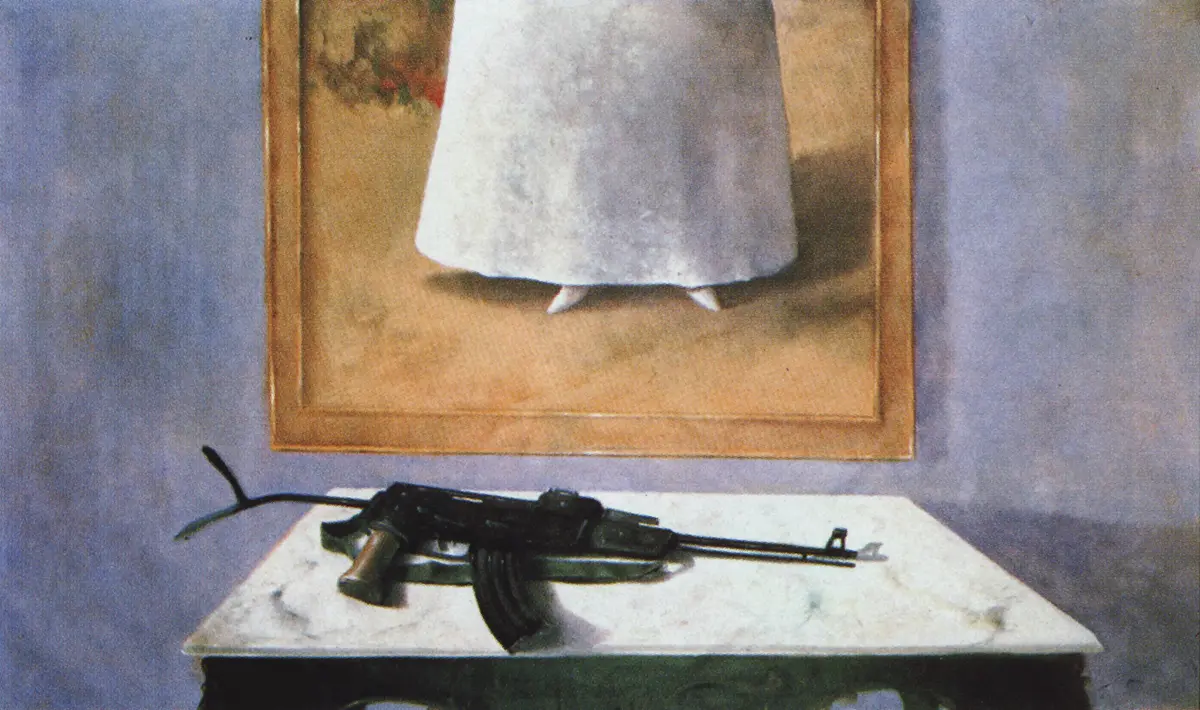
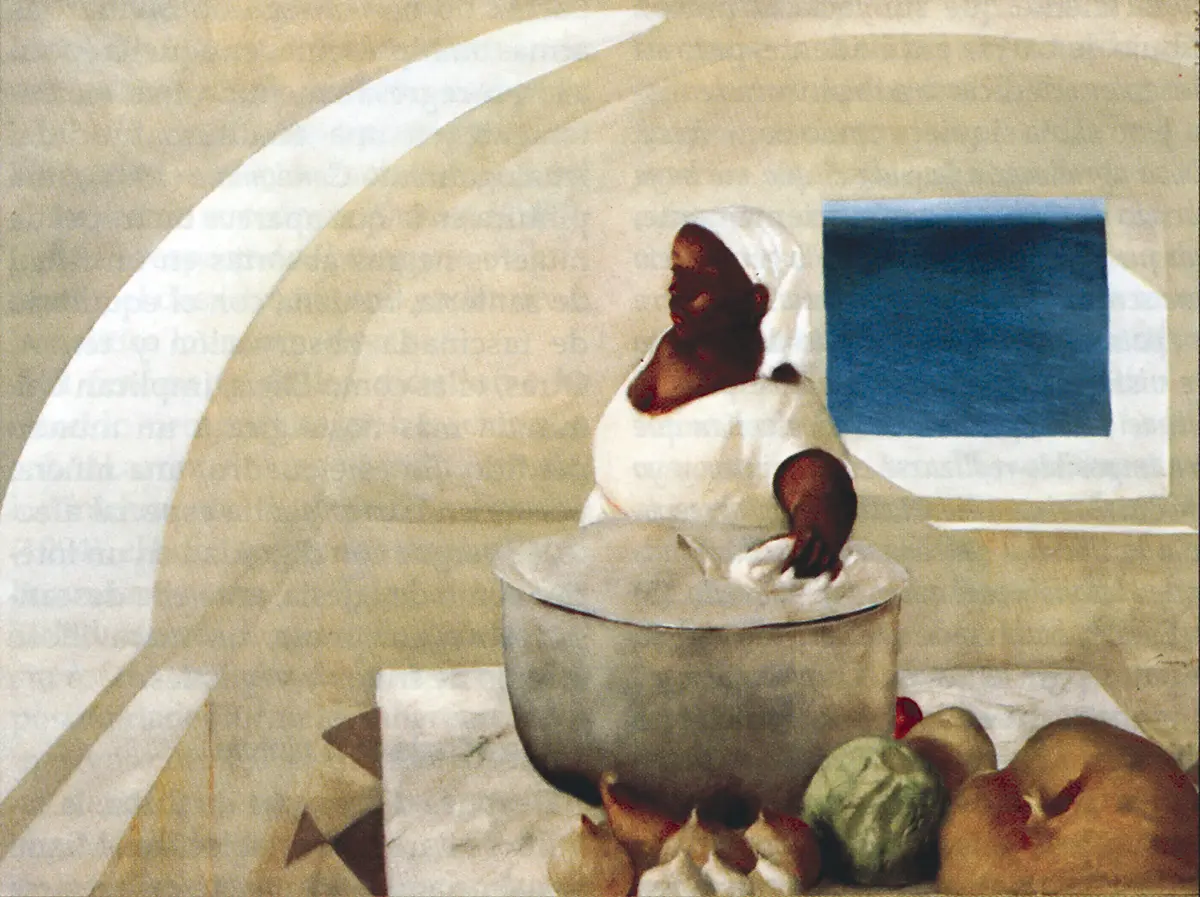
Paintings like Sincerely Yours (1984) embody the inherent paradox. The contrast of the formal foyer with the menacingly gleaming automatic weapon is surprisingly matter-of-fact as if to emphasize Larraz's journalistic approach to a personal anecdote: Larraz's mother was protecting the last vestiges of civility by asserting that in her house, all guns would be left at the door. Culled from among the pictures that passed before Larraz's eyes "like a movie" that is part documentary, part fantasy, the omnipresent guns of that time have proved impossible for Larraz to forget and he has returned to them often, most recently in a cast sculpture. Likewise, Candomble (1993), a painting of a throng of black women absorbed in a Santeria ritual, resounds with a balance of fascinated observation and fear. Other paintings, such as Eligia, imply a more nostalgic regard for a lost world. The subject of this painting, a family nursemaid of whom Larraz was especially fond, stands with dignity in a radiant churchlike interior while on a table before her lies a gorgeous armful of fruits and vegetables.
Apprenticeship to Paint
After escaping Cuba, Larraz's family settled in Miami temporarily before dispersing north. Larraz himself headed first to Washington, D.C., and later to New York to pursue his fortune, working odd jobs and publishing caricatures in leading periodicals such as The New York Times, Time, and Rolling Stone while he began his apprenticeship to paint.
If the Realist style had early captivated Larraz, it was only in young adulthood that the means existed for him to find his way. For the first time, his ambitions found a fertile environment. As Larraz began to absorb influences in his quest toward mastering painting, he turned to those who knew what he wanted to know: contemporaries and friends became sources of practical advice and partners in theoretical.
Dialectics
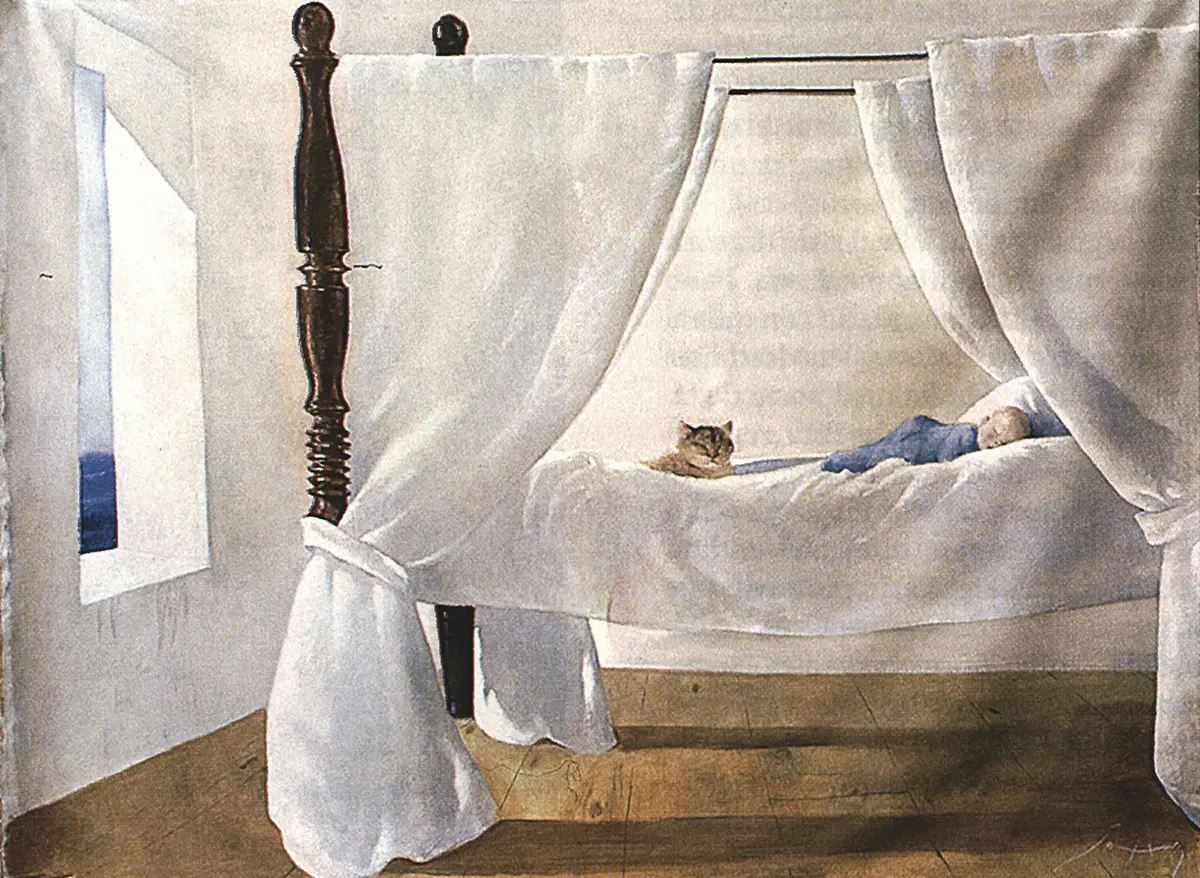
Larraz's New York debut was a 1974 exhibition of paintings and drawings. The still lifes that constituted this show first manifested what would become the central dynamic of Larraz's work — a realistically depicted world invested with the acceptance of metaphysical realities, all suggesting as their closest antecedent the Spanish Golden Age Still Lifes of Zurbarán or Juan Sánchez Cotán. In their classic form, these tableaux of tableware, fruits, and vegetables seem to hover outside of time and space. Described in chiaroscuro, their naturalistic technique and prosaic subject matter become colored with drama, lending to their subjects an unearthly, sacramental quality that compels a metaphysical reading.
Larraz's spin on the tradition is usually playful, representing a vehicle for the complete disruption of the genre, frequently through title and composition relating his subjects to what they imitate. Total Eclipse (1983), for example, displays a partially viewed blood-red squash caressed by a broken pottery bowl. Retreat (1983) analogizes a tin basin holding fruit and a watering can to an armed ship. Its pineapple, pomegranates, and pears are anthropomorphized into passengers. Toy soldiers to the left of the "ship" have compelled with their own cannon the vessel's reversal of direction. Today, in a return to this subject matter in the large-scale cropped still-lifes he thinks about as "details," Larraz has referenced in the burning candle and sliced fruit the vanitas theme that underlies much European painting of the Baroque period.
Larraz's next influence would be American painting. By this time, he had moved with his then-wife and two children to the Hudson River Valley north of New York City. This region, cradle of two American painting traditions, the Hudson River and the Ashcan "Schools," nurtured Larraz's exposure to painters he admired. In particular, he found in Edward Hopper a Realist whose abilities were such that he, more than almost anybody else, could create minimally idealized evocations of the social realities of his day, including their subtexts.
Hopper, like Degas before him (another passion of Larraz's), possessed a brazen and almost cynical eye for the revelatory moment and the unexpected glimpse. His paintings displayed an array of concerns that attracted Larraz and validated his own. Imagine Larraz's delight to discover that the storefront which housed his studio for the eight years of this period of his life is depicted in the Hopper painting 7 A.M. On finding such a sense of identity with another artist, Larraz comments: You start on a road where someone has passed already and you can find everything the other has found until the road parts and you have to take your own road. But, between the beginning and that point, you go on discovering things he had discovered before you start on your own. At that point, you immerse yourself in some world that is your own.... Let that road take you wherever it goes. I like to paint everything in life because that is the closest I can get to Realism in the other sense of realizing oneself and one's inner vision.
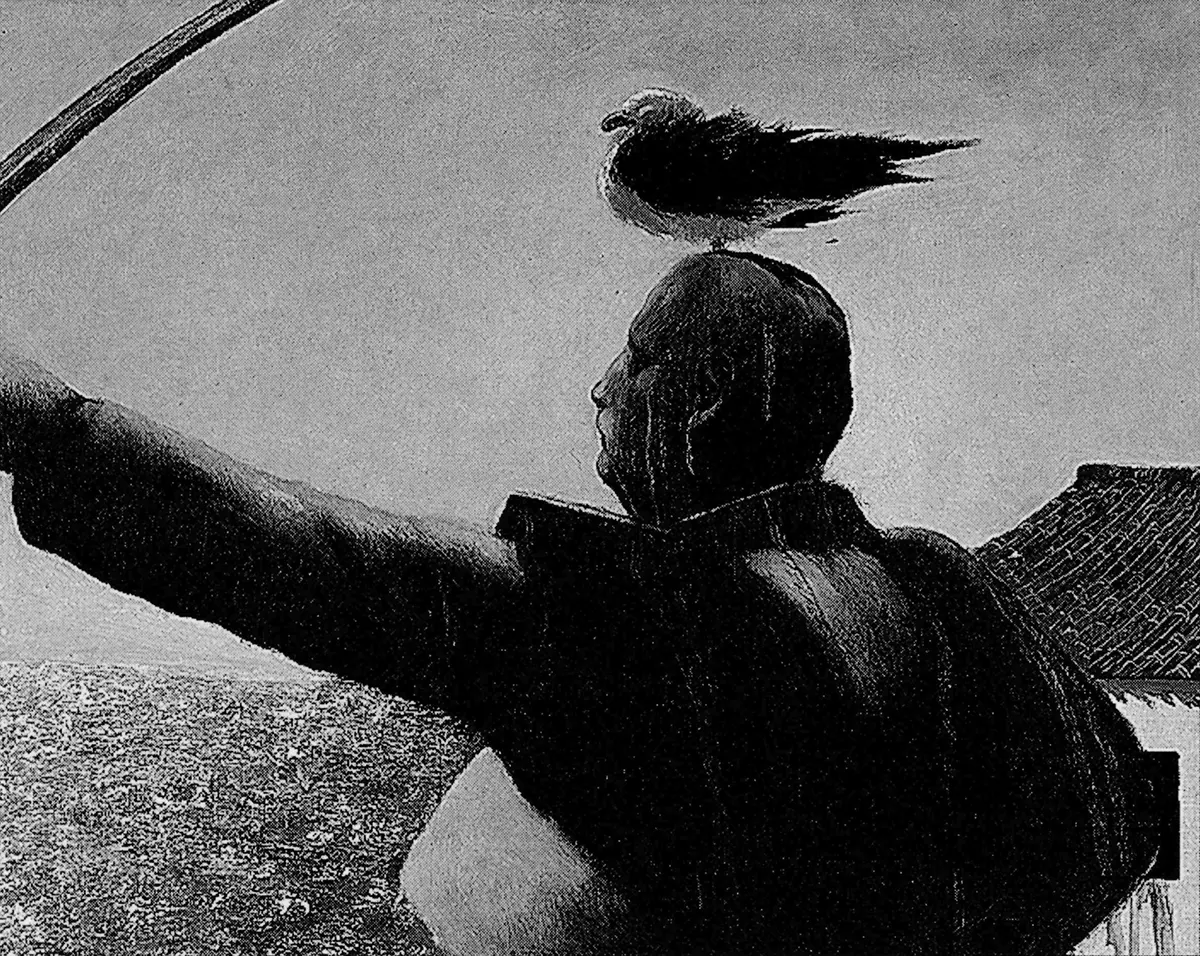
Larraz's quest for the visually and conceptually unexpected — his lifeblood — is echoed by the American scene painters' search for fresh ways of speaking in a representational language. The visionary viewpoint of Grant Wood's daring Midnight Ride of Paul Revere is echoed in Larraz's El Padre de la Patria Nueva (1984) or his Lincoln County (1991).
But as often as not, it is Larraz who trumps in daringness. His eye is restless, afflicted with a yen for spectacle, constantly moving in search of potent, risky imagery. His merging of the realistic and the unlikely unleashes torrents of associations that provoke viewers on many levels. The effect serves to isolate viewers in some nether region between what they know and accept and what is not quite strange enough to be dismissed as fantasy.
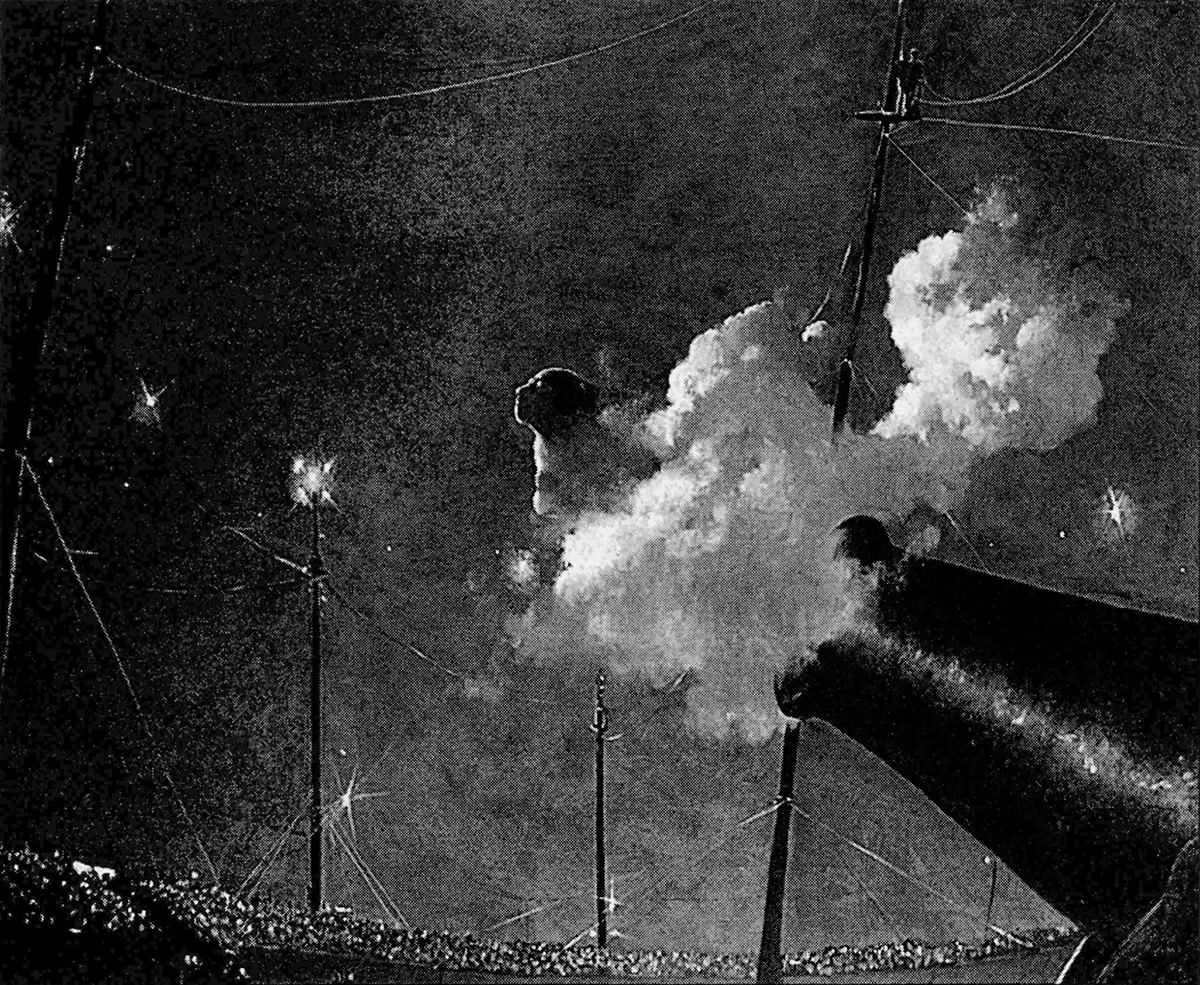
Sometimes it seems to be Larraz's sense of wonder that compels a painting. His The Main Attraction of the Circo Miguelito — The Cannonball Man describes the mentioned character's explosive entrance under the big top. Other times, it seems that what has been invoked is Larraz's incredulity, as in Ansatsu (1989), which makes the viewer an eyewitness to an assassination, the natural disaster endemic to Latin American politics.
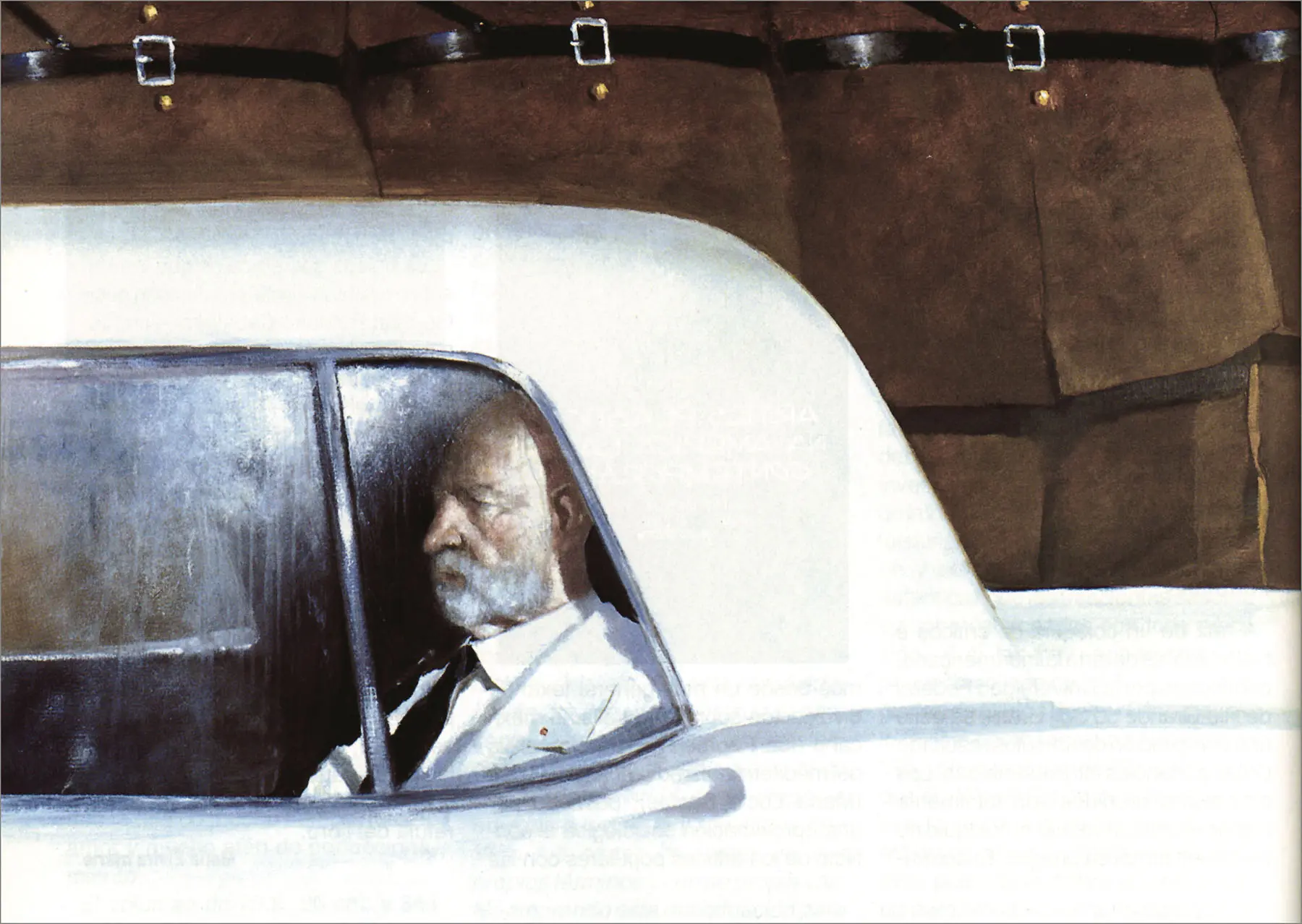
The phenomenon of dictatorship has proven itself to hold a prolonged fascination for Larraz. In a recent version wryly titled The Populist (1994), the leader sits in his glossy American-made limousine, isolated behind a picket fence of faceless khaki-suited henchmen. While the formal possibilities inherent in the massed shapes of the henchmen's bodies are intriguing, it is actually the patronizing security of position that emanates from the central figure that is Larraz's actual subject. For Larraz, it may be a morbid fascination with a pathology that makes him want to explore the "institution" in depth, for these are not portraits, but more examples of a type. Of this continuing concern with an "elite" group of power-holders, Larraz has said: I wanted to show the complacency of a man who is so secure of power and so separate from being a populist, not only in dictatorships...even here you have to point a finger at those things. I wouldn't go so far as to say it's a duty but you have to do it. And you have to do anything that concerns you as a member of society.
This then is Larraz's mandate as a painter — to create a synthesis of the reality of the world and the reality of the individual. While Larraz has defended the importance of inner vision,5 he adds that negotiating the resolution of the inner and the outer can be an artist's greatest problem.
Artists can get so close to what they are working on that they lose perspective. When confronted with Queen Elizabeth II, they "only see the riveting and the black hull, not the ship. The most important thing an artist has to have, aside from self-esteem, is humility."
Larraz describes his need to make art as "a necessity of communication," and tells the following story: "My mother once asked me when I was a child, 'Explain it to me,' and I said, 'Give me a piece of paper and a pencil.' She said, 'What for?' and I said, 'That is the best way I can express myself.'" Larraz adds that the better an artist is, the more reticent he is to open his mouth—he says less and less because the way he can communicate it best is through his art, through what he is putting down. Larraz's sharp opinions become the political cartoons he characterizes as "atom bombs" because of the heavy-handedness of their message.
But, open to interpretation, the paintings operate differently, as pas de deux between the popular and the personal. I leave things open for people because that way, they can participate in that painting. Everybody has their own ideas — I hear two or three people telling me different stories, and I say 'Yes, it's true/ because I accept that it is their story, not mine anymore. Deconstruction theories of literature notwithstanding, this "slippage" of meaning is epitomized in visual art.
The final meaning of a painting is an aggregate of all its meanings — the viewers' as well as Larraz's, and it is in this shared tongue that Larraz communicates. As Octavio Paz has written, "The visual language of painting speaks, but what it says does not need to be translated into words. Painting is a language sufficient unto itself."6
NOTES
1. Miami Herald, December 7, 1994, p.28.
2. Dore Ashton, "Surrealism in Latin America," in Latin American Art of the Twentieth Century, ed. by Waldo Rasmussen (New York: Museum of Modern Art, 1992), pp.101-115.
3. Maureen Mullarky, "Julio Larraz" (review), in Arts, September 1991, p.67.
4. For commentary on Larraz's early years, I have relied on Edward J. Sullivan, Julio Larraz (New York: Hudson Hills Press, 1989).
5. The quotations from Julio Larraz have been transcribed from an interview conducted at his home and studio on January 8, 1995.
6. Octavio Paz, "Art and Identity: Hispanic Art in the United States," in John Beardsley and Jane Livingston, Hispanic Art in the United States (New York: Abbeville Press, 1987), p.3.
K.K. KOZIK
American Art Historian. Lives and works in New York.