The Venezuelan artist Alexander Apóstol held his first one-man show in New York during the months of March and April. Most of the works, and perhaps all of them, had already been shown in the artist’s home country, and now it was finally New York’s turn to see his photographs. This situation enabled the work to be seen from a more complete perspective, since it reflects, in a certain way, its beginnings and changes in these images. At the entrance to Throckmorton Fine Art, the walls of a little corridor presented pictures from the late 1980s and early 1990s. The first impression was of extremely pictorial, aestheticized, and theatrical photographs based on such well-known portraying animals and human beings from another perspective techniques as mise en scene to transmit a mystical aura, which was not very interesting or original. Since then, Apóstol has shown a preference for montage, which he manipulates without the radical approach of the historical avant-garde, as represented by such figures as John Heartfield, Raoul Hausmann, Moholy-Nagy, Hannah Höch, El Lissitzky, Alexander Rodchenko, and Max Ernst. In these early works of Apóstol, there is no ambiguity or multiplicity of meaning: fish, chicken, vegetables, and delicate female faces are exercises of a formal nature that use dramatic light and careful posing to create a theatrical effect.
Since 1991, the images have begun to examine the problems of portraying animals and human beings from another perspective. The juxtapositions are now not just of an aesthetic kind but attempt to break with certain conventions of representation and transgress the visual code in which the images of buffaloes, arms, organs, men and women, which make up Apóstol’s photo-assemblages, are set. The use of fragments becomes crucially important here, since it allows the artist to restructure the syntax of the final work. For example, in Beneficiary Birds (1992), the artist has assembled several images on a rectangular panel measuring 30 x 101 inches. To the right there is a hen looking outside the frame in an almost majestic pose; in the center, 24 little square compartments reproduce a photograph, again of a hen, this time dead, on a plot of land; and finally, to the left of the panel, Apóstol has placed a photograph of a kind-looking woman, with smiling face, sitting in front of a bowl of soup which she is about to eat. The work seems to refer to one of the few needs which we might still call natural, the need to eat; at the same time, the images of the birds, stained with silver gelatine, emphasize the aesthetic features of these animals, which, more than food, suggest a contemporary version of the Dutch still-life works of the seventeenth century. These pictures, however, are an attempt to reduce the increasingly diminishing space between work of art and popular culture, using images of women and men, animals, and clothing of clearly popular origin. In works such as Beneficiary Birds (1992), My Aunt at the Hairdresser’s (1993) and The Tailor (1993), the men and women represented are very far from those delicate female figures, passive or idealized beauties which Apóstol proposed in such works as Hortensia (1989), Nabo (1989) or even The Three Vultures (1993) (in this last work the romantic female figure has given way to the no less stereotyped image of the femme fatale).
What representative model is Apóstol proposing in these images, which incorporate characters who are popular, pleasant, or ordinary? There seems to be an attempt here to problematize representations that are idealized, morally correct, nationally approved, and appropriate in civic terms. In My Aunt at the Hairdresser’s, for example, a woman crosses her hands on her legs, and she is sitting in a very careful pose, but without a blouse. Her breast is covered with a grotesque image of a heart which seems to have come out of some scientific encyclopedia, but without the precision or formal refinement of such images of human organs. A baroque and exaggerated wig covers the head of this woman, who has none of the glamour characteristic of the Venezuelan "Misses" of the beauty pageants or the well-dressed ladies of society. On both sides of the central image of this woman, two identical male images, from the torso down to the feet, emphasize the man’s genitals, which are also decorated with a kind of wig. Although the image in itself is extremely problematic in terms of what the wigs cover (the head of the woman, the genitals of the man), there is an interest here in challenging certain stereotypes of "beauty" and "good manners" which are completely artificial and genuinely cultural constructions.
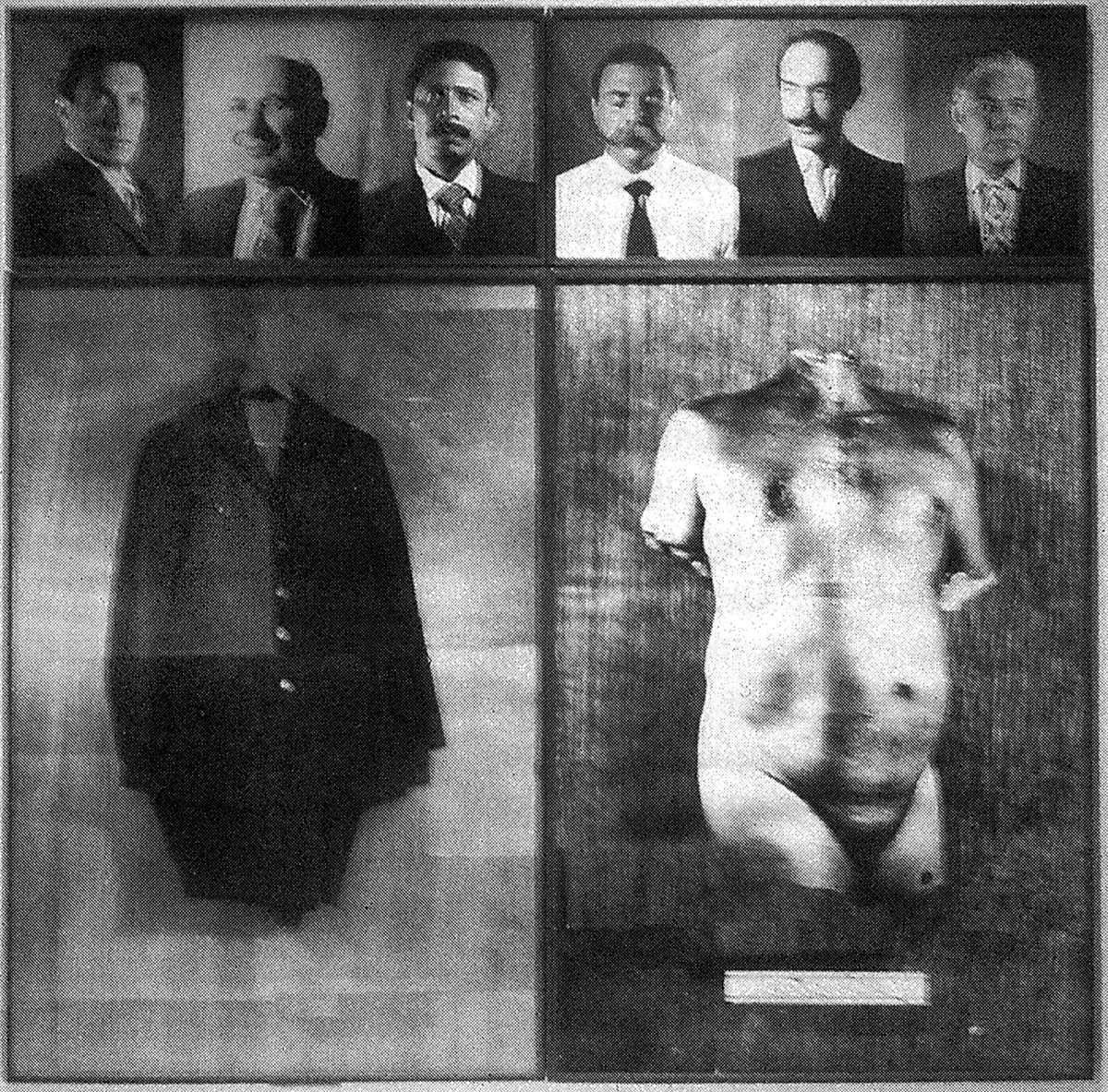
Furthermore, in works like The Tailor, there seems to be an interest in exploring or developing a genealogy of the image of the popular Venezuelan man. In this photograph, Apóstol has placed the familiar faces of everyday men at the top of his picture; in the center, there is a suit next to the bare torso of a headless man. The work to some extent recalls Max Ernst’s The Hat Makes the Man (1920), in which a genealogical tree of hats replaces the names of those who supposedly make up our "identity" and past. In The Tailor, the accessories, clothing, appearance, and the classical mustache combine to reinforce and mold masculinity—a monolithic masculinity which can be adapted to many faces, conventional, anonymous.
The images used by Apóstol in these works have a certain 1940s aura about them—not only because of the processing and use of silver gelatine, but because of the physical appearance of the men and women, with their out-of-date hairstyles, simple clothes, and creole features, aspects which recall the nationalistic literature of the country. There is a certain nostalgia inherent in these photo-assemblages, which seem to suggest, despite a certain critical attitude to visual conventionalisms, an attachment to the idea of well-fed, kind-looking grandmothers, aunts, and family forever with a smile on their faces. The contrast between these images and the work of one of Apóstol’s compatriots, Jose Antonio Hernandez Diez, which was also on show at the time in the Sandra Gering Gallery in New York, is instructive and highlights the problem of finding representative cultural models for a Venezuela that has been stripped of its past and its present. Hernández Diez’s sharp and disturbing installations seem to have found a means of confronting a nation that is no longer kind-looking, where reality is unstable and constantly being adapted and re-negotiated (rather than combined) between the creole tradition and the impact of what we simplistically call "technology" or "globalization." Apóstol, with his archeology of images, seems to be moving towards the present. We will be waiting.
MÓNICA AMOR