
There is a permanent and repeated use of the fiction that contemporary art can be explained in global terms to justify the keys of power. Reference is made to the importance of contexts, precisely in order to dismiss them, and the difference is stressed merely to impose uniformity. It is true that transnationality, multiculturalism, and such concepts as global art and the melting pot of multiplicity are all attractive and provide some real parameters of the functioning and behavior of art, although they all hypocritically mask strategies of power. Even a cursory glance at the essential features of Brazilian art (and this is true of Latin American art in general) of recent decades offers a much more suggestive interpretation, reflecting an almost visceral attitude towards crossbreeding as experienced by those who have lived the process, rather than being just mere actors in some pre-established scenario.
This open-ended approach, the origins of which can be traced back to the profound impact on Brazilian culture of Oswald de Andrade's Anthropophagist Manifesto (1928), is reflected in the works of Lygia Clark and Hélio Oiticica, as well as those of many other artists from subsequent generations, including, of course, those of Cildo Meireles.
The anthropophagous attitude is one of digesting, i.e. integrating all those elements which can be used as basic materials for a new configuration of reality. A bastard version, perhaps, but one which is more intense, richer, and more complex, a reflection of reality itself. Cildo Meireles's way of working is “anthropophagous" in the sense that he “swallows” and “digests” (to assimilate and melt) elements from the history of art as well as from his own social and political environment, adopting a permanent strategy of the work as action, but in which he avoids an excessive presence of manual elements.1

Catherine David 2 quite rightly speaks of Meireles's environment as a culture in shaping subject to change, and she defines his work more in terms of transformation than in terms of rupture.
During the 1950s and 1960s, Brazil as a country had all the structural and economic conditions necessary for the development of a concept of progress based on utopia: there was the enormous wealth of its minerals, the population was dynamic and growing, the country was enormous and as yet unexploited territory, but above all, there was a desire to achieve modernity based on the country's tropical “difference,” a country with its own characteristics and own vision of development. Major infrastructure works were undertaken, including the construction of Brasilia, the new capital, closer to the Amazon jungle, and in the heart of a country that wanted to be “new” and modern. This vitality also gave culture an eminently constructive edge—as reflected in the São Paulo Concrete movement and the immediate reaction created in the form of the Neo-Concrete movement in Rio. There was also the development of the cinema novo of Glauber Rocha, and popular music reached new levels of exquisite refinement.
Cildo Meireles was nurtured in this environment in which unbridled optimism was soon confronted by the immediate and irreparable failure caused by the collapse of the dream of economic, social, and democratic progress, following the advent of the military regime in the 1960s. This gap between the country's aspirations and everyday reality, this crack between the dream as a desire and reality as a failure, was to condition the work of Meireles (and that of many other Latin American artists of his and subsequent generations), although it also helped generate the creative and integrating vitality of that work.3
Initially, the work of Meireles can be directly linked to the Duchampian message of seeing artistic problems as the result of a mental process, encompassing above all a reflection on the perceptual conditions of the artistic work. Meireles often coincides with Robert Smithson in reducing the work to a documentary residuum of some activity or action, as in Mutaçôes geográficas: fronteira Rio-São Paulo (1969), where he proposes the emptying of content in the concept of the frontier as applied to geographical space, through the interchange of earth and plants in two holes on both sides of the (arbitrary and artificial) frontier between these two Brazilian states. A leather suitcase recreates, through its compartmentalized form and earth contents —as if it were the model for some project— the idea of action. This action work, which is part of a broader, more general project on the alteration of geographical conditioners through their transfer or elimination, inevitably takes us back to the “sculptural” Site/Non-site counterpoint established by Smithson. In a similar fashion. Arte física: Cordôes/ 30 Km. de linha estendidos (1969), consisting of a rope stretched out along the coast of the state of Rio which was then gathered up, documented, and stored in a wooden box, to show the relative nature of length —a question which had already been examined from another perspective by Piero Manzoni, using other formulations more directly linked to painting.
The connections and coincidences with Duchamp, Smithson, and Manzoni reflect some of Meireles's basic concerns, including the absolute need for the idea, the mental process project, and the concept, to dissolve the material or objectual connotations of the work.
However, the dematerialization of the work of art does not, in the case of Meireles, mean a nihilist desire or tension as in the United States or Europe, but rather an artistic action in the sense of a project for the conquest of new and unexplored mental territories, which Catherine David defines as the expression of a utopia or a project for emancipation.4

Cildo Meireles incorporates and develops in his work a language of conceptual strategies; his stance is sufficiently diffuse and imprecise to allow him to include reflections on social and political subjects and at the same time to explore matters of artistic perception. He does so with the freedom and autonomy of someone using his own tools to construct an original discourse free of any formalist continuity. Frequently, both aspects, the artistic and the social, are fused together to create a “density” the purpose of which is to make complex the appropriation of the work in the experience, to transform it into action. Such action is simultaneously sensorial, physical, i.e. perceptual, and mental.
Meireles's conceptual language, as to some extent in the case of other artists, both from Brazil and other Latin American countries, does not have the coldness and distance characteristic of North American proposals: the concept and the thought become warm, even begin to bum, enveloping the surrounding contexts, incorporating the social dimension, not in the local typical sense but as a key to political and global positioning (although not fully doing so). The concept and the thought become a strategy that enables abstraction to be made specific, concrete, and rich in content, with the philosophically toned elements being set in an extremely corporeal, visceral dimension.
Guy Brett has defined this sliding process as a transition from abstract towards a social reading of space seen as a flux of densities in transformation, and at the same time, as the source of other transformations.5
The opening up to the outside, towards experience as a commitment to the reality surrounding the artist, is an essential requirement for Meireles.
In this, there are some points of contact with Oiticica. However, Meireles takes a different path: whereas Oiticica directs his action and intervention towards aspects that are ludic, sensorial, perceptual, and even sensual ("action is the pure expression of the work" and the participation of the spectator results in a "magical experience"6), Meireles inclines more to the mental, the thought process, or rather, the invitation to reflection through the use and stimulation of the senses to subvert the norms of perception.
The exhibition which was recently presented at the Valencian Institute of Modem Art (IVAM, Valencia, Spain), curated by Vicente Todoli and Nuria Enguita, presented a selection of works covering the extensive career of the artist from his early pieces, such as Espaços virtuais: Cantos (1967-68), which brought him attention as an artist, down to some of his most emblematic works, such as Eureka/Blindhotland (1970-1975) or Glove trotter (1991). Until now, the work of Cildo Meireles had been shown on only isolated occasions in Europe, with single installations, or within the context of large shows such as the Magiciens de la Terre in Paris, or the last Kassel Documenta. The Valencia show allowed his work to be viewed and set within a global and integrated perspective.
Meireles constantly returns to the experience of dispersion as a means of understanding and thinking of space, as a continuity without limitations. The space of art is prolonged in the space of life, but not as a place where both poles are to be found, but as contiguity which permits transformation. The dispersion is set against but also complements, a desire for concentration and density, a project for expression and action beyond forms and appearances.
Meireles's preoccupations are not directed towards the sociological or political spheres as a first impulse, although his perspective is never out of sight; his concerns lead to substantial proposals for an approximation to the artistic phenomenon of modernity, in terms of criticism and the posing of questions. Meireles tries to resolve these problems through answers that are strategically set in a social context but are at the same time endowed with poetic qualities which can only be understood as an unusual form of belonging that has nothing to do with either national concepts or nostalgic evocations for lost or disappearing Arcadia. On the contrary, Meireles's discourse is energetic and forceful, reexploring situations and problems to show the mistakes and contradictions of the “institutional” responses of the past.
In many of his projects, Meireles approaches his plastic elements through the senses as a means of gaining access to certain critical spheres.
Missão / Missões (How to Build Cathedrals), (1987) is perhaps one of his most well-known pieces and is related to another work. Oblivion (1987-1989). Both propose a reflection on the subtle methods of colonialism and the oppression exercised by dominant cultures over weaker ones, and in particular, the fate suffered by the Amerindian cultures. Excluding any hint of rhetoric from his discourse and avoiding any simple and vacuous pitying of the victim, both installations create a sense of poetic tension that comes close to a oneiric and metaphysical vision based on touch and color.
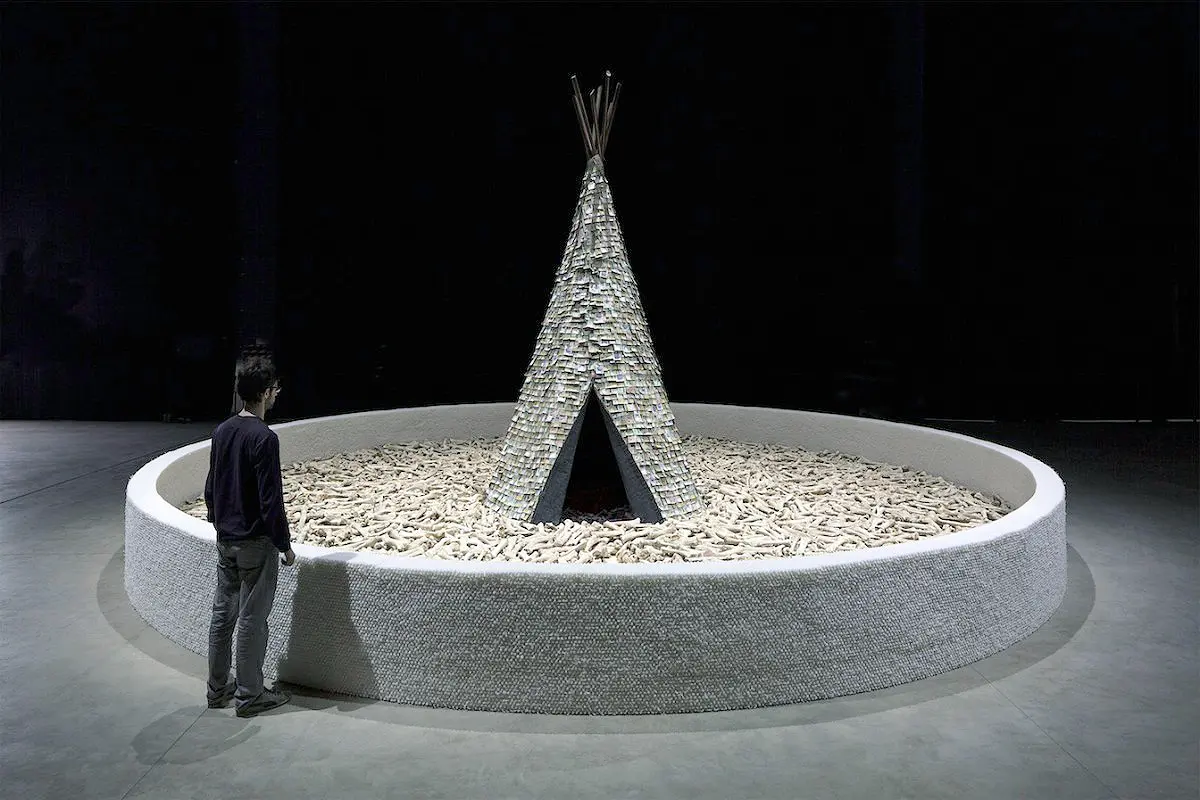
Missão / Missões was inspired by the utopic project of the Jesuit Missions which in the eighteenth century brought the gospel to the Guaranis and organized a collectivist society. But Meireles gives a turn to the screw and proposes another way of understanding the role of the Missions: as a subtle means of introducing the oppression of colonialism acting at two parallel, overlapping levels —the political and the theological. A surface of golden coins evoking the gold of power is “lightly” linked by a fragile column of wafers to the motley roof of bones: the objective is the construction of an atmosphere of power, the cathedral, the emblem of the colonizer. Oblivion for its part shows in a less metaphorical and more directly political way the destiny of the indigenous cultures and peoples of the Americas: in the middle of a circular area covered with bones and enclosed by a small wall of candles, there is an Indian tent papered on the outside with countless banknotes of the countries of the Americas in which the indigenous peoples lived. Inside, painted black, is the terrible sound of an electric saw.
Through (1983-1989) examines the forms of prohibition from a strictly contemporary and almost police-like perspective through a labyrinth of barricades, grilles, fences, partitions, Venetian blinds, elements which obstruct and impede movement, set against a surface covered with fragments of glass and crystal, which leads up to a huge ball of crumpled cellophane. This work is closely related to Malhas da liberdade (1976), a formally minimalist, although expressive proposal of a political kind.
Meireles uses artistic action with the clear-sightedness of someone who criticizes pop art to focus on one of its most emblematic fetishes, the Coca-Cola bottle, while he ironically sifts through some of the power circuits embedded in the social mass consumption machinery. This is precisely the political backdrop of the project titled Inserções em circuitos ideológicos / Projeto Coca Cola (1970): A Coca-Cola bottle filled with refreshing liquid is covered with messages printed on white on a sticker. As the liquid disappears from the bottle, the message ("Yankees go home!") associated with the content also disappears, swallowed up by the transparency of the glass. The bottle is now ready to be reintroduced into the distribution system and is now a carrier of the subversive message virus.
An essential feature of Cildo Meireles's work is its capacity to convert action into intervention: the concept of strategy is linked to action and intervention at various levels.
Inserções em circuitos ideológicos can and should be defined as an anti-ready-made: Meireles does not appropriate the fetish object of the Coca-Cola bottle, the Warhol emblem of capitalist consumption, but rather the market mechanisms. It is precisely these mechanisms that cause the bottle containers to circulate from the producer to the consumer and back to the point of departure for recycling and subsequent re-circulation after refilling, which in the end, are transformed into a new kind of immaterial and ideological ready-made. However, when the squandering of consumption swamped the market with non-returnable glass and plastic bottles, such a strategy was no longer viable, becoming a historical condition impossible to make into a fetish, contrary to what happened with Duchamp's bottle drier.
A similar direction is evident in the works which used money or banknotes as their support.
Belonging to Inserções em circuitos ideológicos, the Cédula project comprises the introduction, through tampons, of disturbing messages that are politically or socially subversive, onto legal tender banknotes, messages which are of course circulated through everyday payments.
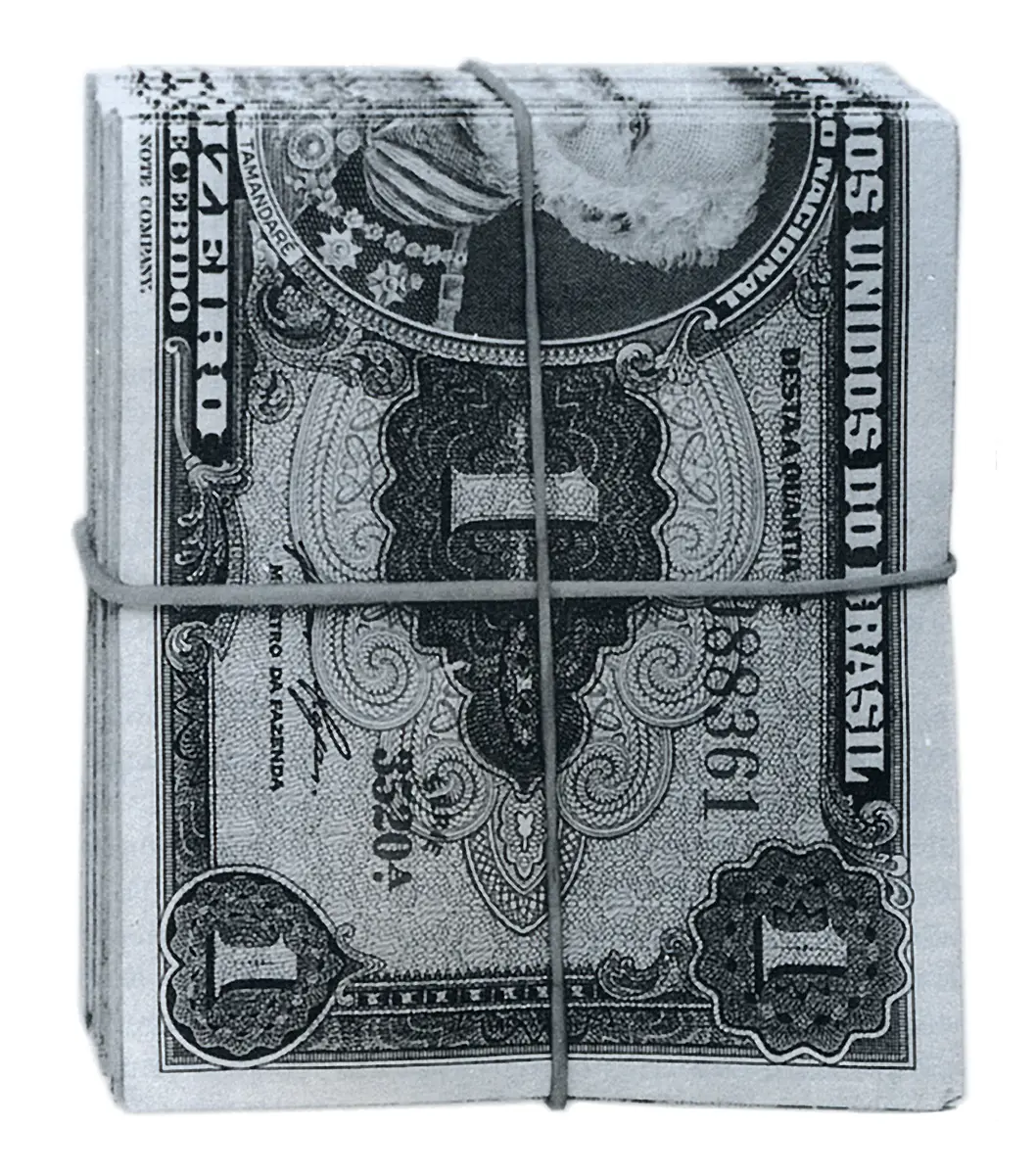
In The Money Tree (1969), the artist explores the differences in the use-value and exchange value of a wad of banknotes, and in Zero Cruceiro / Zero centavo / Zero dollar (1974-1978), produces a fictitious issue of paper money almost exactly the same as that of legal tender, but with ironic differences in detail (such as the caricature of Uncle Sam on the dollar bill worth O). In the case of the bill worth O cruzeiro, the effigy of a patriotic hero is replaced by the image of a native from the Amazon, with a patient from a psychiatric hospital on the other side. Those who have been forgotten in a system of exchange rates become the protagonists of their zero value, i.e., their lack of any value, and their presence, in turn, claims their social and political existence.
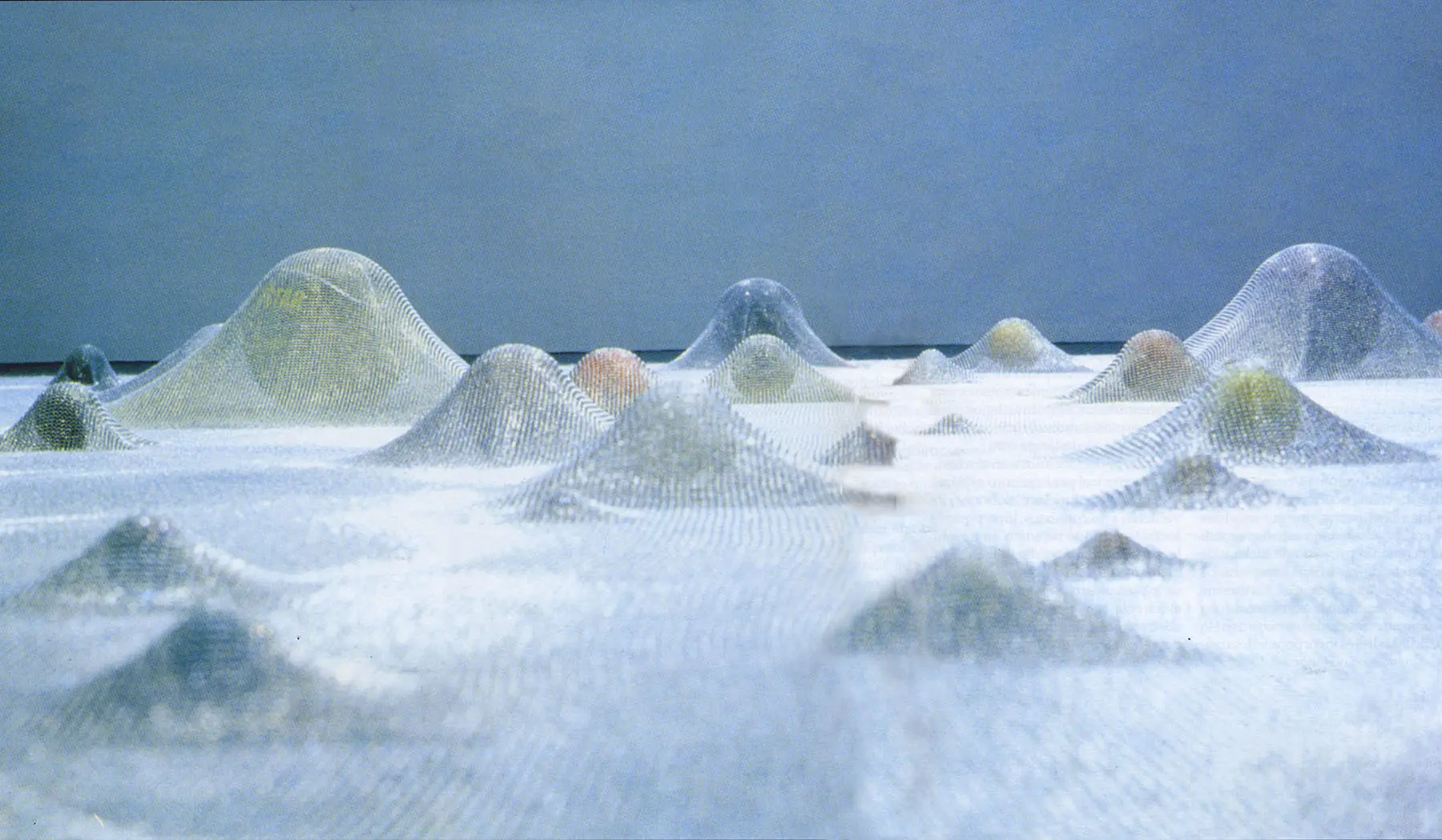
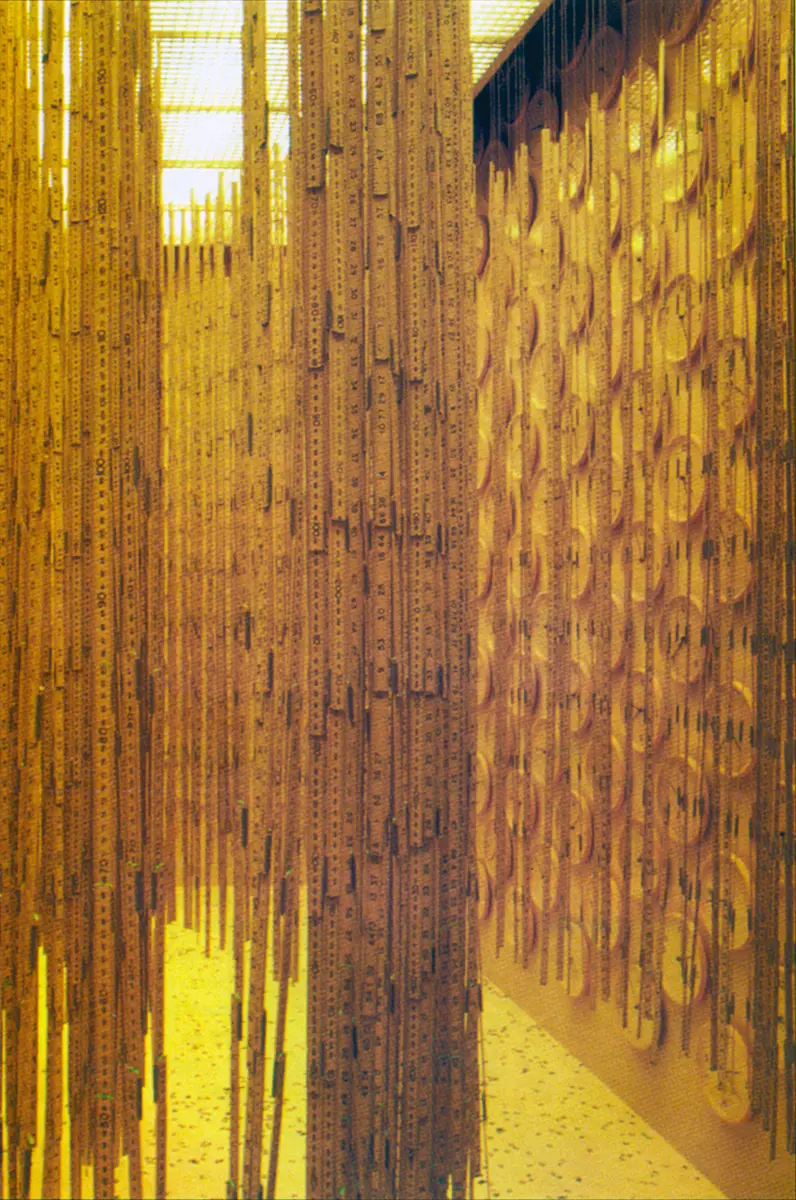
In the Eureka / Blindlhotland (1970-75) project, which proposes a radical analysis of the relationship between time and space in terms of the equivocal relationship between density and volume, space is tactile, sonorous, physical, and eminently mental. It is not a space for perceiving only with the senses, but with concepts, but once again, not in the style of the North American conceptualists, but in a more sensual manner. The same is true of the concept of space and density in Glove trotter (1991), in which a steel net encloses balls of different sizes and colors.
Although at times Meireles' work seems to be excessively intellectualizing, the door is always left open to the “possibility for poetic materialization.” It offers a kind of space for withdrawal, a place for contemplation, and above all, for reflection and questioning.
NOTES
1. Wilson Coutinho, A estratégia de Citdo Meireles.
2. Catherine David, “Da adversidade vivemos”, in the catalog of the exhibition Tunga Lezarts / Cildo Meireles Through, Kunststichting - Kanaal - Art Foundation, Kortrijk, 1989.
3. In this sense, Carlos Basualdo sees the Latin American avant-garde and modernity as a living project within a constant process of evolution. See Carlos Basualdo, “Bodywise”, in Art from Brazil in New York, 1995, exhibition catalog.
4. Catherine David, op. cit.
5. Guy Brett, “Cildo Meireles”, in Tunga/Cildo Meireles exhibition catalog, op. cit.
6. Hélio Oiticica, Anotações sobre o Parangolé, published by the artist on the occasion of the exhibition Opinião 65, Museum of Modern Art, Rio de Janeiro, 1965, and reproduced as an abstract in the catalog of the traveling exhibition Hélio Oiticica, 1992-1994. Spanish edition Fundació Antoni Tàpies, Barcelona, 1994.
SANTIAGO B. OLMO