
Last February, at the X’Teresa Alternative Art Center, an encounter was organized between artists specializing in performance and action art in Mexico and artists from the Latino community of Los Angeles. Although the event was attended by artists whose work is characterized as political, other participants were more interested in the search for personal identity. The project was held in two cities with very different results.
A two-nation event of this kind naturally has an important effect on the establishment of links between the two respective visions. Mexicans and Chicanos are often taken together in the United States art world. Through this encounter, the two groups (Mexico and Los Angeles) were able to influence, through their respective participation, the different approaches and themes. Such an event is rare in the other spheres of the visual arts, where the relationship between artists themselves and the public is a colder one.
The most obvious divergences were apparent in the handling of time. For the Latino artists of Los Angeles, performances usually consist of a series of tableaux or related actions which produce a narrative time edited into sequences. For the Mexicans, the time of action is the same as real time. Things happen in the time required to do them and develop at the speed or slowness with which the artist moves.
Thus, real time and the time of the performance coincide. It can be assumed that the Latino culture in the United States has been influenced by film and the language of television. Actions are executed with a rhythm that requires jumps in time. For their part, the Mexicans lengthen their actions until they convert them into rituals. They display their accessories, make their appliances work, prepare something, and create a sense of expectation.
With one exception, that of Rubén Martínez from Los Angeles, the other performances were choreographed, which did not pose any problem to public participation. Luis Alfaro, well-known for his gay political and anti-AIDS activism, presented a triptych in which he told the story of a homosexual couple. During the first phase of the work, he stuffed himself with little pastries and plunged his head in a bath of water until he lost his breath. Then he went around the auditorium on roller skates, dressed as a woman clothes and telling the story of the homosexual couple. He concluded with a circular offering in honor of those who have died of AIDS. He invited the public to name its victims. The atmosphere of the finale was very moving.
Elia Arce also used a political theme in a satire of Beautiful America. Standing on a stepladder, naked, and with her body covered with sticky tape, she satirized the pro-American singer, gesticulating to an absurd song. Both actions were direct, unequivocally political, with a specific message and target.
Felipe Ehrenberg, already known for his participation in these kinds of things since the 1970s, created a sound environment using tape recorders that reproduced different kinds of music. He shaved his mustache, beard, and eyebrows in front of a mirror. Then he cut the skin of his chest and abdomen, letting the blood run, and lay down on a piece of cloth, where he left a red mark. He covered the mirror with the cloth and broke it with a blow of the hand.
In the case of the Mexican performances, the actions were proposed as a metaphor of some personal situation. The individual confronts an aspect of reality and comes up with a response. The action is not directed at anyone, and the affinities with the public occur, but at the individual level. The artist directs his efforts towards debunking social roles and creating new identities through the use of rituals, such as the washing of feet, in the case of Lorena Wolffer.
Fundamental to the art of our times is the direct relationship with the public. Far from continuing to pay homage to the creator and his talent or work, what counts here is how the work talks to us, touches you, moves me.
Almost any artistic medium can achieve this, or rather could, before the advent of the television age. With electronic communication, we have been marooned in a mass of illusionist images, half-information, and one-way communication. Thus, the mandate of today’s artist is: "Look for good and achieve its transcendence...Not only to make ideas or revelations into substance, but to make these revelations actually important for the public. "1
In the state of skepticism and defeatism currently affecting culture and society in Mexico, it is easy to lose the thread of "what is important," "what counts," "what is relevant." Thus, we should try to define what kind of art we want today. An art which allows us to appreciate differences—those which dissolve in the mass-oriented culture—, a visual art which helps us to understand the world in which we live, an art which allows us to make critical judgments in the light of the evidence and in a spirit of empathy for a given position, an art of action rather than of contemplation.
Performance art already has a history of several decades in Latin America, and it is no longer possible to consider it as something «new» at the risk of making it a further modernist fetish in form to the detriment of content. Our current situation requires a different practice in which the public and the artist find themselves in the same place at the same time, participating simultaneously in the awareness enhancement process. Rather than invent forms, the artist must work and deal with things which already exist and involve the spectator in a situation which belongs to them both.
An example is the performance by Rubén Martínez, in which an AIDS test is applied to the artist just as it might be in a health care center, with replies to a questionnaire on the person’s habits and customs, which achieves the reaction that action art should generate. The people present had probably heard about this kind of test; they know about the disease through hearsay or personal experience, but to participate in the situation as such, without fiction, is a way of living and becoming aware of the problem.
Although all artists are the product of their time and cannot give what they have not received, the fact remains that art must be generous with its public. The interdependence between the artist and the public is especially important: the creator must explore existing territories and themes so as to offer the maximum number of options to his co-participants, but the public too must demand that the artist live (and not merely act) out what he is showing, whether in physical, symbolic, or affective terms.
These three spheres of the presence of a creator in his work are those which give it credibility and encourage the spirit of participation among the public, so that what is being said is not only a revelation but something which involves those present.
The action work by Lorena Wolffer, consisting of washing the feet of her colleague artists with blood and water, generated such an atmosphere that members of the public in Los Angeles began to wash the feet of others, or let their own feet be washed. However, when the action was carried out in Mexico City, some artists refused to participate, and in general, the public was reluctant to cooperate. These differences between the respective publics illustrate the differences between the cultures involved, which is a healthy thing if it is not homogeneous. Nevertheless, it is disturbing that the local spectator should have been more passive.
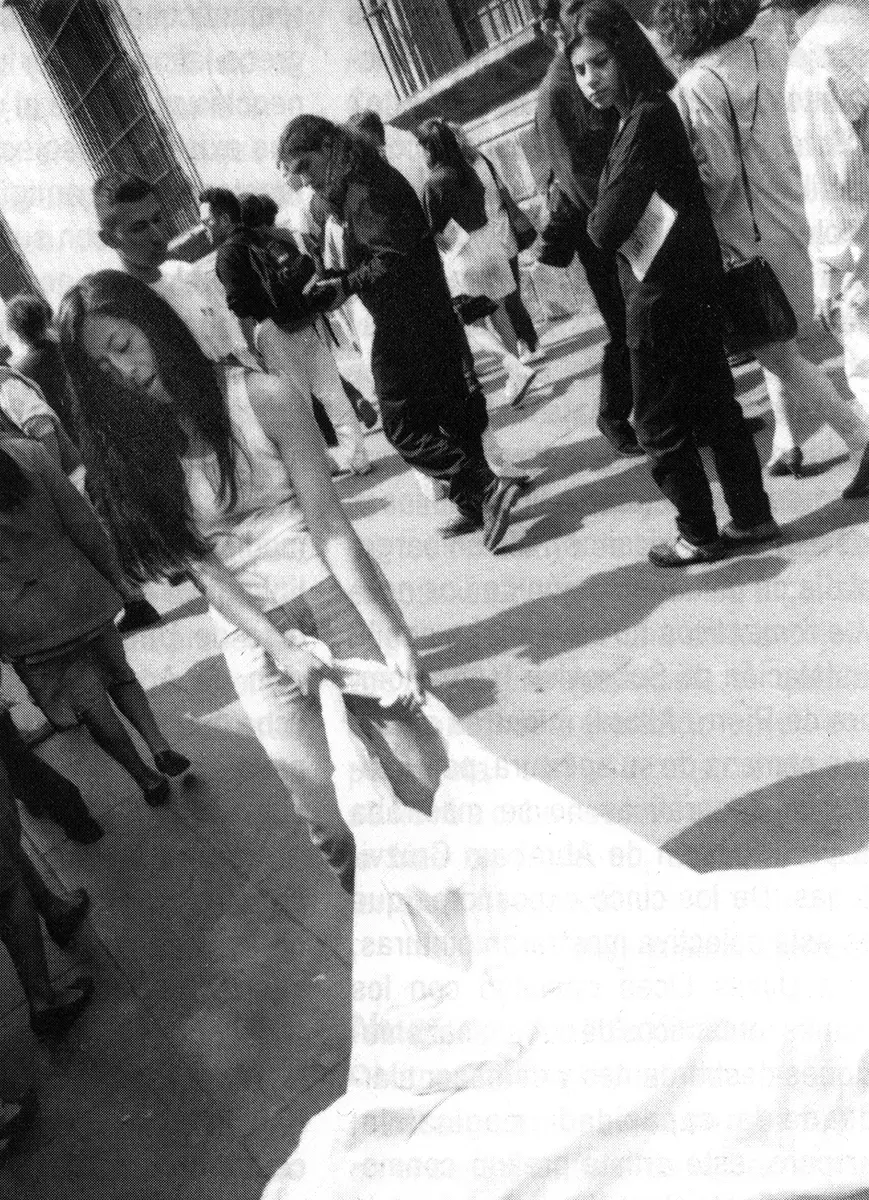
The sense of community whereby art should be created to be useful for its time does not mean that it has to reproduce the conditions for the spectator to identify himself: performance art is a field for negotiation in which the conditions of life are presented and freed, so that each can add or take what he wants. While Elvira Santamaría, in her presentation, dragged along her colleague Eugenia Vargas, the public attending the performance looked on. In the street, however, several passersby helped Elvira with her burden to the final destination, the center of the Plaza de la República, or Zócalo, two streets away from the X’Teresa auditorium. The participation came from people who did not know that it was a predetermined action, but they joined forces with the artists.
There are many forms of action that happen each day around us, and which we would never dream of describing as art. But seeing them through the eyes of art, adapting them to the times of performance, we can see that there is no real separation between art and life and that the most important thing is to name and point out what is happening and affecting us, so that others, too, can participate.
When this happens, art and culture will cease to appear as something we can do without during times of crisis, and people will recognize them as real tools for change.
NOTE
1. Text by Estela Conwill Májozo, in Mapping the Terrain, Ed. Bay Press, 1995.
JOSÉ MANUEL SPRINGER