
Young painter Ernesto Pujol shares with other Cuban artists the condition of exile, in which cultural and national identity are necessarily shaped from outside the island, based on memory and history but also on myth. Pujol speaks of the strong formative influence of his grandmother and great aunt, who, with their stories, provided him with an intimate point of view of Cuba in the early part of the century. Years ago, he began to write these stories down for fear that the oral tradition might be lost. Now the stories take visual form in his paintings. Pujol presents a series of objects, takes an inventory of memories in order to come to some definition of Cuba and what it means to be Cuban.
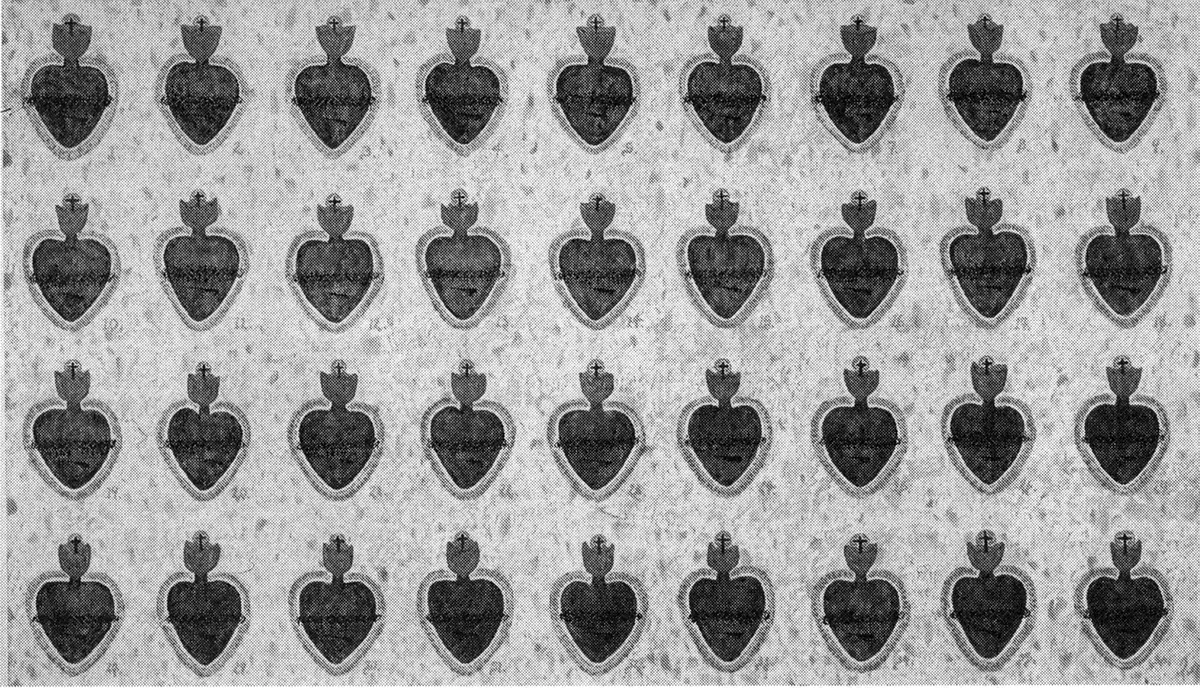
In these family stories, there existed two separate and opposite parts of the same world: that of the Spanish bourgeoisie—interior, cool and familiar—and that of the African slaves—exterior, hot, poor, and savage. The two realities are evident in Pujol’s work. The former is represented by everyday objects, all of them white: underwear, shoes, beds, cradles, tubs, and scissors. These are sometimes set against patterned backgrounds that recall wallpaper and reinforce the sense of domesticity. The latter is composed of black elements set against more abstract, textured grounds: heads of cooks and slaves, roosters, serpents, and knives. Pujol presents the objects in an orderly repetitive pattern, labeling each one with a number or letter as if they were displays in a museum. The apparent monotony, however, only serves to strengthen the impact of the objects, since we recite them visually as if they were mantras or part of a magic incantation. In one painting of a series of black figures, repetition serves also to express the anonymity and oppression of slavery.
While artists such as Bedia take inspiration from the African roots of Cuban culture, Pujol takes an interest in "the myths of the white man." In the paintings with white objects, clothing, and beds always appear with ominous red stains, and the tubs are filled with blood. On the one hand, they allude to the rape of the artist’s aunt—an event that was hidden so as to avoid scandal—but for Pujol, they also symbolize the hypocrisies of this white culture and its legacy of oppression and injustice.
PAOLA SADA