
Within the profound constructivist tradition, which is one of the features of contemporary Venezuelan art, there are numerous artists—especially in the provinces—who have remained outside the official cultural circuit and who have been shunned by the main exhibition venues. The work of these artists is, at times, measured and patient, a decanting of a personal language in the difficult process of construction with pure elements.
This is the case with Gabriel Marcos (Caracas, 1938), whose sculptural work, based on solid and uninterrupted research, is known and appreciated by only a few specialists who have disregarded the prejudiced views of the avant-garde and have seen quality in his work and the strength—the fine aggressiveness—of his sense of volume.
Francisco Da Antonio, curator of this exhibition, notes these special features of Marcos in the catalog introduction and the fact that he has remained on the margin of our contemporary art, despite his long career extending over the last four decades of our century, his uninterrupted research, and the authenticity, elegance, and quality of his work. Marcos began to work in sculpture in 1966, after a brief passage through painting. In fact, his works from that time were, rather than sculpture in the strict sense of the term, "colored objects" which allowed him to explore the possibilities of volume and which subsequently took him to the world of sculpture.
His first sculptures (from around 1970) were pieces coordinated with a motor in which the artist explored the movements of rotation, transportation, and gravity. Subsequently, in 1978, he presented his first Articulating Structures, anodized aluminum "pieces made up of inter-exchangeable modules inside a cube; both the cube and the modules were cut at different angles, which made the forms variable; the articulation of the parts in turn modified the structure."1
On the basis of this idea, Marcos has constructed articulating sculptures in which the construction emphasizes the sense of directionality. In works such as Gamma, for example, this directional emphasis created by the paralleled bodies is enriched by the articulation of fragments of these bodies, which, with their capacity for manipulation, counter the predominating lines of force in each piece. This, in turn, creates a dramatic tempo, a tension leading to a formal climax.
In Ithaca, the directionality of the "main" volume is offset by the intervention of other directional lines marked out by other volumes, where the obliquity differs from that of the main volume by only a few degrees. In the same way, the artist perforates the parallelepipeds with lines that follow the direction of the mass or with abrupt horizontals. The result is a work of delicate tension, a piece of measured and palpitating beauty.
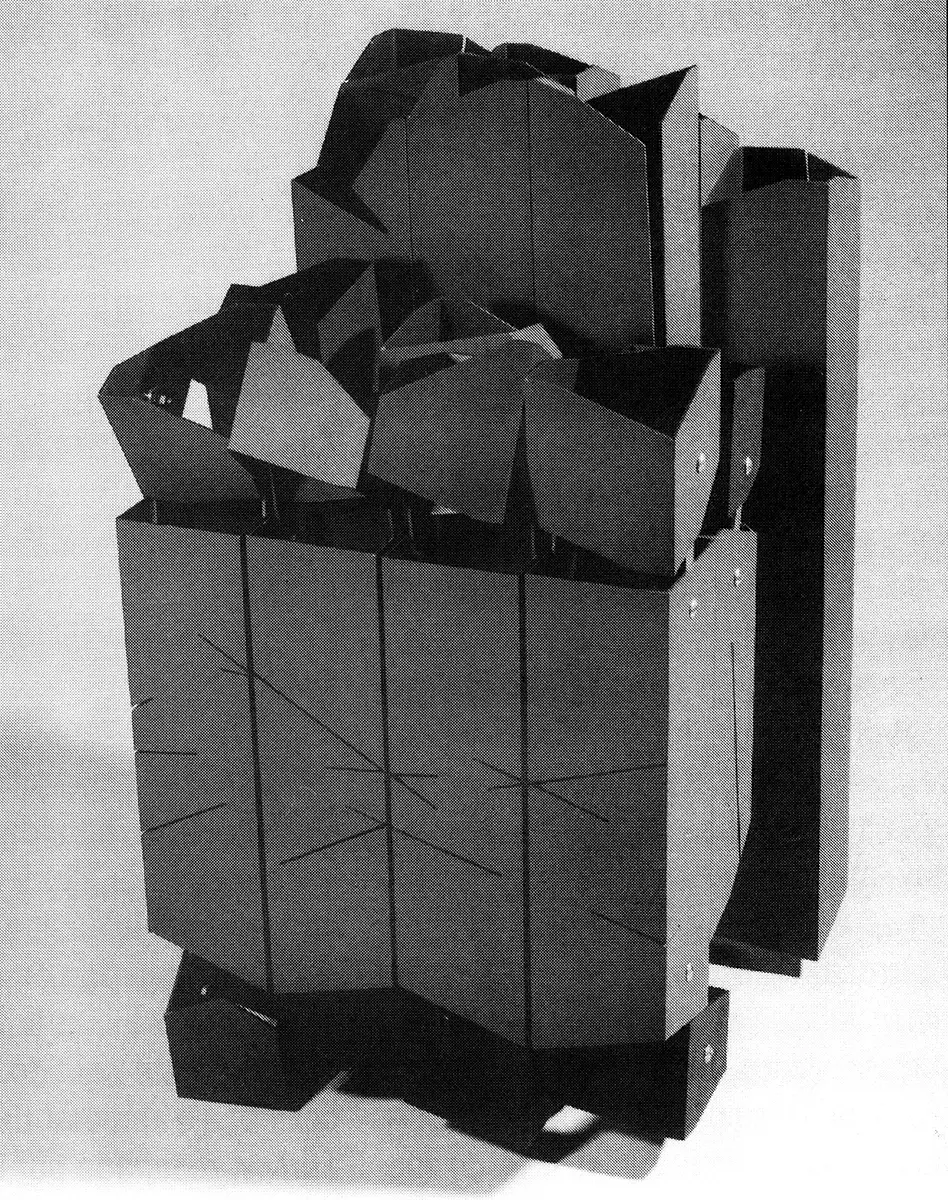
This exhibition by Gabriel Marcos, the first show of constructivist art in the Arturo Michelena Museum (Michelena was our greatest nineteenth-century artist), was, as Da Antonio pointed out, "not only a well-deserved act of justice, but a genuine 'celebration of the spirit' and a public demonstration of recognition for a poetics whose voice belongs to our grand history."2
NOTES
1. Gabriel Marcos, quoted by Francisco Da Antonio, "Una poética para el espacio urbano," Foundation of the Arturo Michelena Museum, Gabriel Marcos. Una poética para el espacio urbano. Esculturas 1976-1994, Caracas, 1995, P-12.
2. Op.cit. p. 3.
KATHERINE CHACÓN