The French anthropologist Marc Augé once wrote: "Post-Modernity transforms the ancient (history) into a specific spectacle, and the same is true of all kinds of exoticism and local particularisms."1 Marc Augé was here reflecting on the substantial value of primitive anthropological space and the restricted place into which ancient spaces are cataloged, classified, and raised to the category of places of memory by modernism.
This idea of the sterilization of history through its transformation into a spectacle is accompanied by a reflection on the non-places produced by Post-Modernity, places characterized by the accelerated circulation of people and goods, such as airports, stations, highway intersections—which offer an unprecedented historical experience of solitary individuality and non-human mediation (a billboard or screen is enough) between the individual and the public domain.
These non-places, which form a context of dehumanization for life today, generate different reactions, anxiety, protests, the search for lost equilibrium, and ways out of this historical period whose essential mode is one of excess, the endless overabundance of events, objects, times, and hermeneutic investigation.
When we look around us, we see that there are artists who, conversely, offer us keys for the recognition of those extraordinary symbolic universes which we have inherited and which are grounded in a language that reflects the idea of the Italian philosopher Gianni Vattimo that "ethics is a reference to roots which justify discourse."2 This external accumulation, internal void, and vertiginous sense of time have led some artists to turn towards these anthropological spaces, which are organized through the relationship of man with the world as an existential place, a place with meaning.
Among the artists who have used the life force of poetry to render history incandescent, we find the Argentinian sculptor Hernán Dompé. During his first period, closer to figuration, he created warriors bearing stones in their hands. The stones could be read as symbols: stones fallen from heaven, sacred stones, stones of thunder, of lightning, which are equivalent to prehistoric flint axes; and the axe has from the earliest traditions of mankind, been associated with the symbolism of stone and thunderbolt.3 It is precisely the theme of weapons and axes that was to play an important role in Dompé's subsequent production.
The warrior figures with their features suggesting the ancient races of the Latin American continent disappeared from his work in 1980 after a trip to Peru and Mexico; the stones were now used as a kind of crown for his new sculptures, as in the work which won him the Esso Prize in 1982.
It was at that time, said Dompé, that the abstract element acquired a kind of root-like character: it was germinal, an archaic nucleus.
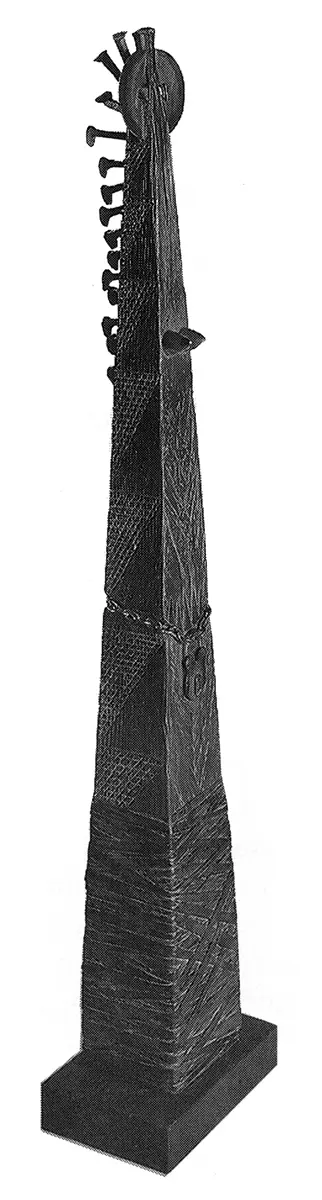
Although this trip led to the disappearance of figuration from his work, the warrior remained implicit in the world created by Dompé—a world of aggression and power, of strong, virile affirmation, made up of lances, crossbows, bows, spikes, pikestaffs, and crest-like forms, in which he gave full rein to his imagination.
The figure of the warrior returned, however—personified by himself—in an installation which Dompé carried out in collaboration with Remo Biancheti in September 1986 in Buenos Aires.4 Entitled Block, the accompanying brochure included the comment: "Full stop, end of the party, turn of the century. Lightning rod. My thoughts are with you."
Both artists worked in two and three dimensions in this exhibition, which needed to be viewed as a totality, that is, from within. It did not present the violence of contemporary technology, but rather used crossbows and arrows as traditional weapons, signs of man's centuries-old aggressive behavior. The idea of recurrent human violence was reinforced by the use of a video in which Dompé, dressed in black leather, fired arrows one after the other.
The arrow recalls the suffering of St. Sebastian and, through him, all the iconography of martyrdom. In the paintings, the bloody feet alluded by metonymy to the human body wounded by implacable human violence —the feet of Christ on the cross being the greatest example.
The installation reflected certain constant features of Dompé's work: fragmentary allusions which are never made overly explicit and the association of present and past (with emphasis on the former). Indeed, the video introduced different time scales and stressed the relationship between the reality of the sacrifice and its simulacrum. There was a further interplay between language and meaning in the denunciation of violence on the one hand—homo hominis lupus—and in it playing a lead role in the video on the other.
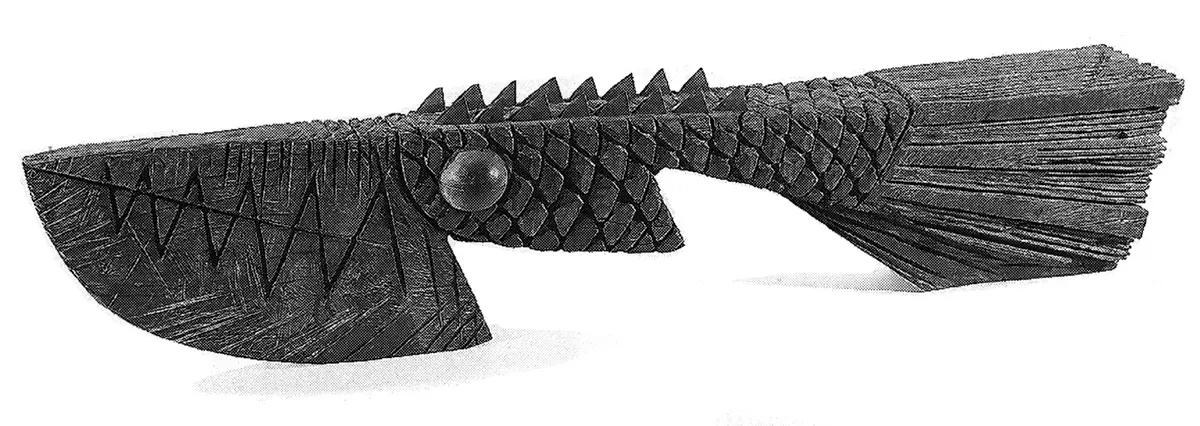
From this point on, Dompé's work becomes polysemic, with time and cultural space multiplying in the interplay of mirrors, creating a cascading, chasm-like effect.
In his early works and in the installation, there was an implicit idea of adventure that required a protagonist. The heroes are warriors who use weapons, who travel the seas, who nourish their own mythologies, and fascinate the collective imagination. Joseph Campbell has said that the hero's conduct is a constant breaking of the crystallization of the moment, with the hero becoming the champion of creative life.5
There is an almost obvious similarity here with the artist and his power to endow reality with meaning, to resume the unending exploit of creation.
But there is no nostalgia or neoromanticism in Dompé's vision of the past or in his conception of the artist. He explores anthropological structures that are related to our oldest traditions, using deliberately primitive forms to emphasize his desire to penetrate deep and to show our relationship to a historical world.
History implies roots, tradition, and the continuity of man's presence on earth. Dompé's erect monuments seem to reconfirm this will for permanence and persistence in the effort of humanization.
In his work, the artist also seeks out the mark, the sign, the trace, and the wounding of the material as testimony of man's fragility and precariousness.
This antithetical interplay between permanence and precariousness gives considerable seriousness to Dompé's work and the mobility of his inevitably postmodern view. It is a view which, in many cases, through humor and the ludic spirit reflected in the distance given by emotional and non-discursive irony, emphasizes the moment from which he embarks on his cultural chronicle.
Sharp like his spikes and crests, his irony becomes increasingly unbridled: his references are more elliptic and the use of recycled objects more and more delirious.
This is perhaps one of the keys to his freshness and spontaneity: his ability to generate a sense of play and astonishment, his imaginative unease which appears to linger on certain topoi but which in fact is continuously transforming them. Although these topoi (totem, knife, etc.) emerge from the magical transformation of everyday objects or fragments into poetical acts, they are subsequently transmuted as though they themselves generated one another in an unending process, through nascent and ever-new appropriations or inclusions, through the trigger of Dompé's imagination.
As regards the concept of the artist as creator, as craftsman, it is worth recalling a remark by Giulio Carlo Argan: "art is doing, doing in the best way, but in the end doing." When Dompé was a child, his aunt was a librarian at the Higher School of Fine Arts in Buenos Aires. She used to take him along with her once a week, but he always stayed where there was clay, in the ceramic and sculpture workshops. He grew up in an environment of manual work, a world of carpentry, smithies, with cars, boats, and agricultural tools, and he was always very interested in discovering the energy of the objects around him. He saw work as something sacred, as a kind of purification by fire.
His discovery of the energy of waste products led him to seek them out at every opportunity, to collect them and then use them with patinas, resins, trompe l'oeil techniques, and very elaborate modifications of form which revealed coincidences, unusual encounters, and unexpected surprises.
It is precisely this energy, as perceived through the physical sensuality of his materials, that kept him away from any idealization or nostalgia and led him to establish an ever-active and creative link with the past.
Another enriching aspect of his experience was a trip he made to the United States on an Esso scholarship. Because of the circumstances in which artists live in Argentina, his studio in Buenos Aires was very small. His trip to the United States brought a change of scale. He had the opportunity to see an exhibition of 400 sculptures by David Smith, the work of Noguchi, and the Hirshhorn Museum. He also found himself before enormous canvases by Kiefer and Baselitz, seven meters by four. He became aware of the monumental scale and felt comfortable with it. His training in New York also enabled him to discover a sense of freedom, of total independence from current trends and fashions. This experience verified his idea that sculpture has no limits.
Perhaps his insistence on not limiting the flight of his imagination and freedom can be related to the places in which he has chosen to work: a studio in the mountains of Córdoba which offers him a sense of solitude and another in the heart of Buenos Aires, where he can draw on other sources of inspiration Dompé himself has said that in developing each work, he discovers a point in which he can begin to perceive the strong voice of the object itself; from this point on he shares in its growth until a dialogue is finally established. As he builds his works, he feels he is carrying out a ritual. He creates an inner narrative, which he develops as he does the assemblage. Dompé perceives these narratives sometimes as a form of delirium, coming from some inner voice and displaying itself in settings which produce unusual encounters.
There is no sense of disjunction in his assemblages; his use of fragments is always directed towards a synthesis which gives the work a contained sense of power and tempered drama.
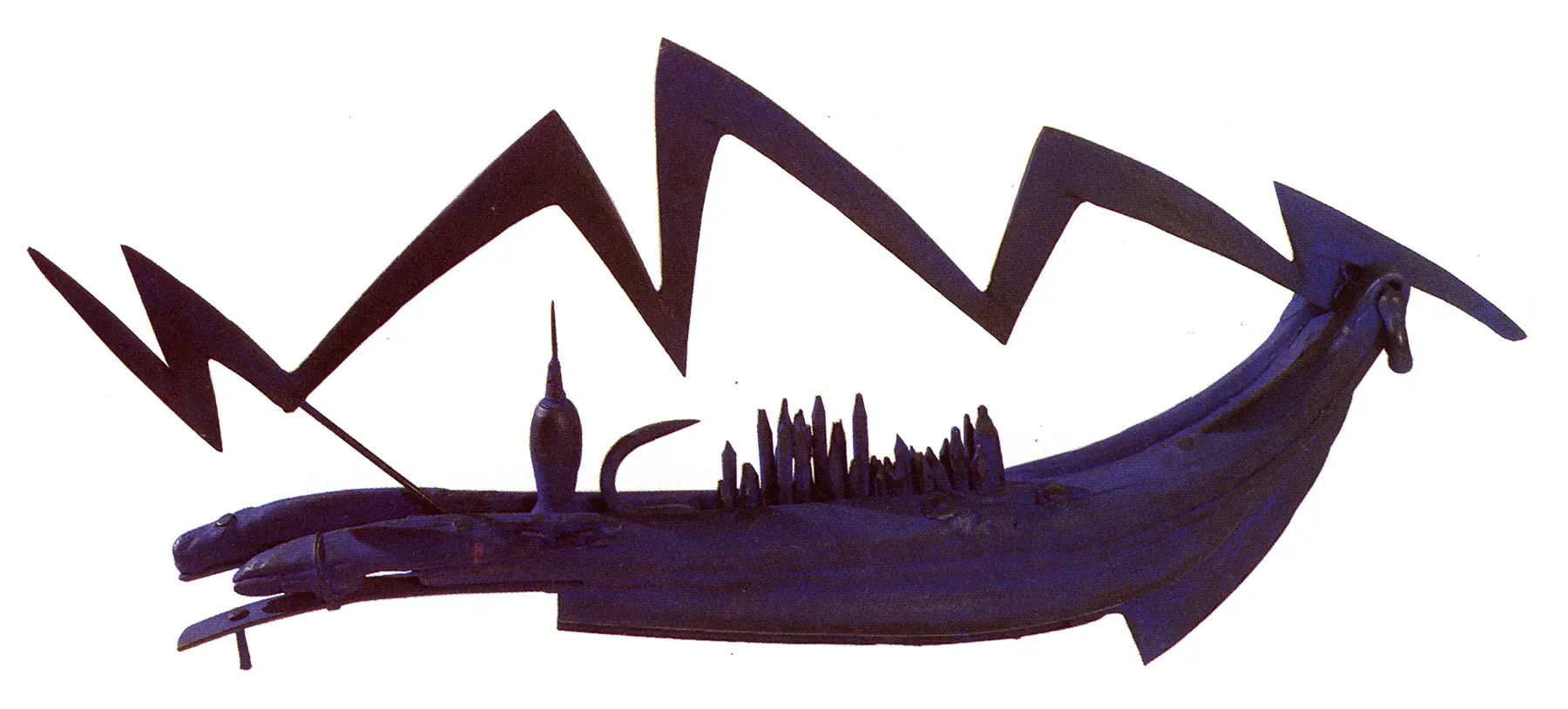
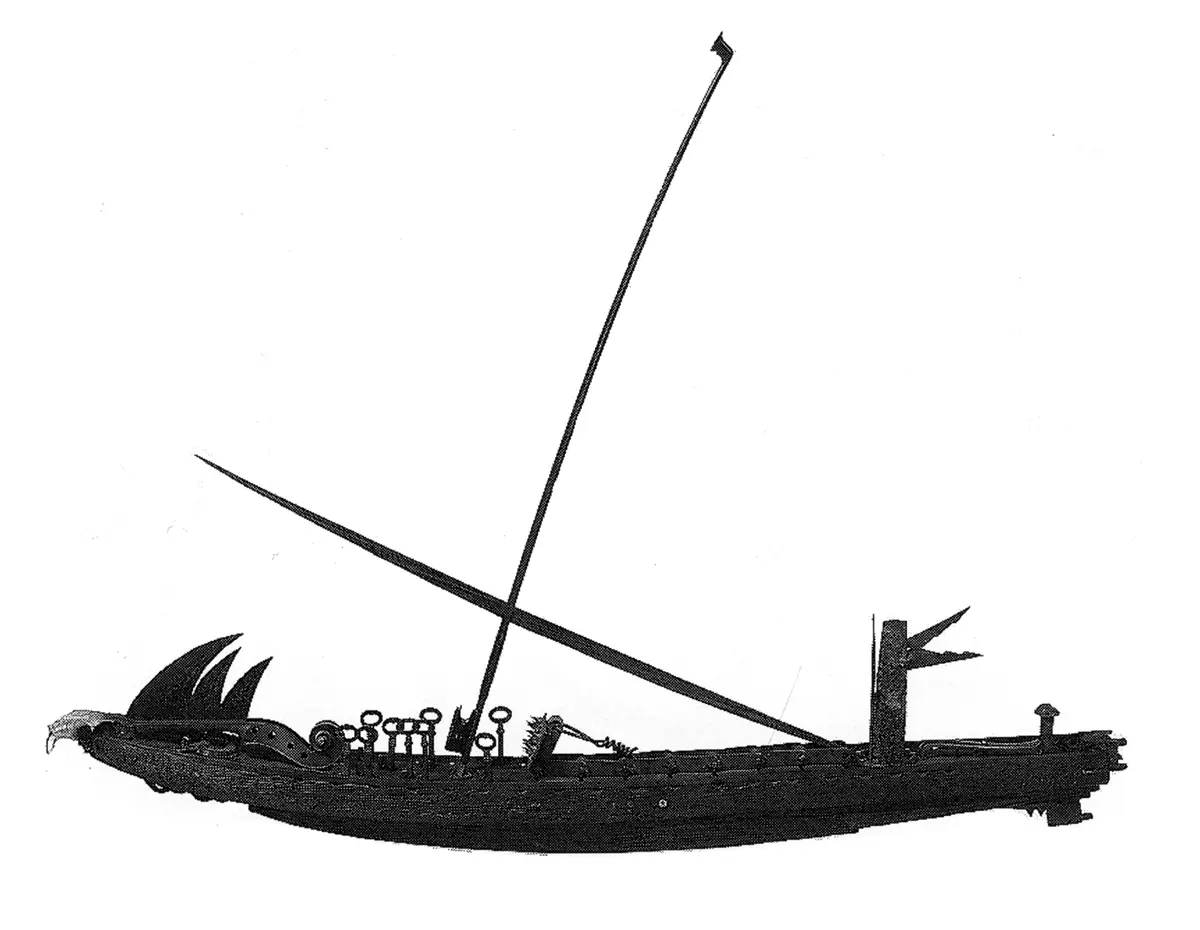
These resemanticized fragments sometimes become frightening extrapolations, such as the bones and teeth, which can be seen as the bow of a ship, or more playfully, the ancient keys, which become deck elements, or a spur, or half a horseshoe, all of which help suggest the almost legendary profile of a ship.
Ships, like axes, are often linked to the idea of thunderbolt, both because of the dynamism of form and the actual titles of the pieces, such as Thunderbolt in the Prow, Axebolt and And a Mysterious Thunderbolt (this last reference is full of subtle irony, since it is a reworking, totally out of context, of a line from a famous song by Carlos Gardel).
The symbolism of the thunderbolt is related to the masculine principle of universal power: it was the main attribute of Zeus in ancient Greek mythology and of Indra in the Veda mythology.
This male world in Dompé's sculptures is further reinforced through the knife—which, as an instrument for cutting and carving, is the active force that modifies passive matter—and the lance, an axial phallic symbol of both fire and war.6
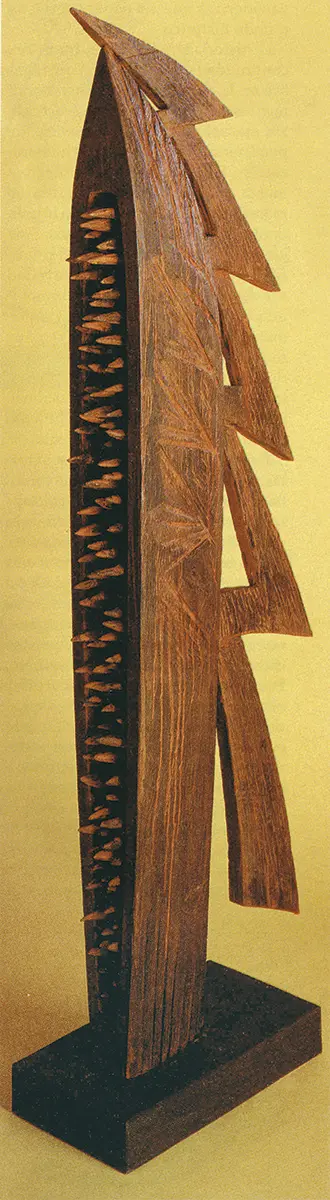
The theme of the labyrinth, the complex symbolism of sacred rites of initiation, appears sculpted in the stone, marble, and wood of his totems or monumental figures. This male world is complemented by certain tools and implements: Pincers, Shovel, Pick.
The female world is also present, with its clear sexual attributes and playful use of analogy and, as in the many Women Friends series, by inverting Duchamp's painting La mariée mise a nue, in which the female figure predominates over the anonymity of the many bachelors. Another note of irony is reflected in the title of one of the boats—The Queens of La Plata. The sculpted wood, pigmented or burned, stone and marble, iron and resin, rags, string, paper, leather, and laminated copper are the materials that Dompé uses in his impressive vertical sculptures and horizontal boats, which sail only through the imagination. In his black pieces, Dompe uses a chipping technique, which is a form of direct cut that can be applied to stone with a certain angle of break.
In 1989, Dompé did a series of boxes which he called Vaulted Niches, structures ending in triangular forms full of extraordinary drama.
His series of drawings, Cosmic Encounter, his Ritual Place, his totems, and his sacred conception of the workplace all indicate an effort to preserve the sacredness of space, a recognition of the vital incandescence of magic as a liberating power in the human spirit. Hence, his relationship with chance and hazard, the occult, obscure, and hidden dimension, his attraction for the irrational and mysterious.
Apollinaire once said: "When I speak of time, it no longer exists."7 Sacred time and space have other dimensions, and the diachronic game of time has immense possibilities.
To appreciate the work of Hernán Dompé in its widest sense, we have to be aware of the dangers it holds: the risk of succumbing to aestheticism, and derivative production, of lapsing into vacuous «neo-archaisms», «fantastic» concepts or stereotypes which on more than one occasion have constituted the answer of countries on the periphery to the paradigms of the centers.
In conclusion, Hernán Dompé is a unique artist of considerable creativity, both within and beyond his native land.
Photos: Courtesy Der Brücke Gallery.
NOTES
1. Augé, Marc, Los "no lugares". Espacios del anonimato, Ed. Gedisa, Barcelona, 1993.
2. Vattimo, Gianni., La sociedad transparente, Ed. Paidos Iberica, Madrid, 1990.
3. Guenon, René, Símbolos fundamentales de la ciencia sagrada, EUDEBA, Buenos Aires, 1969.
4. Jacques Martínez Gallery, Arte Contemporáneo, September 2 - 27, 1986.
5. Campbell, Joseph. El héroe de las mil caras. Psicoanálisis del mito, Ed. Fondo de Cultura Económica, Argentina, 1992.
6. Morales y Marín, J.L., Diccionario de iconología y simbología, Ed. Tauris, Madrid, 1984; Rodríguez Santibáñez, P., Diccionario de las religiones, Ed. Alianza, Madrid, 1989.
7. Quoted by Baudrillard, Jean, in Olvidar a Foucault, Ed. Pre-Textos, Madrid, 1978.
NELLY PERAZZO
Critic, professor, and historian of Contemporary art. Member of the Argentinian National Academy of Fine Arts. Curators of the Libero Badii Collection for Credit Bank Foundation, of Argentina.