
Though it has become fairly common to see "unfamiliar matters" within an art gallery, what José Antonio Hernández-Díez has created for his installation in New York can be startling, nonetheless. The centerpiece of this exhibition is a group of objects uncanny in their visceral effect. They are described by the artist, perhaps half in jest, as "cyberpunk" skateboards —skateboards fashioned from pieces of fried pork skin which are browned, crinkled, and still dripping with grease. The pork skins, known commonly in Spanish as chicharrón, are a popular food item in the artist’s native Venezuela as well as in other Latin American countries. While Hernández-Díez’s use of organic materials brings to mind the work of some artists, such as Damien Hirst, his unusual assemblages go beyond mere spectacularization. Here, dead flesh is manipulated and transformed, with wheels grafted onto suggest potential reanimation. The skateboards evoke at once the degradation of the body and its perverse transubstantiation.
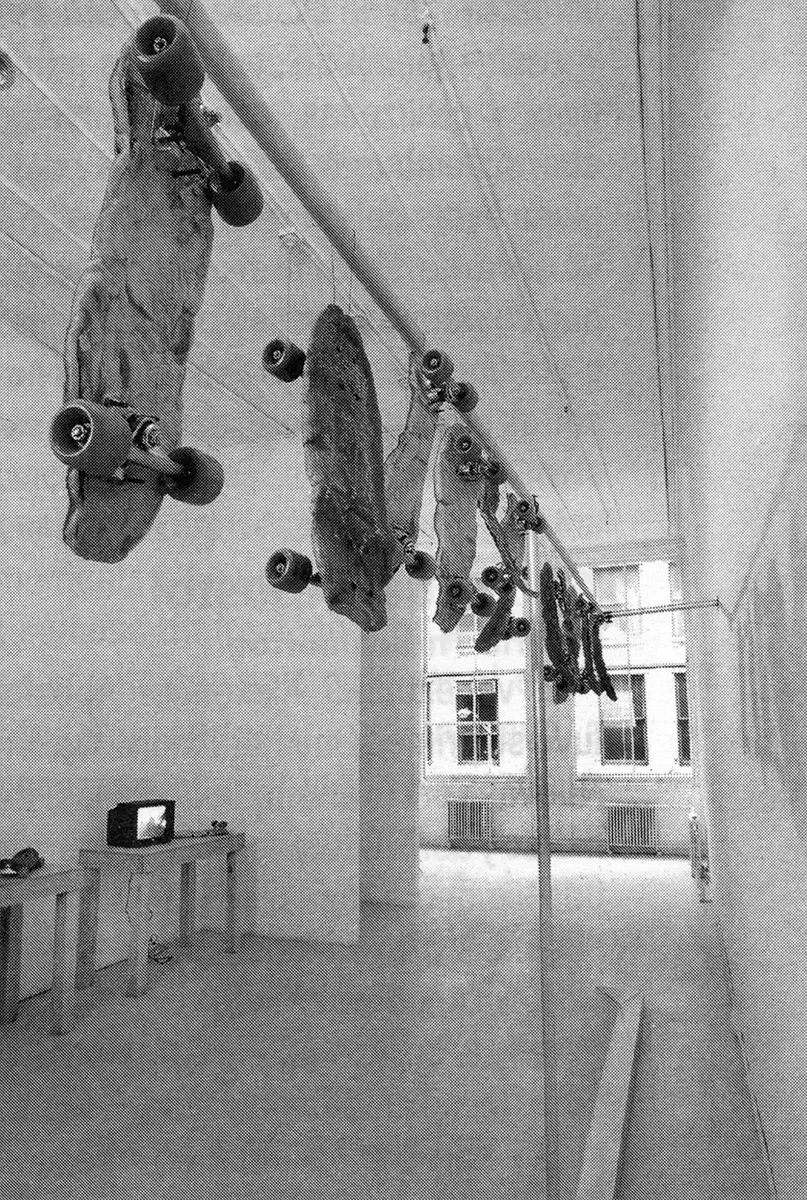
These oddly arresting objects are incorporated in different ways in the installation’s two major components. Along one wall, 12 skateboards are strung up on a T-shaped steel post, with two narrow troughs placed beneath on the floor to catch their grease. The fleshly skateboards dangle high up in the air like corpses after an execution, their effluvia tracing the process of decomposition. On the opposite wall, the artist has assembled a video tableau consisting of three different stations, each with a skateboard and a monitor placed on a table. In the first monitor, a skateboard fries in boiling oil; in the second, it rolls on and on along a street pavement; and in the third, it lies on the ground, licked and gnawed at by street dogs. According to the artist, the three stations may be interpreted as the stages of birth, life, and death. The graphic image of the hot oil and of a skateboard in perpetual motion, without a rider, expands on these analogies and suggests others as well—pilgrimages and the ceaseless journey of life; food and the satiation of bodily needs; fire and the punishments of hell.
Hernández-Díez’s installation is compelling precisely because its multiple associations do not settle into one set of simple meanings but continue to trigger others. In view of the artist’s previous body of work, such as the exhibition Saint Guinefort and Other Devotions in Caracas in 1991, references to religion—to its metaphoric structures and central preoccupations—inevitably come to mind. At the same time, the artist’s meditations on life and death are refracted through a new lens, that of the technological landscape of our times. The fluorescent colors of the skateboard wheels, the sleekness of the industrial materials, and the unnatural glow of the video screens all juxtapose starkly against the corporal body that is presented with such heightened sensorial effect in this exhibition. The conjunction of these seemingly discordant elements—spirit, body, technology—results in powerful reverberations which address our present-day longings and anxieties.
That the artist initially produced the work for a specific group exhibition context renders our reading of it even more layered. Prior to its New York showing, the installation was seen as part of The Raw and the Cooked, an exhibition organized by the American curator Dan Cameron for the Reina Sofía in Madrid. Hernández-Díez thus responded literally to the exhibition’s title—a reference to the seminal book by Claude Lévi-Strauss and his schema of primitive and civilized societies — with a project, however, that disobeys and dislodges such binary categories. In Hernández-Díez’s work, there is no longer a simple return to a raw or pristine body, as much as it may continue to attract and haunt us.
ALICE YANG