
Manuel Ocampo makes his first appearance in Canada at the MAC, with twelve mid-size and large-format works. Ocampo had little studio art university background, and his most serious art experience was at age 15, when he started faking antiquated colonial paintings and religious icons, and selling them to foreign dealers and tourists.
The 29-year-old, self-taught artist irons a variety of movements from Colonial Art, Folk Art, Surrealism, Pop Art, to Neo-Expressionism to become an Independent Artist. "My work is a statement, the message is very personal, and it is about my cultural background as a Filipino with all the religious imagery."1 His iconography is political and anti-colonialist, based on the domination and indoctrination of his homeland by the Spanish (300 years), Americans, and Japanese. His highly provocative work has a strong visual presence, using symbols: crucifixes, thorns, skeletons, swords, coffins, skulls, devils, and snakes. Combined with German and American oppression symbols, swastikas, and Klansmen in their hooded uniforms. Of course, using this imagery, his work provokes the viewer to react in some way, but what on the TV news or in daily life does not demand our strong reaction?
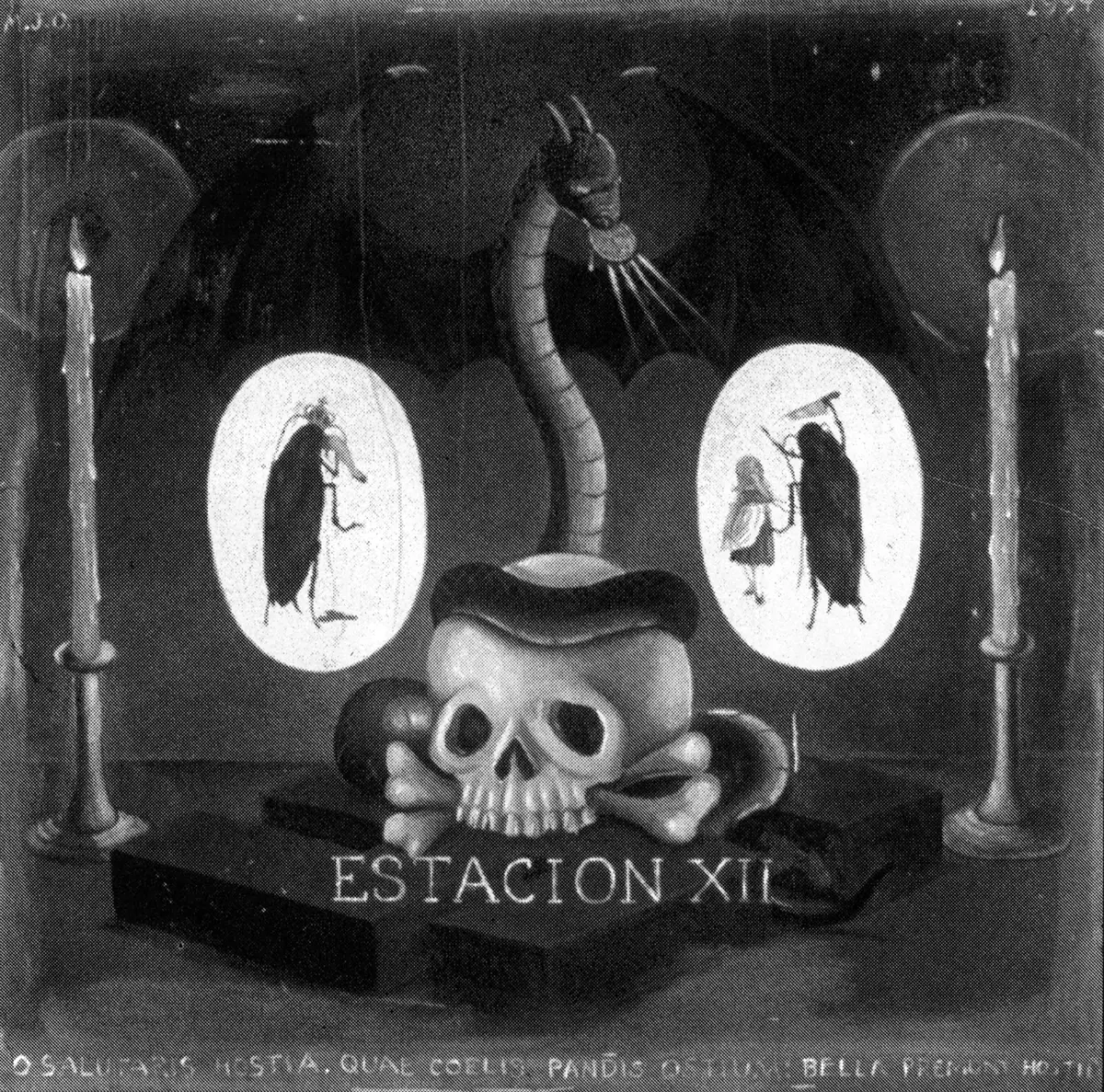
Ocampo put emphasis on writing on his paintings, to send a stronger feeling to the symbols and imagery, it could be Arab, German, or Spanish; here he accomplishes his intentions not only visually but on meaning. well. On Fifth Station (from his series of the Stations of the Cross), the German writing on bold nazi lettering complements the Klansman with a sword in one hand and a justice scale on the other, sitting on a globe carried by two black children with angel features, as in colonial paintings. "I hope that viewers also see the absurdity, humor, and fatalism in the images I portray.2 The raw technique used in False Gods for True Believers / Eleventh Station can not match the painterly technique he used when copying the colonial paintings. In Christus Bei Gottvater Fürbitte Einlegend (Christ in the Name of the Father Pray for Us), a Klansman is descending on a white horse, while in the background, the city below is on fire as a kind of Apocalypse. A humanized horse is sick in bed with a bottle of cognac in his hand, in You are a Soul / Seventh Station.
His other visual language is more like newspaper editorial cartoons; they are monochromatic, full of symbolism, and intense, as in Prognosticatio, where a Klansman is at center stage carrying a huge swastika over his shoulder.
"Ocampo’s overall view of his paintings gives a sense of old-looking or aged artificially, but the artist explains, Actually, I don’t age the canvas, although it appears that way. I think of it as more like beating up the painting, giving it a beaten-up and weathered look. I don’t like the idea of art being too precious."3 Ocampo uses stains and drippings on most of his paintings to break the tradition of using these techniques only on abstract painting, "I want to subvert the language of painting and of colonial painting."4
NOTES
1. Interview with the artist, February 1995.
2. From the catalog exhibition of Paraíso abierto a todos at The Mexican Museum, April- July, 1994
3. Interview with the artist, February 1995.
4. Interview with the artist, February 1995.
AUGUSTO CHIMPEN