The definition of an expression of the problems of women, as seen from their own points of view, was one of the achievements of the new Cuban art1 which revitalized culture on the island in the 1980s. It appeared outside any feminist program, as part of the both subjective and social concerns of the new art. However, works such as those of Yaquelín Abdalá, Lidzie Alvisa, Magdalena Campos, Ana Albertina Delgado, Rocío García, Marta María Pérez, Magalis Reyes, and Sandra Ramos present a number of features usually associated with feminist art, and project their bodies and the personal towards a discussion of social and cultural problems. But they reject the feminist label, curiously for the same reasons as Chilean artists who developed a deconstructivist art in their country. Almost all believe that this term and its programs restrict them by reducing the work from the rank of superiority of the general and universal (masculine) to the rank of inferiority of the specific and particular (feminine),2 disparaging and discriminating against their work as "women's art."
This non-militant development may seem ingenuous when we recall that the criterion of artistic "quality," as Richard notes, has been forged by the hegemonic discourse of the universal-masculine school.3 But at the same time, it does give spontaneity to the works. In the case of the Cuban artists, it must also be remembered that the Revolution brought about a massive integration of women into social life and promoted their equality with men —even reflected in the legal details of the Family Code. It thus proclaimed the same objectives of equality advocated by the so-called feminist movement, but as part of a revolutionary program from the vantage point of power. However, Cuban society continues to be one of machismo and power, despite its Marxist-inspired program for women, which is structured in terms of a phallic-centered military authoritarianism based on the patriarchal figure of the chieftain.
Marta María Pérez (1959) was the first Cuban artist to work with her own body and in the immediate context of her experience as a woman. She is also the only artist to use photographs for this purpose, using her own image. She began with her experience as a mother, from her pregnancy in 1986. She used these experiences in her series To Conceive (1986-87), about gestation, in Memory of Our Baby (1987- 88), which is like a photographic album on her child's birth, nursing, and development, and in a third series on the relationship between mother and child. These three series established a direct link between her intimate life and art, providing a living discussion of her own experience. The works provide a physical vision of motherhood, made up of cries, liquids, and scars, stripped of its lyrical elements. At the same time, she created a tense and ambiguous relationship between that experience and various popular beliefs.
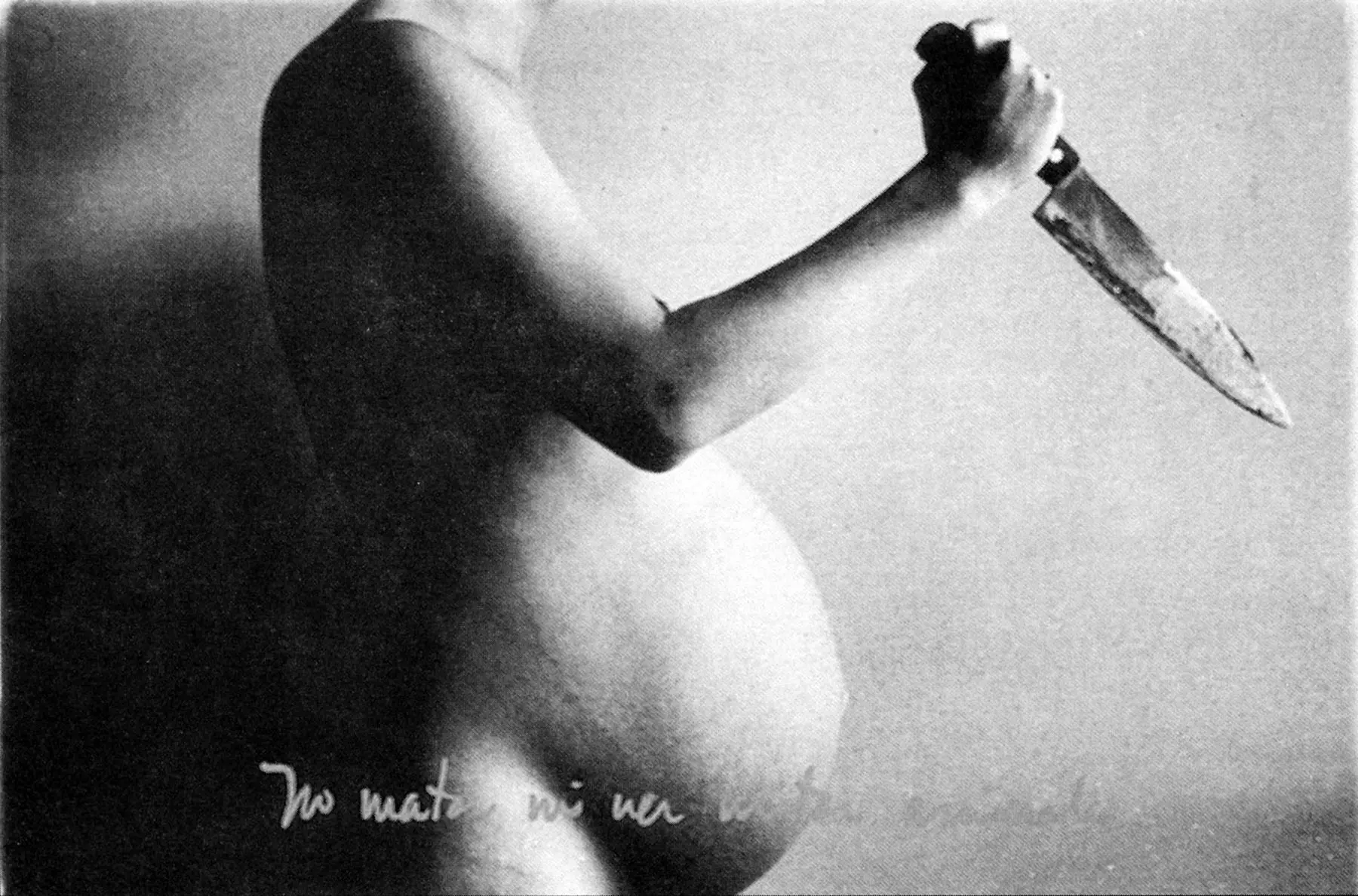
Her work has both a testimonial and an emotive aspect. The anti-romantic view of maternity, based on the "objectivity" of the body, is communicated by visual tropes. In her art, physical elements appear alongside imaginary ones, personal elements alongside myth-making references, and testimonial photography next to ritual. In her first series, Pérez sought to contradict the protective taboos of motherhood, in real acts that placed her in mystic danger of her own pregnancy. Perhaps the Cuban artistic photograph that is best known after those of Che Guevara is one from this series, in which she appears in profile, brandishing a knife, her abdomen swollen with her advanced stage of pregnancy. The fusion of Afro-Cuban religiosity with the feminine experience through the physical was developed towards an anagnorisis of the body in terms of the santeria and palo monte cults. The body was thus made into a metaphor that expressed, through art, intuitions about the world characteristic of those two religious-cultural beliefs of sub-Saharan origin.
This is the only case of "feminism" based on Afro-American cosmovision. It is, furthermore, an example of the interiorization of these visions in the new Cuban art, which uses them conceptually and in close association with other contents to make statements about contemporary experiences and situations outside the realm of "primitivist" poetics. Then there is the equally powerful potential of photography as a means of ritualization, which, although seeking artistic objectives in Western terms, is in fact determined by other perspectives.
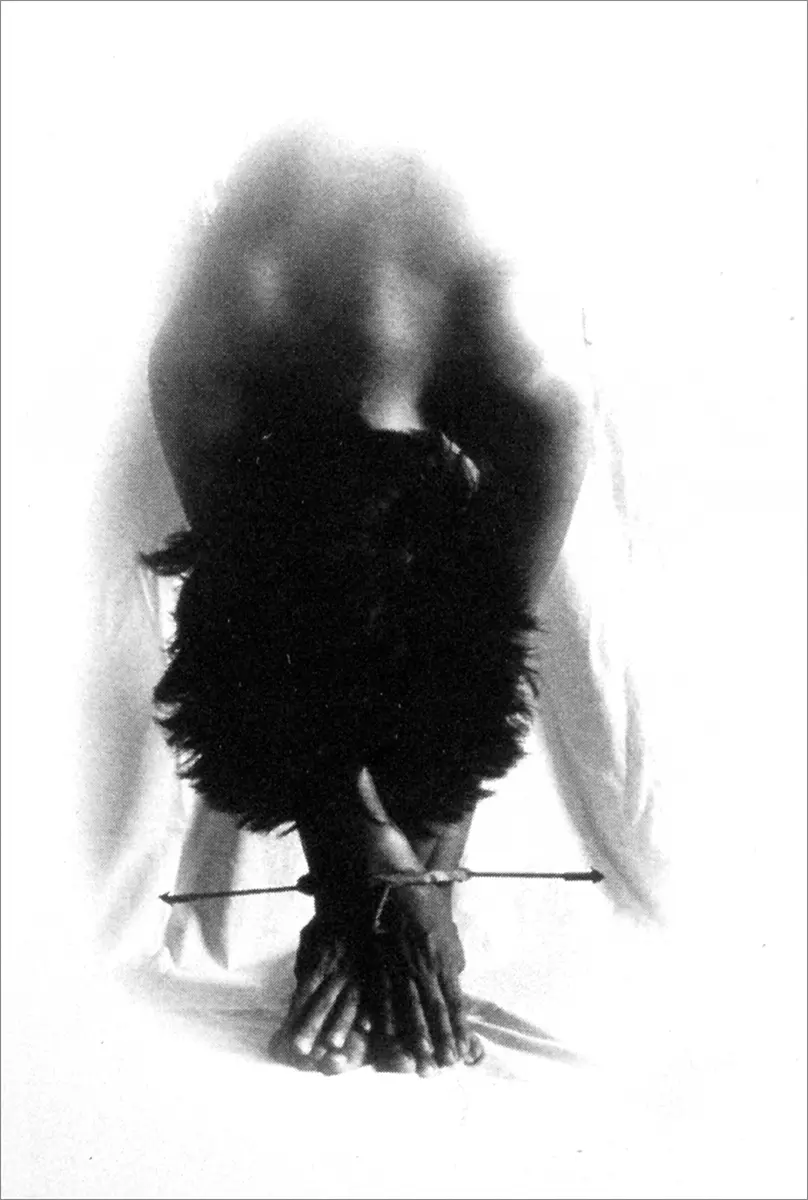
In many of these works, particularly in the Parallel Cults (1990) series, Pérez proposes a re-mythification of femininity, working her body like an altar. These are not studio photographs in the style of Rotimi Fani Kayode, Mario Cravo Neto, Gerardo Suter, or Luis González Palma, where a generalizing and very aesthetic vision of the body is achieved through settings with models, or where sacred elements are linked with Yoruba (Kayode or Neto) or Meso-American (Suter and González Palma) traditions. Neither are they a simulacrum, such as the very elaborate deconstructive parodies of Cindy Sherman. Although she too constructs an image to be photographed, Pérez stresses the testimonial and personalized elements, exploiting the documentary capacity of photography rather than its independent artistic potential.
She creates a kind of body installation that becomes a crossroads of different cultural, religious, and existential features, designed for the photograph, which is the final product. But in a paradoxical tension that gives density to her art, the photograph becomes rather a vehicle for a kind of frozen performance, posed for the camera —with the real photographer remaining anonymous. In a sense, this is related to Ana Mendieta's use of the photograph, where the important element was the mystical-artistic liturgy which she achieved in her interrelation with nature, to which the photography bore witness. However, as in the case of Pérez, the photograph was the result to be shown, and the work involved photography from the initial stage. Despite her photographic modesty, the mise en scène by Pérez would be almost pure ritual without the symbolizing distance provided by the camera.
In Parallel Cults the artist alludes to how her life is related to a number of religious cults, like twins, to whom, in fact, she herself gave birth. The integration between experience at its most carnal level and mystical elements, a characteristically active feature of her work, has now become its nucleus, as in the photograph showing the needles of the silk-cotton tree, the sacred tree of the gods Iroko and Changó in santeria, a living altar for the four Afro-Cuban religious-cultural complexes —which appeared in her body like some kind of protection which was both magical and physical.
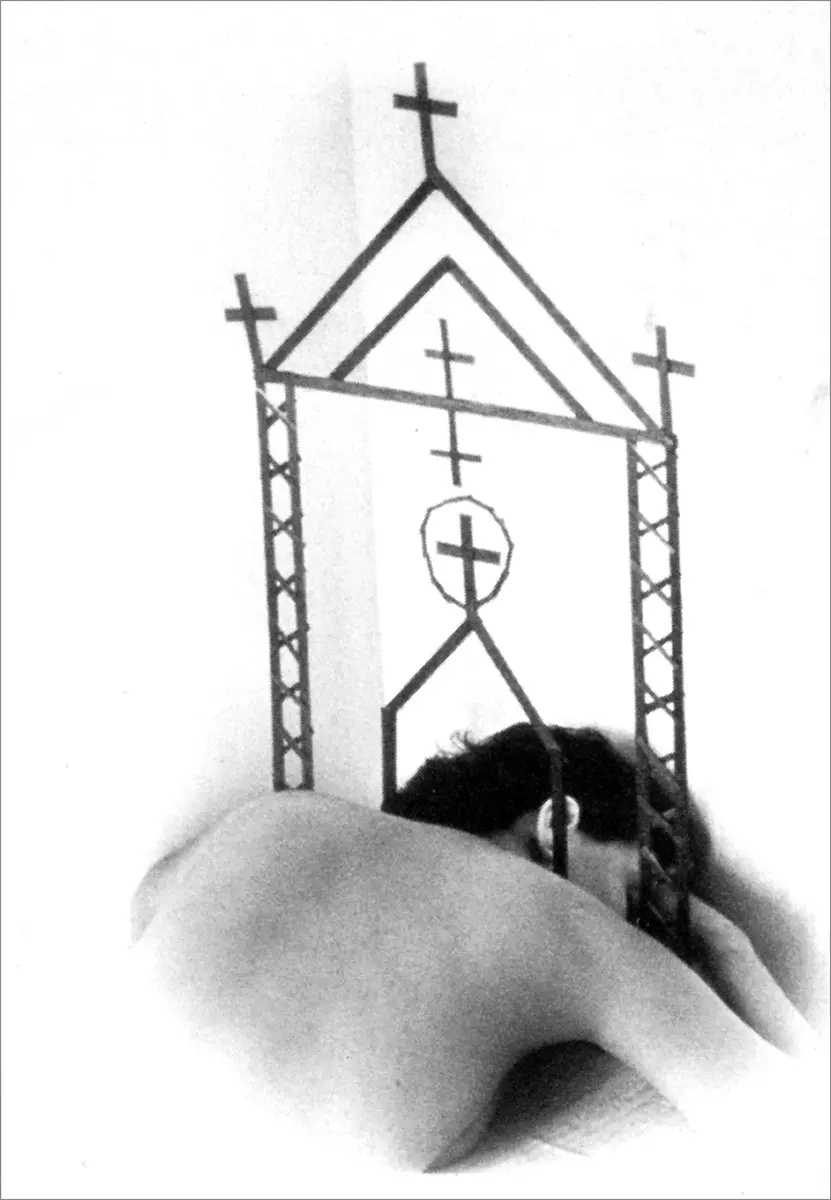
The gesture of uncovering her body is significant throughout all her work, a metaphor of mystery revealed. She never appears naked but opens or lifts up her clothes to reveal a mystical secret borne by her body. This is evident in the photograph in which she reveals a kind of amulet on her chest, a form of religious protection. The trope of the feminine body as an altar is complemented by that of Pérez as a priestess who shares the power and transcendental knowledge located in her own body, which is a hierphanic space, the seat of her aché,5 her personal sacred energy.
In another work, she appears lying on a gynecologist's table, with a mirror placed on her sex, an allusion to the mpaka mensu of the palo monte cult, receptacles of power of Kongo origin consisting of a pot of beef with religious ingredients, with a mirror serving as a lid which will cause as Robert Farris Thompson would say, “flashes of the spirit"6 which the priest uses in his divinations. The artist's internal organs thus become a mystical cavity, creating an image that forges feminist, religious, existential, humanistic, and vernacular discourse.
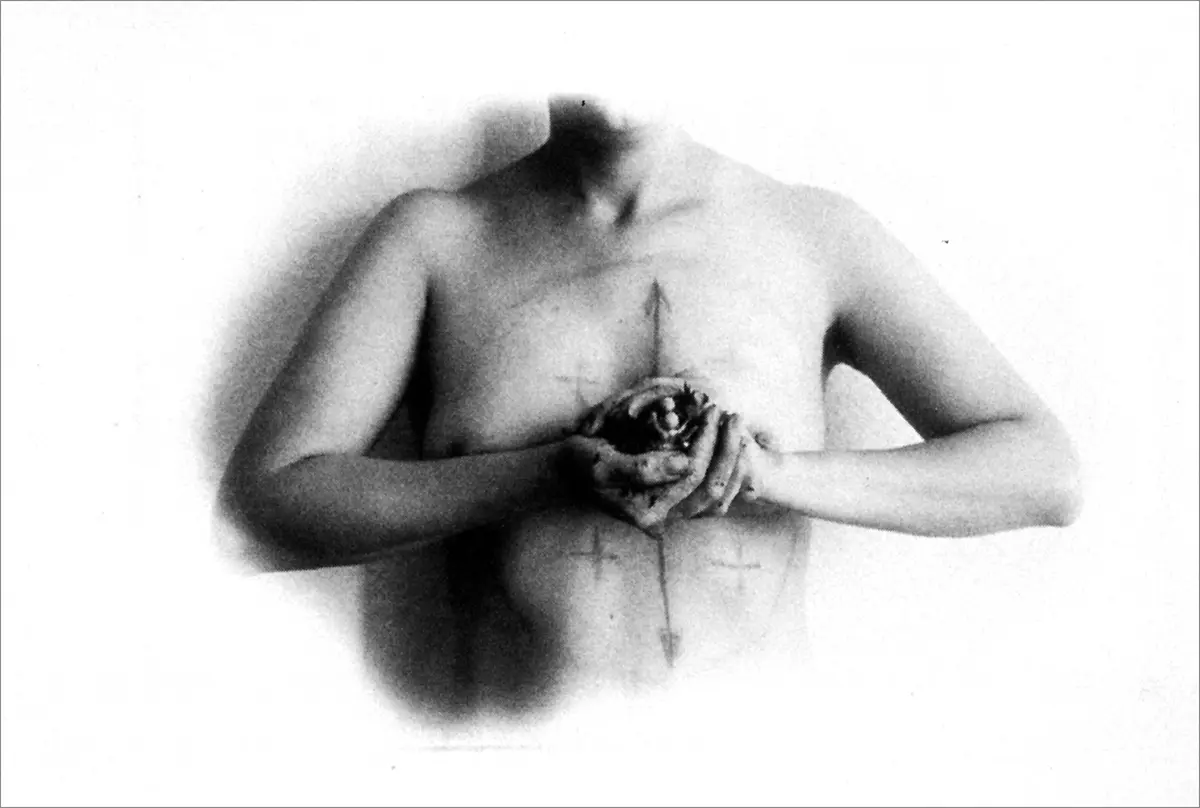
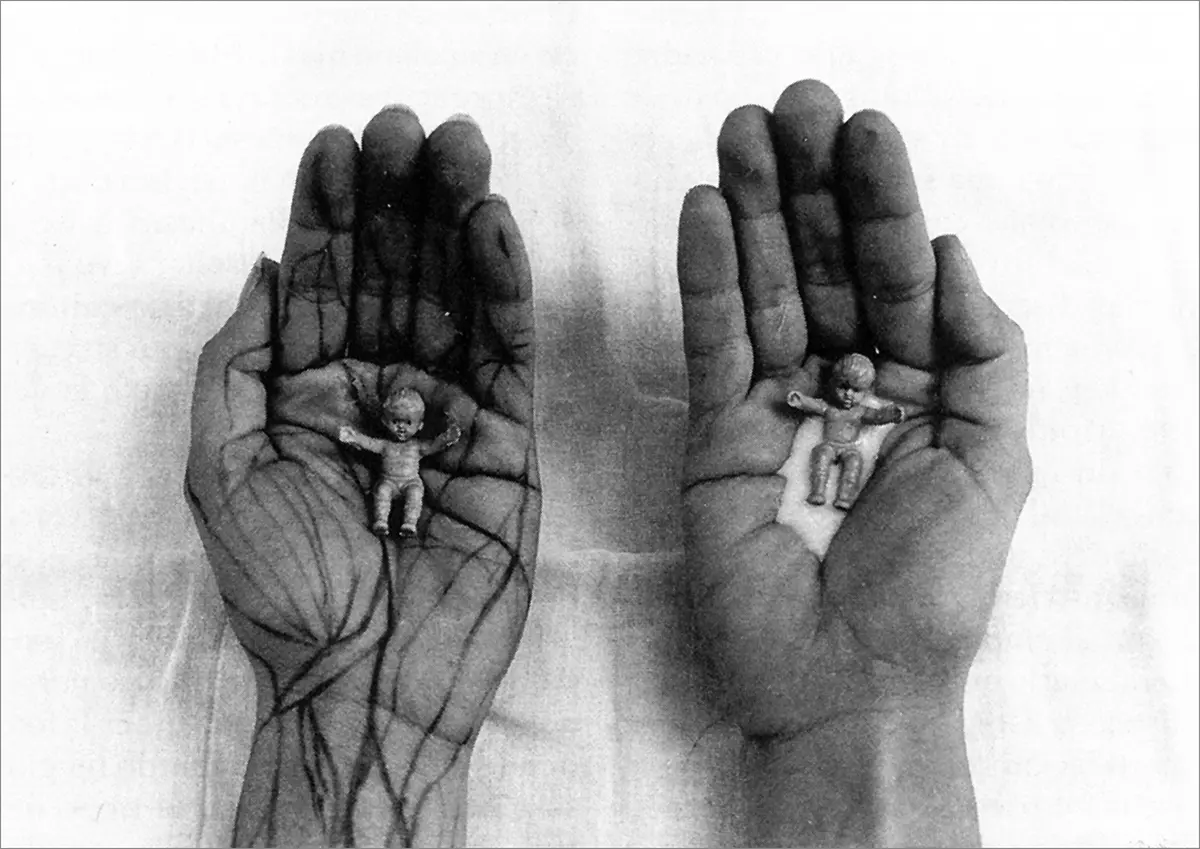
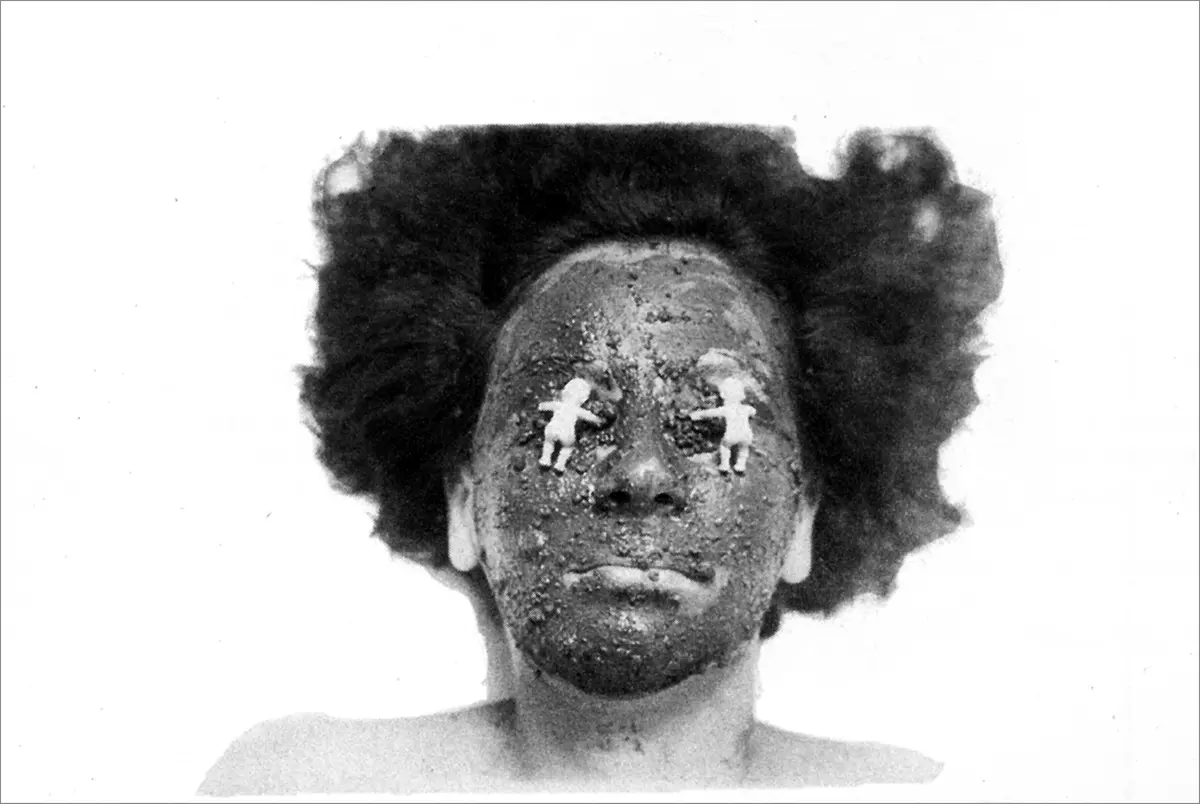
In the same way, in Macuto (1991) —the name of another receptacle of power in the Palo Monte cult— she prepares this religious object by kneading her inside the two little dolls that she used in earlier works to represent her twin daughters. Her chest becomes a hierophanic space, made sacred by one of the ritual palo monte drawings, central to that religion as a kind of software for liturgical purposes. In this case, it is "the sign of the four moments of the sun, "7 the sign of signs, the basis of everything: a graphic synthesis of kongo yowa, or cosmogram.8 This sign both summarizes and depicts the world, explains it, and activates its center of power, marking the very axis of the cosmos, the only privileged point in which the object or the religious ritual being prepared can acquire force. The arrows in the drawing on her skin indicate the axis of the artist's body, and her arms complete the drawing, which indicates the center of everything, where the living and the dead, the sea and the land come together. To identify the center of a specific woman's breast as the center of the cosmos, in the context of motherhood, is one of the most powerful images that Africa has bequeathed to Western art. The fact that it is a photographic image introduces new meanings related to technology, testimony, and representation. Seen in other terms, it could be read as one of the most radical feminist affirmations.
Another daring feature of this linking of personal and sacred elements can be seen in the works in which she establishes a relationship between the images or receptacles of power of the gods with her body, as in the series Paths (1990), where the body emerges from a fundamental image of Elegguá, the Yoruba god of change and crossroads. But Pérez goes even further and constructs similes that equate her body with the sacred depositories of the gods. In the Santeria tradition, just as in the Yoruba religion in Africa, there is almost no depiction of the gods, and there is much less fetishism than in the Catholic practice. On the other hand, the gods are considered as living essences deposited in receptacles containing their ache, their sacred presence, and power contained in certain objects and substances which are used for ritual purposes. The gods are inside these receptacles, into which food is placed for them, and the strength of which is used for ceremonial purposes. Thus, in a recent, very powerful image, Pérez equates her own head with the hanging gourd of the god Osaín. Similarly, when she was breastfeeding her twin daughters, she converted her breasts into the depository matter of the Ibeyes, the twin gods of santeria, in another image from the Parallel Cults series, where the cosmovision is blended with her own experience, the "feminine" with religious and cultural elements.
Marta María Pérez is an example of the re-encounter of art and religion within the context of the new Cuban art. The link is not thematic but conceptual, and one involves processes and meanings, in the style of Juan Francisco Elso, the major figure in this field.9 Her work is also paradigmatic of a vision based on non-Western principles, but one which uses the space and inclusive methodologies opened up by Western post-modernism. She is the only artist to have extended the experience into photography, and at a time when photography is exploring the growing possibilities offered by high technology and digitization, Pérez is embarking on a journey in the opposite direction.
NOTES
1. Concerning this movement, see Luis Camnitzer, New Art of Cuba, Austin, 1994; the catalogs of the exhibitions Raíces en acción. Nuevos Artistas de Cuba, Carrillo Gil Museum of Art, Mexico City, 1988; The Nearest Edge of the World. Art and Cuba Now, Boston, 1990; Kuba OK, Statische Kunsthalle, Düsseldorf, 1990; No Man is an Island. Young Cuban Art, Museum of Art of Pori, 1990; Los Hijos de William Tell. Artistas Cubanos contemporáneos, Alejandro Otero Museum of Visual Arts, Caracas, and Luis Ángel Arango Library, Bogotá, 1991; the issues dedicated to Cuba of the journals Third Text, London, No. 20, Autumn 1992, and Polyester, Mexico City, No. 4, Winter 1993.
2. Nelly Richard, "Women’s Art Practices and the Critique of Signs," in Recovering Histories. Aspects of Contemporary Art in Chile since 1962, Center for Latino Arts and Culture of Rutgers, 1993, pg.88.
3. Op.cit.
4. In Cuba, there are four very active religions and religious-fraternal societies of African origin which have been adapted to their new context: abaV.ua (of ejagham, efik, and efut origin), arara (of ewe-fon origin), palo monte (oikongo origin), and santeria (of Yoruba origin).
5. Ashe is one of the fundamental concepts of the Yoruba Weltanschauung. It refers to a universal energy present everywhere to a greater or lesser extent and with varying features. Thompson has translated the term "as the power to make things happen" (see the following note).
6. Thompson, in reference to the expression of mystical forces, titled his already classic study of the plastic arts of African religions in the Americas: Flash of the Spirit. African and Afro-American Art and Philosophy, New York, 1983.
7. Robert Farris Thompson and Joseph Cornet, The Four Moments of the Sun. Kongo Art in Two Worlds, National Gallery of Art, Washington, 1981, pp.43-52; Robert Farris Thompson, Flash of the Spirit, op.cit., pp.108-116; Wyatt MacGaffey, Religion and Society in Central Africa: The Bakongo of Lower Zaire, Chicago and London, 1986, pp.42-51.
8. A. Fu-Kiau Kia Bunseki-Lumanisa, Le Mukungo et le monde qui l'entourait. Cosmogonie Kongo, Kinshasa, 1969. See in particular illustrations no. 2, 8, 9, II, and 17-29.
9. See the essay on this artist in the catalog of the show titled Ante América, Luis Ángel Arango Library, Bogotá, 1992, pp.88-93.
GERARDO MOSQUERA
He is a Cuban critic and writer and a former recipient of a Guggenheim Foundation fellowship.