Last April, the Garces Velasquez Gallery presented a one-man exhibition of work by the Cali artist Óscar Muñoz, his first in Bogotá since 1991. The show, entitled Narcissuses, consisted of photographic images of documents. The first impression created by the images was the desire to collect, something which recalls childhood passions or the nostalgia of maturity, reflecting on self-images from times long past. Apart from what has been lost, there was also the sense of the ravages of time.
Deterioration, as well as the possibility of disengaging oneself from the strong links of some object desired, leads the artist to observe the steps and changes in the metamorphosis of the image, the cherished image which becomes painful when we see the changes wrought by time. Change is present in all life and existence, but how can it be incorporated into a work of art? How can the artist conceive what is fragile, changing, unstable within the context of his own self-love? It was through such questions that Óscar Muñoz appealed to the narcissus that lies inside all of us.
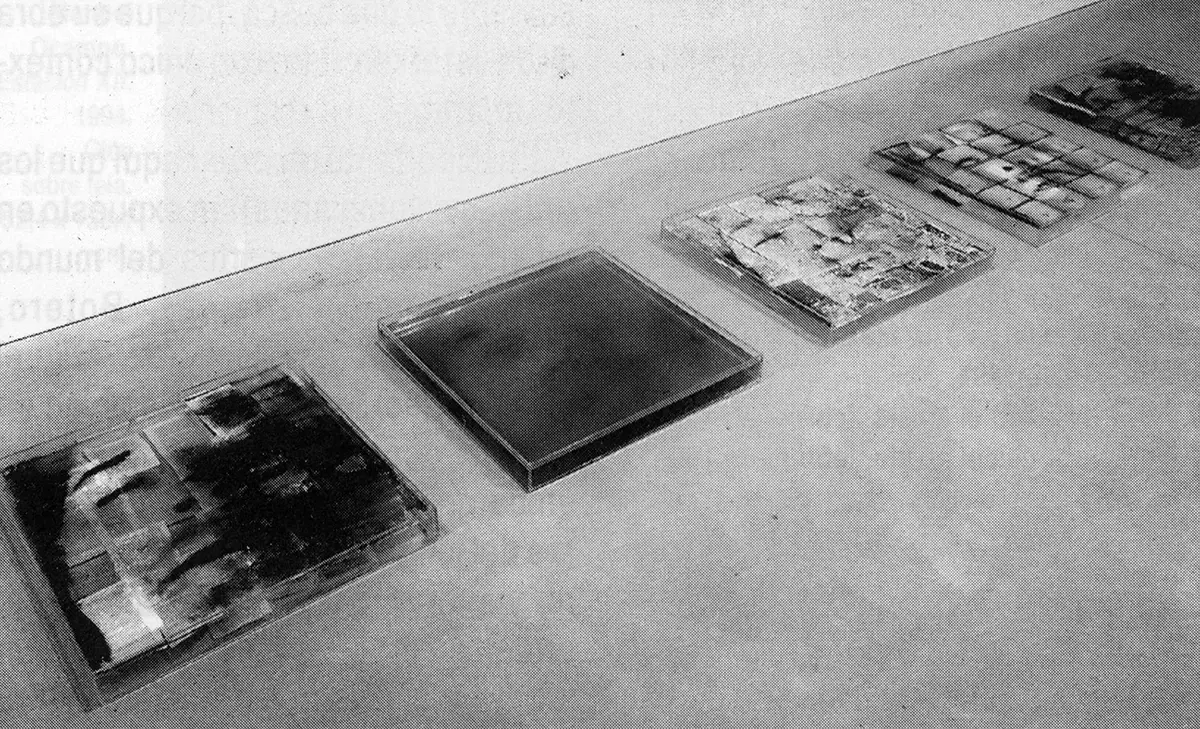
The key lies in the materials used: paper, water, charcoal, and a sieve are the resources that Muñoz uses to create his new system of images. He has chosen these basic materials to create his work, but without forgetting the artistic and conceptual qualities
of drawing. The fervently sought objective is to communicate a sensation of lightness and instability. The process begins with a desire and the artist’s hand and continues with the passage of time, including the external contingencies that take the work to its conclusion. The charcoal dust passes through the sieve and floats on the water, forming a drawing through the small fatty particles. Looked at from a distance, the drawings seem to be solid; up close, the impression is more diffuse and imprecise. "The artist proposes the drawing, and 'time' completes the process." Time, like the artist, is a draftsman and a creator of the work.
Óscar Muñoz’s drawings propose various versions of himself, although it is the same photographic image, dreaming, fantasizing, reflected in the water, with the ambiguous glance creating the enigma which enriches the work. The primordial concern is to create a work in a constant process of elaboration through chance and hazard and the hand of time.
Given these characteristics of change and the use of water, the works were placed in boxes where the supports are mirrors, bathroom tiles, or paper, which reinforce the sense of ambiguity. The works in which the process had not ended were placed on the floor and, depending on the respective stage of progression, contained water; those in which the liquid had dried up were hung on the walls.
These last-mentioned pieces formed a group of smaller-sized works, which created the effect of almost sacred images, an impression enhanced by their setting within the gallery space.
There was a sense of freshness and charm in the contrasts that give time its essential value, but which obstinately take us towards a state of deterioration and attrition, the ravages caused in the image. A portrait is an instant of life, which makes the figure of the person depicted eternal. It captures a moment of life. In this exhibition, Muñoz explored the problems of artistic creation and drawing, problems that have always been features of his work. As Baudrillard has said, man wants to possess and master time, to appropriate it and control its trajectory; he makes use of serialization to combat the fragility of the ephemeral and fleeting. Collecting is not only a matter of objects, and one can collect oneself with one’s own photographic images.
The process of elaboration here implies the idea of life in an image that never stops being made; otherwise, there would be death, which would be synonymous with a finished image, eliminating the religions and ideologies in the everyday mythology that absorbs the anguish of time and death. In Muñoz’s earlier work, desire was seen as the main theme and as self-sufficient; now there is separation, and the artist has managed to achieve the materialization of the parts, restoring to them the significance of the passing of time.
MARÍA TERESA GUERRERO