
Seeds for Forestry Reconstruction was the title of a recent collection presented by Rafael Rivera Rosa, inspired by the urgent need to address the problem of environmental damage occurring in the modern world. The excessive confidence placed in the myths of science has led us to abuse our habitat. This destruction of our forests has involved various factors which, taken together, are an effective recipe for disaster, with hazards, irresponsible attitudes, ignorance, and mistakes occurring all at the same time. Sometimes, the damage has been committed in a premeditated fashion by those irresponsible enough to adopt the now decadent idea that the devastation of huge areas can always be justified in the name of progress. Such an attitude is foreign to the dialectic which governs the universe, and brings mankind to the brink of disaster. The ancient Greeks believed that those who, in one way or another, disturb the order of the cosmos must answer to the overwhelming response from higher forces.
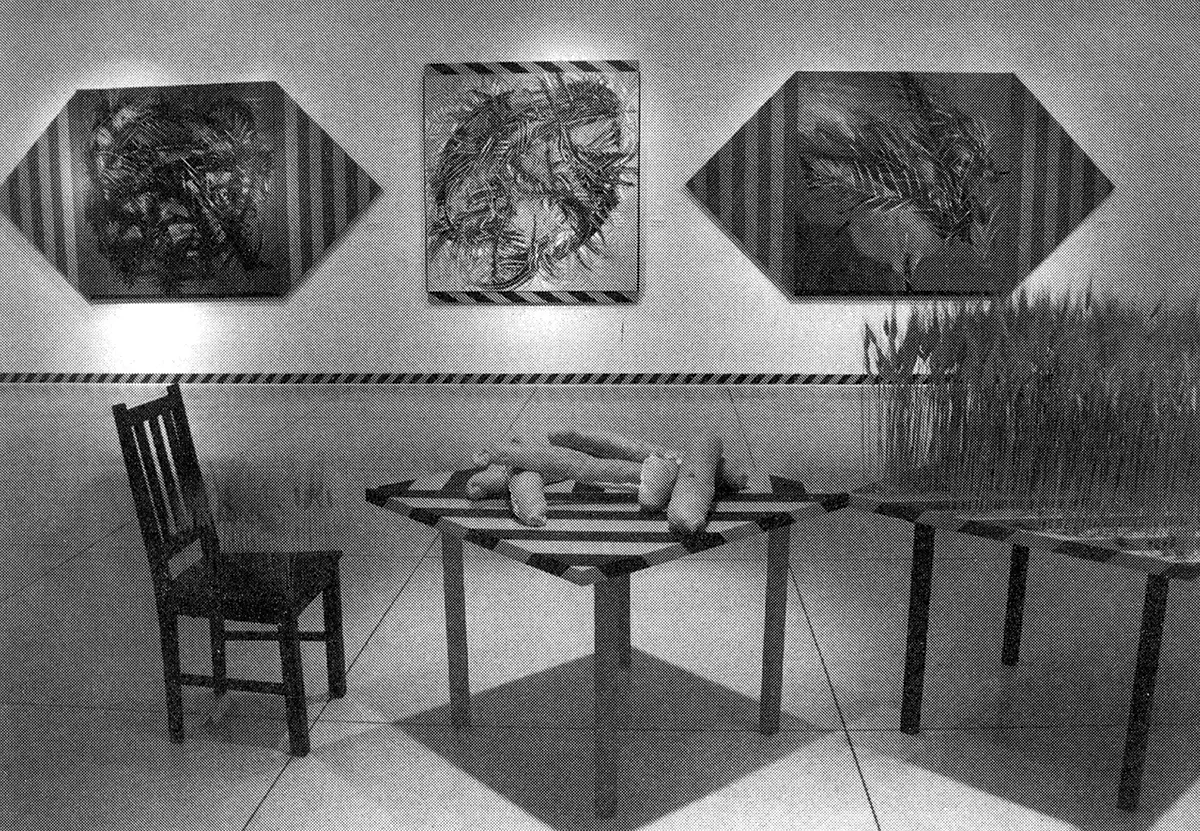
The seedbed that Rivera Rosa brings to our attention is a declaration intended to alert people who, in the midst of the delirium of power, seize the wherewithal to unleash an apocalypse. He makes a crucial appeal for the respect of the natural environment. The painter installs his seeds in areas of purity. The regularity of the background colors creates an appropriate atmosphere for their germination and survival. In this way, the artist emphasizes universal values that are essential to continuing life. This confrontation with the power latent in these substances, which come from protohistory, shows us that they continue to be a promise for a better future. The labyrinthine lines of the seeds on the point of germination, which are the protagonists of this series, seem to be a response to some calligraphic impulse of a universal language still unknown to many people. The artist thus becomes the interpreter of the messages of redemption printed on the discourse of time. These are presented in containers where the atmosphere without blemish of any kind fuses with ideals and possible realities. It is a kind of ratification of the ancient concept of the eternal return. This work has been conceived in a cryptographic terminology that is both forward-looking and yet maintains links with messages emanating from the depths of the spirit; it is based on a concept derived from abstract reasoning of a premonitory kind.
Special mention must be made of the coordination of the pictorial languages coexisting in each work. This kind of cultural crossbreeding has been a feature of the history of the Puerto Rican arts. Some time ago, I pointed out how, in The Wake by Francisco Oller, for example, impressionist and naturalist tendencies co-exist alongside hints of the Academy. When Oller developed his ideas, his purpose was to take the work to the Paris Fall Salon, an international forum, to denounce the situation of penury existing on our soil under Spanish domination. Rivera Rosa does something similar by effectively combining organic and geometric abstraction. He wants to create an awareness in the spectator of the threats posed to the vegetable kingdom.
Mention must also be made of the way repetition is carefully used to give the spectator an almost kinetic impression, creating an optical circulation effect which functions like an energy field. There is no room here for negative influences, because in this nascent world, which is strictly protected, there is no possibility of death. We are, therefore, in a world in a not very remote future where life continues to be as it is, but with an awareness of the existential experiences of a generation conscious of its duties to the environment. To humanize these symmetrical agents is essential if we are to meet the challenge of the increasing cybernetic presences. Since the psychic in man is a response to a chemical situation involving a number of factors, such as memories, things forgotten, memories, we need to recodify our ideas to systematize the realities which can be recycled. Thus, Rivera Rosa suggests that mathematical rigor is one way in which we can rediscover intellectual horizons that will continue to be valid in the current context and axiology of an era of regulators. To subsist in this world means distancing oneself from the servility imposed by outdated habits that have ruled for millennia. To conquer the formal rhetoric of what is conventional, we must construct a new order. Conscious of this, the artist has created a work which, in ideological terms, is a response to the parameters of this desirable world.
A derivation of the argument in Rivera Rosa’s work is the allusion that major contemporary problems are of an ethical nature. Hence, the a need for a solution to the threat of the hecatomb, which would result from the devastation of the forest. The canvases contain seeds, which are placed in individual containers where they are protected to ensure their immediate or subsequent germination. The idea is that they will be used when the conditions are appropriate. To some extent, it is a kind of return to Noah’s Ark. Something similar occurred in the medieval monasteries, where the monks guarded the historical legacy world following the fall of the Roman Empire. The objective was to reuse that knowledge when the situation became normalized. When the future of humanity is endangered, man has tended to guard all the essential things for life in a safe place until the emergency has passed.
This exhibition created the sensation of finding ourselves in some kind of greenhouse where the seeds became symbols of salvation. Rivera Rosa knows that the cells represent the different vegetable species, and has developed a specimen fusing the characteristics of different kinds of seeds. Through such a concept, the artist communicates the urgency of the subject and offers an option for survival.
The series consists of eleven paintings, where symmetrical and three-dimensional elements are used in unconventional ways. Since the works have been conceived as modules, they can be assembled in different formats. Thus, the work allows for external interventions without any loss of representational meaning, and in this way challenges the traditional static aspects of many works of art. The components of the nursery are seen as skeins in which the filaments are on the point of freeing themselves from their original enclosure. The effect is enhanced by the use of internal lights from a nucleus that seems about to expand. This is a positive sign since it suggests the transcendental nature of matter and texture. It is also important to mention the emphasis placed by the artist on his plastic resources, which he handles in an emotive manner to suggest a vision that seems to be the result of a revelation from the beyond.
Another noteworthy feature is the care given to detail and the preservation of ephemeral flashes, of shadows whose contrasts allow the chromatic variations to create unexpected effects. Rivera Rosa’s previous paintings were microscopic examinations of foliage, which showed that each embryo offered an entire world of possibilities. I have been able to follow closely this stage in the artist’s work, and this exhibition bears witness to what the artist has achieved in his studio. These images, which seem to mark a major change in his career, are the result of a process of intense and disciplined work, a self-imposed discipline that in the end has facilitated the production of a work that otherwise would have required much longer periods of time. Evidence of all this can be found in the artist’s studio in the canvases that document the work he is now showing.
JOSÉ ANTONIO PÉREZ RUIZ