In Medellín, following a long and spirited debate on public spaces, approval for the design of a public square, a major road, or a piece of public sculpture, all matters which used to be mere bureaucratic formalities, has now become a process in which civic consensus plays an important role. This provision has been included in the municipal statutes in an attempt to counter the wave of “inaugurations" of public works, the sole purpose of which is to gain prestige for political purposes.
The proposed San Antonio Park was to be constructed in the empty space of what was once a historical center, now swept away with indifference, and which, for years, was a kind of graveyard for abandoned cars. The regulations for the competition were very ambiguous, since they mentioned the need for a "green lung" for the city. The winning project was submitted by Juan José Escobar & Co., which proposed a handsome hard square with surrounding structures, clearly marked off as a public space for various
activities (musical, political, religious), now that the destruction of the Cisneros Square meant that the city did not have any other kind of place suitable for such activities.
But the distance between the drawing board and reality is a long one, and in Colombia, the reality is often a poor and distant version of the original proposal. This also happened in the case of the San Antonio Park: in order to make it “profitable," it was decided to place a number of “receptacles" on the side overlooking the old Junin Street, which could be used as small stores, and which only generated a kind of semantic confusion. What could be the possible content of a public space that denied the life around it, its relationship with the old street, and with the adjacent and vital little square of San Ignacio? Botero’s sculptures, which looked like multiples rather than originals, did, however, provide a rather interesting touch, although they lacked the visual and conceptual force of his famous Fat Lady.
How can a public place be conceived without taking account of the participating actors? The idea was to meet the challenge of making this a modern park vis-à-vis Republican concepts, but not even the acoustic shell helped ensure the involvement of the new voices, the new forms of music in the city. For whom was it therefore designed? Could such a project forget the essentially popular character of the sector?
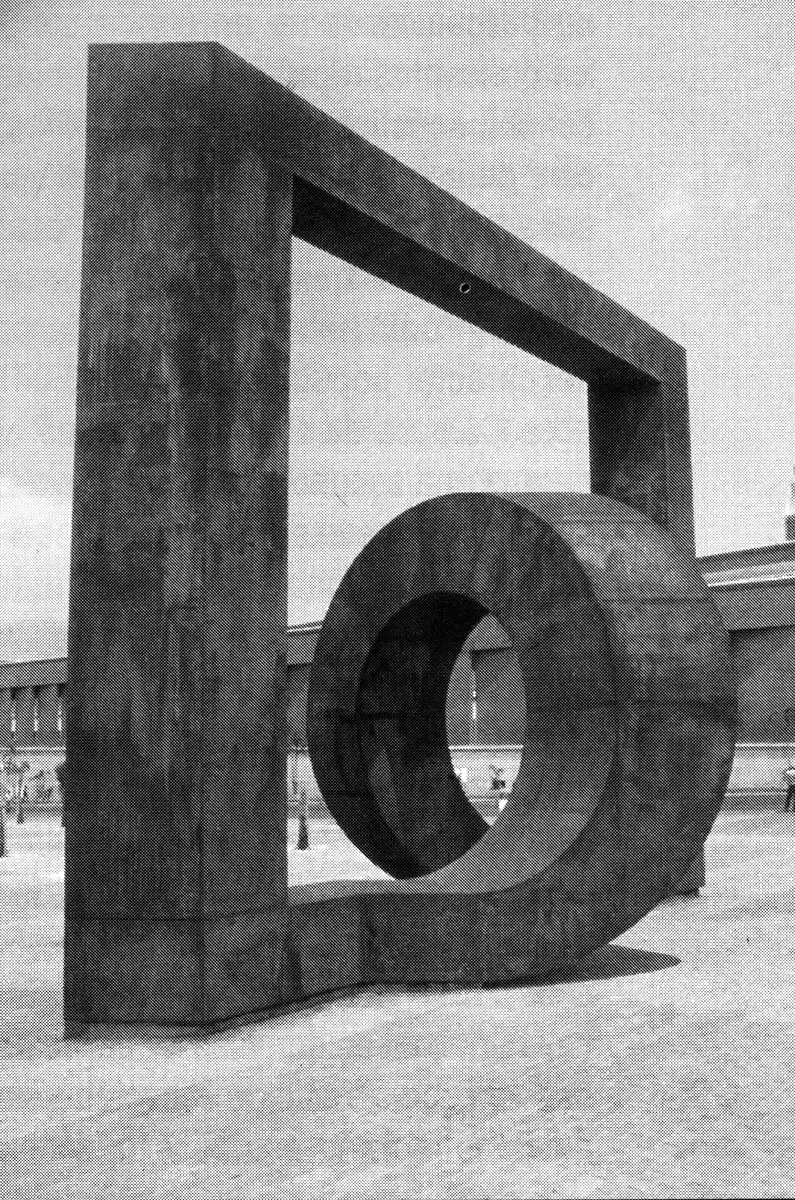
The Chamber of Commerce donated a sculpture by Ronny Vayda—a door which the sculptor resolved extraordinarily well, which gave some sense of mental order and necessary visual configuration to a space which until then had remained confused. It was a geometrical object raised to the level of a "found object," the culmination, furthermore, of a rigorous sculpture art placed in buildings where it often went unnoticed. It is a modern sculpture that made modern a space that until then seemed to lack the vocation to define itself as such.
DARÍO RUIZ GÓMEZ