
Under a project launched by the architect Alberto Petrinal, current director of the Hispano-American Museum of Art, the chapel of this museum is being used for temporary exhibitions of contemporary Argentinian art. The house, built by architect Martín Noel, is a typical example of the theoretical principles of the colonial renaissance, which in Argentina reached its height around the 1910 centenary. Thus, the shows presented in the chapel are related to the general objective of this institution, which is to promote aesthetics with a national and historical orientation.
In 1994, the project was inaugurated with an exhibition of work by Marcia Schwartz. This year, in the months of March and April, it was the turn of Santiago García Sáenz, with an exhibition entitled American Visions.
García Saenz (1955) belongs to the generation of artists who emerged in the 1980s, and who include Schvartz, Pierri, Pino, Pietra, and Pirozzi, among others. They shared the general spirit of that time, characterized by the neoexpressionist wave and the return to painting. At that time, García Saenz’s work showed a strong erotic content, with an almost wild treatment of texture and brush strokes.
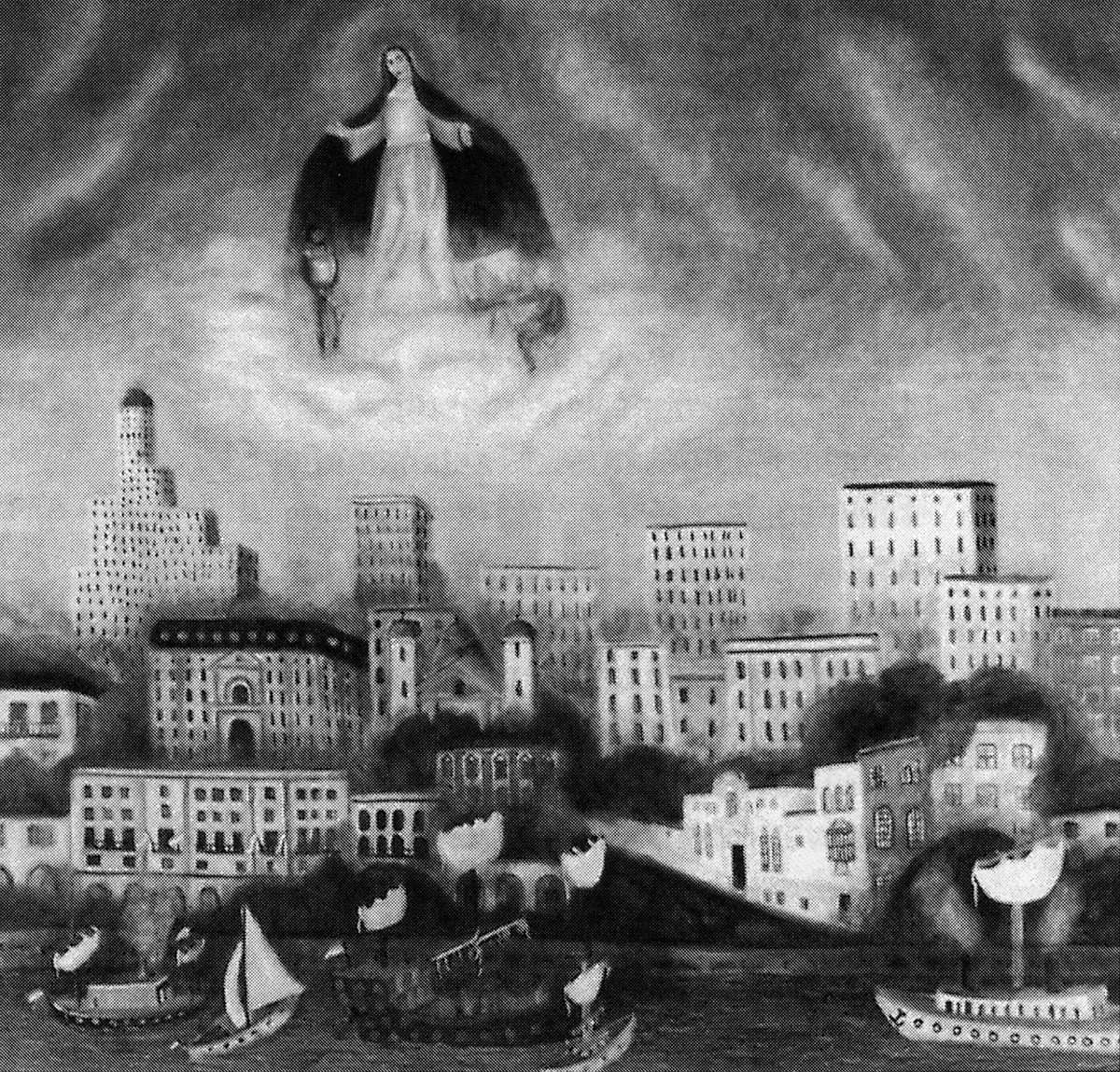
In 1986, García Saenz traveled throughout Latin America, visiting Paraguay, Bolivia, Mexico, Ecuador, and the north of Argentina. Reflecting on the approaching 500 years of the discovery of the New World, he began to prepare an epic and historical series of works under the theme of Looking for you, America. In 1988-89, he painted the altar of the Church of Saint Cecilia in Castelar, in the province of Buenos Aires, and since then, his work has begun to acquire the characteristics of his present production.
In American Visions, the popular iconography of the continent is freely fused with aspects of the Cuzco tradition. The religious syncretism of the peoples of Latin America is emphasized by the eclecticism with which Garcia Saenz superimposes biblical legends, stories from the New Testament, and apocryphal tales of local origin. The Magi appear as gauchos; Jacob is a mason dreaming of a celestial city, surrounded by Paraguayan ruins in a tropical forest. Sacred and profane elements coexist in a tale in which memory is the source for the imagination. The images of Garcia Saenz combine his childhood memories with the collective memory of national history, where the Americanist element is revitalized through textual juxtapositions and cross-references. In some cases, contemporary architectures can be identified with precise buildings in the city of Buenos Aires, giving the images strange subtleties which highlight the deflection of traditional discourse through a new reading which defines the features of an authentic culture.
The show concluded with the series on Christ of the Sick, where the reinterpretation of the religious content is combined with the idea of the end-of-century torture wrought by the terminal diseases of our times.
LAURA BATKINS