We are standing right behind the windshield of a speeding locomotive. It rains. A single wiper sweeps the rain to the sides as an underpass approaches. Out of the wiper's reach, our vision is partially blocked by raindrops sliding sideways with the wind. Ahead, the rails glister against the dark railroad bed penetrating the space under the bridge. Converging toward the horizon, the rails take us along with them.
A theatrical description is probably the most suitable way to put into words Sebastião Salgado's photographs, since in order to get his message through, he opts to naturalize their photographic character. Salgado wants to make one forget that these images are photographs. He seeks to engage the viewer in a process of virtually experiencing, of living through these images as opposed to a state of mere contemplation. One is called upon by these images. In his introduction to Workers, An Archaeology of the Industrial Age1— a combination of book and traveling exhibition — Salgado claims that "these photographs tell the story of an era. The images offer a visual archaeology of a time that history knows as the Industrial Revolution, a time when men and women at work with their hands provided the central axis of the world."
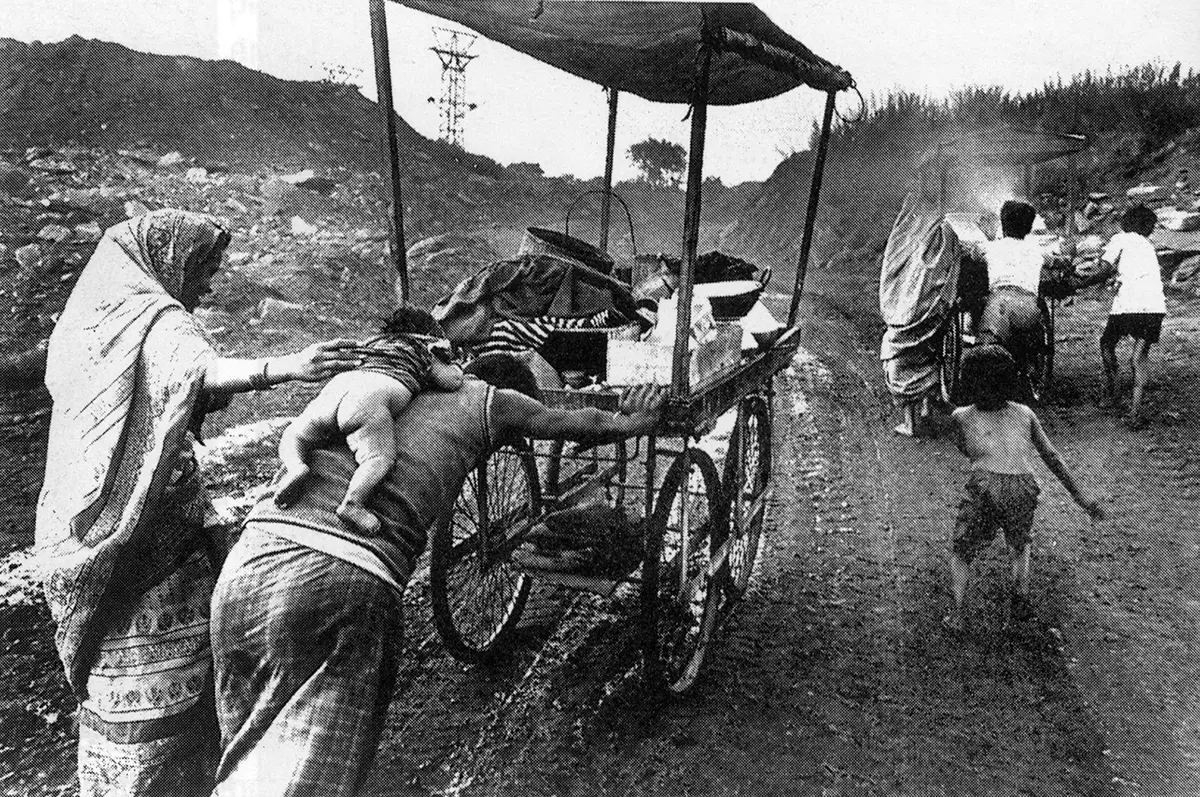
He defines his work as "... an homage to workers, a farewell to a world of manual labor that is slowly disappearing, and a tribute to those men and women who still work as they have for centuries."
The photograph described in the opening paragraph belongs to the series Railroads in France — one of the many thematic groupings composing Salgado's Workers. Of some 250 images exhibited, this railroad photograph is among the few that do not depict workers, but it is perhaps the one that most paradigmatically reveals Salgado's photographic tropes.
Space, for instance, is experienced as a deep recession. The illusion of perspective is here pushed to its ultimate consequences. The tracks are the elements that most literally produce the perspectival space ahead of us; each rail functions as an abstract construction line converging to a vanishing point. The wiper and the water marks it leaves on the glass reiterate that, as done with almost every other element in this image. The bridge crossing the railroad echoes the frame holding the windshield; this frame itself echoes the camera's viewfinder, which in turn can be interpreted as doubling the photographer's/viewer's eyelid. The complete schema of perspective is thus doubled in this image: the cone of vision opening up from a point in the viewer's retina toward the picture plane (in physical space), and closing down again from there toward a vanishing point (into the virtual space of the photograph). To hyperbolize even further this baroque effect of trompe l'oeil, Salgado lets the railroad bed bleed into the viewer's space — an arrangement he repeats in most of the photographs in the show.
What happens then when this deeply recessional space becomes populated by working people? What happens when the space of industrial work meets the contemplative space of the museum?
The photographs in Workers rely as much on the greasy, dusty, smoky environment of industrial labor as they do on the aseptic walls of museum galleries and the pristine white paper of expensive art books. Actually, it is from the merging of these two conflicting spaces that Salgado drives the rhetorical power of his images; it is by bringing us along with him in this uninvited penetration through the space of these people at work that he forces us — bourgeois museum frequenters — to confront in the eye the intimidating or intimidated countenances of his subjects.
Paradoxically, at the same time that these images have their "photographic-ness" naturalized, they also celebrate the technology of the photographic apparatus. Wide depth of field, small grain film, precise control of light and shadow, and carefully balanced prints give the photographs an extraordinary amount of detail that is well beyond what the human eye can simultaneously perceive. Besides evoking a "reality effect"—the code of realism — this overflow of details points to the technique of photography, to the photographer's skill, to the camera as an instrument to expand vision. Like in the railroad picture, there are many examples in Workers in which the photographic apparatus is doubled in the image. In Man Cleaning a Rum Distillery in the Rum Havana Club Plant, Cuba, 1988, the rusted metal tower seems to be an extension of the cylindrical body of the camera lens, penetrating deep in space through the body of a man whose head emerges from it to greet us with a smile.3
The status of these photographs is also puzzling. Do they belong to the discursive field of the archive, to the tradition of photo-journalism, as signaled by the map at the exhibition's entrance or by the structuring of the book and exhibition space into neat roman-numbered economic categories: I. Sugarcane, Tobacco, Cocoa, Perfume; II. Fishing, Slaughter Houses; III. textiles, Bicycles, Cars, Shipyards...? Are these photographs being proposed as evidence for the socio-economic thesis that the photographer seems to put forth?4 Or are they within the register of aesthetic discourse and the space of exhibitions, as suggested by their carefully studied compositions, the exquisite range of tonal values, the sophisticated enhancement and juxtaposition of textures — the often beautiful arrangement of fabrics, flesh, clouds, rust, hair, water, sand, smoke, leaves...? Is not aesthetic value the currency that allows these images of impoverished workers to circulate at ease into the walls and pages of the art world?
The answer to all these questions is yes, since the ambiguity between the archive (the document) and the museum (the artwork) is at the core of Salgado's Workers. If one adds to ambiguity the interpellative mode of these images, the naturalization of the photographic process, and their excess of significant form (almost all details in the images are highly motivated), we have all the elements to characterize what Roland Barthes defines as myth.5 To Barthes, myth is a process of signification that adheres in a parasitic way to another process of signification. It hides itself in the primary system, emptying it of its original meaning. Barthes writes: "From the point of view of ethics, what is disturbing in myth is precisely that its form is motivated. For if there is a 'health' in language, it is the arbitrariness of the sign which is its grounding. What is sickening in myth is its resort to a false nature, its superabundance of significant forms, as in these objects which decorate their usefulness with a natural appearance. The will to weigh the signification with the full guarantee of nature causes a kind of nausea; myth is too rich, and what is in excess is precisely its motivation."
In the case of Workers, artistic discourse is the metalanguage parasitically operating upon the archive, upon the "archeology of the industrial age." The men and women in these images have had, from the beginning, their subjectivity reduced to the unidimensional label of workers; myth empties them one step further; they become simply a qualifier in the expression "socially concerned art."
NOTES
1. At the International Center of Photography, Midtown, on view from February 17 through May 26.
2. Pages 258-259 in the book version of Workers.
3. Ibid., pages 32-33.
4. See Rosalind Krauss's "Photography's Discursive Spaces" in The Originality of the Avant-Garde and Other Modernist Myths. Cambridge, Massachusetts: MIT Press, 1986.
5. Roland Barthes. "Myth Today" in Mythologies. New York: Noonday Press, 1990.
FERNANDO ACEVEDO