In 1957, on the occasion of Roberto Matta's exhibition at the Museum of Modern Art of New York, the critic William Rubin wrote that the philosophy of the surrealist painter was "essentially hermetic."1 Rubin was right, despite the fact that Matta had developed in such a way that the artist who arrived in New York from Paris in 1939 was not the same one who had returned to Europe in 1949 to settle in Rome. He was not the same person because ten years of intense work and dramatic personal and political events had taken him from suggestive abstraction towards a mysterious and at times abstruse kind of figuration.
A reading and interpretation of Matta's work requires initiation. That being said, however, in 1995, we can ask whether Matta was ever a hermetic artist in the strict sense of the term. Of course, this question would seem to refute Rubin, whose 1957 text is the clearest, most precise study that had until then appeared on the work of the Chilean painter. Matta seemed to be hermetic—I venture to say today—but he was not hermetic. His language experienced the same process that has characterized all other languages generated by modern art, which, in its heyday, made even the erudite ask themselves questions. Julien Levy, Matta's New York gallery dealer, said of the artist: "For me, he was by far the most fertile of the young surrealists (...) At first sight, his drawings were seductive, although incomprehensible."2
The relative hermeticism of Matta begins to disappear when we examine the initial process of his work. Thus, I shall limit myself to this foundation period in his work, the period of the 1930s and 1940s. But first, let me say that I shall base my remarks on the belief that Matta is a painter of matter in perpetual movement. His painting reveals physical and psychic stages of transmutation. In his best pictures, he is the artist of the non-permanent in permanence. The concept of transmutation, of course, implies change, flux, i.e., a displacement in space and time which creates a dialectic of divergence and convergence.
Architecture and Utopia
The first hint of this appeared in the thesis which Matta presented in 1932, at the age of 21, for his diploma in architecture from the Catholic University of Chile. According to a section entitled Chronologie et documents in the catalog of the retrospective show of his work in Paris in 1985, the artist presented 147 nudes "metamorphosed by the mysteries of drawing into 147 places of different religions, and a temple which gathered them all together into one."3 Nothing is left of this ambitious and unusual project, although it can be deduced from the above that the concept of the monumental structure was governed by the idea of convergence.
Architecture is above all a matter of space. To its three dimensions, Matta added a fourth—the time factor, which he introduced at the conceptual level by suggesting that multiplicity (of religions) would one day converge into unity. Here, it should be noted that the time implicit in the sequence of drawings did not seem to depend only, as in the case of any building project, on the displacement of persons, but on the semantic content of each of the parts or details of the project.
I have emphasized this initial proposal by the artist because it reflects the space-time obsession that characterizes his best work. Furthermore, what he achieved in Santiago was not a monument that is located in the real world but in utopia. In the nudes
of this early project, the motivations of the dreamer and visionary predominate over those of the draftsman or craftsman who focuses his work in a rational and practical way towards specific and potentially tangible aspects. We can therefore conclude that the freedom to dream was already beginning to take up arms against the limitations inherent in any attempt to implement projects in the real world.
Matta went to Europe in 1933, where he became an enthusiastic visitor to museums. In Italy, he drew details from the works of the masters. In 1935 in Paris, he joined the architecture workshop of Le Corbusier, and in 1936, in London, he worked with Walter Gropius and Moholy-Nagy. Initially, the Chilean seemed destined to become a skillful architect, perfectly familiar with the most advanced trends of the time. But that same year, back in Paris, he came across the first issue of the surrealist journal Cahiers d'art, which became a sort of compass that directed him towards his true vocation.
Design is a discipline directed towards the solution of specific problems. The designer begins with a reality and returns to it to modify or change it. The designer's product is always an attempt at integration with the objective world. This is a thorny problem, because Matta was looking for something else, something in the nonobjective world. Hence, his enthusiasm for Cahiers d'art, which dealt with the surrealist object, the product of fortuitous associations beyond the utilitarian and functional.
In one of the articles of the attractive surrealist publication, Christian Zervos wrote: "In our creations, irrespective of the discipline used, the true and the arbitrary come together."4 Zervos went on to explain: "Abstract artists have mutilated art and suppressed certain fortuitous elements, the simple effects, the unusual incidents which encourage the spectator to dream."5 The first quotation justified automatism; the second gave it a meaning. A year later, in 1937, Matta devoted himself passionately to working on the automatic drawings that marked his entrance into the surrealist movement.
In Matta's best pictures, automatism is more than a gesture or technique: he goes beyond the expressive nature of the line or stroke in search of the expressive dimension of the subject. What is important is not the script but the ideas that, through improvisation, the script manages to generate. Matta has always tried in his painting to refer to matters which he himself has described as transcendental in social, human, and even scientific terms. His statements in this respect are so numerous and explicit that there is no need to quote any of them. This means that his work can be interpreted. By way of illustration, I prefer to look at something which historians have so far overlooked, namely that one of the starting points for Matta was another interpretable work, Picasso's Guernica. This will, of course, take us to the heart of his vehement rejection of the rationalism of a certain kind of architecture.
From Picasso to Duchamp
The young architect Roberto Matta collaborated in the construction of the pavilion of the Spanish Republic at the 1937 Universal Exhibition in Paris, when he was asked to try and get Picasso to speed up his work on Guernica, which was to be shown in the modern building. According to Matta, "Guernica was in the beginning a drawing and in the end a drawing."6 On the basis of Picasso's colossal drawing, Matta did a variation in 1938. It was an untitled drawing included in the catalog of the 1985 Paris retrospective under number 20. Divided into three parts, the central section showed on the left a pyramid-like grid which recalled the horse in Guernica. Towards the middle of this central section, there is a black sun, slightly oval in shape, which refers back to Picasso's sun-lamp-eye. To the right, Matta placed a second grid shape, which synthesizes the group with the shouting woman in Picasso's work. The sun reappeared in the illustration of song number 3 of Maldoror of Lautréamont (1938) and became an atom-star in a drawing dated February 7, 1938, which was dedicated to André Breton.
The elementary principle that art permits the representation of one thing through another thing acquired a new meaning when a sculptor friend of Matta's showed him the bronze lion in the Denfert-Rochereau square in Paris, and told him that it was not a lion but a city. Matta's comment was that "if a city can be represented by a lion, then anything is possible."7 What was special about a lion-city in the square? Both a lot and nothing. A lot, if we remember that it made invisible what Picasso's sun-lamp-eye made visible. And nothing, if we remember that in his graduation thesis, with his allegories of religions, the emerging artist had already tried out this kind of representation vis-à-vis the nineteenth-century academy.
At the beginning, Matta had many paths to cover. They included, given his training as an architect, constructivism and purism. But his experience in Le Corbusier's studio had been far from positive, to the point where he said that "there was no teaching and there was no practice."8 His disappointment with Le Corbusier made him scorn architecture, which he criticized without caring one iota about whether it was avant-garde or successful. Of the architect Le Corbusier, who designed the much-applauded Spanish pavilion, Matta said he was "bad." Matta did not have the slightest admiration for the work of the best architects of the time, although he could stand in front of the mediocre monument in Denfert-Rochereau and —horror of horrors—disentangle the possibility of working on a substantial reality over and above external reality, the principle of super-super-reality which was to be launched by André Breton.
In point of fact, the ground had already been prepared theoretically by Cahiers d’art. The Zervos article used as an epigraph a sentence taken from The Immaculate Conception, a text by Andre Breton and Paul Eluard published in 1930, which reads: "Conventional representations of geometrical sources from nature are seductive only in terms of their power of obscuration."9
This invitation to the arcane was complemented by an article by Gabrielle Buffet on Marcel Duchamp, which analyzed, among other matters, the Rotoreliefs, or optical discs. Pleased that Duchamp was interested in the "esoteric values of various kinds," the author explained that with his disc, the great Dadaist enters a "mixed and complex scientific field, at the limits of psychology and physics."10 In a few lines, Gabrielle Buffet managed to describe a totality which, in its plurality, incorporated disciplines and subjects which had hitherto been regarded with indifference by plastic artists.
Gabrielle Buffet examined aspects of Duchamp's humor and the way the use of puns, as in the Mona Lisa with a mustache, was "an usurpation of the privileges of the master work." The reference was to the double meaning of the capital letters which Duchamp wrote on his reproduction of the Leonardo picture: L.H.O.O.Q. (phonetically, elle a chaud au cul, i.e., "she's got the hots"). Over time, Matta would give proof of an equally incisive and fertile linguistic talent, even composing titles by combinations of phonemes from two or three languages.
The Principles of Matta’s Pictorial Equation
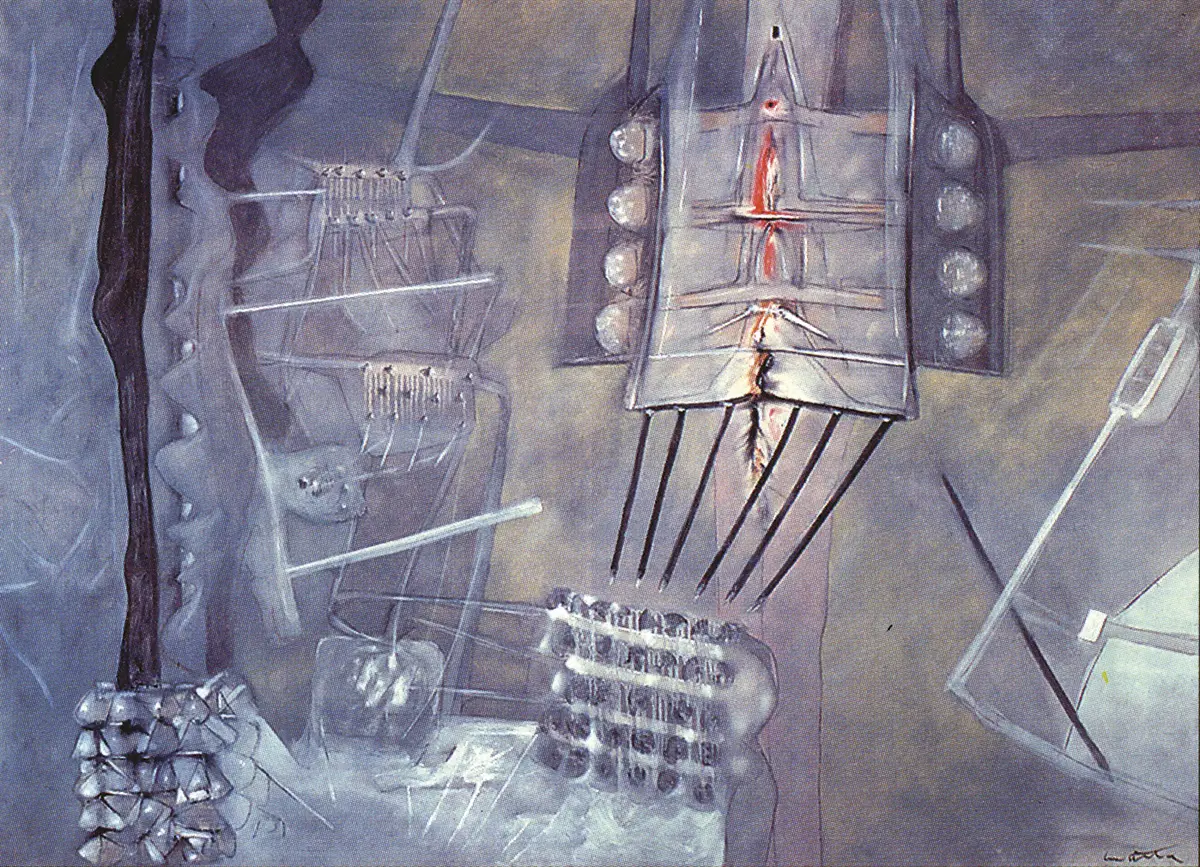
Matta recognized that Gabrielle Buffet's text was a revelation, since it showed him that it "was possible to paint change."11 To paint and not structure architecturally that change. The artist had defined his scope of action. In doing so, and in taking a stand in the sphere of ideas and concepts, he broke with Le Corbusier and abandoned architecture. The rupture was motivated by "Reasonable Mathematic," an article by the French-Swiss architect published in 1937, which Matta refuted in his "Sensitive Mathematics, The Architecture of Time." The titles alone of these texts illustrate the gulf between the two. Matta's text, half manifesto, half personal program, appeared in the surrealist journal Minotaure. Its content virtually announced all Matta's work, so I shall quote some of the most important extracts.
In the first paragraph, Matta speaks of tender parallels and soft and thick angles, concepts that immediately set him apart from Le Corbusier's rationalism. Then, in a clear reference to the maternal womb, he wrote: "Man longs for the dark pulsations of his origins, enveloped in the damp walls where the blood beats." This leads to the conclusion that man should give less attention to architectural techniques and create a"theater where he is everything: argument and actor, the scene and silo within which he can live"—a phrase which describes the special characteristics of Matta's pictorial space. Following that, he had an observation: "Let us remain immobile between the moving walls." And he cried: "We need walls like damp canvases which become distorted and reflect our psychological fears."
The newborn surrealist proposed that we surround ourselves with objects to help the bodily organs become conscious of themselves and to stimulate the spirit. To this end, he added, "the cosmos insinuates itself like a mold, as in a matrix shaped to the measure of our movements." With admirable audacity, Matta was inspired to see the relationship that could be established between the confined inter-uterine space, the space of an apartment or a room through which movement was possible, and limitless cosmic space.
Matta also envisaged the possibility of constructing objects which would free us from the angles in an environment, objects which would comprise sexes of unusual conformation, whose discovery would provoke more attractive desires than those of a man for a woman, to the point of ecstasy. In good surrealist prose, full of obliqueness, suggestion, and playfulness, the Chilean shed light on a path which he was now to follow by imagining the existence of umbilical cords through which we communicate to the stars. He thus confirmed that his objective was to endow his spaces with the organic quality of the maternal womb and the vastness of the cosmos. Under the influence of Duchamp and in accordance with the proposals of Gabrielle Buffet, Matta let it be known that he would fuse psychology and physics and join together their "limits."
Anticipating deconstructivism by several decades, he announced: We must protest against right-angle digestions. According to him, in certain conditions, we might take note of the hardness and the softening of space. This was the subject that he was to develop in many pictures, immersed as both artist and man in that dirty season of holes which the sun offers us. In the last sentence of the manifesto and program, the young Matta proclaimed: "And we shall ask our mothers to give birth to a piece of furniture with warm lips." Matta wanted to conjure away the rationalism of the right angles of architecture with the organic nature of the universe of his dreams.
Sensitive Mathematics was illustrated with the interior view of an apartment designed in the traditional style, although very modern, the furniture in organic forms similar to those of Henry Moore. Of course, the 1937 drawings did betray the influence of Moore on the young Matta. On the other hand, in the variation of Guernica, the grid forms could also be traced back to the sculptures of Naum Gabo and Antoine Pevsner. That the architect should be interested in these sculptors is not surprising. What is unusual, however, is that he should use the open technique of drawing to suggest the closed three-dimensionality of sculpture. This is both strange and not strange. It has understandably been repeated that Matta is a draftsman of extraordinary talent and skill. If early on he renounced the idea of practicing architecture, it was because he did not want to be restricted to working in three dimensions. For Matta, the two dimensions of paper or canvas were more than sufficient for capturing the multi-dimensional nature of his imagination.
Confirming each and every one of the proposals of Sensitive Mathematics, one of Matta's projects for an apartment contains pieces of furniture which seem to have sprung from some female womb, a domestic space of inclined or curved walls, and, finally, seen through two doors and a window in the roof, the black plane of infinite space speckled with stars. Almost in the center, there is a photograph of a man. This collage is the visual equation that resolves almost all the questions raised by Matta's work. Because, as the artist said in 1982, for him, "painting always has one foot in architecture and the other in dreams."12 And the purpose of art, according to a declaration in 1979, is "to invent the language allowing us to see the changes in human relations, in human history, and the human mind."13
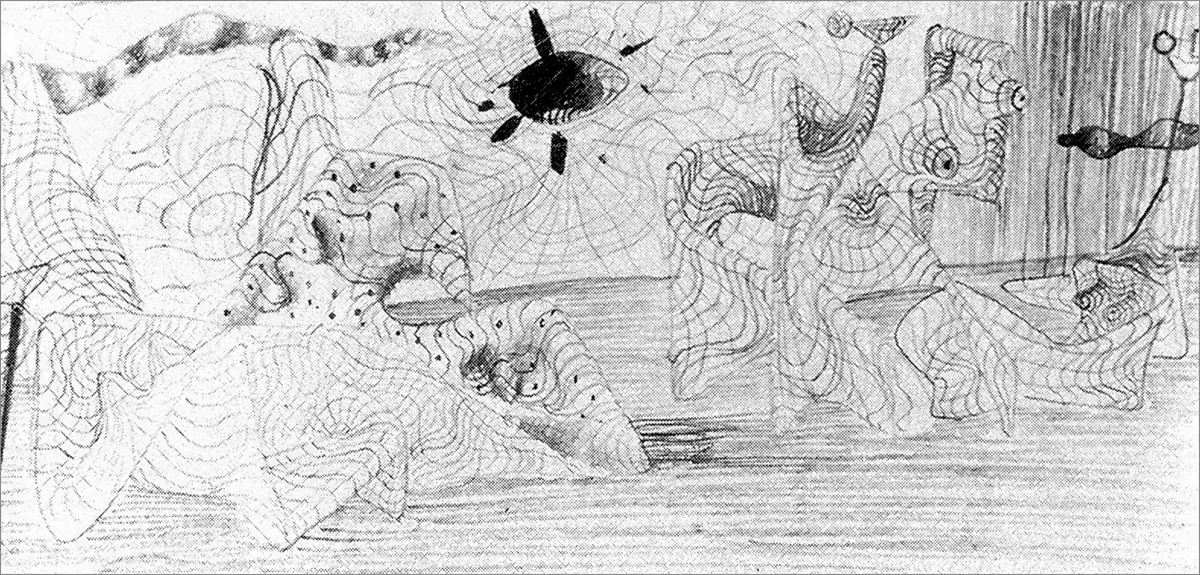
Matta has painted change since 1938 and has suggested it with titles that have been equally changing. His base or starting point was always architecture, which, in principle, is stable, introducing arbitrary elements into a discipline ruled by precision and measurement. Matta introduced arbitrary elements at the conceptual level, not in real terms. In this way, he could establish a boundary with traditional architecture and seek solace in the architecture of his dreams. How he has done so can be seen from the work of other painters.
While Tanguy and Dalí accepted natural space as a means of facilitating the mise en scene of objects and figures in strange situations, Matta subverted this space and the habitual mise en scene of the surrealists because it was and had been, in the final analysis, the established and usual practice since the Renaissance. While Masson and Pollock made automatism into graphic signs, Matta turned it into a territory of time or a passing of space, with the unusual feature that what lay ahead could also be behind and follow on from now. While Magritte bordered on the commonplace, manipulating natural physics within verism, Matta filled himself with Jarry and, instead of metaphysics, went beyond metaphysics. If Dalí illustrated the fantasies of the subconscious, Matta, with the faithfulness of the landscape artist observing his inner landscapes, painted them as if they existed there, with his easel and palette as the cyclone of time blasted forth with dizzying force, integrating and disintegrating space.
The Four Morphologies of Matta
In full possession of his conceptual and poetic faculties, the new surrealist painter moved forward with such speed that in just over a decade, he managed to paint subjects and themes which I would not dare to classify into periods, which is the usual practice in such cases, since their limits sometimes overlap. I have decided to group them together under the title of morphologies, since the term implies the convergence of meaningful elements which give them their characteristic in the theater of events, the theater which the painter was gradually creating in his imagination. The word "morphology" was used by Matta in an interview quoted by William Rubin, in which the painter explained that, almost in the mid-1940s, after a crisis following his attempt to "scrutinize his inner being," he tried, in Le Vertige d'Eros, "to create a new morphology of others, within my own field of conscience."14 Matta repeated this in an interview in 1966, referring to the morphology of his "first language."15
The first morphology of Matta is that of the agate, evocative of caresses and the theories of Freud. The second is the morphology of vertigo, inspired by Marcel Duchamp and the theory of relativity. The third is the morphology of Eros, that of the thousand and one copulations. The fourth and final morphology is that which Matta called the "morphology of scandalous man," i.e., of torture, destruction, and death. Matta, the humanaut, has thus traveled through the contradictory and multiple psyche of man as the center of the universe.
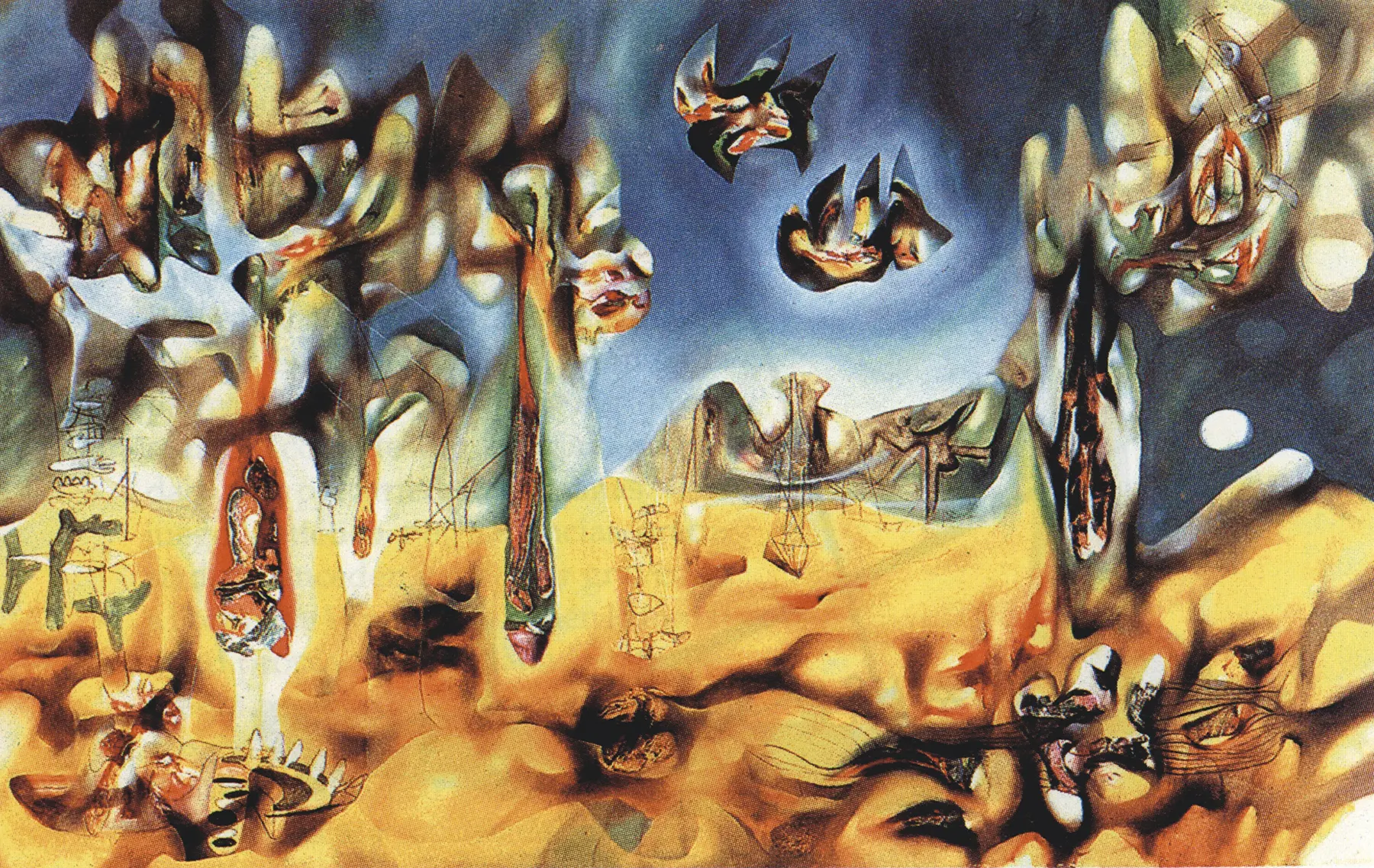
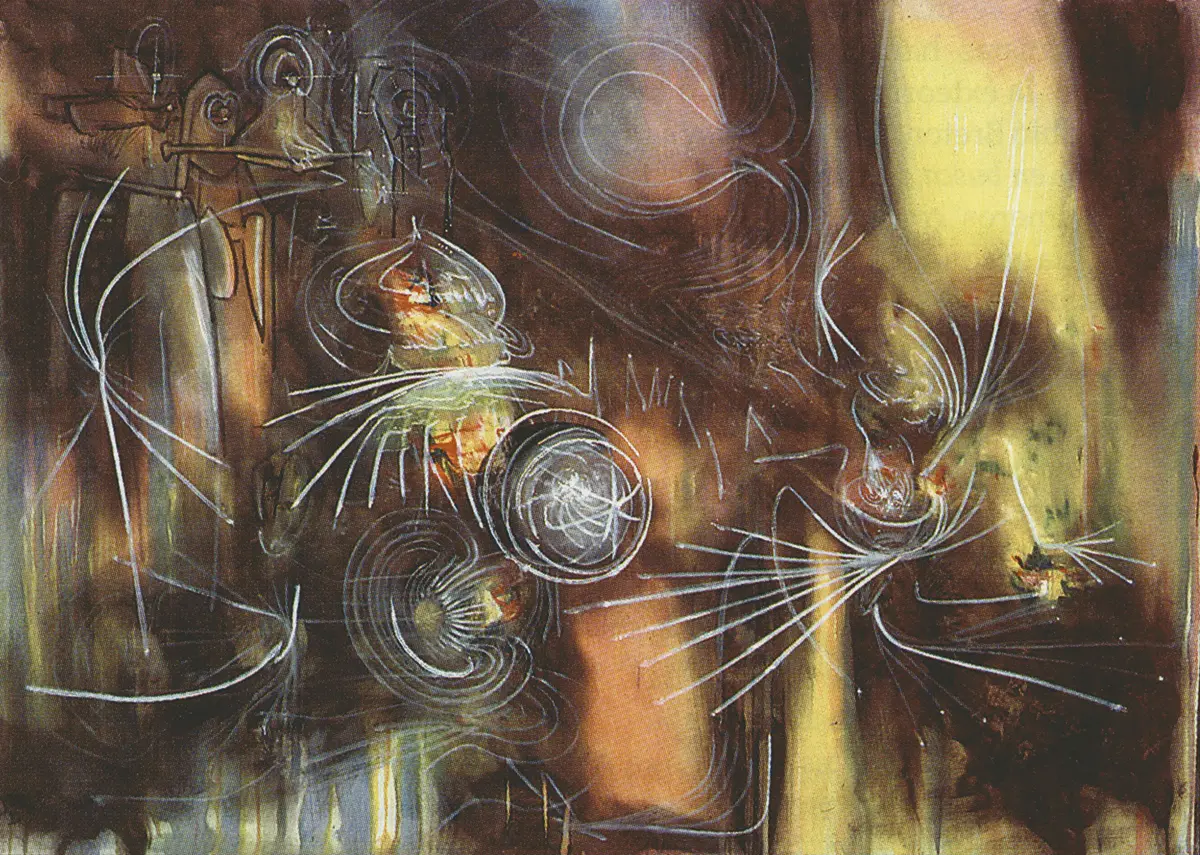
The morphology of the agate is that in the pictorial surface is presented as both a solid and a gas, similar to some watery crystal. The forms flow in a state which seems to be halfway between the moment when all its various components fuse (a variety characterized by color and tone) and the moment when the fused elements break up in a process of mutual integration. Here and there, we can perceive zones of color which become sharp points, now becoming slender, now suddenly thicker, suggesting contours which seek order in genuine knots of air. Space undulates gently, in slow motion. The morphology of the agate is that of the space within the womb. In Matta's best paintings, there appears what several analysts have already mentioned: the exteriorization of internal elements. Breton wrote that "Matta submerges himself in the search for the agate."16
The first organisms of this nascent morphology float silently in pictures in which the vocabulary of classification is often used, such as Morphology of Desire (1938), Inscape (1939), and Morphologic psychologique (1939). Everything here is miasma or a fusion of light and shadow, the stimulator of biomorphic structures in the process of construction. Although what Matta paints seems to occur in some intimate, reduced, and secret place, there is at the same time a sense of the vastness of the galaxies, i.e., the reverse of what he proposed in Sensitive Mathematics, the matrix as cosmos.
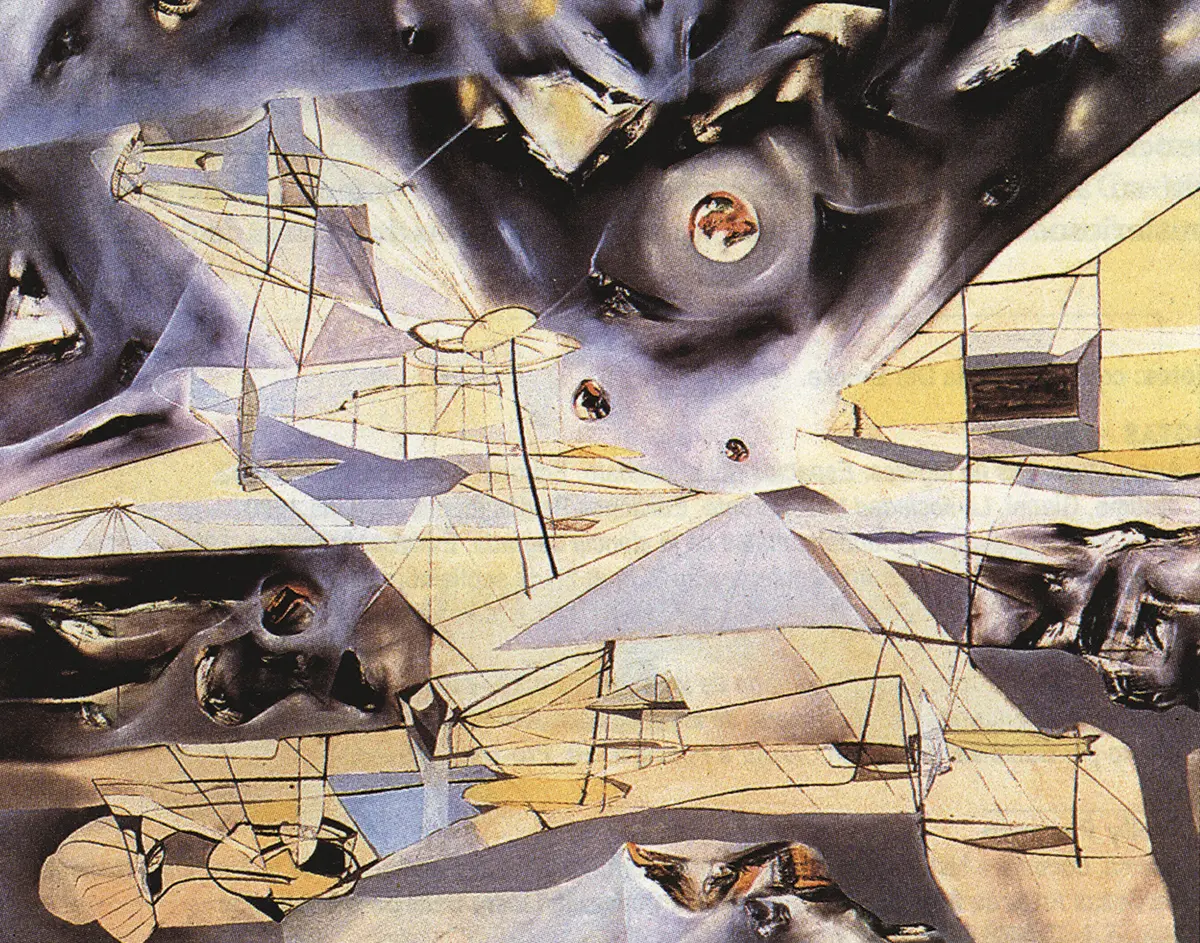
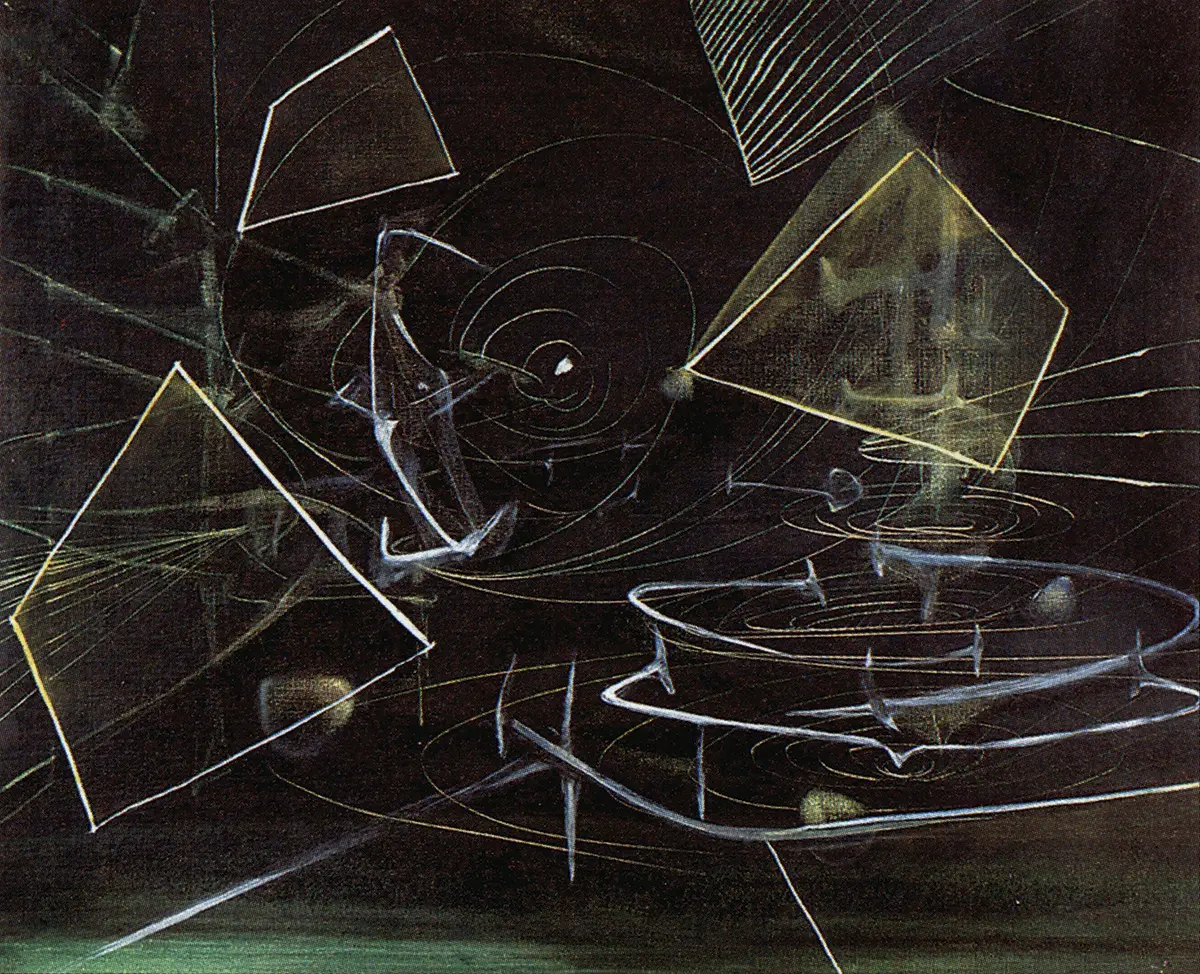
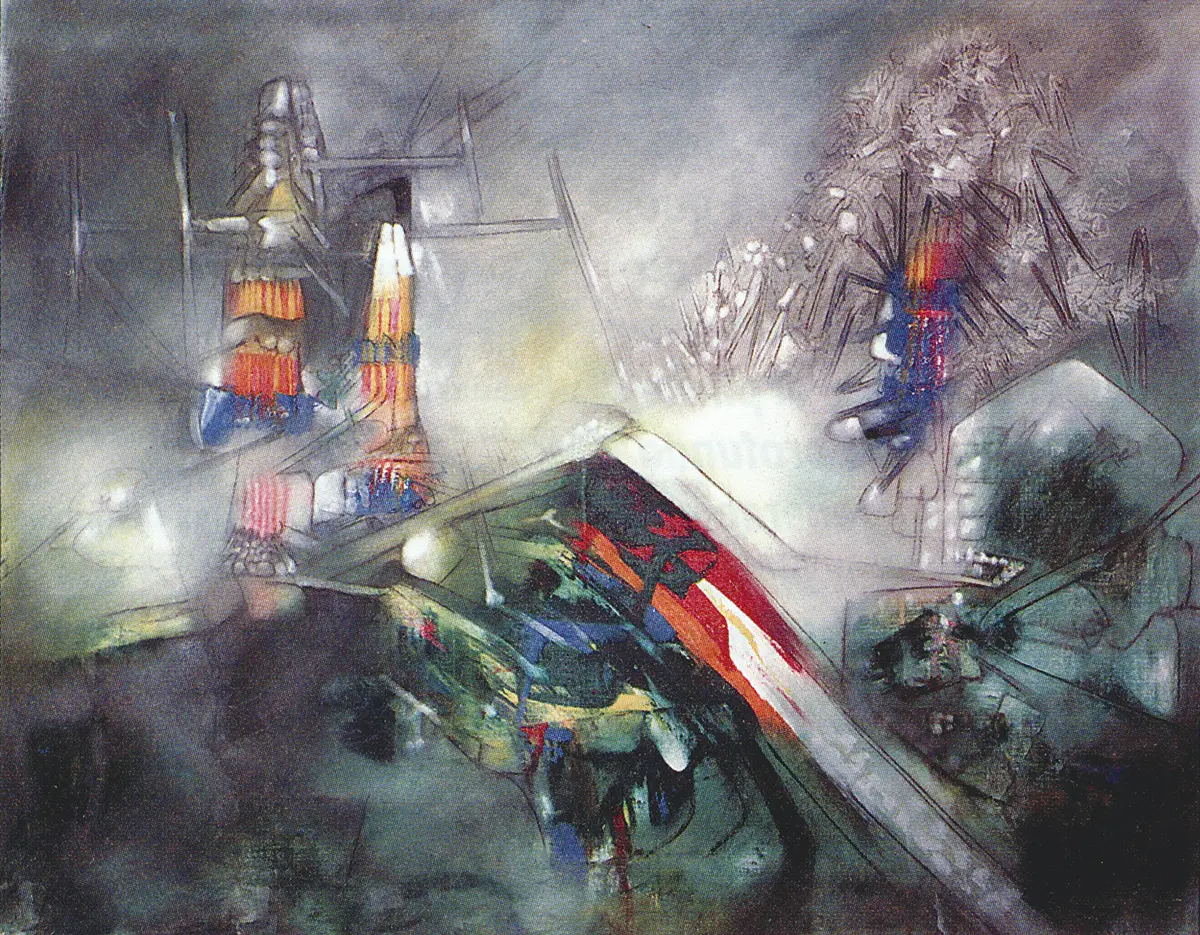
In the morphology of vertigo, white stones appear, which float like boats, and black surfaces that open onto nothingness. Transparent veils limit or hold back —or perhaps guide—the flowing of matter. The penumbra folds back, the shadows become airy, and some objects give off light instead of receiving it. Linear bands, governed by points of invisible and rare gravitation, rotate with a centripetal and centrifugal movement which accelerates them, yet at the same time deflects them, makes them harder, breaks them, curves them within a space which also wants to be curved, a space with and without limits, gaseous and dense, crystalline and opaque, dark and brilliant, both full and empty. It is a space which is simultaneously the setting and the protagonist, the music and the dance. It is the magma or primordial soup that contains all the possibilities of matter, or the instant in which matter is "the argument and the actor," according to Sensitive Mathematics.
Works such as Horoscope (1937), Le Fogat de la lumière (1937), Space Travel (Star Travel) (1938), and Dark Light (1940) belong to the primitive stage of this morphology, where there is a sense of sculptural volume. In the second stage, there are works such as Locus Solus (1941-1942), Éronisme (1943), Le Vertige d'Eros (1944), and The Onyx of Electra (1944). Matta paints what is infinitely large and infinitely small, the atom and the star. There is a fertilization of forms which suggest the cell, the seed, the bud, and the flower. We see multiplication, contact, and the excitement of incubus—and succubus—ike abstractions which recognize and long for one another, seek out one another, and fuse. The painter shows us matter in the splendor of its sensuality and the full use of its sexuality, and the space which unfurls before our eyes becomes a succession of elastic rooms or an infinite enclosure in the process of construction.
The morphology of Eros is the easiest to recognize, since the figuration here becomes explicit. It can be seen in the vaginas that scream and the erect tongues, which seem to be talking phalluses. The teeth grate and the lips become twisted with pleasure and excitement. The couples merge into a single body when they do not interlock like machines whose heart is a piston which moves to and fro, which moves to and fro, which will always move to and fro, forever and always. This is the morphology which shows us, as in a catalog, onanism, sodomy, sado-masochism, group copulation, and self-flagellation. The best works here include Le Coq (1941), the series The New School (1943), Science, conscience et patience du Vitreur (1944), and X-Space and the Ego (1945). These works display the eternal caressing of structures, either because they are anxious or because they isolate themselves in solitude. The morphology of Eros is the morphology of the sexes of unusual conformation according to Sensitive Mathematics.
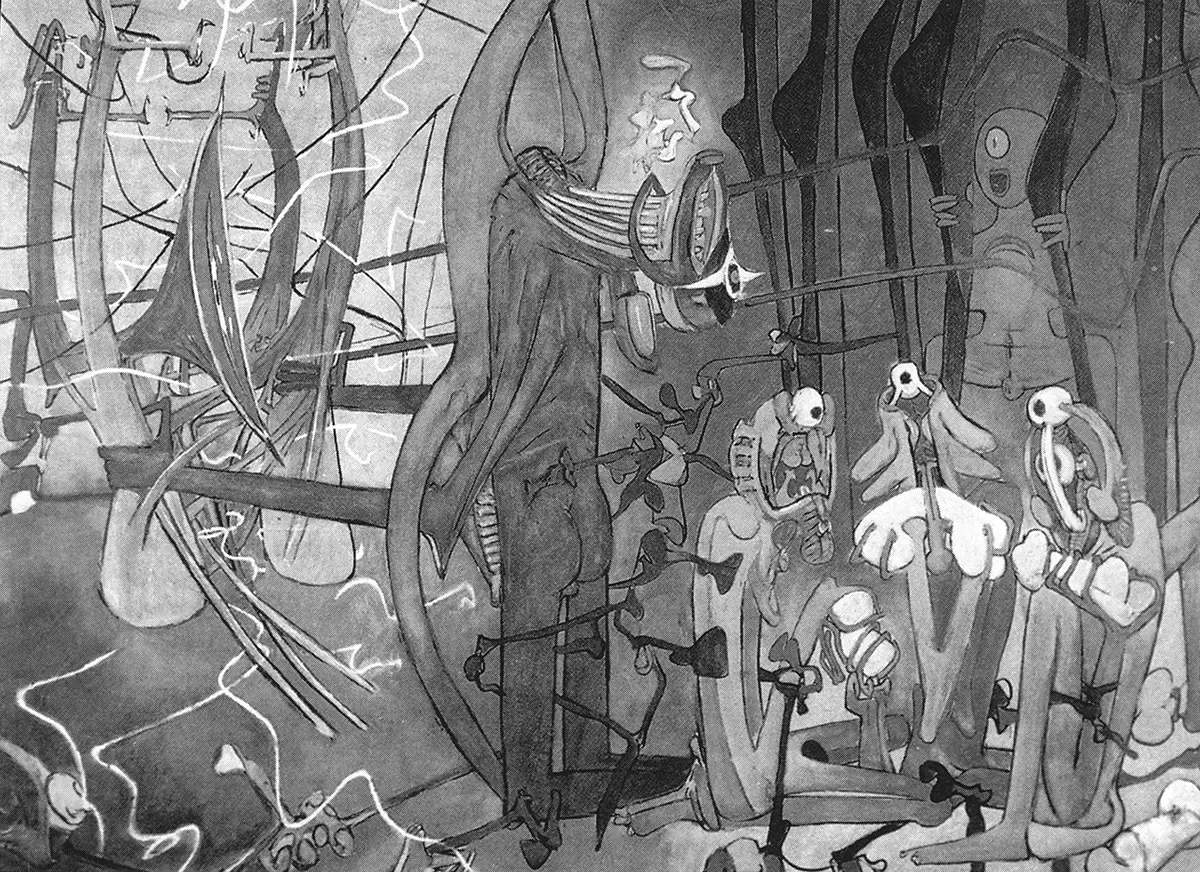
The morphology of scandalous man is that of war and torture. It is full of executioners whose masks make them look like robots and their manacled, generally naked, victims. Beings and machines clash against each other. An aberrant historical event, the Second World War, had left millions dead on the battlefield, in the razed cities, and in the concentration camps. Of such bloody conflict, Matta said: "I experienced a kind of shock when I realized what war and concentration camps meant, and my awareness increased. I tried not to use my own morphology, but a social morphology."17
Science and conscience battled one another in the body of Matta when he painted Pour une vertu jeune (1946), How Ever (1947), Crucifixion (1947), and Against You Murderers of Doves (1950). If the structures mingled with pleasure in the morphology of Eros, in the scandalous man morphology, they were the protagonists of a horrendous death shock. In an attempt to reinforce the atavism of destruction and self-destruction of which we were the victims, the figures take on a totemic air. The morphology of scandalous man is the morphology of this "existence" which, in a phrase not yet quoted from Sensitive Mathematics, is perpetually embittered, "since in certain circumstances, we allowed ourselves to become idiots by contemplating the numbers like price tags instead of seeing things as they were."
Between each of these morphologies, there are works that evoke the existence of intermediate states. Between the morphologies of the agate and vertigo, mention can be made of such works as Rocks (1940), Invasion of the Night (1941), Le Pendu (1942), and The Earth is a Man (1942). In Le Pendu, "the fluid envelope of painting is both the placenta and an apocalyptic cosmos."18
Between the morphology of vertigo and that of Eros, there is one of the most significant and important of Matta's pictures, the title of which, The Bachelors, Twenty Years After (1944), is a tribute to Duchamp's Grand Verre. According to Romy Golan, who has made the best study of the intellectual and artistic relationship between Matta and Duchamp, in this oilwork, Matta painted the magic molds of the Grand Verre, which are placed like the stills used to distill the raw matter or cosmic dust into the philosopher's stone.19
Between the morphologies of Eros and scandalous man, we can place There was Blood (1942), Etre avec (1945), and Accidentalité (1947). Pleasure has become pain, and love is now violence. In Etre avec, we witness the events of a masturbation room in which onanism is practiced, even with tools and machines full of barbed wire. Men and women wound their own bodies, a wounding which in the next morphology is turned against their fellow human beings.
But irrespective of the morphology, Matta does none other than show us the behavior of matter, from the origin of the universe to the formation of life and love, which renews life, to the destruction that brings death in its wake. Seen in these terms, Matta's work is an ambitious and vast circle that encompasses everything from the Big Bang down to the present. His real theme is time, the process of becoming.
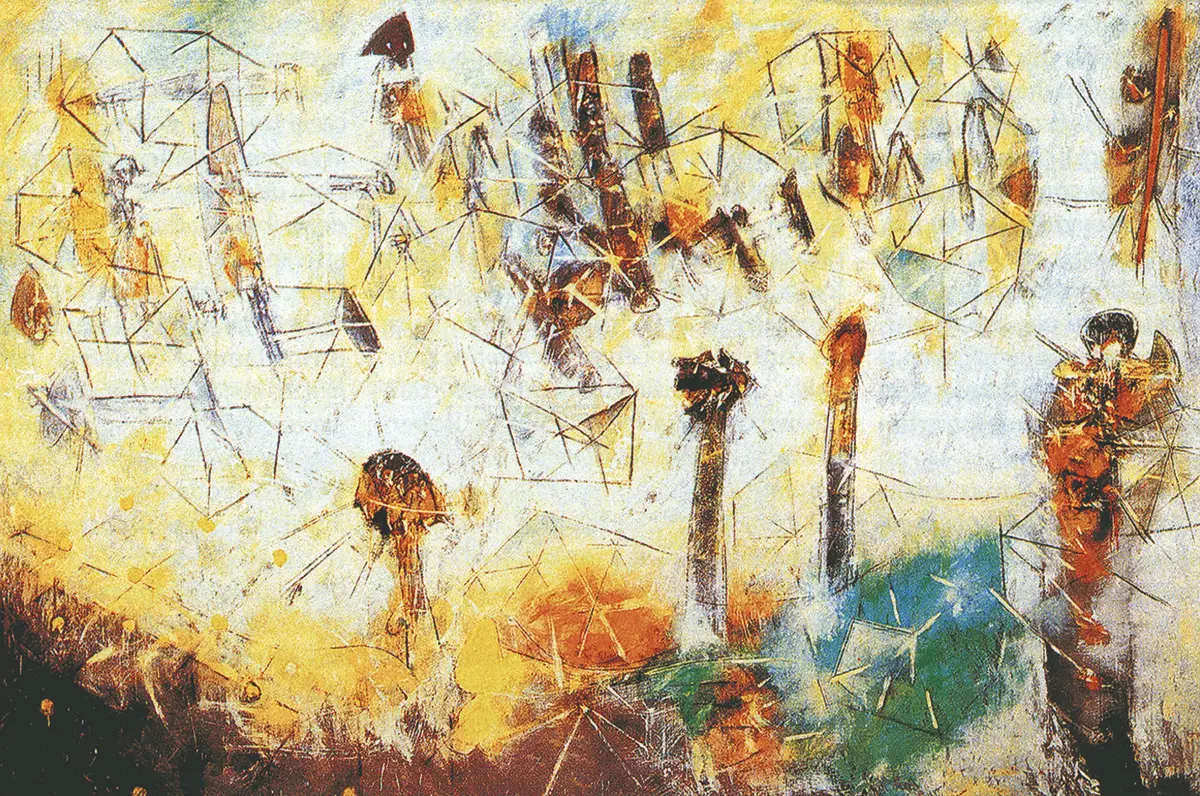
According to André Breton, Matta is the artist who tries to "represent the interior man and his misfortunes." What he paints "has nothing to do with the air we physically breathe."20 The Chilean surrealist has explained that: "It is not about the verb to paint; it is about the verb to see. I set forth the same problem that Picabia set forth, I think. Picabia always tried to show that which was not there. Because of this, I would say that we both had a similar view on things. For Picabia, as for me, the main objective is the virginity of the eye."21 Matta's declarations on this matter can be multiplied. A good painter and a good theorist, to the virtue of being a great painter, we add the virtue of having an out-of-the-ordinary intelligence. This is the reason why he had such an intense relationship with Duchamp, the intellectual artist par excellence.
The complexity of Matta's work, then, makes sense. So much sense that with the passing of time, it is clear that he is the most profound painter of his generation. For example, Roberto Matta was born two and a half years before Jackson Pollock. In terms of the verb "to see," in Matta's works, we see what we can also see in Duchamp's work but not in Pollock's: a deliberate change of objective that makes us meditate, not contemplate.
NOTES
1. William Rubin, "Matta pintorvisionario," in Matta, Ministry of Culture, catalog of the exhibition at the Palacio de Cristal, Madrid, September-October 1983, p.23.
2. Julien Levy, Memoir of an Art Gallery, New York, G.P.Putnam & Sons, 1977, p.247.
3. "Chronologie et documents," in Les Classiques du XXe siècle - Matta, catalog of the retrospective exhibition at the Georges Pompidou Center, National Museum of Modern Art, Paris, October 3 - December 16, 1985.
4. Christian Zervos, "Mathématiques et art abstrait," Cahiers d’art, n° 1-2, Paris, 1936, p.8.
5. Op.cit., pp.9 and 10.
6. "Chronologie et documents," op.cit., p.266.
7. Ibid., p.267.
8. Ibidem., p.265.
9. Christian Zervos, op.cit., p.4.
10. Gabriele Buffet, "Coeurs volants," Cahiers d’art, op.cit., p.34.
11. "Chronologie et documents," op.cit., p.266.
12. Matta - The Logic of Hallucination, catalog of the traveling exhibition organized by the Art Council of Great Britain, I984-85, p.5.
13. Ibid., p.4.
14. William Rubin, op.cit., p.27.
15. "El surrealismo y la pintura," in Matta, Ministry of Culture, op.cit., p.42. This is an interview conducted by F.C.Toussaint, published in Les Lettres Frangaises, June I966.
16. André Breton, "La perla pervertida," in Matta, Ministry of Culture, op cit., p. 16.
17. Romy Golan, "Matta, Duchamp et le mythe: Un nouveau paradigme pour la dernière phase du surrealisme," in Les Classiques du XXe siècle, Matta, op.cit., p. 41.
18. Ibid., p.41.
19. Ibid., p. 39.
20. André Breton, "Hace tres años", in Matta, Ministry of Culture, op.cit., p. 21.
21. María Luïsa Borrás, "Conversación con Matta en abril de 1983," in Matta, Ministry of Culture, op.cit., p. 10.
ÁLVARO MEDINA
Colombian art critic and historian. Collaborator of Arte en Colombia/ArtNexus since its foundation, he was our correspondent in Paris for 13 years. Presently, he is a professor of Latin American art history at the Universidad Nacional de Colombia, Bogotá.