
The Museum of Modern Art La Tertulia began its program this year with three one-man shows by three Colombian sculptors. The first included the latest works by the veteran Édgar Negret (1920), who, in the last decade, has been recreating pre-Columbian themes, in particular those of the Aztec and Maya cultures and of the ancient inhabitants of Peru. His habitual style, based on the assembly of laminated aluminum, nuts, and bolts, has become a multi-colored proposal in which the mechanical fuses with a sense of optimism in constructions that are not only youthful and joyful in appearance, but profound in their reflections.
Negret gives his sculptures names that leave no doubt about his argument. Inca Flag, Quipu, Laguna, Sun, complex solutions of engineering with a rich and vital relationship of colors, are works that seek to express a sense of mysticism, ritual, magic, and mystery, combining an allegory of the past with a resolutely modern treatment.
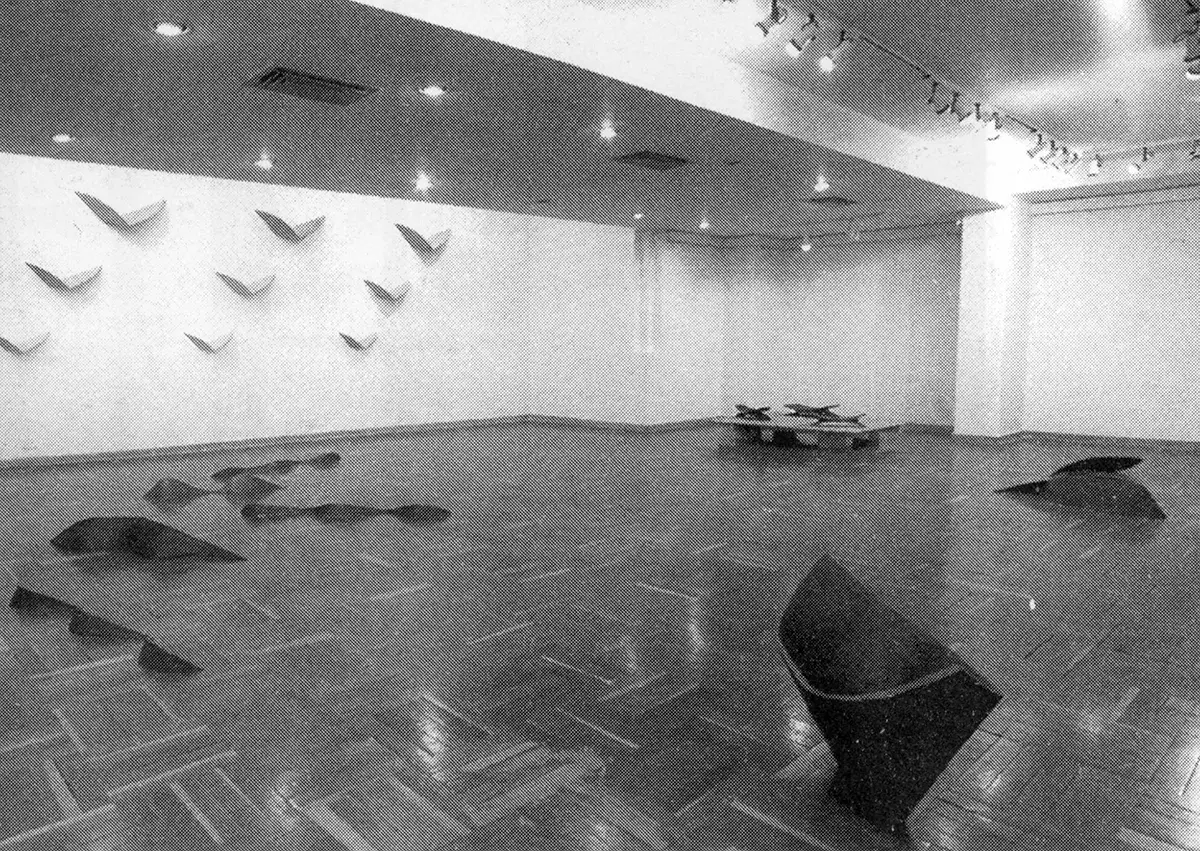
Hugo Zapata (1945) uses landscape elements, such as stone, metals, and water, to evoke typical features of tribal cultures. Their rituals, beliefs, and the development of the landscape are treated in forms which suggest not only emotional states, but physical aspects of weight and consistency, which the materials themselves express.
Zapata not only transfers and uses stone as a source of argument and emotion, but also includes in his public work the marking out and transformation of the elements of nature. In this sense, he is an artist who is deeply committed to weather, species, and the changes of nature.
From the same generation as Zapata, John Castles (1946) reworks the tradition of contemporary metals and their aesthetics (iron, aluminum) to explore their physical and poetic properties. His recent Aquatic series consists of biomorphous forms that recall the proposals of Arp, Miró, and Calder, which the artist endows with new and powerful spatial problems, with natural recourse to the severity of minimalism, which gives his work a convincing sense of presence.
MIGUEL GONZÁLEZ