
Of the three Spanish-speaking islands of the Caribbean—Cuba, Puerto Rico, and the Dominican Republic, it is the latter where women artists continue to be in a marked minority among their male colleagues. Despite the fact that art is one of the professional fields that, in Santo Domingo, is the least marginalized in terms of the condition of women, and where there is equal opportunity and treatment for all, male artists outnumber women by six to one. However, this "self-discrimination"—which is mainly due to family, educational, and social factors—is weakening, if we compare, for example, the post-1965 generation with that which began to produce in the 1980s.
Myrna Guerrero and Danilo de los Santos, both artists, teachers, and historians, recently organized in the Casa de Bastidas a multiple event on Women and Art in the Dominican Republic Today, which included an exhibition, seminar, and book catalog (due to be published). While most of our group shows are generally made up of a selection of works and artists, whose only link is that provided by the organizing institution, this exhibition, which had a precise framework, offered an impressive group of pictures, sculptures, drawings, prints, photographs, and installations, reflecting the work of four active generations of women artists.
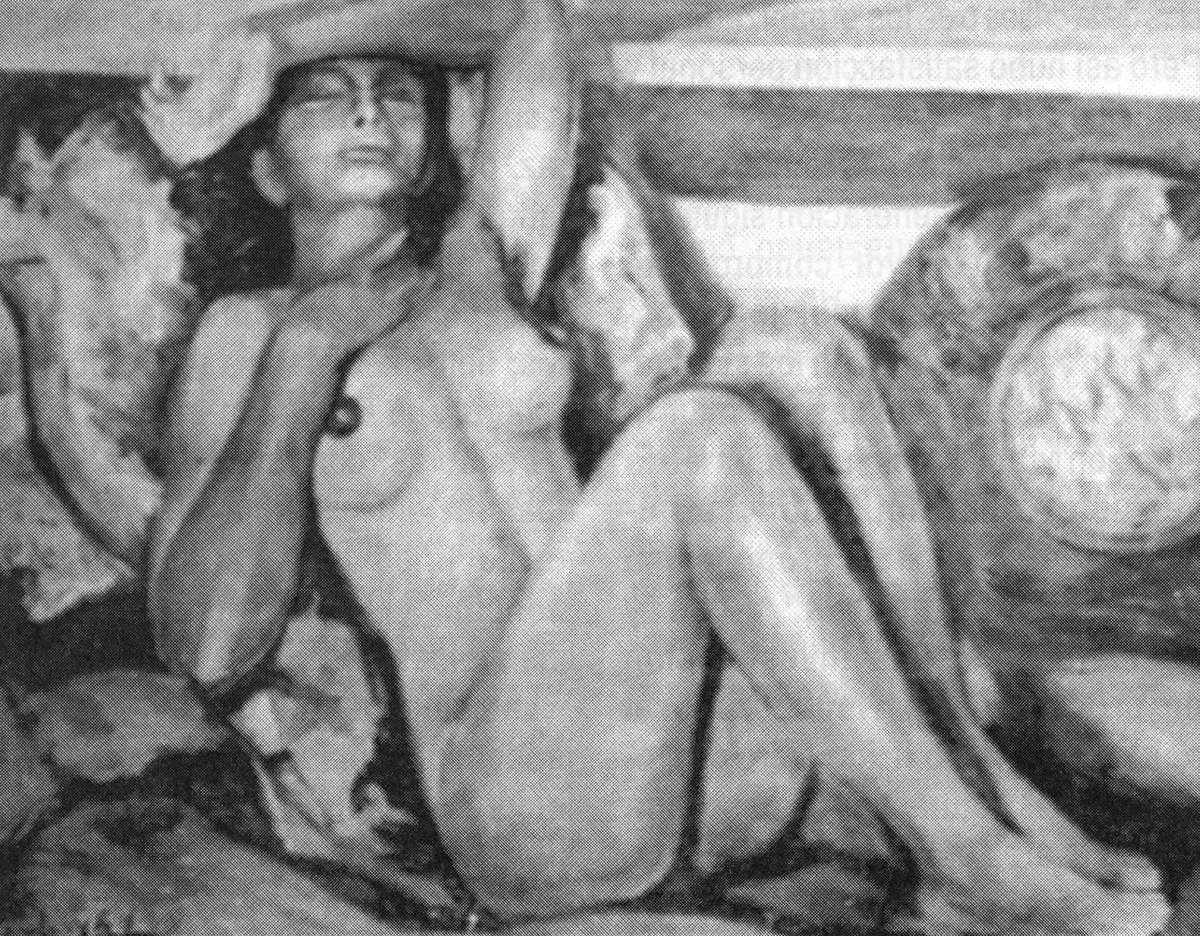
The exhibition, which extended over four rooms of the secular Casa de Bastidas and headquarters of the Voluntariado de las Casas Reales, was based on an historical starting point which paid justified homage to Celeste Woss y Gil (1890-1985), the first major women painter in the country, who studied, lived, and showed her work not only in Santo Domingo but in Cuba, the United States, and Europe. Before her, no other painter had explored in such a natural and impressive way the theme of the nude and the exaltation of miscegenation. Her solid male and female bodies, which appeared in a notable number of paintings and drawings, are examples of both academic principles and the spirit of modernity.
Quite rightly, this small but great show was separated from the rest of the exhibition in two small and "intimate" rooms. Crossing the passageway, the visitor went along the long L-shaped space where the curators had placed the works by the other artists. There was no separation between the two- and three-dimensional works, and neither was there any classification by age, reputation, style, or genre. This was not simply an "easy way out," but a philosophy. Works by dozens of active artists from the country were there, all very different except for the common denominator of their sex, without any kind of hierarchy. The quantity and diversity of these works gave a sense of strength and motivation, a feeling that they had a definite place in the visual arts of the country.
The task carried out was an enormous one. In most cases, each artist was properly represented at the appropriate level with recent works. This rather informal kind of selection enabled everyone to participate. In the case of young artists, the question of the most solid and significant period of their works does not arise. The selection was more delicate in the case of the major figures—such as Ada Balcacer, Marianela Jiménez, Elsa Nuñez—since the exhibition did not establish any precise time-periods or themes. These "established" figures selected their own most representative works, although the selection did not necessarily coincide with what the critics or organizers would have chosen. But this approach ensured personal satisfaction and participation.
Frequently, the painters of the mid-twentieth century and of the following generation emphasized their greater sense of commitment through expressionism, introspection, and myth in the 1970s. Their current works alternate between figuration and abstraction, "sensitive geometry," baroque, and organic art. Ada Balcacer, for example, proposes a symbiosis of figures, lights, and geometrical elements, a continuing process of investigation. Elsa Nuñez opts for lyrical abstractionism, but with figurative insinuations. Rosa Tavarez applied polychrome elements and textual variations to her installation, whereas the passion for drawing and "fat women" inspired Maria Aybar in the creation of a fantastic and contemporary version of the Venus of Lespugue.
There is a current dearth of women sculptors; Soucy de Pellerano, who was commissioned to execute a monument for the Dominican Republic Square of Quito, continues with her anthropomorphic versions of the machine, while Amaya Salazar has done some promising work with her small bronzes, which recall Camille Claudel. The figurative sculpture of Beatrice Escoffier, the wife of José García Cordero, was the work with the greatest sense of craft and training. She was followed closely by Grecía Rivera, with her plaster molds in a feminist- inspired installation. Charito Chávez showed consummate realism in a self-portrait and a three-dimensional polyptych. Jacqueline Soto also presented some strange and silently aggressive ceramic works.
Of the painters from the 1970s, special mention must be made of Myrna Guerrero, with her giant figures full of symbolism and syncretic graffiti, and Tete Marella, with her neo-renaissance vestments set in geometrical sculptures. The exhibition confirmed that those artists who had first shown their work in the 1980s offered personal and very impressive visions of everyday life, intimate experiences, or collective mythologies. Belkis Ramírez, ascending in installations, was represented by wooden prints of impeccable technique. Luz Severino, another very skillful print-maker, has a more vehement character and is unable to confine her painting to either abstraction or figuration. Inés Tolentino, in an exploration of time and memory, conceptualizes each of their signs with a sense of distance and emotion. Scherazade García, the youngest of the painters, who recently presented her first one-woman show, revealed lyrical expressionism extended towards the future. And Yuli Monción and Lisettte Mejía confirmed their very promising potential.
Overall, it was photography which proved to be the most satisfying category—a domain until very recently virtually "reserved" to men. Clara Barletta captured the poetry of the child and the adolescent, without compromising social content. Maritza Álvarez, a polyfacetic artist, gives her black and white images the same sense of non-conformism as her paintings and drawings. Mary Rosa Jimenez, whose earlier unusual visions of Paris were most impressive, presented some intervened and fragmented photography. And Scarlet Victoria was the absolute revelation of the show, with her panoply of women as objects or housewives, incisive, humorous, and rigorous, and with (deliberate?) traces of kitsch.
Although it is true that women artists, in the currently vital artistic scene of the Dominican Republic, are still at a disadvantage in numbers and relatively timid, the extensive collection of works on show at the Casa de Bastidas was proof that today, and especially in drawing and painting, women are emerging as a powerful force. In our view, this was one of the most necessary events to have been organized in recent years, and one which will encourage women artists in the country to broaden their terrain within the visual arts of the country.
MARIANNE DE TOLENTINO