I.
Evohe! Volposados en la cresta del murelio, se sentían valparamar, perlinos y marulos. Julio Cortázar, Rayuela. Capítulo 68.
The sense of rebellion generated by the scenic adventure of the choreographer and dancer Álvaro Restrepo (Cartagena, 1957) jolts all the senses of the spectator, who experiences a sense of withdrawal and visceral shuddering, an unstoppable desire to rush out, to burst into tears, and a decisive yet timid sensation of happiness. Words, many words remain on the tips of our fingers when we witness the shows (communions?) of Álvaro Restrepo. And there is the risk that we will say very little.
Rebis, Sol Niger, I, Arbor, Gonzalo, The Sickness of the Ángel, Ordalía are titles which already mean many things in the (not so) secret spectacle of culture in Colombia. There is much to be said, and those of us who have written on them have dared to describe them as "theater dance," "unconventional proposals," "stage poetry," "performance," "post-modern dance," and "dance ritual." But in the end, anyone who wants to reflect on what stage spectacle means in this disconcerting Latin American country faces a real challenge when he enters the deep and glacial world of Restrepo. There are no genre barriers, becoming an integral plastic fact where image and space poetry, colors and sounds, forms and figures are added in a visual totality which locates him and causes the experience to burst beyond the limits of the stage.
When we return to the uncertainty of everyday life, of the world of fragility, and suspect that art becomes distorted in the palm of the hand, the work of this dancer-choreographer appears like a light inside the labyrinth of unreason, a powerful example of what it means to be a creator in the impatience of everyday existence.
Where can we begin? Perhaps, with sensations, contextualization, or the effects of critical distance. Any method is feasible. In any event, free of the false traps of totality, the path before us is the same as that which faces the curious reader of hieroglyphics: when the enigma has been resolved, what is left in the hands is a new sacrifice of reason. And the game begins all over again.
II.
I visited my friend, and the floor of his door was so naked. Sogi Shohaku and Socho (Minase sangin)
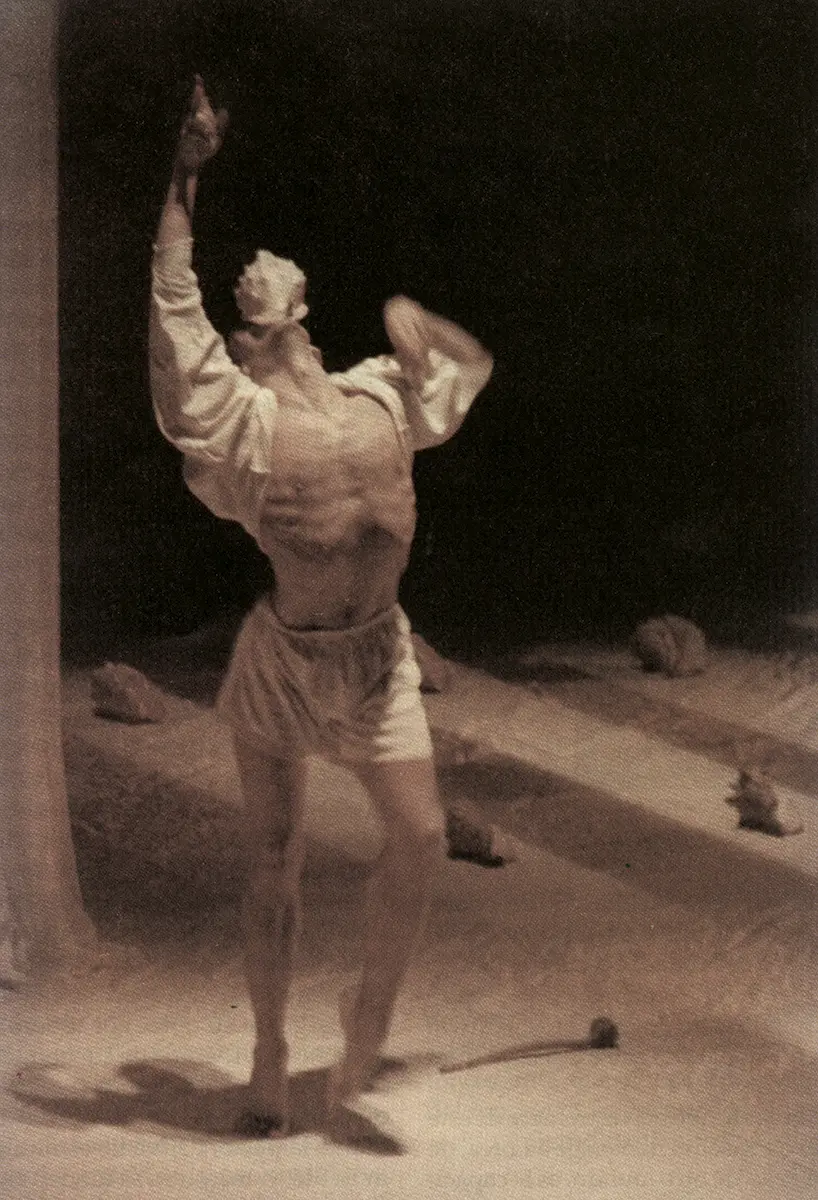
From the Orchard of the Mute (1986), the first scenographic work that Restrepo explored, was based on a homage to Federico García Lorca. Here, amid old persons and tenuous light, heat, and uncovered heads, space began to become transformed into a place where memory and dream would walk hand in hand, offering the spectator an opportunity to engage in a slow dialogue with them, because of the hermetic complicity of the choreographer.
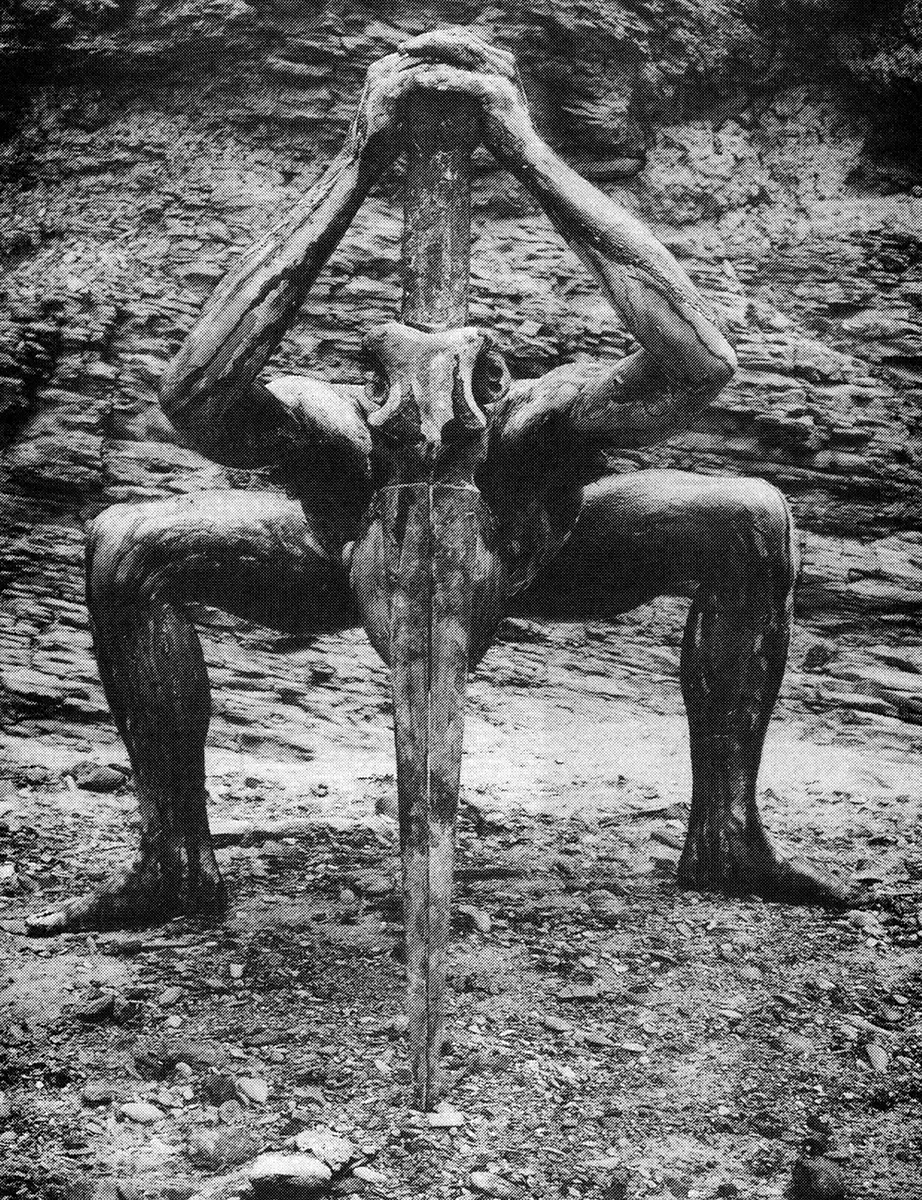
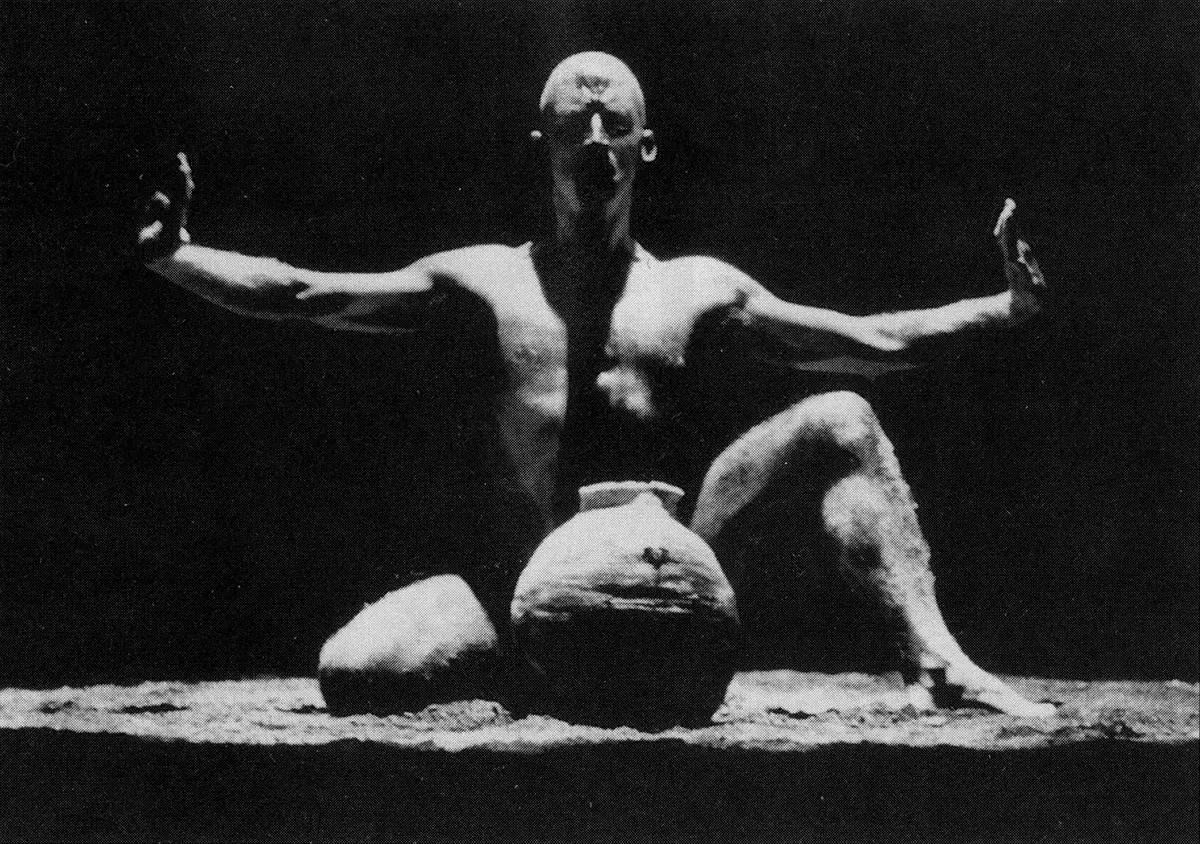
From this first experience, which was initially performed at the La Mama Theater in New York after years of intensive study with different dance masters, Restrepo plunged into the abyss of finding his inner self on stage. From Ondina, a fragment of From the Orchard of the Mute, originally interpreted by the artist Maria Teresa Hincapié, there emerged what was to be considered Restrepo's first major work: Rebis, a little jewel of contention, poetry, technique, and absolute risk. Restrepo tells us that Rebis in Latin means an androgenous being. It is a "fusion of principles that, in medieval alchemy, was thought to lead to the legendary philosopher's stone." On the basis of this principle, the choreographer and his company (his own company)? which, not by chance, was called Athanor Danza, achieved one of those few sublime moments of work with the body on the Colombian stage. The verdict has been the same in the different countries in which Restrepo has bared his body in order to bare his soul. (Rebis received the Grand Prize Pegasus in Hamburg's International Theater Festival in 1992).
Perhaps what is most moving in this new and unusual homage to Lorca, this Rebis from some other world, is the intimate capacity of the dancer to pursue his movements to their final consequences, so that when we enter the theater, we do not know if we are interrupting some sacred ritual, or whether, on the contrary, we should feel at ease in the presence of such an act of submission. With his body painted and done with savage wisdom by Susana Carrié, and primigenial (and apocalyptic) music by Gabriel Ossa, Restrepo creates a work which fuses with nature and his awareness of conflict and rest, but at the same time, with our own fragile violence, with the poetry of reiteration and the return to the womb and nudity.
I remember that at the end of the first part of Rebis, I always asked myself where the essential strength of a person apparently so calm as Restrepo had come from. And the reply came fifteen minutes after the interval, when the dancer launched into his Traditional Courtly Dance of Korea: Variations on the Chu Neng Mu, which he had learnt with his teacher Cho Kyoo-Hyun (with whom he began to work on the choreography of a multi-media spectacle, O-Ilé, by Liliana Villegas, almost ten years ago). Here, in this tiny oriental piece, lay the technical roots of what had been seen during the first fifty minutes of the work. It was a simple, but important moment for the observant spectator, since it took us into the very heart of the creation, into the most intimate secrets of the artist, who with discreet magnanimity revealed all his formal and expressive resources to the public. Something similar (but in a clearly Colombian context) occurs in his Improvisations on Songs of Cowherds, where Restrepo seemed to be dancing to the wind, free of the bonds which had held him until then. The combination of Korean rigor and the delicious anarchy of the improvisations set the tone, the perfect fusion that the artist has always wanted to achieve in all his work. Finally, mention must also be made of his homage to Cortázar and chapter 68 of his work entitled Hopscotch, where words act as a stimulus for the muscles, the one fusing into the other in a cacophanous diversion with rapturous results.
This work, which he created in 1987, provided Restrepo with all the tools that he had apparently been seeking for so long. We should remember that he began his dance studies at the age of 24, an age which, for the purists, is already too late to achieve a good level of technical and artistic development. But Restrepo has demonstrated that where there is a will, there is a way.
III.
I have an inconclusive child, drinking water inside of my dreams, he laughs... (A.R.)
In 1989, the dancer Elsa Valbuena worked with the Athanor Danza Company, and Restrepo did the choreography for her in the new work entitled Sol Niger. In this piece, the music (Seven Poetical Compositions from a Friend by the Galician troubador Martín Codax) played a crucial role in creating the atmosphere. The scenography suggested some melancholic print by Durer (design by Bernardo Rey), and the lighting (initially by Ricardo Neira) was the intimate accomplice of the dancer.
The work, which was premiered at the Camarín del Carmen and then traveled to the Canary Islands, became a new experiment with new sensations when it was reworked by Restrepo and the Costa Rican Humberto Canessa a couple of years later. The spirit of the work continued to be the same, but the counterpoint between the two interpreters took the piece to a much more sublime level. That being said, one might ask whether the work of Restrepo (or at least his work to date) requires the physical presence of the choreographer on stage for his ideas to acquire their full resonance. It would appear to be so, if we judge by this present case. At all events, when Sol Niger was created by Elsa Valbuena, it already had all the ingredients of an extensive poem which would grip our very entrails. But Restrepo and Canessa made it into something new, in which the mirrors, nature, and the measured silence of the dancers became a much more audacious tableau vivant.
"Sol Niger, as the program note pointed out, is an archetypal journey... hence the allegory of the encounter between rational and scientific thought and the universe of intuition and magic." It is in this balance between different forces that we can see the sensibility of Restrepo's works. The permanent polarization between reflection and emotion, the male and the female, movement and stillness, life and death, poetry and prose, reflects the search of this artist for an encounter with total language, in which dance, theater, music, games, the plastic arts, video, philosophy, literature and the intimate contemplation of the world come together hand in hand, within a new sensibility and a new complicity with the world. Sol Niger marks a firm forward step towards the consolidation of this equilibrium.
IV.
Y trempa. Your body will have the arrogant vigor of a congested sex, irritated. (Jean Genet)
In 1991, Restrepo produced a new work, I, Arbor, Gonzalo, with the participation of Humberto Canessa, Rosario Jaramillo, Dafne Pasqual, Marianne Roige, and Restrepo himself. Once again, the music was by Gabriel Ossa, the wardrobe by Susana Carrié, and the sets by Liliana Villegas and Luis Guillermo Vallejo.
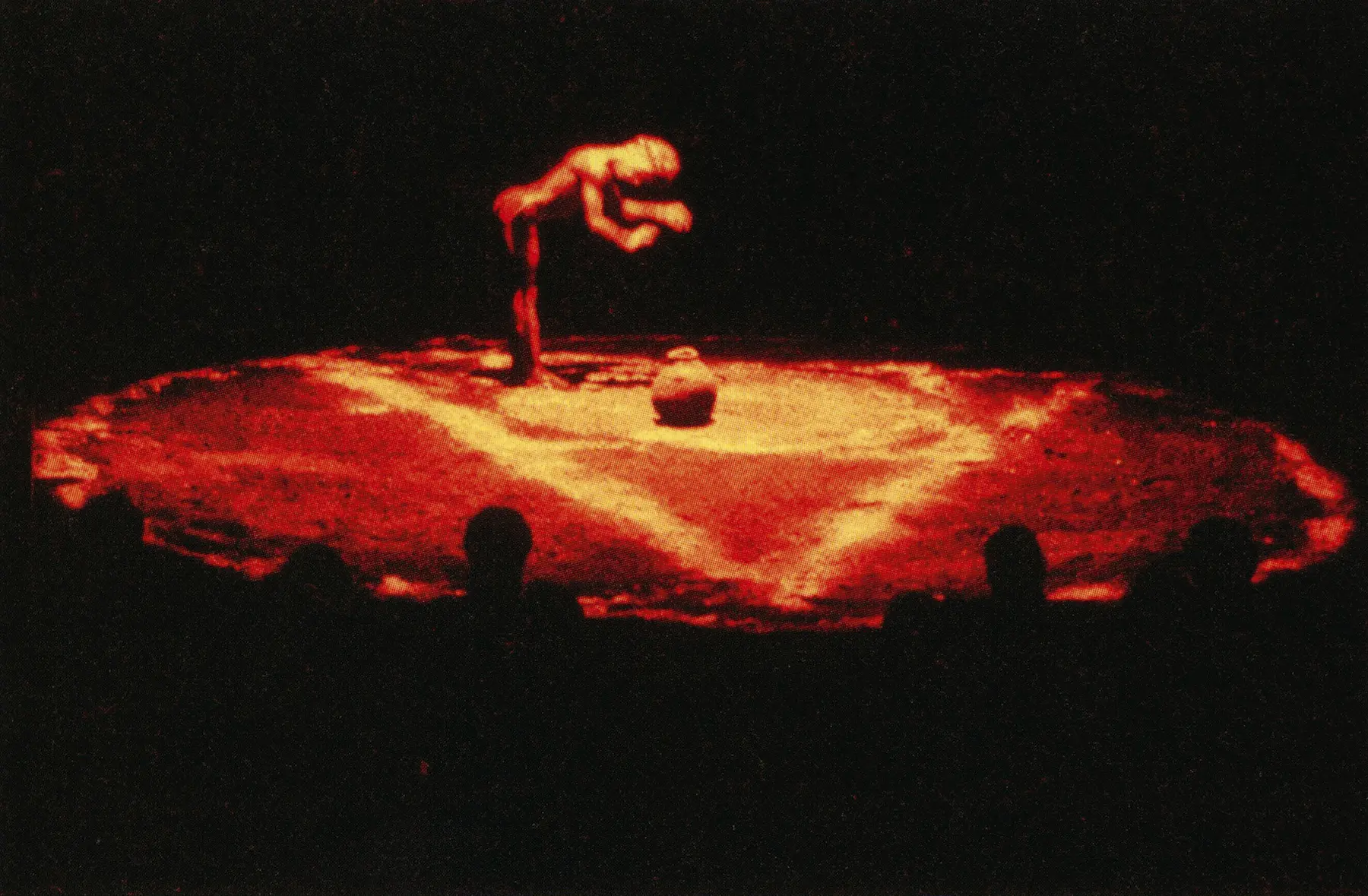
We are now in the presence of a wrenching autobiographical vision of the world, a search for an "ancestral memory" which will achieve its communion through precise symbols, evocative objects, the fusion of forms, and reflections on the stage. Restrepo describes the starting point in the following terms: "My older brother, Gonzalo, an autistic deaf-mute, my shell brother, pillages the dreams of my infantile memory. His shadow, the sacred extension of my fears, accompanies me always, relentlessly stirring the profound meaning of my days." We are here in the presence of something new: the world of memories, the long-gone hell of childhood, where now everything becomes silent, a return from death where the first steps of life are being told.
Here we see different characteristics of Restrepo's work, with the rewriting of signs and homages heard before: texts by Cortázar, childhood songs, the slow, eloquent silences, the fusion of water, earth, fire, and air, and the objects that fuse together with the dancers. But there is also the writing of a private universe which is imposed on the eyes of the spectator in a much more incisive manner, over a period of an hour and a half, in which communication is now achieved through the slow complicity of memory.
This work led to a kind of spin-off on the same theme, a new piece entitled The Sickness of the Ángel. Here, Restrepo goes to the final consequences of his thematic obsessions. But this Angel flies over the stage with wings that are much more secure. I, Arbor, Gonzalo may be seen as a version of From the Orchard of the Mute, whereas The Sickness of the ángel is nearer to the experience of Rebis. In each case, one work has been a kind of trial laboratory for the other without detriment at any time to the work of experimentation. However, The Sickness of the Angel comes very close to touching the fatal limits between life and death and producing in the spectator an emotion which goes well beyond his own limits. The synthesis is clearer, and Restrepo alone, through Canessa and the figure of the child, manages to submerge himself in the amniotic essence of the impossibility of living. As Colombia Moya pointed out in La Jornada (Mexico City), "with a prodigious sense of imagination and deep knowledge of time and rhythm on the stage, Restrepo takes us by the hand to reveal layers of consciousness in the different autistic areas inhabited by despair and solitude; the unglorious epic of broken movement, wings impaired by everyday effort." In this way, Restrepo plunges into the depths of his own language, so that his dance becomes a consolidation of unexpected dimensions. The ground of risk has been prepared for future adventures.
The next step in this direction was a curious homage to the memory of Maurice Ravel, a spectacle presented at the Palasport dell'Arsenale in Venice in October 1991. Here, with the physical presence of the plane on the stage, Restrepo, Canessa, and Marianna Roige recreate themselves in the sonorous labyrinths of the Bolero and Gaspar de la Nuit. Once again, the forms are recreated through the stimulation of geometrical forms, which the choreographer has pursued through his dance career. Following this experience, Álvaro Restrepo is no longer searching on the stage, but is in the process of finding. And, like all great artists, he runs the risk of plunging into unknowable depths and losing himself.
V.
How to conceive that a phrase is anything but a monologue, that an extasis has a value beyond itself, that a god cares about our salvation and our loss? (E.M. Cioran)
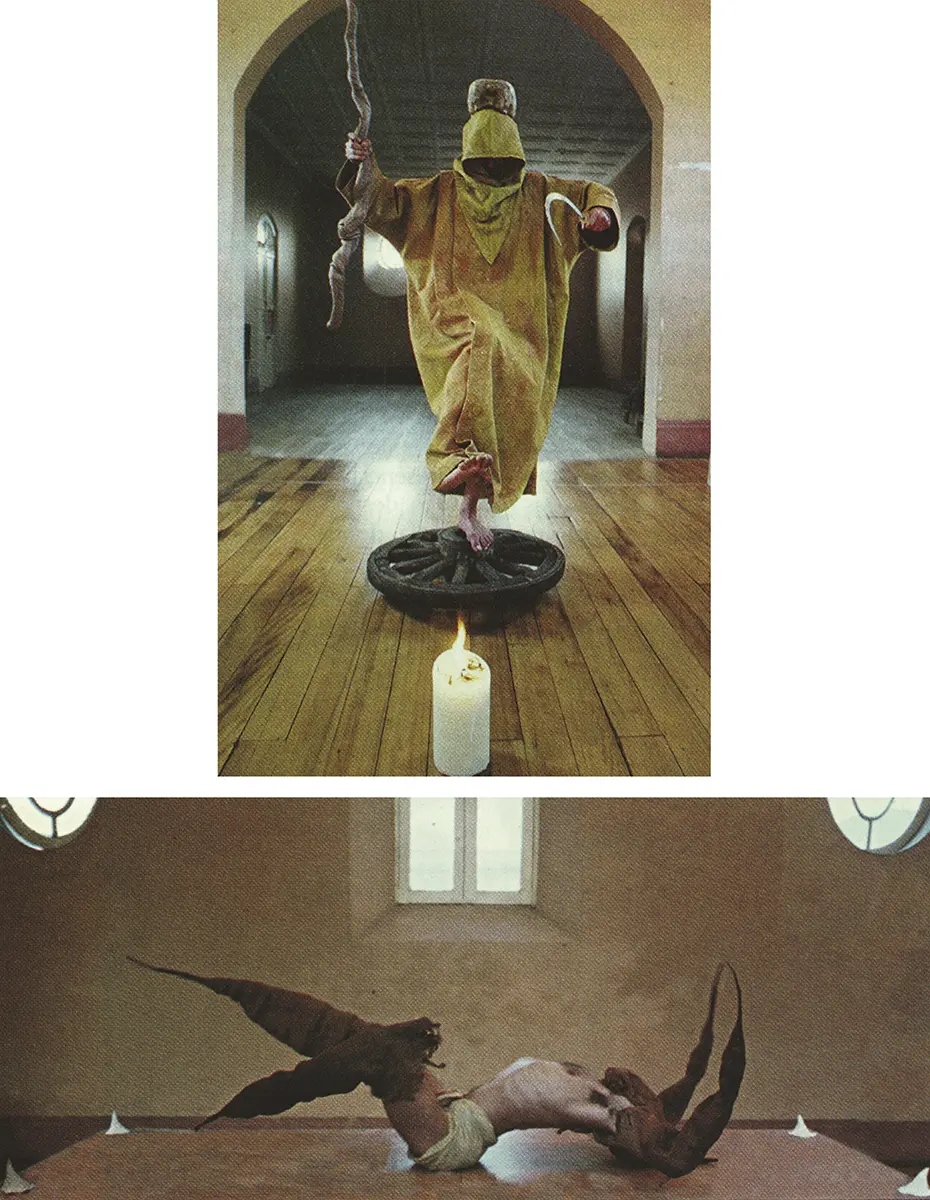
On February 21, 1992, the painter Lorenzo Jaramillo died in Bogota. The film director Luis Ospina made an impressive documentary on the artist's final days, the final title of which was Our Film. Here, in a kind of lullaby for a dying man, and through the five senses of the artist, we discover his hell and his paradise, his sensibility and his ordeal. This last word was to echo deeply in the memory of Restrepo, until it became the starting point for a new work, entitled Ordalía, The End of the Body, which was premiered in the Basement of the National Library of Colombia, as part of the 4th Ibero-American Theater Festival in 1994.
"Ordalía... is conceived as a "religious allegory-installation": the itinerant spectator participates in this ceremony, since proximity with those who are "officiating" makes the relationship with the stage event more direct and real." This was how Restrepo presented this new and profoundly risky work, in which he was accompanied by Humberto Canessa and by the impactful presence of Lorenzo's sister, the actress Rosario Jaramillo. The setting was the work of the artist Marta Combariza, highlighting the fusion of the plastic back of the stage, the installation, and the scenic manifestation. The music, once again, was by Gabriel Ossa.
At that time, Restrepo was concluding his work as founder-director of the Higher Academy of Arts of Bogota, where this intense ritual poem was produced, in which the images of the dancers were enveloped within a space that would finally devour them. In the final conception of the work, in the ruins of the former Colombian television studios, the spectator was invited to become a discreet voyeur, forced to view the ceremony through a heavy black veil, while the actors-dancers concentrated on their own gestural tragedies, far from the world and the public. Too far, perhaps. The spectator had to fight physically with the space to be with Rosario, Canessa, and Restrepo, but without being able to reach the three within a spectacle that required introspection and concentration. But this was impossible. In my view, Ordalía was faced with an obstacle of a practical nature that prevented communion between the public and the "officiating" figures. The presence of the three great interpreters was intensely felt, but we could not reach them because of a caprice which proved to be an impediment. With the exception of this unfortunate sense of distance, the images, the atmosphere, and the interior space were all, once again, heart-rending and convincing, taking us to the very doors of death, the domain of the unknown, of fatal evidence, and the frenetic search for the "semen of God." Perhaps this was the most physical and the most implacable. It was, without a doubt, a dangerous adventure in which the artist and his collaborators explored the final consequences of his style. It was an imperfect work, but an intensely alive one.
VI.
Hesicastic rhythm, we can begin (Lezama Lima).
Finally, we must also mention the most recent and intimate stage adventure of Álvaro Restrepo, presented between March 8 and 18, 1995, at the Casa del Teatro in Bogota. It consisted of an experiment entitled Motu. Proprio, in which the dancer and choreographer gave himself up to the curiosity of the public, as if he were the victim of some strange sacrifice. Over a period of eight days, Restrepo presented a work of "pure dance," to use his words, in which I was trying to discover, for each proposed theme, a language and code of movement, as well as a dramaturgy which would help relate and bind the different elements making up the fabric of the stage event.
In Motu Proprio, we see Restrepo seeking out creation, inventing it anew each night. On the basis of various musical proposals for each encounter with the public (first session: Saraband; second session: The female voice, religious music; third session: contemporary music; fourth session: vernacular music: memory and imagination; fifth session: the objects of Athanor Danza; sixth session: choreographic studies; seventh session: silence and movement; eighth session: Summa), this individual caprice of the artist became a fundamental experience for all those of us who have followed his work closely. In a sense, it achieved the same objective pursued by his workshops for the training of young dancers. But this time, it was Restrepo himself who was exposed to improvisation, to hazard, to the uncertainty of creation in the presence of a curious and disconcerted public.
On the first night of this series of experiments, Restrepo began to beat an object, apparently made of metal, with a small rod. On top, there was a black and white television, with the image of an old woman suffering or dreaming. The light faded, and there was a harsh text by Genet, until five "classical" objects of the Athanor Danza Company became visible in weak, specific lines. The light then became almost full again, and we heard a saraband by Bach, and Restrepo began to draw and to create his face, which perhaps he had lost and which he needed to recuperate, like Dorian Gray, in front of the mirror of the public, the silent eyes which gave shape to that face. Thus, night after night, he created a puzzle of chance and hazard which confirmed once again that Álvaro Restrepo is one of the most disturbing consciences on the contemporary Colombian scene. Let us hope that his silent return to Cartagena, where he now lives, will allow him to return very soon to the great theater of the world to continue his exploration of something that is also, in a sense, our own exploration.
SANDRO ROMERO REY
Colombian writer. Lives in Bogotá.