For many of us, the work of Tápies was the revelation of our youth at the end of the 1950s and early 1960s. He, more than any other artist, taught us that painting was not limited to oil and the brush and that the canvas could "become' texture, become a wall instead of describing it. More effectively than Rothko, he showed us that the "center" did not have to be filled with information, that a void could mean many deep things. Thus, it seemed most appropriate that his painting and that of colleagues from his generation in Spain should be presented under the label of "other art"1 even though we were not exactly sure what the term meant. And although the term did not explain anything, it did suggest the possibility of something unusual, that the history of art was an open-ended one, which could be begun again. In this, Tápies became a new Spanish "pioneer", although without the colonializing connotations of the concept.
In the United States, Tápies never achieved the influence and impact that he created in Latin America. It is not that the market has not tried to promote him. The Martha Jackson Gallery in New York presented many one-man shows of his work; there were retrospectives (including one at the Guggenheim Museum in 1962), and the name of Tápies was always there, in one way or another, as the name of a famous and important artist. But he never managed to become an influential painter. This is in part due to the fact that a lot of North American painting during the years of his greatest fame was trying to incorporate itself into the canvas, to eliminate the spatial and tactile references, to tinge the surface as if paint were aniline. In this sense, Tápies's concern for the emotional and philosophical (and even mystical) suggestions of texture was at odds with the dematerializing speculations characteristic of art at that time.
The dictate of minimalist standards made Tápies into an artist who was out of place for at least two decades, a kind of "other artist" whose work was negated by the ground rules. The Guggenheim Museum recently decided to represent him in a major retrospective at its SoHo premises (from January 27 to April 23, 1995), with 56 works from 1946 to 1994, organized by Carmen Giménez, the Museum's curator, who is of Spanish origin.
The show was presented chronologically and gave a clear overview of Tápies's artistic development. Paradoxically, this clarity resulted in some confusion for the spectator. The visual force of the works, invariably impressive in hedonistic terms, was surprisingly not sufficient to sustain a strong exhibition in overall terms. It was like being confronted with a number of pages promising to become a book, but which never does. The pages are of great beauty and formally unified, but dispersed as regards the problems to which they refer. To continue with the book image, Tápies appears like a master designer skilled in the art of book-binding, but unable to string his arguments together.
This criticism may seem unfair. After all, the same remarks can be applied to Rembrandt or many other artists who formalized their style and used it as a means of investigating content and their surrounding reality. The problem concerns above all the historical moment in which Tápies's works were produced. Compared with his times, Tápies, surprisingly enough, appeared in this show as a conservative painter. This does not negate the technical innovations which he introduced on the artisan side of painting or diminish the enormously powerful effects of some of his pictures. The idea that he is a conservative painter refers more to his specific position as regards painting.
Tápies appears, throughout his evolution, consistently committed to painting and uses it as his fundamental support. Painting is his perceptual crutch. The technical "transgressions" in his work are really done in his paintings for a better understanding of reality. Tápies is a pictorial imperialist, with the maximum extreme being the conversion of all reality into painting. It is an aesthetification of reality through technical expansion rather than an expansion of perception. And thanks to his enormous strength as a designer, he manages to make his enterprise seem probable. Thanks to his breaks with traditional technique, he seems to be a member of some liberating avant-garde. But the result of his work—to comply with the stereotype of the walls which is generally applied to Tápies—is that we no longer see the wall in the picture in the museum, but a Tápies on the wall of the street. However, the point is not that the wall in the street reveals its aesthetic conditions to the observer, but that a picture is being projected onto the wall in an attempt to make it into yet another object for collection.
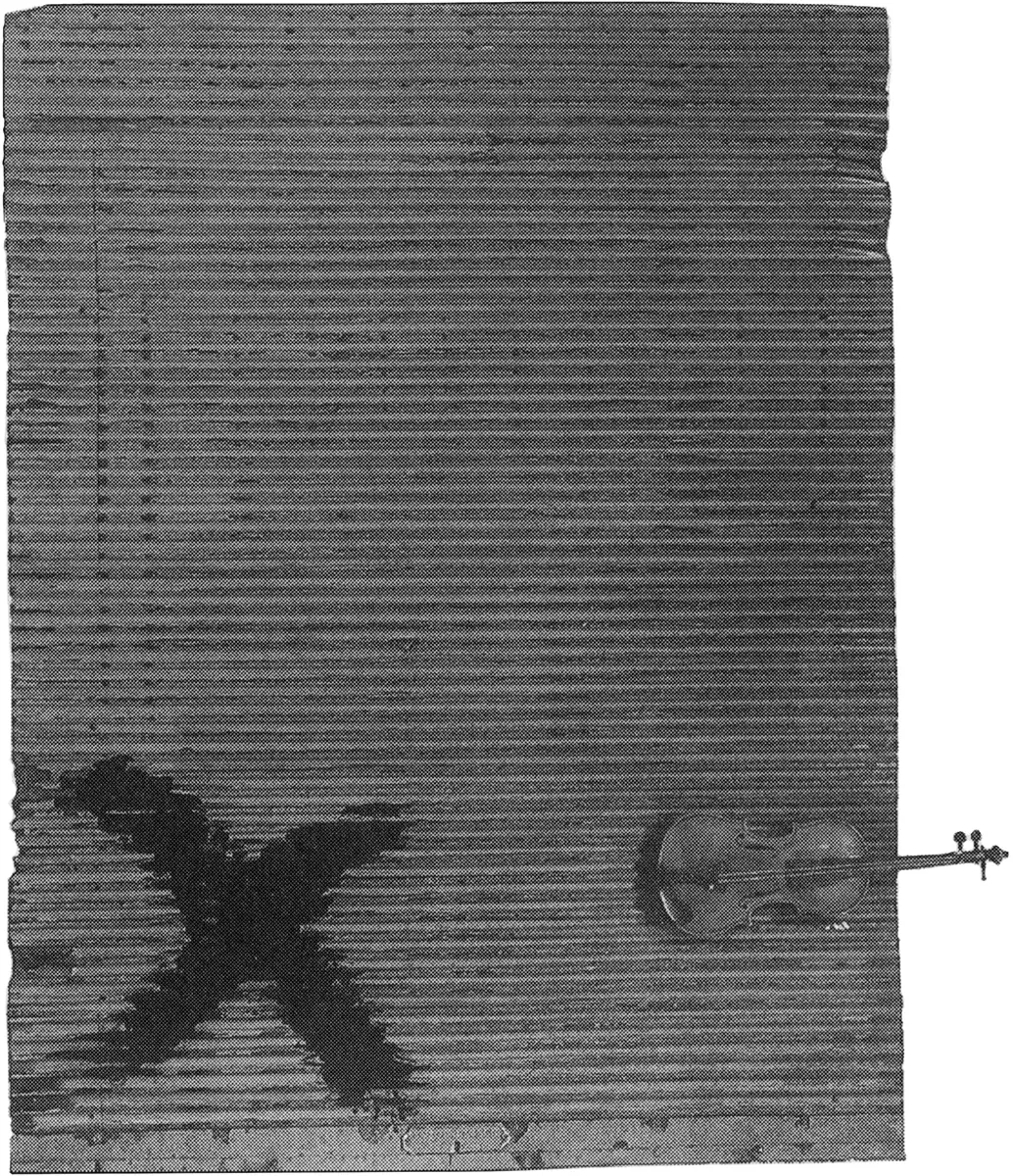
In this sense, Tápies's work is different from and contrasts with that of many of his contemporaries who dedicated themselves to eliminating the frontiers between art and everyday activity. There is, for example, an interesting link between Tápies and Rauschenberg, where the work of each explains the work of the other. Metallic Door with Violin (1956) is exactly what its title says it is. It consists of a shutter which can be rolled up and that is used to protect businesses, with a black cross mark (which may be an act of vandalism done with tar), as well as a real violin. The work, which is sweetly sad in its evocative power, emphasizes the empty space of most of the surface and maintains an aesthetic elegance which recalls more a classical Greek temple than any possible Dadaist aggression.2 Rauschenberg's Bed, dated one year earlier, is also real. But savagely daubed with paint stains, it involves another kind of appropriation: that of the invasion of everyday life into art. Here, anything can actually be art, rather than just serving as a screen on which to project it.
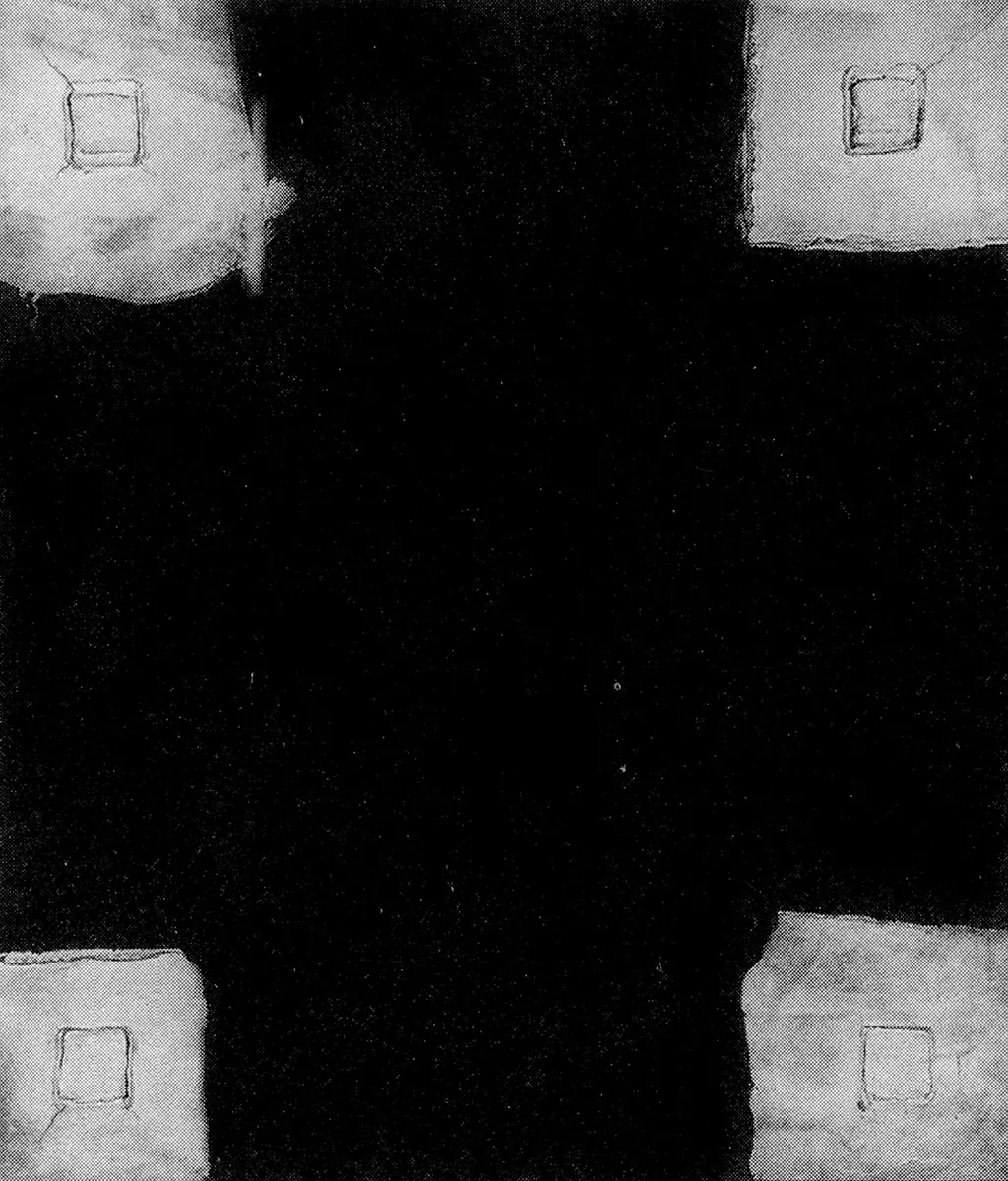
In this exhibition, Tápies appeared as an artist who is primarily (although not totally) formalist. The accumulation of matter around the periphery of the pictures, leaving a kind of textural void, a kind of visual silence related to his interest in Oriental philosophies, is perhaps his most impressive resource. His Four Grey Squares on Brown (1959) is the clearest example in the show and typical of a broader series. As the most formal economic work in the retrospective, it is also perhaps the most perfect. There is no trick here, no direct allusion (except the vague reference to the cross suggested through its absence), it is like a perfect square where the only thing you can do is sit and wait for some inspiration. It is a painting without any theory or analysis—it illustrates nothing but itself. But what might have become a vaguely constructivist tautology with hints of Malevich here becomes an independent magical field (a goal which Tápies makes vaguely explicit in his texts). In other earlier paintings (Painting with Red Cross (1955), Large Grey Painting No. III (1955)) and some later (Large Matter with Lateral Papers (1963), White with String (1973)), the formal schema is retained but interrupted by stronger symbolic allusions which evoke literary references.
It is this recurrent symbolism in Tápies's work that gives the impression of unadministered dissonance. The use and abuse of symbolism might serve as a guide to the classification of his work. In some cases, the most successful, the symbolism emerges from the texture in a process of subtle suggestion. The artist scratches and opens the surface to facilitate expression. The symbol remains in the picture and establishes a dialogue with the spectator. In this category, the scratches sometimes become scribbles and forms of writing without any explicit meaning; they are mysterious in their hermeticism and establish a parallel counterpoint between stroke and texture. Juan-Eduardo Cirlot, the Catalán critic who was one of the main spokesmen of Spanish informal painting, quotes the text of an alchemist to describe these works: "I consult him only when there is neither form nor figure (...) When there is form, do not pay any attention to it, but when it has no form, then it is the sacred fire."3
The balance that Tápies achieves in these pictures is fragile, and the seduction of the symbols is powerful. When the symbol seduces us, Tápies allows the literary reference to take over the work. Although this is not necessarily negative, since the artist does not adjust his language to what is a radical change from his other work, the spectator becomes confused. The picture in such cases no longer evokes something, but dictates it. When we are about to exercise our imagination along with the artist, as we learned to do in the above-mentioned pictures, then we see that the message is served up to us on a spoon and directly into our mouths.
The problem does not lie in any formal variation between the works; in any case, it is the lack of variation. The Painting with an Ironing Board (1970) includes the title object, along with a rag and a small mirror. The treatment in the work avoids any immediate possibility for narrative dialogue between the elements of the picture. In Painting with a Bucket, of the same year, there is a bucket of water incorporated into the painting, and under it, the texture shows traces of shoe marks and a blue stain, clearly made by water. It is a pretty picture, but unforgivably trivial.
This irregularity in treatment would be more acceptable if it occurred during periods determined by some kind of investigation. But it occurs in a haphazard manner. In visual terms, the spectator feels that he is being led around the exhibition by a particularly strong and sure hand, but that the artist hesitates when it comes to matters of communication. There is an overwhelming rhetorical eloquence combined with a kind of mental stammering. At least, until the work of 1988.4
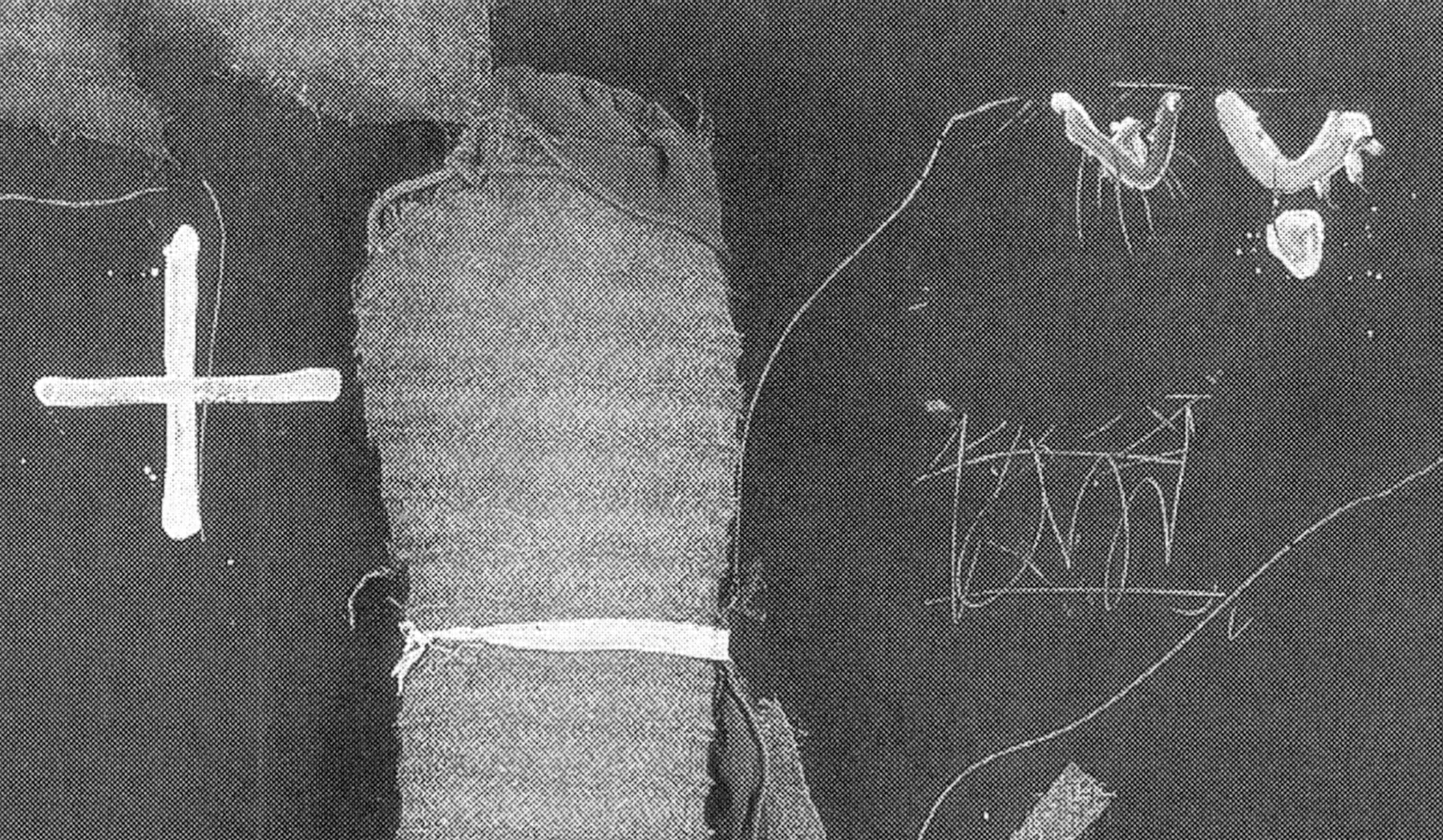
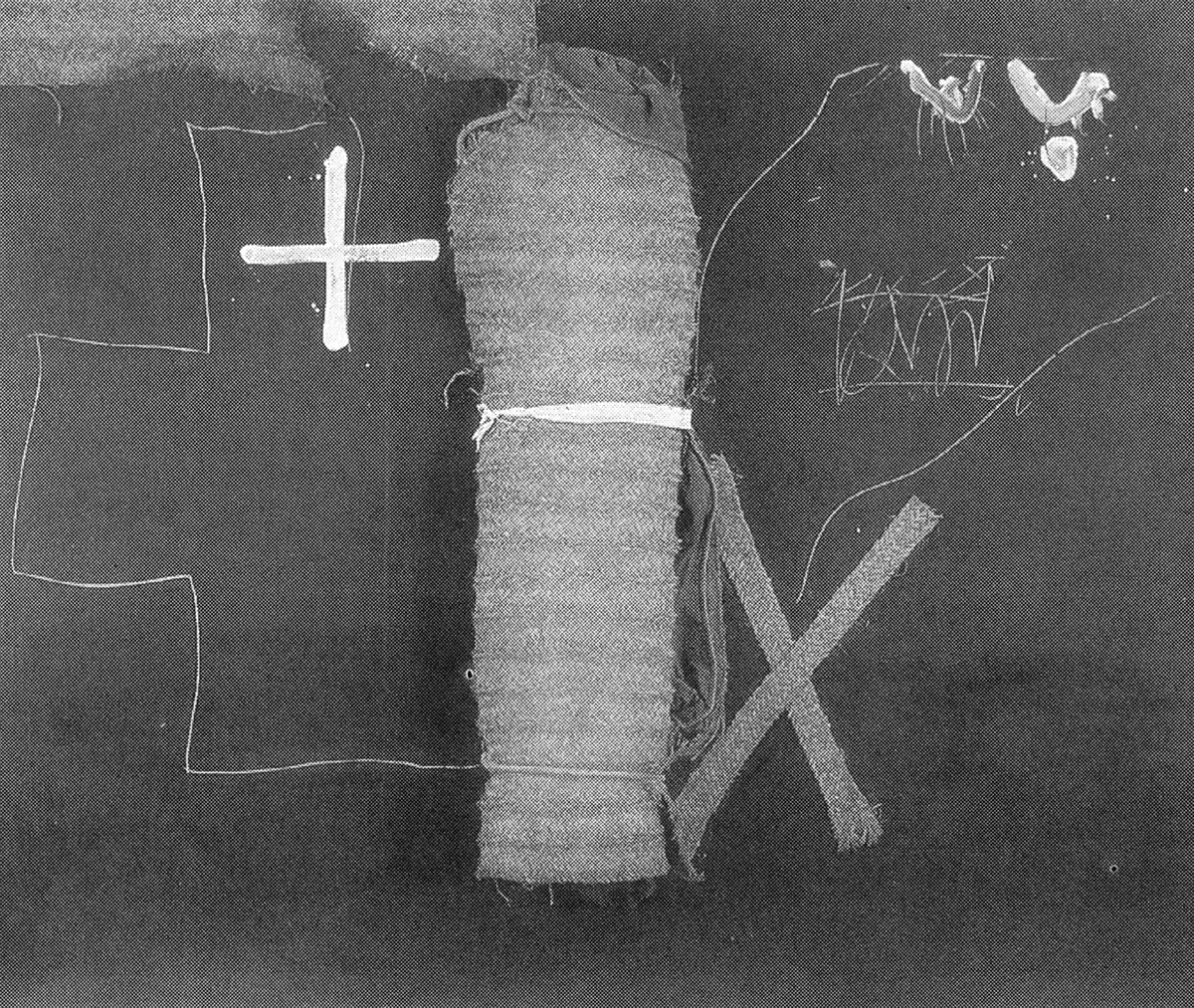
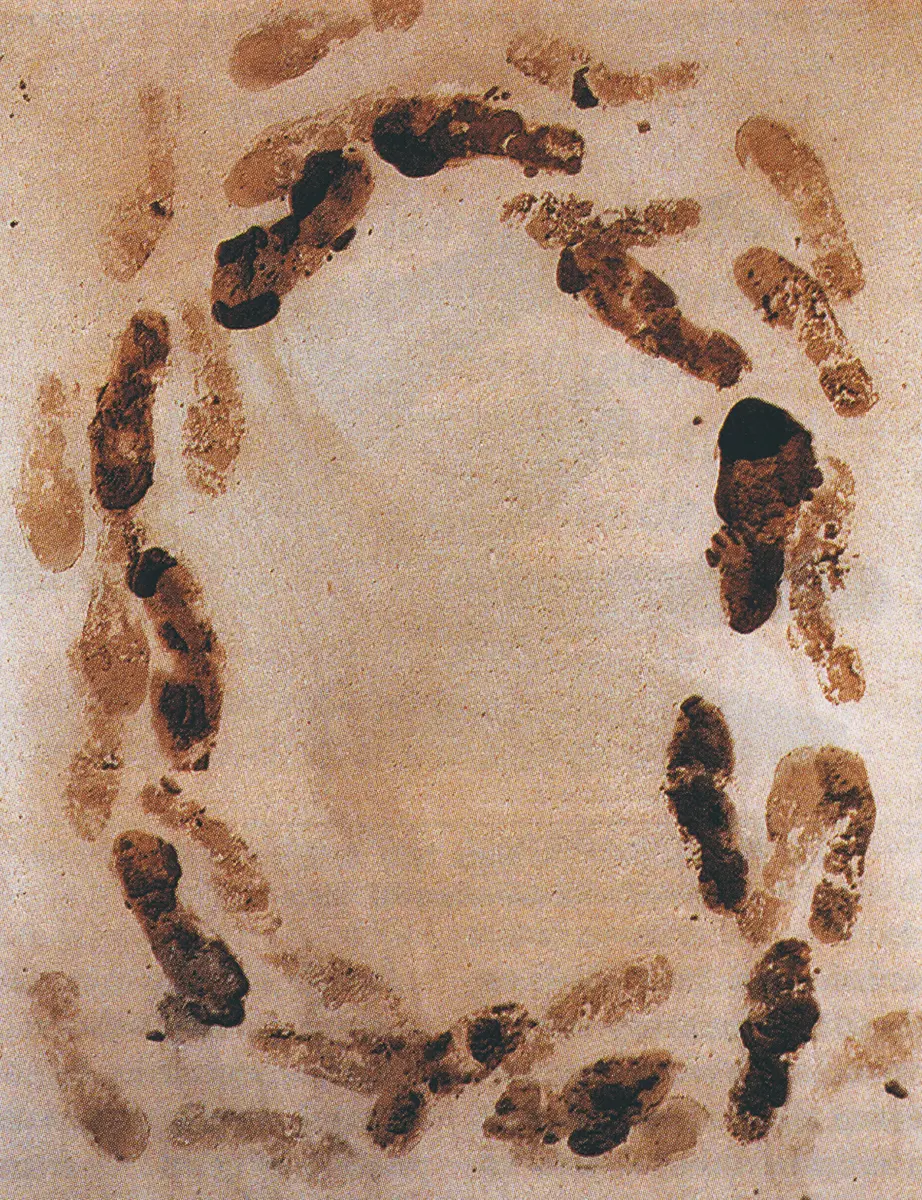
From that year on, Tápies seems to have found an equilibrium. Infinity (1988), Great Diptych (1990), and Bundle (1994) encompass all the previous experiments and fuse them in a masterly fashion. The exhibition proved a bit disconcerting because of all the jumps that it proposed, although the landings were soft. It also gave the impression that this was not the definitive retrospective. Tápies, who is not in any way afraid of space, needed more room than this show offered and more than 56 works to reflect his true dimension. There were no installations in the show, such as those he presented at the Venice Biennial in 1993. Although these were generally viewed unfavorably by the critics, they were important because of their formal divergence from his earlier trajectory. They cast light on less well-known facets of his work and certainly helped him to achieve maturity in his later paintings. Neither did this exhibition contain any drawings or prints, which, although they often repeat his pictorial work, do form a large part of his artistic production.
Although there were many sources of dissatisfaction in this exhibition, it did make one long for a definitive retrospective, a calmer and more generous view of his work, one which would allow configurations to be established in certain research undertaken, and one which might cancel out some of the earlier criticisms. And one which might explain the mystery and paradox of a powerful master who is respected and accepted by the mainstream, but who is at the same time relegated to a kind of cultural exile by that same current. It is an exile about which this exhibition remains silent and uninformative. As in the best of Tápies's pictures, it is something which is simultaneously absent and present.
NOTES
1. This term was first used by the French critic Michel Tapié.
2. Dore Ashton, in her good introduction to the catalog, interprets the work as a superimposition of sounds, the violin and the sound of the shutter being rolled up or down. Tápies, Guggenheim Museum, New York, 1995, p.35.
3. Jean-Eduardo Cirlot, Significación de la pintura de Tápies, Biblioteca Breve, Seix Barral, Barcelona, 1962, p.86.
4. The hesitation is reflected in two remarks cited by Cirlot, one by Herbert Read and the other by Giulio Carlo Argan. Read says: "The secret of his art should not be revealed, because there is no such secret, only a physical object with no other magic than that which the wind or rain creates as we pass by." For his part, Argan says: "It is not arbitrary to look for a symbol in Tápies’s work; it is arbitrary to look for any symbolism." Cirlot himself (pp. 16-17) explains everything by intuition and rejects all programs. It should be remembered that Tápies’s most explicitly symbolic works were produced after these two remarks were made.
LUIS CAMNITZER
Uruguayan artist. Professor in the Department of Visual Arts of New York State University, College at Old Westbury.