The Museum of Modern Art of Santo Domingo recently took a good initiative, when it was decided that during the holding of the National Biennial of Visual Arts, or the Biennial of Painting of the Caribbean and Central American, arrangements would be made to try and allow the winners to present individual exhibitions of their work at the Museum. This stimulates the prize winners by enhancing the recognition of their talents and, in the case of young artists, it is the best way of "confirming" the jury’s verdict before the public. This was precisely what happened recently during the Second Biennial of the Caribbean, when the Gold Medals were awarded to two Cuban painters: Eleomar Puente and Carlos René Aguilera. Both shows were enthusiastically received by all sectors, including collectors.
Carlos René Aguilera, who comes from Santiago de Cuba and is a graduate of the Higher Institute of Art of Havana, belongs to the new generation of Cuban artists and print-makers who astonish us by their fusion of confidence and seriousness, academic background, and fantastic ideas. Using very personal imagery of pluralistic inspiration, Aguilera’s work illustrates the view expressed by Gerardo Mosquera about the new Cuban artists: "They (the new artists) have no qualms about appropriating incorrectly and decontextualizing aspects of the mainstream or from wherever to their advantage, re-inventing them and using them, along with their own ideas, to create an art which is local in the twofold sense of being the product of local values and attitudes, and satisfying the needs of the surrounding environment."
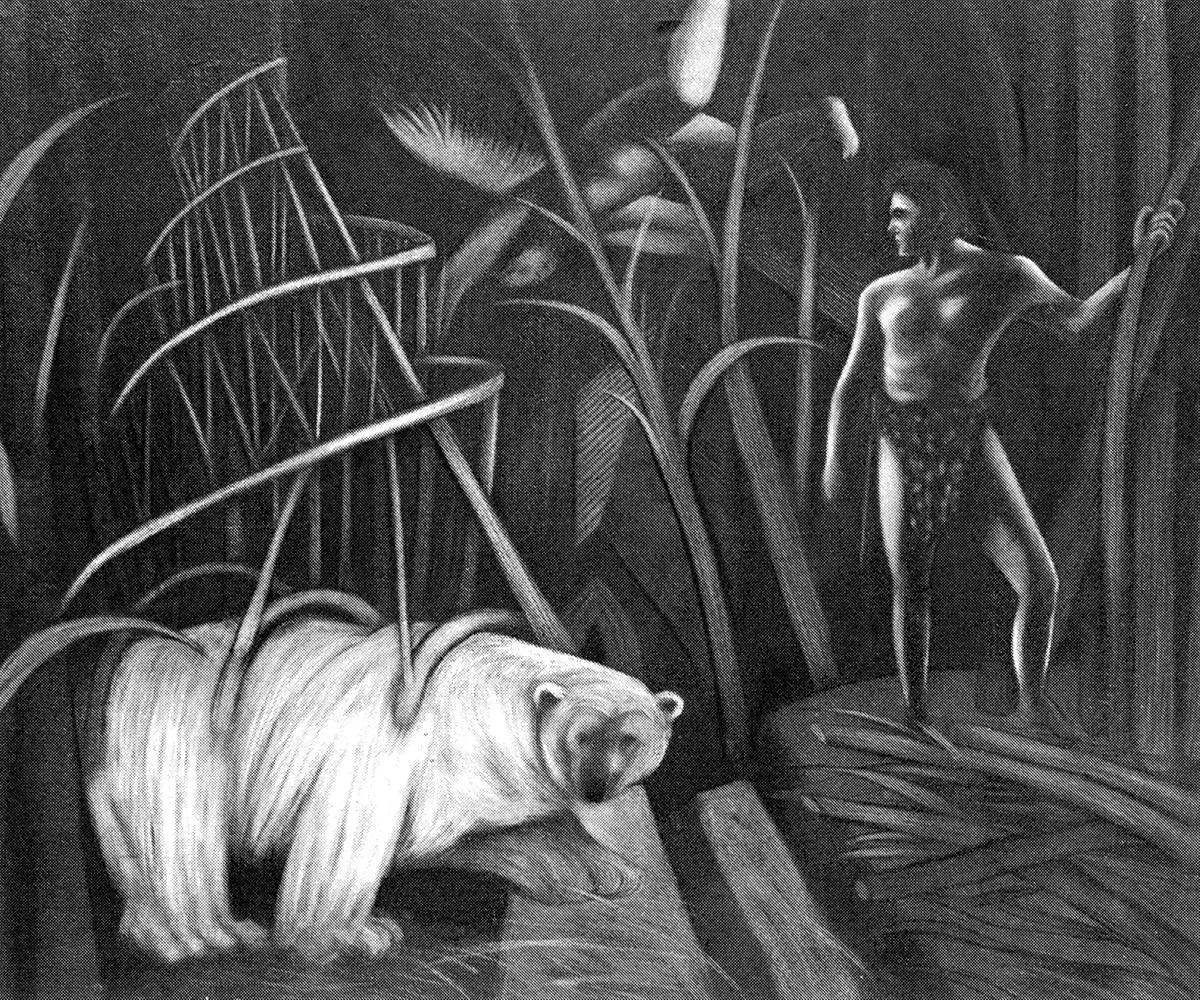
Perhaps more than any of his peers, Carlos René Aguilera creates a sense of consternation when we first look at his work. What are these white polar bears doing in the tropical forests and sugar fields? Why this obsession with towers—mythical—the tower of Babel and the more recent one of the Russian constructivist Tatlin? Who is responsible for the desertification, the factories, the alteration of the climate, the wasting of natural resources? Such are the questions raised by Aguilera’s work. But each spectator will have his own, as he looks on these unusual scenes, which often have an epic "beauty," and remembers what Baudelaire said, that beauty is always strange.
We feel ourselves drawn towards some kind of pleasant Apocalypse, and the cataclysm is near. Aguilera tells us, in a drawing which is "cutting" (the result of the print and the wooden plate) and has a subtly luminous sense of color, to stop believing in utopias. There is no greater allegory in this respect than Tatline’s spiral—never constructed—or the Tower of Babel in its (abandoned) Breughelian version transferred to the Caribbean, innocently,» he confronts us with David’s Marat, murdered in his bath. This implacable determinism makes it impossible to grasp the ungraspable.
However, it would be an injustice to Aguilera’s paintings and intentions to reduce them to local or internal allusions. It is not that his iconography evades utopias and national realities. Indeed, he encompasses them and goes beyond them. Hence, the almost widespread identification of the white bear with the symbolism of power and Soviet interference of the past. The critical eye is directed towards an epoch and a planet full of confusion and disrespect for the rights of the weak, a world of absurd circumstances. The repeated presence of the bears in the pictures, the only main or deceptively secondary protagonists in the tropical landscape, makes them a parable of this imbalance. Finally, in the universal chaos, and fleeing from the melting pole, they too are vulnerable. In The Intruder, they appear wounded. Is nobody safe?
Aguilera warns us about lapsing into total pessimism, and he does so through his painting. The fable—which is here a kind of visual poetry—suggests humor and games. We have the impression (and this is also the case with the other Cuban Elomar Puente or the older José García Cordero, from the Dominican Republic) that the artist really savors the "pleasure of painting," the pleasure of inventing, of suppressing the concept of improbability, of creating metaphors... In short, there is a multiplication of philosophical propositions, a polysemy reflected in the varied kinds of options regarding situations, composition, and aesthetics. And even art, in a picture with a unique context, The Sample, enters the demythologizing world of Carlos René Aguilera, with its "barbarians" and suggestions of iron bars... The artist’s condition is indeed a sad one.
Carlos René Aguilera, encouraged by the enthusiastic promoter Lyle O’Reizel, will have much to contribute to Caribbean post-modernity, another feature of his work which exceeds the limits of this short note.
MARIANNE DE TOLENTINO