
In 1989, in the Galena de la Raza, an alternative space in San Francisco, California, Eugenia Vargas carried out a performance that has become a touchstone by which to understand her oeuvre: Inside the gallery, she built a mound of earth with a long, shallow depression in the center. Vargas covered her nude body with viscous red pigment and then lay in this bed of earth for forty-five minutes, shielded from her audience by a large sheet of plate glass.1 The artist lay as still as possible, sensing the rhythmic quality of her breathing, her pulsating heart, and her growing physical discomfort. As time passed, evaporation from her breath clouded the sheet of glass above her, obscuring parts of her body, particularly her face, genitals, and stomach. The artist assumed an appearance that was both spectral and carnal. Some onlookers became disgusted with the raw, bizarre appearance of her body; others reacted with fear, anxiety, or contemplatives. Untitled (action piece), as the performance is now titled, is emblematic of Vargas's work because in it, she transformed her body into a collective symbol of humanity in order to address such sweeping concerns as mankind's dependence upon the earth for its survival, the dialectical relationship between corporeality and spirituality, and the need to know one's self purely, independent of cultural and material contexts. The artist has employed her body in nearly all of her installations, performances, and photographs because she believes that it allows for the most powerful, unmediated expression, and, moreover, because through it, she can impart truth.2
Eugenia Vargas's career has followed the kind of nomadic path common among numerous artists from Latin America. Born and raised in Chillán, Chile, she went to the United States as a young adult in 1970, where she lived briefly in Wisconsin, then in Bozeman, Montana, until moving to Puerto Rico in 1984. Puerto Rico differs greatly from her native Chile, but it was there that she experienced a heightened, more sophisticated awareness of the fundamental spheres of influence, including the legacy of European colonization, Catholicism, and the persistence of economic and social marginalization, that have shaped her own identity as well as that of all Latin Americans. Her perception of this cultural condition intensified when, a year later, she came to live in Mexico City. The country's rich historic traditions, as well as a range of situations she encountered there —the state of the natural environment, the status of women in contemporary society, and the complex nature of Mexican cultural identity— provided her with a wellspring of inspiration that has deeply affected her artistic direction. Vargas arrived in Mexico in 1985 on the very day that the great earthquake struck, a fact that may seem little more than an ironic footnote to the biography of an artist so preoccupied with the natural world. Nevertheless, witnessing the manner in which the Mexican people lived through this catastrophe served to hasten and intensify her appreciation of the culture and social problems that profoundly dictate the quality of life in that country. It was there that she resolved to formulate a visual language that could most powerfully convey the public and private issues that form the content of her mature work.
The images of the Earth Series (1987-1989), a group of large-scale (1 x 1.2 meters) black-and-white photographs, were among the first works Vargas executed in Mexico. Each photograph in the series is a nude self-portrait that documents a private performance. To produce them, the artist traveled to the nearby countryside where, working in isolation, she disrobed, covered her body with mud, and assumed varying poses for the camera. In one triptych containing close-up images of Vargas's head covered with mud, she portrayed herself with an open, howling mouth, as if she were attempting to exorcise some unendurable pain. For other photographs, she played out invented rituals as she posed hunched into a ball like a fetus, urinating while standing up, and lying rigidly as if dead. The visual power of these works is derived in great part from the convincing manner in which she was able to assume varying personas in these images, such as that of a madwoman, a fertility deity, or a corpse decaying into the earth. By obscuring her usual identity, she became a kind of everywoman who symbolically reconnects with the earth and proposes a timeless, essential vision of humanity.3
The performances upon which the Earth Series is predicated suggest a deeply intimate and natural form of spirituality, recalling the religious practices of ancient American peoples who perceived the earth as a sacred realm. Because these works involve a symbolic submission of the body to the earth in acknowledgment of humankind's utter dependence upon nature for its survival, they invoke the concept of sacrifice, a cornerstone of many early Mesoamerican cultures. Foremost among Vargas's historic influences are the beliefs of the Aztecs' culture, which held that the gods sacrificed themselves in order to make possible human creation; humans repaid the gods and nourished the universe through countless imitative acts of ritualistic sacrifice. The artist does not view sacrifice as a negative phenomenon; rather, she envisions it as a life-affirming act, one that is not dissimilar in connotation to the Day of the Dead ritual practices still carried out annually in many parts of Mexico.4 It is perhaps the Aztec term tonalli, referring to the energy released into the world as a result of sacrifice, that best describes the artist's aim in performing these acts.
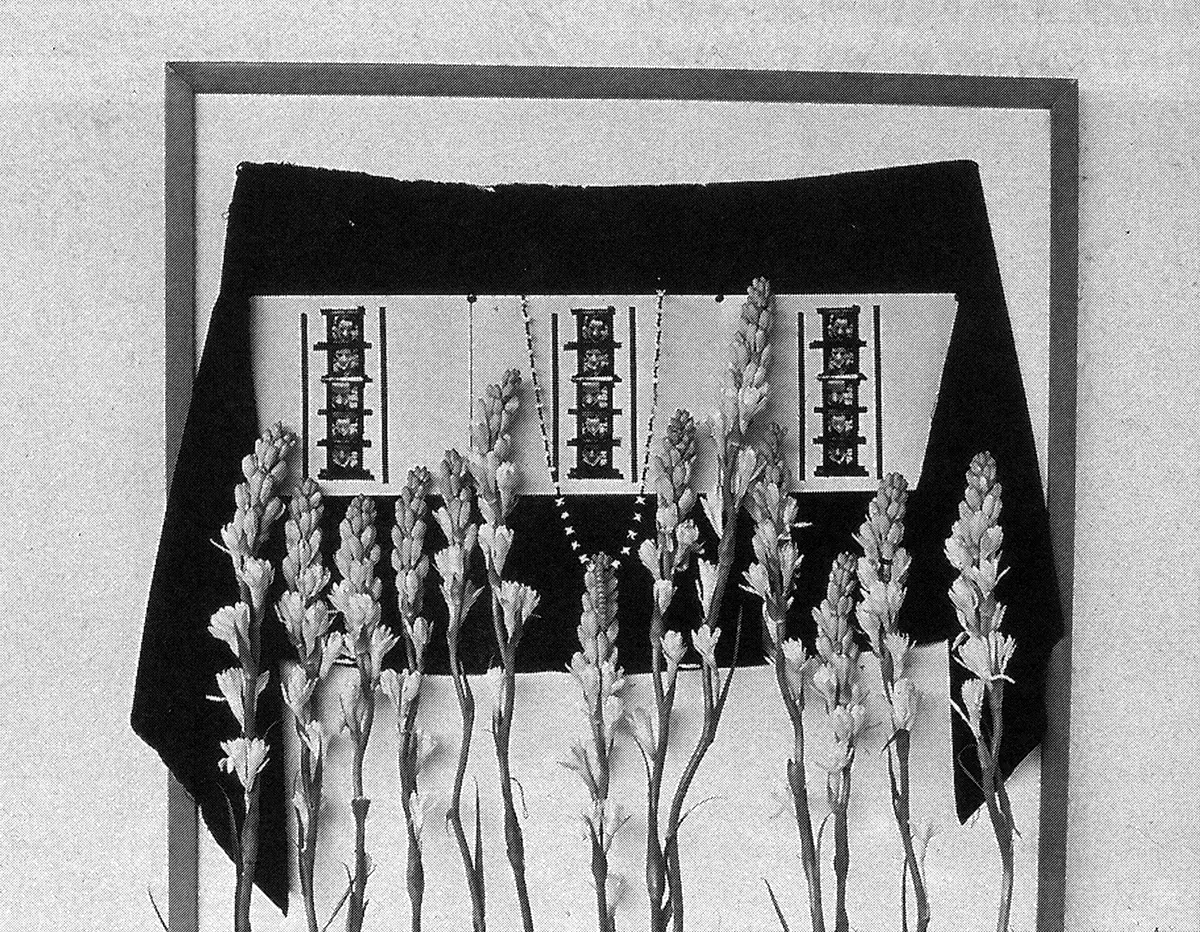
In the Earth Series, Vargas symbolically shed herself of material associations; in contrast, in her subsequent untitled body of work, she juxtaposed self-portraits with myriad objects to construct a frank and emotional visual autobiography. These large-scale (39 x 46 in.) color photographs record assemblages of such objects as toy horses, horseshoes, candles, rulers, flowers, her passport, and other seemingly disparate objects and possessions that she mounted on a wall of her studio. More explicitly autobiographical than any of Vargas's other bodies of work, she underscored in this series the very means of artistic presentation and disclosure through her emphatic depiction of curtains, cloth backdrops, canvas stretchers, and sections of frames. While these works are far from being narratives, through these devices the artist presents information that tells a story, or at least fragments of one. The forms depicted in these compositions, however, simultaneously mask and carry meaning, rendering ambiguous and anxious clues to Vargas's psyche. The desire to return to one's familial roots and the loss of loved ones, pervasive themes here, are evident in the inclusion of such objects as an old photograph of her mother and father, toy horses that symbolize her love of horses as a child, and Vargas's Chilean passport. Moreover, displays of flowers, black curtains, and candles in several works endow them with an elegiac quality, suggesting that the series was produced with some measure of nostalgia. Vargas's self-portraits also appear in these tompositions: the employment of small-scale reproductions of her older works is a self-referential musing on the artist's chosen medium and mode of working; they also cast the series as a historic record of her imagery. The new self-portraits she created for the series, many featuring a small wooden saddle attached to her torso or head, have a fetishistic quality. As an object with equine associations, it recalls the artist's youthful adoration of horses. Nevertheless, because the saddle is shown confining her body or awkwardly covering her face, this benign object is transformed into a potential device for physical and psychological torture; it also becomes a symbol of painful memory when considering the repressive environment that Vargas's family in Chile endured while living through the years of Pinochet's ascendancy.
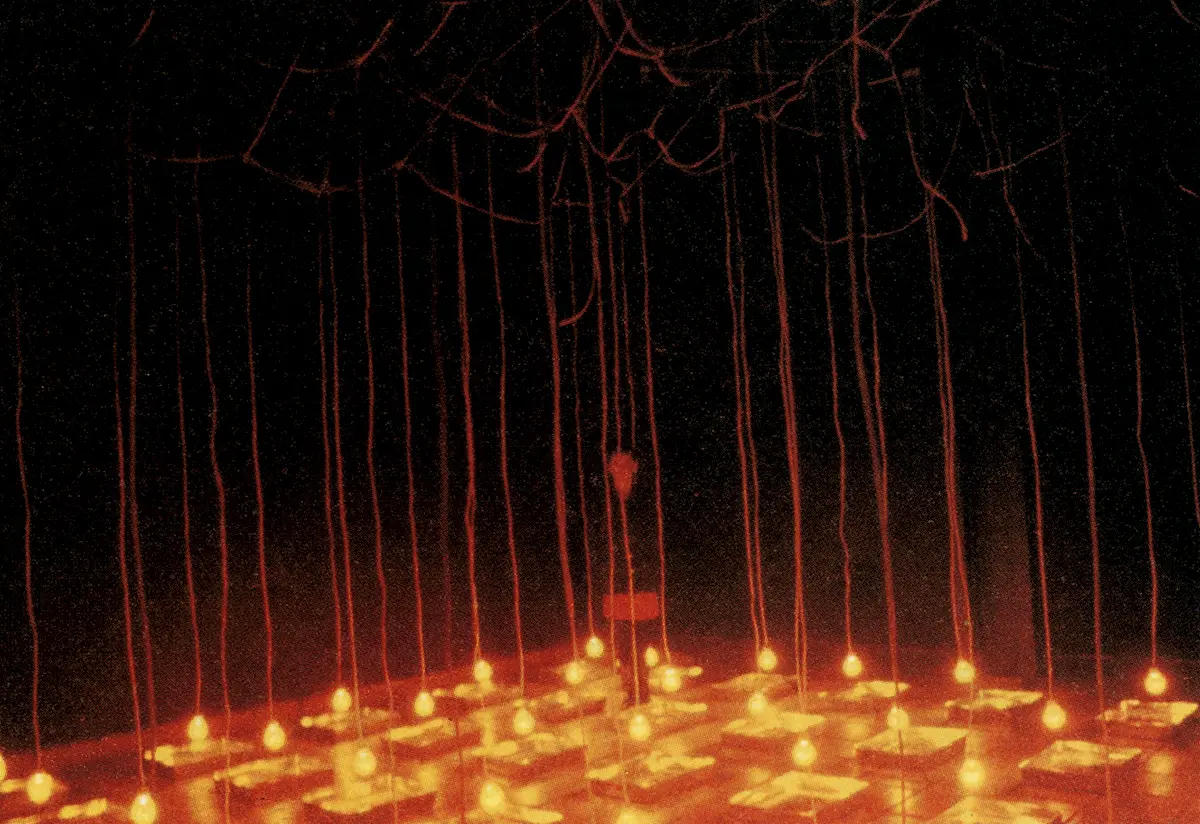
In 1991, Vargas realized one of her most significant projects to date, Aguas, a site-specific installation exhibited at the University Art Museum of the California State University at Long Beach. (The work illustrated here depicts a version of the work installed at the Museo de Monterrey, Nueva León, Mexico, in 1993). In a windowless room, fifty-six red safety lights were hung by cords from the ceiling, and an equal number of photographic developing trays filled with water were placed on the floor beneath the lights; each tray held a black-and-white print of a photograph taken by the artist. Aguas was devised as a time-based installation. In the two months while it was on view, the photographic images gradually faded, often to the point of complete deterioration, the paper began to disintegrate, and the water in the trays evaporated. The slow but visible process of destruction intrinsic to the installation acted as a metaphor for the devastation of the Lerma River, a principal water source for Mexico City and Guadalajara.5 Vargas spent several months visiting sites along the Lerma where she photographed chemicals and waste products that contaminate it, debris choking its path, and, most frighteningly, children playing in it or along its banks, one would assume, oblivious of the peril it holds. Upon entering the installation, the viewer encountered a scene of calm and orderliness, with the warm glow of dim lights and neatly arranged rows of developing trays. Walking along the narrow paths between the trays became a gradually intensifying experience; with each image, the viewer was confronted with an ever stronger indictment of the degree to which the environment has been allowed to decay, not by natural forces, but by acts of man. Moreover, as the photographs in the installation most clearly manifest, it is the disenfranchised —children and the poor— who are typically most deeply and directly affected by environmental crises.6
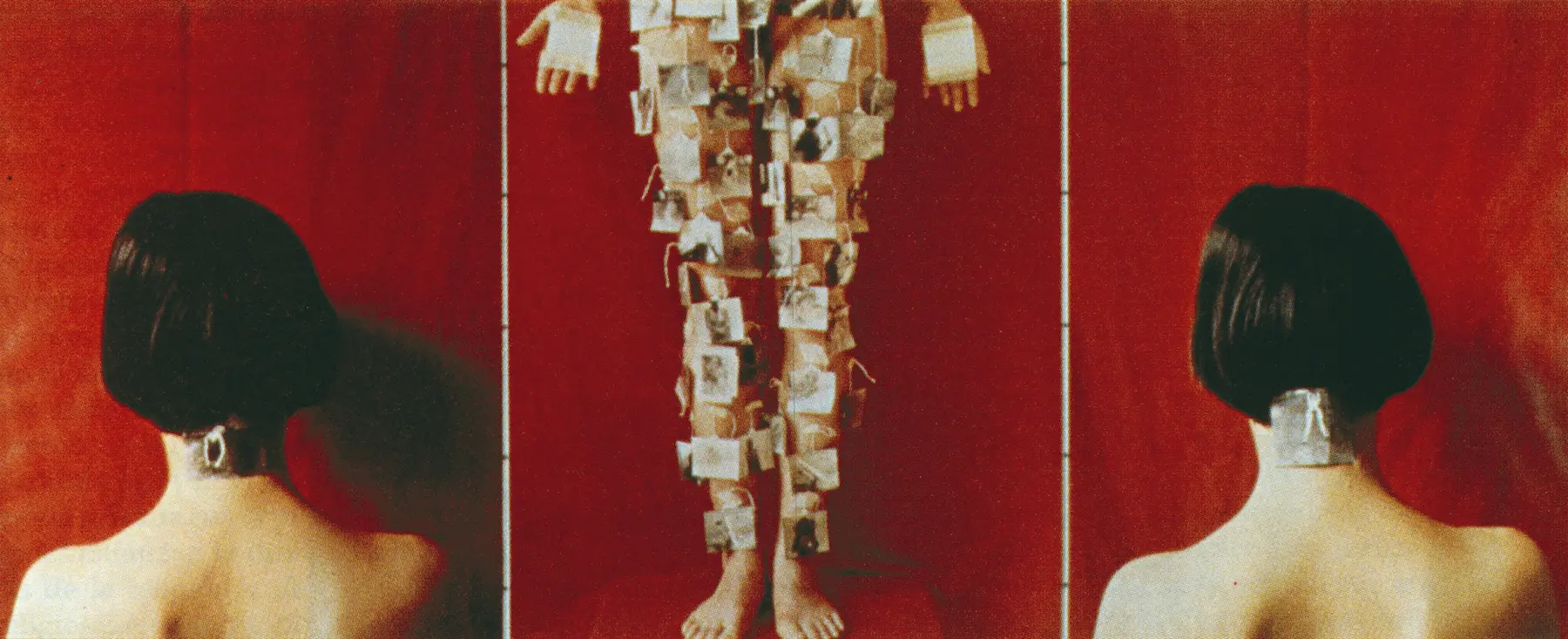
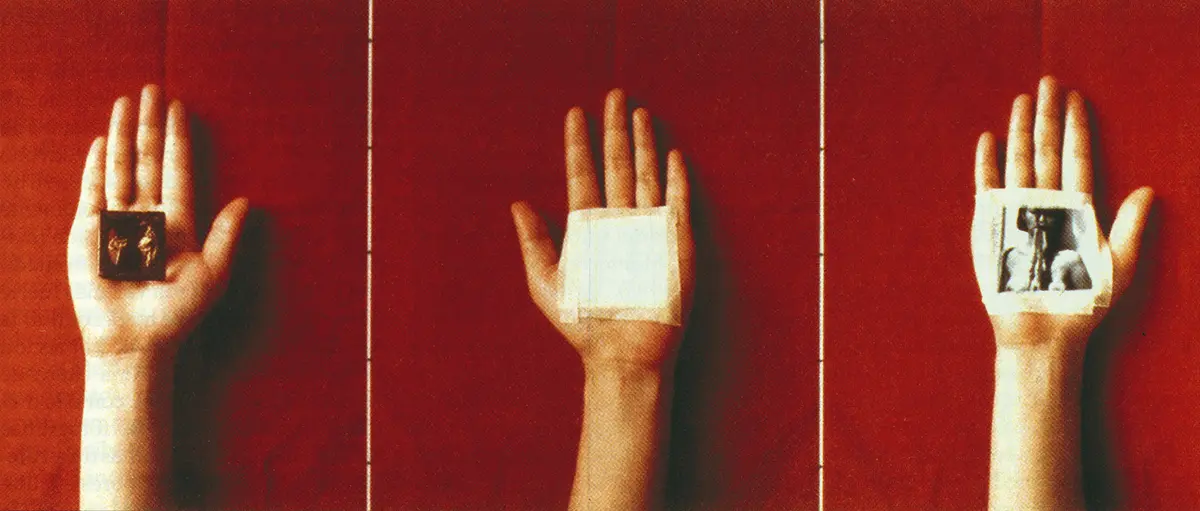
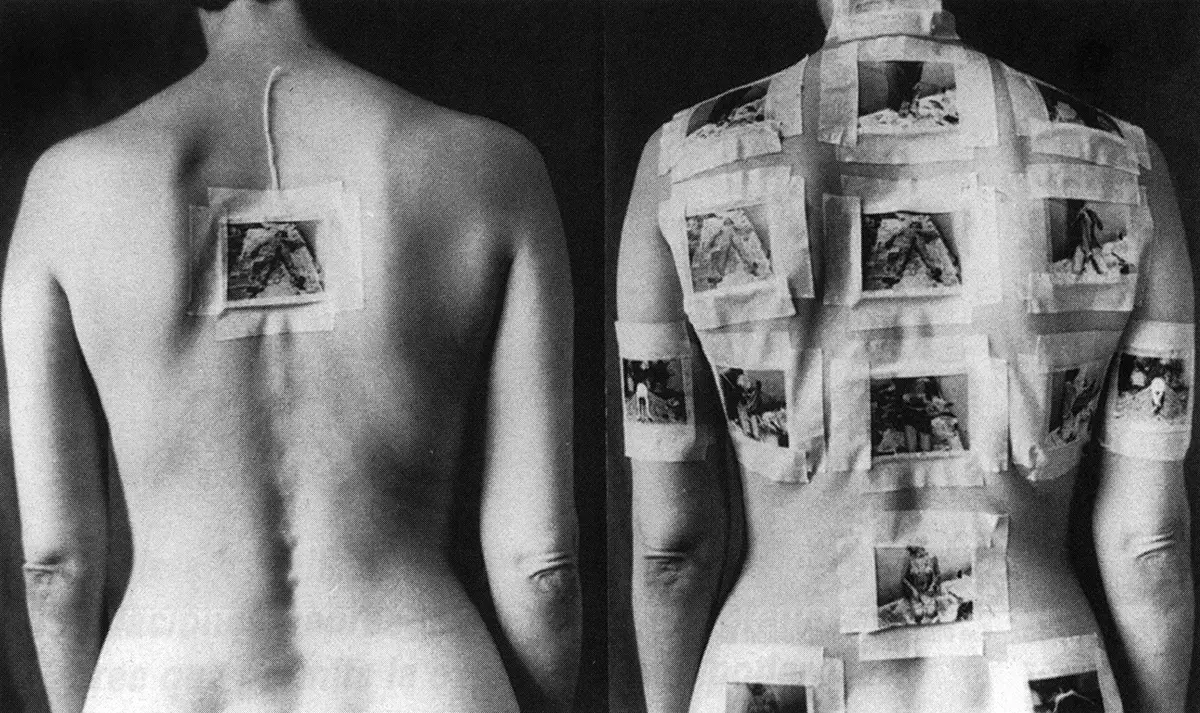
Vargas's most recent large-scale color photographs feature parts of her body —the palm of her hand, the nape of her neck, and her back— upon which are attached small photographs, primarily self-portraits from previous series. The artist never reveals her face or the front of her body in these images. Rather, she recasts the body into a locus for examining the intersection of public and private memory. These images stress the pervasive influence of religion and religious images in forming her own identity and, more broadly, in Latin American cultures. In the triptych, Untitled (1993), Vargas displays three separate images of the palm of her hand. The palm in the center panel displays a white square; that on the left holds an antique picture frame, on the right, a photograph of herself from the mid-1980s in which animal entrails hang from her mouth. The bandages, the repetitive images of hands, and the crimson backgrounds upon which they are photographed allude to the stigmata and to spiritual pain. In doing so, the work brings to mind occurrences of the stigmata among Medieval female saints —phenomena understood today as being as much erotic as they were spiritual.7 As in much of Vargas's oeuvre, memory and the inevitability of physical decay are also symbolized, in the worn picture frame and in the old self-portrait of the artist. In the center of another untitled triptych from the series is an image of Vargas's legs strewn with small photographs. It is flanked by photographs of the artist seen from the back; in each, the nape of her neck displays two small photographs of her body sprawled upon the ground in different directions. This work also has religious associations, with its loose reinterpretation of the kind of ex-voto typical in Mexico, statues of saints which people cover with small photographs in thanks for favors granted. As Osvaldo Sánchez has stated, "In the work of Eugenia Vargas, time always emerges as a mental trajectory of recovery and also of constant loss. The body drifts towards other orders beyond the physical."8 In these works, Vargas uses her body to meditate upon the boundaries between physical and spiritual existence, between life and death. Here, the body loses its viscerality as it becomes an abstract domain that endlessly records, remembers, and memorializes the incidents of a life and of a mind's spiritual yearnings.
"We live in the western-most part of the old world on the totally inexplicable edge of the new world. A new form of sacrifice and prayer, and the concept of infinity, are of critical necessity" (Michael Tracy).9 Vargas's contributions to a collaborative work known as The River Pierce: Sacrifice II, with the artists Michael Tracy, Eloy Tarcisio, and others, delineated the manner in which art, religion, history, social concerns, and personal life converge in her work. Held on Good Friday, April 13, 1990, The River Pierce was a spiritual rite and political action that took place on the northern bank of the Rio Grande near the village of San Ygnacio, Texas. The artists organized the event as a plea for awareness and protest "against the cavalier disregard for, and corruption of, the river that sustains life on the Border, a permeable boundary and symbol of hope for refugees heading north."10 It began with a procession, a loose reenactment of the Stations of the Cross, involving some 200 artists, writers, scholars, environmental activists, clergy representing diverse faiths, and people who live along this part of the United States/Mexican border. The gathering of people accompanied a mule cart that carried Cruz: La pasión (1987), a cruciform sculpture of monumental proportions made by Michael Tracy, that was laden with old votive paintings, tin milagros, and fresh and dried flowers. As they walked along a dirt path, some of the participants read homilies, chanted, or sang. Upon arriving at the banks of the Rio Grande, they encountered Vargas and a few other artists dressed only in the mud and grasses of the river. As the cross was floated into the water, Vargas was enveloped in a swath of magenta-colored silk cloth and handed a torch. She was then taken in a small boat to the raft holding the cross. Vargas set it afire and witnessed with the others its violent decomposition into a disfigured heap of charred wood and ash. The River Pierce embraced Christian and non-Christian religious philosophies, reflecting a syncretic approach to religiosity that has informed much of Vargas's earlier work. It suggested that ritualistic acts independent of specific institutional dogmas can affect social change, particularly when they involve the participation of those for whom change is most needed.
Eugenia Vargas's emergence as a figure of note in the art world of Mexico occurred in the late 1980s, precisely at a time when numerous visual artists of her generation in that country were exploring an iconography related to identity and culture, primarily through the medium of painting on canvas. Vargas's work proposed a distinct alternative to the prevailing trends of her artistic milieu, and indeed, one that has been influential to a number of artists and photographers in that country.11 It would be incorrect, however, to define her as a "Mexican," or, for that matter, as a "Chilean" artist. If Vargas's work is to be situated within any geographical boundary, it must be in the broadest hemispheric terms, as an American. Bom in the southern sector of South America, she has lived in the Caribbean, the northern part of the United States, and Mexico. Vargas's experience of these distinct geographic and cultural areas, as well as her profound concern for the state of the land, has deep resonance with the meaning of the Americas. In the pre-Hispanic era, the land was considered to be sacred and the wellspring of life by numerous indigenous cultures. For the European colonizers, it was the land and all that it held that drew them to the New World. Today, as natural resources and undeveloped areas continue to dwindle, the land has become a contested battleground with profound social, economic, and political implications. In the often unsettling manner in which Vargas combines references to nature, to history, and to her own life in her works, she reflects the disjunctive quality that is at the heart of the American experience. Acknowledging the impossibility of reconciling these disparate cultures and epochs, her work posits a necessary reinvention of the self, one that begins with the dignity of the body and the individual, and that culminates in a recognition of the earth, the singular domain that unites the fragmented elements of American existence.
Photos: Courtesy of Carla Stellweg Gallery
NOTES
1. Vargas realized a version of this performance in October 1990 at the Centro Cultural Hacienda in Mexico City.
2. From the author’s interviews with the author, December 1990 and September 9, 1993.
3. Some observers have noted parallels between this series of photographs and works by the late Cuban artist Ana Mendieta. To be sure, similarities exist between the work and outlooks of the two artists: both used their own bodies in the production of their work, both undertook private performances in natural surroundings which were documented photographically, and both established connections between the land, the female body, and spirituality. In an interview with the author, Vargas stated that she became aware of Mendieta’s oeuvre only after her death and was surprised by the correspondences between them. She notes, however, that distinct motivations underlay the two oeuvres. Mendieta’s work reflected a search for identity and a desire to return to her roots and homeland. Vargas, on the other hand, creates her work with an assured sense of identity, having experienced no sense of cultural displacement, despite her move from Chile to the United States and ultimately to Mexico.
4. From the author’s interview with the artist in New York, January 4, 1991.
5. Vargas also cast a critical eye toward her own working methods in this installation. As curator Diana du Pont wrote in the brochure accompanying the installation, "(this project) is her way of questioning the conflicts she faces in the production of her own art —because photographic processing is extremely toxic— and, at the same time, of inviting us to consider with her our private uses of water and how they are balanced against the public uses of this resource." See Diana du Pont, Centric 45: Eugenia Vargas (Long Beach: University Art Museum, California State University, 1991), n.p.
6. For The Border/La Frontera: Art about the Mexico/United States Border Experience, a 1993-1994 traveling exhibition organized by the Centro Cultural de la Raza and the Museum of Contemporary Art, San Diego, Vargas created an installation with a parallel message. Comprised of 100 plastic bags suspended from a ceiling and containing water and children’s shoes, the work trenchantly symbolized the meager living conditions typical of the underclass population living near the United States/Mexico border.
7. For a discussion of the role of the stigmata and mutilation in female religious experience, see Carolyn Walker Bynum, "The Female Body and Religious Practice in the Later Middle Ages." Michel Feher (ed.) Fragments for a History of the Human Body (Part One) (Zone Books: New York, 1989).
8. Osvaldo Sánchez, "Eugenia Vargas", Poliester vol. 2, n.º 5 (Spring 1993), p. 37.
9. The River Pierce: Sacrifice II, 13.4.90 (San Ygnacio, Texas: The River Pierce-Foundation, 1992), p. 33.
10. The River Pierce: Sacrifice II, 13.4.90, p. 12.
11. Although Vargas received a tepid reception from the artistic community when she first began to exhibit her work in Mexico, eventually, her presence there has had a substantial impact, seen, for example, in the number of photographers who now produce large-scale images, and in the work of women artists which manifest themes related to the body and feminity such as Ana Casas, Laura González, and Tatiana Parcero.
ELIZABETH FERRER
An art historian and curator specializing in 20th-century Mexican Art and Photography, Ms. Ferrer is the head of the Visual Arts Department at the Americas Society, New York.