In a country now facing one of its worst economic crises, where society has lost faith in its political leaders, and where money for culture has been in short supply, the presentation of events such as salons and biennials is indeed an act of heroism.
Thus, once again, in a spirit of serious and coherent dedication, the Jesús Soto Museum of Modern Art of Ciudad Bolivar took the lead in organizing the Guayana Biennial. This fourth edition was once again curated by Freddy Carreño and Ruth Auerbach. Carreño has now been the director for some years of this Museum, and Ms. Auerbach is well-known both within and outside the country for her acute understanding of contemporary art. The fourth edition of this Biennial gathered together work by two generations of Venezuelan artists and non-nationals resident in the country. The first have already achieved distinguished national and international careers, and have won prizes on several occasions. The younger members have, in recent years, been participating in events, biennials, and exhibitions, and may well achieve excellent careers.
The most well-known artists in our country were present, including Eugenio Espinoza, Héctor Fuenmayor, Roberto Obregón, Sigfredo Chacón, Óscar Maldonado, Alfred Wenemoser, and Pedro Teran, among others. The younger artists now emerging, with a fresh approach to aesthetic problems, included María Cristina Carbonell, Juan Pablo Nascimiento, Carlos Molina, Mauricio Lupini, Enrique Eduardo Molina, and Diana López, who was recently awarded a grant by the Institute of Contemporary Art PS1 of New York and the Calara Foundation of Caracas. All these artists, using different approaches and media (painting, sculpture, videos, installations), presented a number of proposals, some illustrating the evolution of art as something without any frontiers. Others referred to the personal development of the artist.
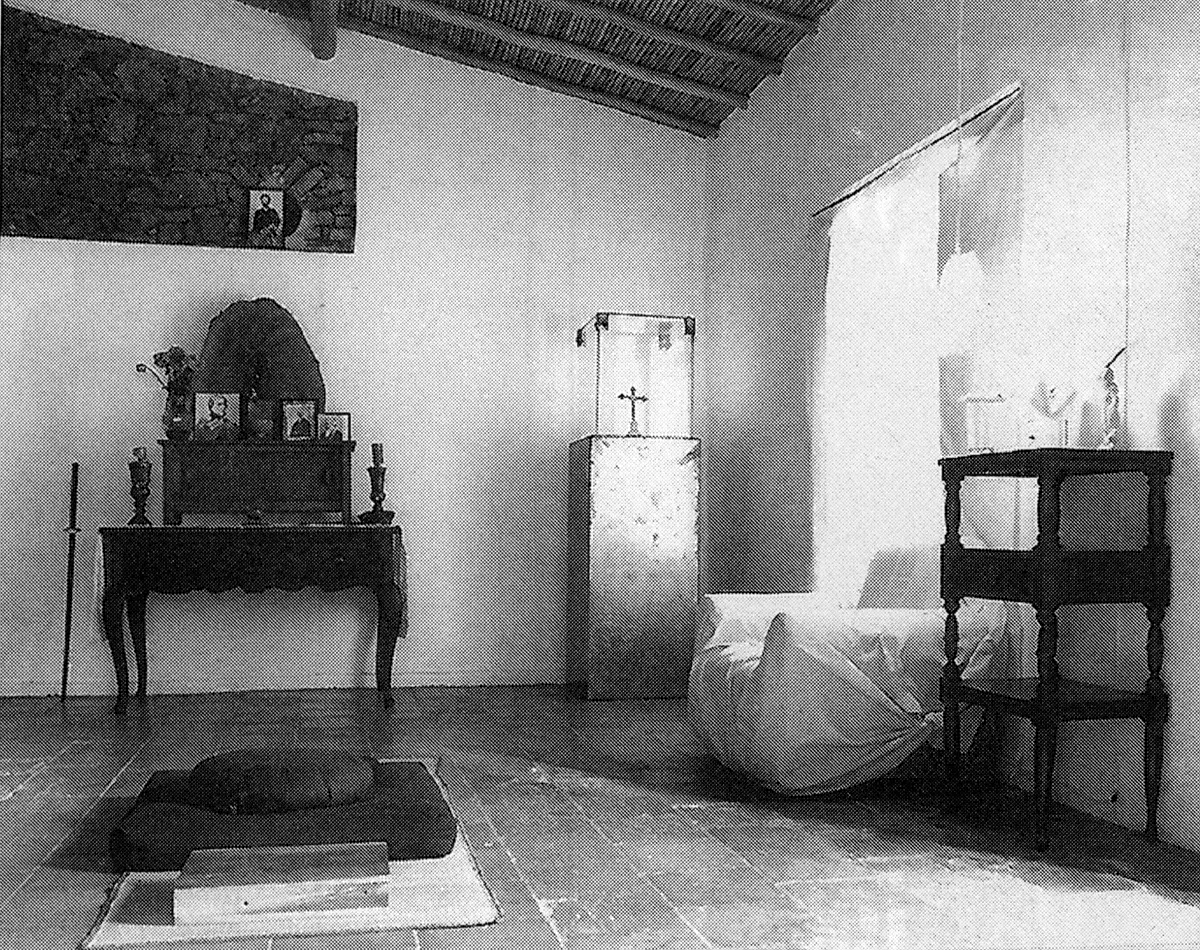
Auerbach and Carreño managed to give the event a very festive and majestic feel. The Museum was the epicenter, which allowed the visitor to enjoy visiting the works and installations on show. There was a well-designed map available which showed the visitor how to begin the visit from the Museum and rapidly reach the historical part of the city, the second and perhaps richest part of the show. Set against historical monuments, and with the Orinoco and Angostura as backdrops, the show included a series of works that established a dialogue with the environment or involved the inhabitants. The Casa Congreso de Angostura, El Correo de Orinoco, and La Casa Piar were, for a few months, no longer the sacred shrine of the civilian and military heroes of the war of independence, but became places for dialogue between two epochs, two ways of thinking. Thus, the work by Héctor Fuenmayor, entitled Death and Insurrection, a kind of performance and installation, comprised three parts: the first in the Soto Museum, White Square on White, the second in the Metropolitan Cathedral, Wall in Honor of Atonement, Wailing Wall II, and the third in the Casa Piar, In You, Iron of Great Luck, or more precisely, in the room where Manuel Piar was held prisoner before being shot. Fuenmayor fused into a single time two periods of history, the imprisonment of Piar and his own period of confinement. Fuenmayor remained locked up in this room for three days, living with the objects of Piar and his own (photographs, a Buddhist altar, and other kinds of personal objects). During this period, he prayed, meditated, and, according to his own words, the confinement became a spiritual retreat where the subject is submitted to a systematic negation of his existential self through the exercise of zazen (Zen meditation). Fuenmayor thus exorcized one of the saddest and most mistaken periods of our history.
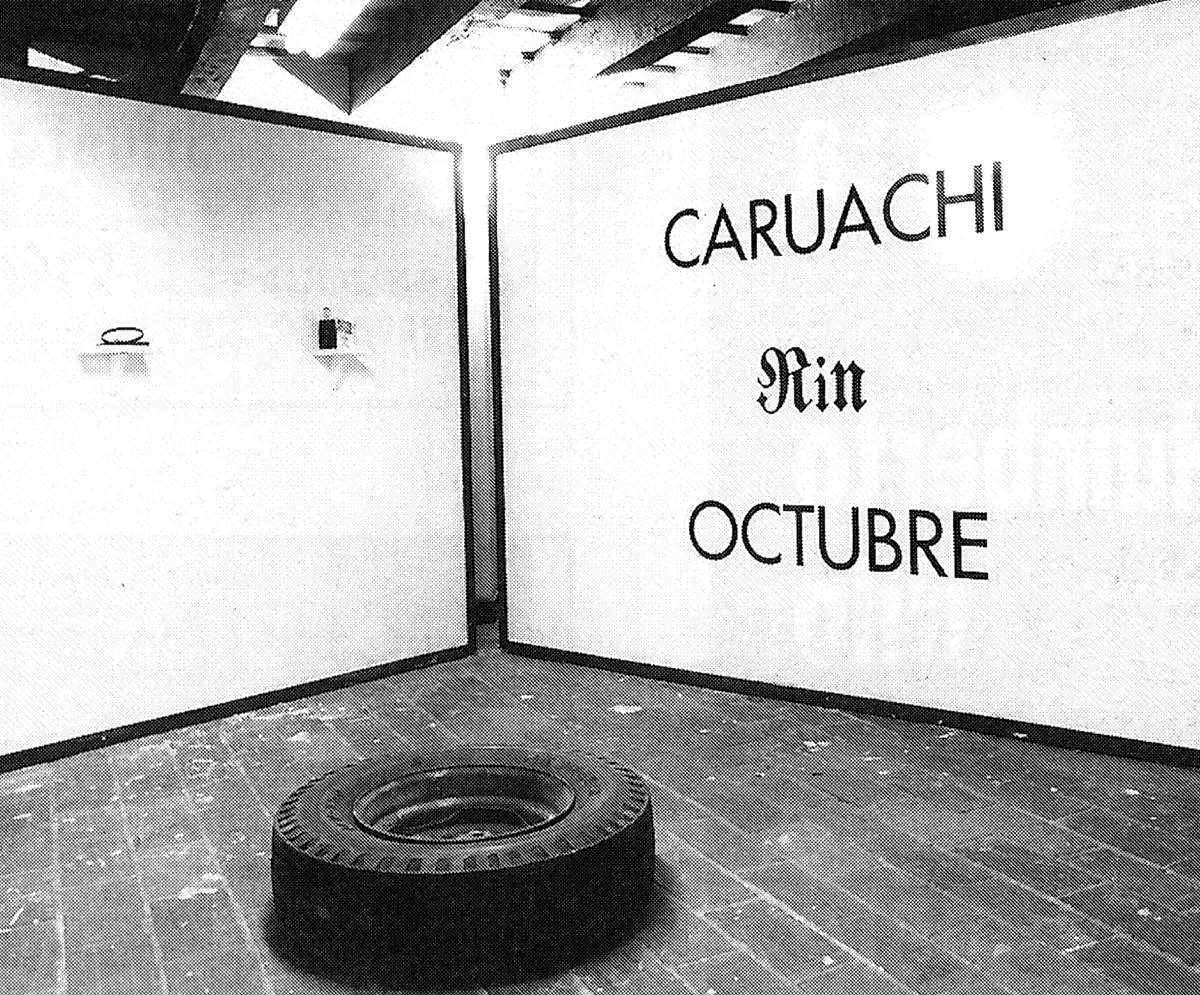
With the installation Rin and Intermittent Neon, Roberto Obregón explored another terrible period in our national history, the dictatorship of Marcos Pérez Jiménez. Under this regime of terror, all kinds of torture were used. That described by Obregón was one of the most common techniques used by the National Security against political prisoners, the rin; the technique, with intermittent flashing neon lights, was used by Augusto Pinochet’s police in Chile. The paradox established between these instruments of torture is that throughout history, man has used manacles, flashing lights, dark rooms, exile, and other contrivances to annihilate expressions of individual will. The grand prize of the Guayana Biennial was shared in this edition by Héctor Fuenmayor and Roberto Obregón.
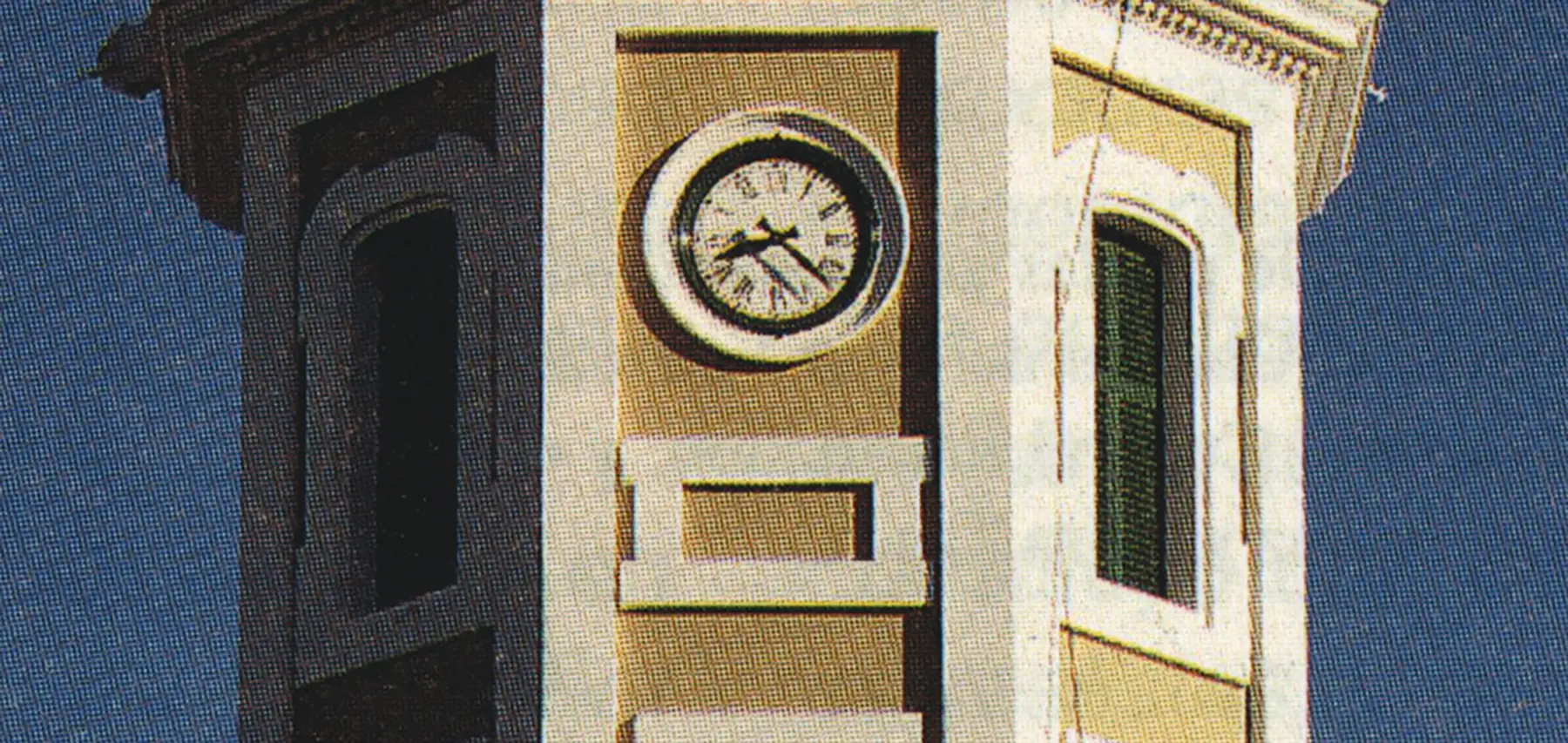
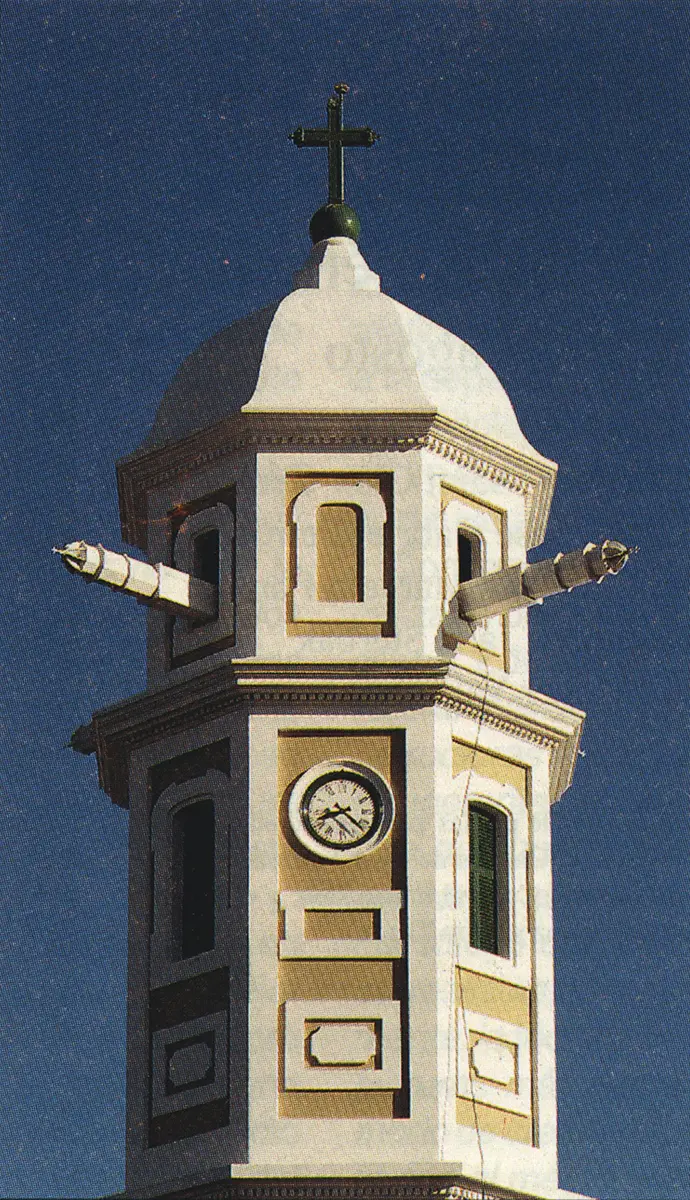
Alfred Wenemoser, a Venezuelan artist born in Austria and based in the country since 1978, is one of the most renowned and respected conceptual artists in the region. His installation RM Guayana, presented in the bell tower of the Metropolitan Cathedral, astonished and perplexed visitors and passersby at Plaza Bolívar, where the temple is located. Drawing on his background in architecture and engineering, Wenemoser created scale models of the tower that, emerging forcefully from within the structure itself, projected outward toward the four cardinal points. With this installation, Wenemoser received the Special Projects Award from the State Government.
Sigfredo Chacón received the Bolívar State Painting Prize for his works Monochrome Painting with Rats and Dalmatian Painting with Flies. As Chacón describes them, these pieces form “a conceptual collage that recreates situations in total contradiction with the purely abstract approaches that characterize my work.”
Pedro Terán, who has explored the myth of El Dorado for many years, presented a synthesis of his research through La escalera de Manoa (The Stairway of Manoa), an installation made of gold leaf that shimmered and dazzled passersby. Terán interprets the myth of El Dorado, evoking the sense of awe and intimidation it inspired in the conquistadors who sought the mythical city of Manoa.
Eugenio Espinoza has long been investigating the codes of visual language. His work Obstruction of Language is a kind of installation that, resembling traffic signage, reproduces photographs of the artist making various gestures and facial expressions reminiscent of baseball players—gestures that, taken out of context, acquire new meanings and connotations.
María Cristina Carbonell received the Three-Dimensional Work Prize for a piece that stood out to the jury for both its contemporary relevance and flawless execution. In Epicedio (Song for a Hero Fallen in Battle), Carbonell takes inspiration from the footprints of endangered animals to express a broader humanistic concern, portraying these species as heroes who survive humanity’s encroachment.
Mauricio Lupini, a young photographer, won the Two-Dimensional Work Prize for his Series B No. 2. The series features photographs of Barbie dolls stripped of their clothes, accessories, and makeup, transforming them into cold, lifeless objects devoid of the charm they usually convey. The paradox in Lupini’s work lies in the juxtaposition between the doll’s artificial coldness and the emotional detachment associated with the late-century ideal of feminine perfection.
With Mundo raro (Strange World), Enrique Eduardo Molina revisits Pop Art. His work draws from the comic books he enjoyed in childhood, now used as a vehicle for conceptual exploration. His canvases, teeming with imaginary characters—monstrous beings that invade and visually pollute urban spaces—reflect the chaos of contemporary cities.
In the 1994 exhibition Índice, organized by the Alejandro Otero Museum of Visual Arts, Juan Nascimento parodied Andy Warhol’s Campbell’s Soup Cans using a fictional utopian product. This time, he turns to the iconic Polar beer can as a means to expose the mechanisms of fetishization in contemporary society. Compacted into briefcase-like forms, these cans become tangible, museological works of art. Through this gesture, Nascimento sanctifies the banality of the discarded object—one whose final destination might be the trash heap, or, with luck, the recycling bin.
Describing every work exhibited in this Biennial would be impossible given space constraints. However, it is worth emphasizing the high level of excellence across submissions, reflecting the solid training of Venezuelan artists, their wealth of references, and the strength of curatorial criteria. Equally noteworthy is the caliber of the selection and awards jury, which included Roberto Guevara, Tahía Rivero, María Luz Cárdenas, José Antonio Hernández-Diez, Jesús Fuenmayor, and Jorge Rigamonti for two- and three-dimensional works and large-scale installations, and Ricardo Armas, Ricardo Gómez-Pérez, and David Suárez as jurors in the photography category.
ANITA TAPIAS
Crítica de arte y historiadora venezolana. Reside en Caracas.