
The San Juan artist Francisco García Burgos explores themes that have enabled him to go beyond illusory frontiers and observe history from the privileged position of the dreamer. The special nature of his work lies in the development of an optical narrative in which each picture becomes a vivid scene. His version of the theater of life does not omit any symbolic details, so that there is no risk of the spectator forgetting anything. This is because he takes as his starting point the affective nihilism suffered by large sectors of the population in our present-day societies. This attitude leads to a veritable plague of skepticism, which is profoundly detrimental to mankind. The proliferation of critical situations has unbalanced many groups in our societies.
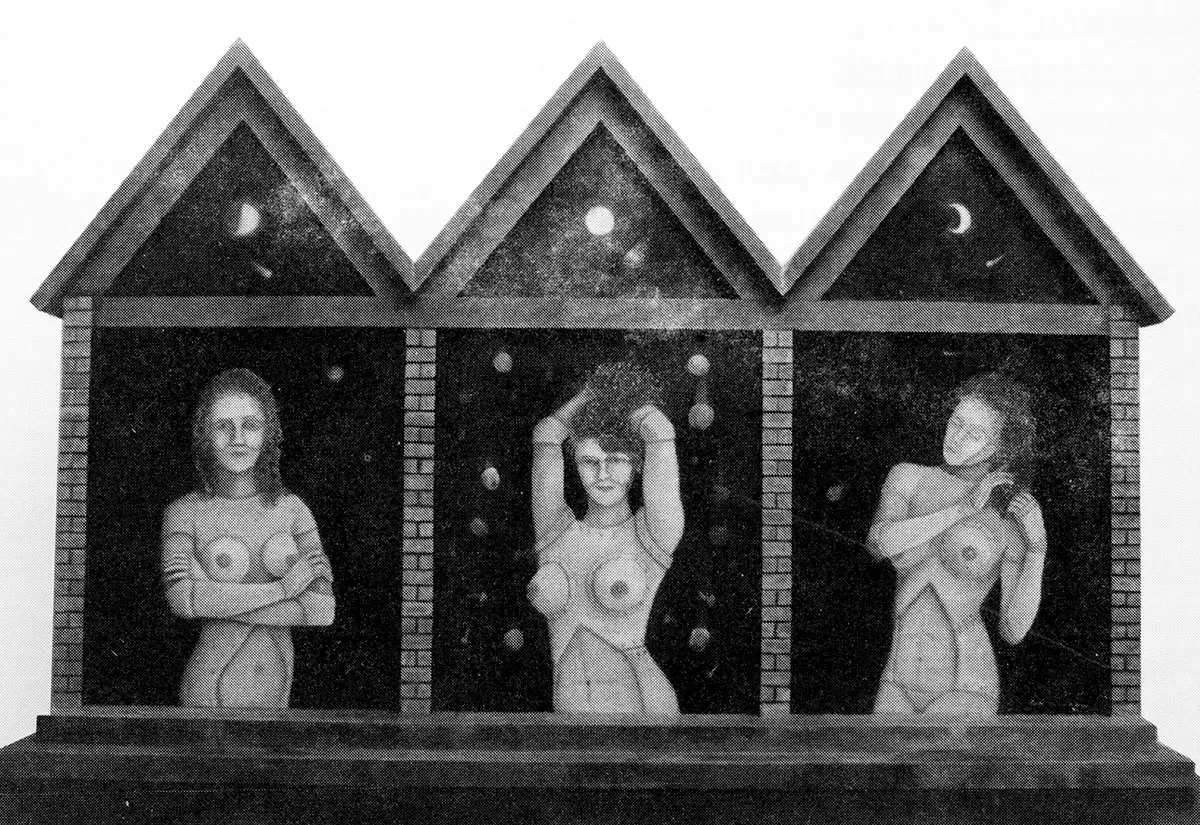
The sarcasm implicit in his work is tempered by a sense of exquisiteness in the images, where every detail is handled with great care. Although his work is very topical, his style clearly reflects that of the classic period. This helps him to direct his messages and to place emphasis on vital aspects of contemporary society, fundamental events of life through his portrait of the ages, with sharp observations on the unrest characteristic of our times. The references are subtle, but direct, to the insensitivity generated by so many tensions.
Through his work, García embarks on a journey back to remote times. His intention is to give the spectator a version in which fiction fills out scenes laden with legendary qualities. He presents real events seen from a perspective of fable, chimera, and myth, a story told by him which gives us a version of life as conceived by beings in the process of losing their sensitivity. His truth acquires the tone of a warning, bidding us not to lose the flexibility which gives purpose to existence.
His images are now dominated by figures whose psychologies can be defined: they act like machines with predictable movements. Taken together, the works become a kind of unusual masquerade, where each is wearing a disguise made of a metallic epidermis that reproduces their own images. This results in the creation of a well-orchestrated farce, where the director is the artist and the actors play themselves. The artist maintains an absolute control over his work, and nothing is left to chance, so that even hazard becomes something calculated by the creative mentality. Each scene is nurtured with feelings resulting from the investigation inherent in each collection. To show the absence of affections, he achieves the flexible geometry of the reflections of this unusual mineral skin, which assigns the characters to the borders of everyday experience. It is unusual to note hints of a medieval atmosphere seen, in technical terms, from the Renaissance standpoint, and which at the same time seem to project futuristic messages.
The profane altarpieces house figures taken from myth, history, the imagination, or visions of reality, which are processed according to the logical perspective of art. For example, the Three Graces seem to be models gliding down some catwalk. Each is covered with triangular roofs containing the different phases of the moon. In Impossible Rooster, the bird’s plumage is presented as if it were some impenetrable armor. The sense of presence is strengthened because it is shown as an independent being contained within a metallic frame, which is proof of its power.
JOSÉ ANTONIO PÉREZ RUIZ