
This past Spring, there were, as always is the case in this city of perpetual visual riches, extraordinary exhibitions in the galleries and museums, both large and small. Although London has not yet manifested a huge appreciation for Latin American art, there have been some notable exceptions. The Hayward Gallery was home, in the summer of 1989, to the debated yet highly important exhibition entitled Art in Latin America: The Modern Era. The catalogue, edited by curator Dawn Ades, is still a very valuable source for English-speaking audiences interested in a broad spectrum of information on the art of Latin America. This past spring (February 24-April 23), the Whitechapel Art Gallery presented a significant exhibition of the work of some of the young Cuban artists who represent the best of the vibrant scene, which is very much alive and well in Havana.1 The London exhibition, entitled New Art from Cuba, included paintings, prints, and ambitious installations by nine artists between the ages of 23 and 27: Pedro Álvarez, Saidel Brito, Tania Bruguera, Alexis Leyva (Kcho), Sandra Ramos, Fernando Rodríguez and three artists who comprise the group known as Los Carpinteros (The Carpenters) — Alexander Arrechea, Marco Castillo, and Dagoberto Rodríguez.
Virtually all of these artists have been widely seen in Havana in recent months — at the last Havana Biennial in the spring of 1994 and in the massive exhibition entitled Una de cada clase organized by the Fundacion Ludwig de Cuba in March of this year. Their art has also been represented in Berlin at a recent anthology of work from the Havana and São Paulo Biennials at the Haus der Kulturen der Welt. The artists in the London show have emerged from the highly creative atmosphere of the Instituto Superior de Arte (ISA), founded in Havana in the late 1970s. This institution, virtually unique in Latin America, combines instruction in all of the plastic and performing arts and is one of the most significant nurturing spots for the enormously energetic activity going on today in the Cuban capital.
Much of the art of this exhibition referred either obliquely or directly to political issues (an interesting barometer of the slowly emerging liberalization of officially sponsored culture in Cuba), especially that of the dilemma of emigration. Kcho (who recently had a brilliant solo exhibition at the Center Wifredo Lam in Havana) presented an impressive installation called Siempre se Fue, with a large arrangement of forms that resembled both palm trees and the paddles used to propel the rafts with which so many people left Cuba in August/September 1994. Sandra Ramos created an ambitious series called Migraciones —mixed media pieces with suitcases that open and reveal images of, for example, a Dreaming Farm Worker adrift on the sea in a raft, yearning for such typical Capitalist luxuries as cabin cruisers, big cars, stereos, as well as more mundane objects, such as hamburgers. In the works of Los Carpinteros, humor and irony are the most significant elements. Their piece, entitled Havana Country Club, shows men at leisure playing golf on an overgrown field. To understand the work, it helps to know that the Instituto Superior de Artes is located in the former buildings and grounds of the luxurious Havana Country Club.
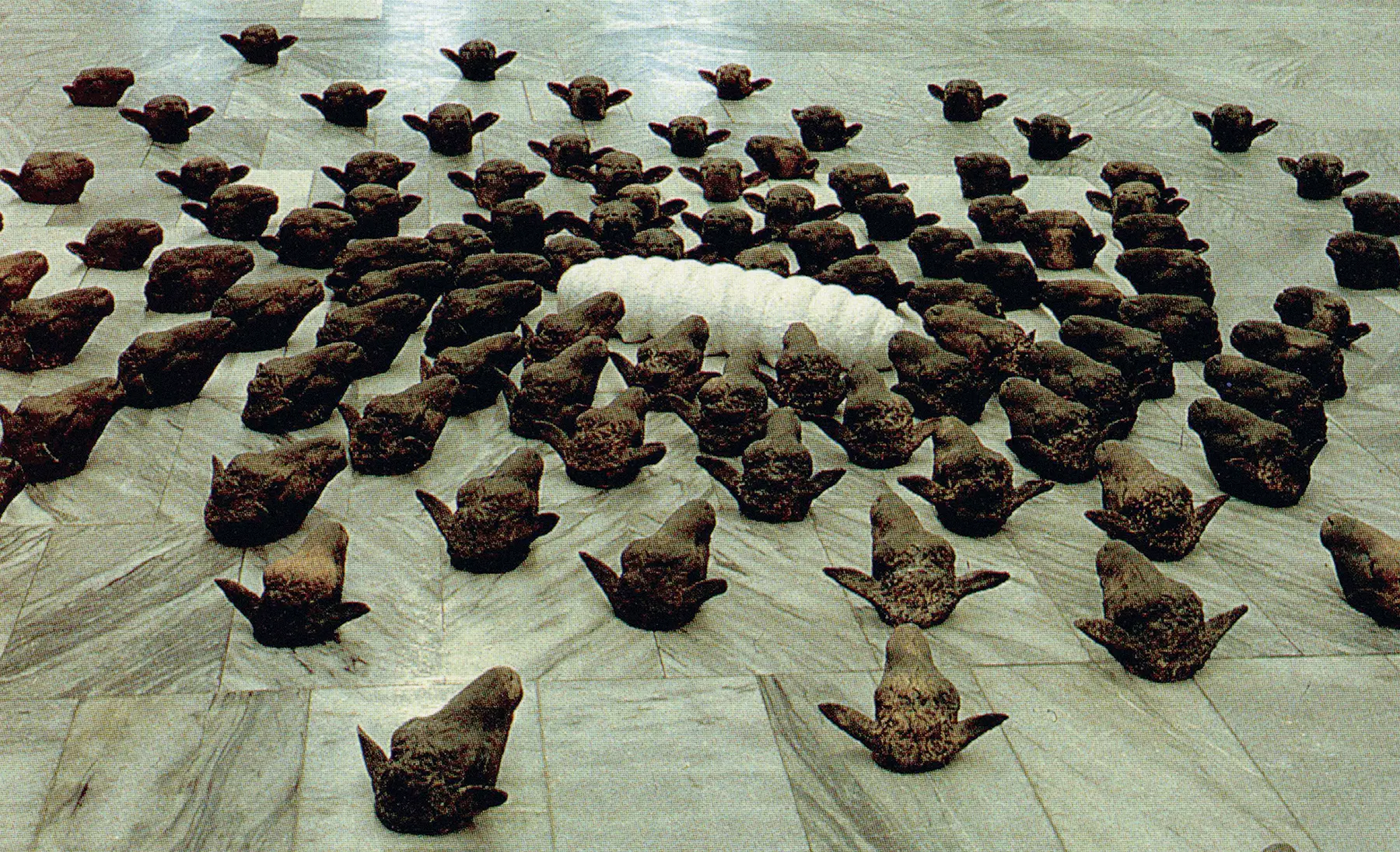
Saidel Brito was represented by a work entitled Emigración Voisin. As is often the case in the work of this young master, he presented a group of animal heads executed in realistic-looking ceramic, arranged on the floor. The piece, which includes many cow heads, was named for the French agricultural and livestock expert André Voisin, who advocated a special means of breeding cattle in the tropics. The plan, embraced by the revolutionary government of Cuba, was to provide a larger and cheaper food source for the people. It was ultimately a disaster and abandoned before Brito was born. Brito’s use of animal heads to suggest social situations was brilliantly seen in his recent Havana exhibition (as part of the Fundacion Ludwig’s Una de cada clase show at the Convento de Santa Clara). His piece called Oveja negra displays a large number of sheep’s heads crowding around the carcass of a worm. One could easily read into this image many connotations regarding unquestioning following of authority as well as the theme of the Cuban diaspora (the word gusano—or worm—was almost universally used in Cuba for years to describe those who left the island).
Pedro Álvarez plays with the concept of kitsch and nostalgia (another leitmotif in contemporary Cuban art) in his garishly-colored pictures that appropriate themes from "classic" nineteenth century Cuban paintings (such as those by Víctor Patricio Landaluze) and juxtapose them with motor cars from the 1950s (of which there are so many in Havana) and consumer objects like billboards for Benetton clothing. Álvarez’s paintings were impressive to visitors at last fall’s Second Biennial of the Caribbean and Central America (at the Museo de Arte Moderno, Santo Domingo) and were equally powerful in London.
London has always presented some of Europe’s most outstanding old master exhibitions. From January 19 until April 9, the main exhibition halls of the Royal Academy of Arts were home to the splendid exhibition of Nicholas Poussin. This overview of France’s greatest Baroque master was first seen at the Grand Palais in Paris. London had a reduced version. There were fewer pictures, and the drawings, which, in Paris, had been seen together with the paintings, were presented at the Dulwich Picture Gallery in a suburb of the British capital. The smaller size of the London Poussin exhibition made it a more manageable and more concise show. The brilliance of Poussin’s achievements was more comprehensively assimilated by the viewer —from his early rich, sensuous style (manifested in the extraordinary Martyrdom of Saint Erasmus painted for Saint Peter’s in Vatican City in 1628-1629 and not unlike the work of some contemporary Italian Baroque artists like Guercino), to the late, severely classicizing pictures such as the brilliant set of allegories of the Four Seasons created between 1660 and 1664 for the French statesman the Due de Richelieu and now in the Louvre. The catalogue for both the Paris and London versions of this exhibition is indispensable for lovers of the French seventeenth century.
At the National Gallery from February 22 to May 21 was one of this year’s most satisfying and moving old master exhibitions. Spanish Still Life from Velázquez to Goya was organized by North American scholar William B. Jordan and the Irish authority on Spanish art Peter Cherry of Trinity College, Dublin. Although the title indicates that the show started with Velázquez, it actually presented work from the most brilliant of still life masters of the earliest years of the seventeenth century. Juan Sánchez Cotán created some of the paradigmatic Spanish still lifes in the first decade of the century. Known for their few elements, separated one from another so as to allow the viewer to concentrate attention on the inherent sacredness of each object, Sánchez Cotán’s work should be recognized as forming a brilliant start to the grand still life tradition of the Iberian Peninsula.
One of the most interesting things about this show from the Latin American point of view was the use in so many of these pictures of fruits, vegetables, or ceramic vessels from the New World. In Sánchez Cotán’s c. 1600 Still Life with Game Fowl in the Art Institute, Chicago, the artist paints a chayote, a cucumber-like vegetable native to Mexico. In Juan van der Hamen y León’s 1627 Still Life with Sweets and Pottery (Washington, D.C., National Gallery), we observe a bowl imported into Spain from Tonalá, Mexico. Antonio de Pereda’s Still Life with Sweets, Vessels and Ebony Chest (1652, Hermitage, Saint Petersburg), a lacquer vessel from Mexico, shares the spotlight with other luxury items. The "exotic" appeal of the faraway colonies is manifested in these examples.
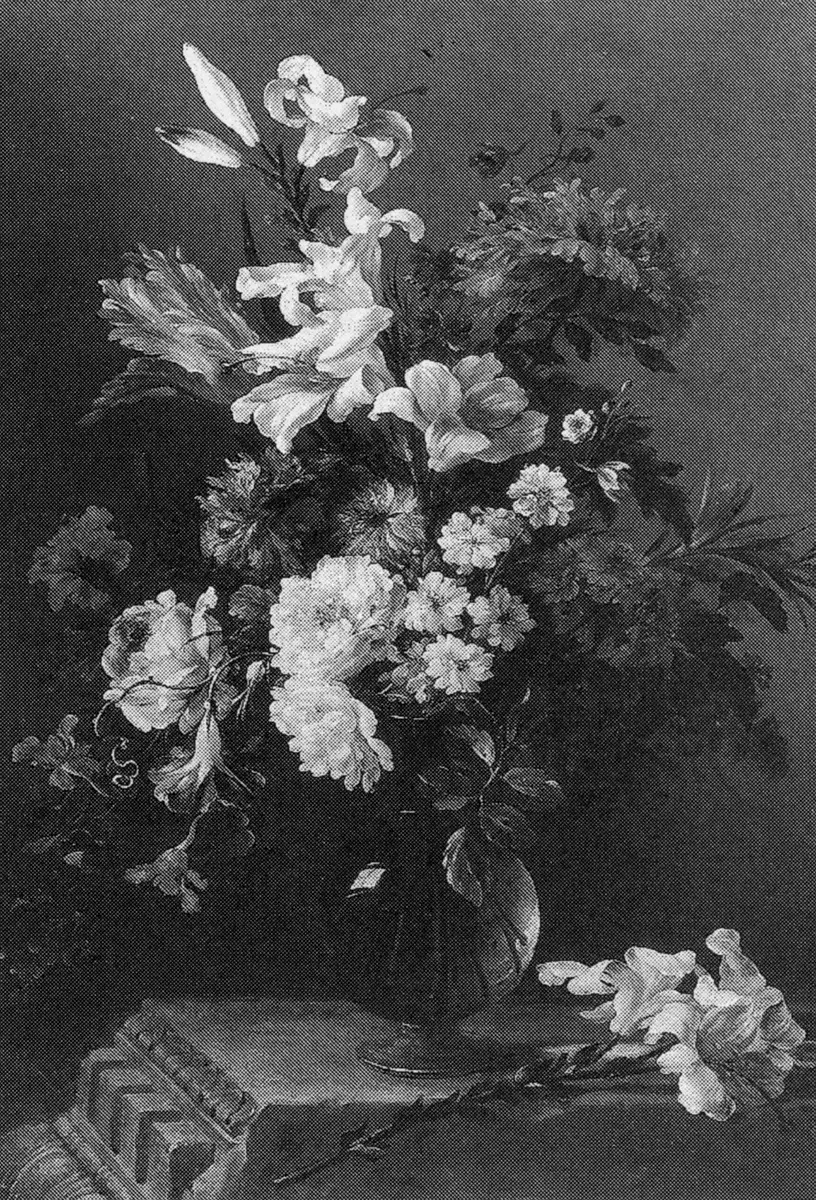
Flower pieces were another significant category of work shown at the London exhibition. Among the masters of flower painting in the Baroque period was Bartolomé Pérez, who represented the last generation of painters working during the reign of King Carlos II. His sumptuous assemblages of flowers of various types and representative of various seasons, similar to a work in the North Carolina Museum of Art, Raleigh, gave great pleasure to viewers in the exhibition.
Of all the still lifes, Goya’s series of dead fowl and fish painted in c. 1812 was among the most haunting. While one could see how they appealed to Édouard Manet, such a great admirer of Goya, one could also imagine the intense interest they exerted on the Symbolists, such as Odilon Redon, subject of another splendid show in London this spring.
Redon was certainly an admirer of the more grotesque and dream-like examples of Spanish still life painting — especially those by Goya. The Redon show originated at the Van Gogh Museum, Amsterdam, traveled later to The Art Institute (Chicago), and remained on view at the Royal Academy of Arts through April. As important as a draftsman and print maker as a painter of unsettling oneiric fantasies, Odilon Redon was equally at home while painting exquisite, jewel-like pastels of flowers, many of which were included in this splendid exhibition. Visitors to the Redon show were also able to appreciate Redon as an important precursor of the Surrealist imagination.
NOTE
1. The exhibition traveled to the Tullie House Museum and Art Gallery in Carlisle from May 6 to June 25.
EDWARD J. SULLIVAN
Professor at the University of New York Department of Visual Arts.