
The imagery of Afro-Caribbean religious syncretism is one of the essential features of Cuban art today. Although its subtle variations and manifestations are to be found in dozens of islands and along the continental coasts of the Caribbean, where African immigration has directly or indirectly had a significant impact, it is above all in Cuba that we can find its more varied features, and where it has been the most exhaustively explored.
Two poles should be established, which mark the artistic expression of religion in this context, and which have different degrees of complexity at the symbolic level. There is an emphasis on signs which announce power or the mystical properties of the deity, its representatives or adepts, that require a prior knowledge of the codes governing hierarchy in the pantheon or the members of the rule. Restriction in the access to the referents or meanings established in mystical circles reaffirms the supremacy of the initiated, but its transfer from the ritual level to that of the work as a commodity, i.e., its alienation, its transformation from a vital and transcendent element into a folkloric, commercial commentary, implies ingenuity, or something excessively calculating.
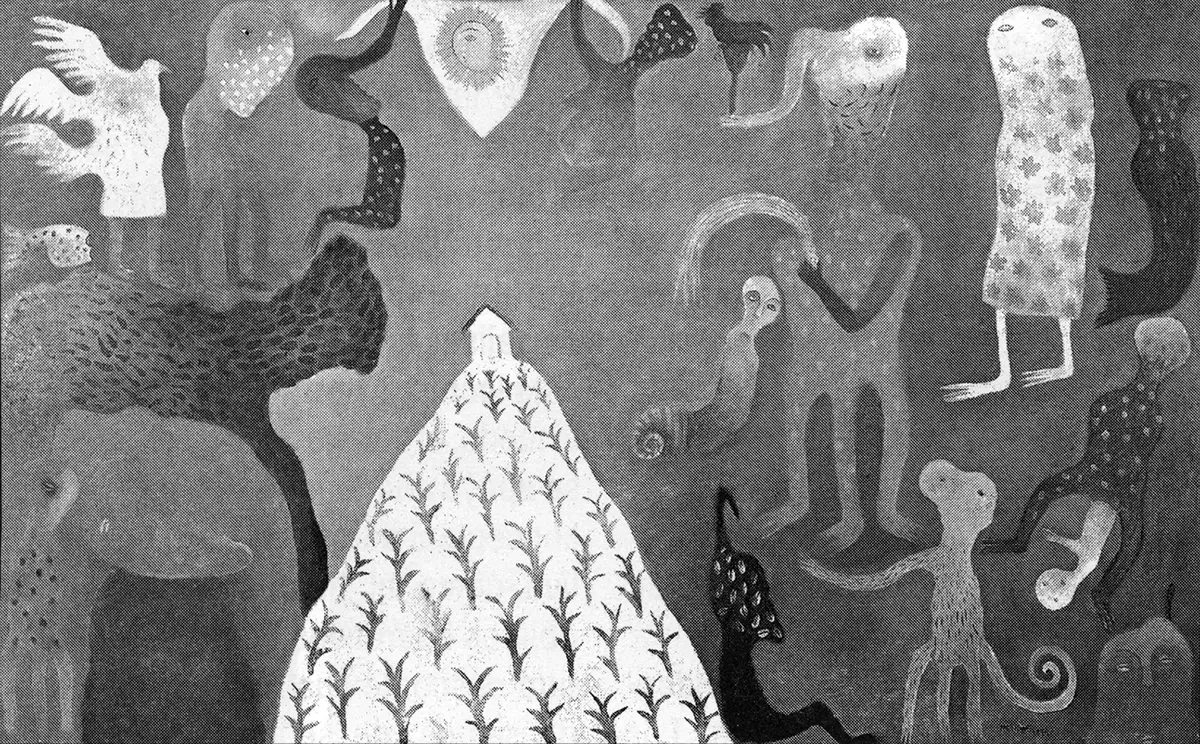
Manuel Mendive does not make this mistake, and he does not try to surprise us with mysteries not revealed. His work is at the opposite extreme of semiotic monosemy, decontextualized crypticism. Thus, his supposed ingenuity is in fact the reverse, the appropriate way to explain the cosmogony which governs his life and his attitude, something which in itself distinguishes him from those who indiscriminately exploit their religion. Yes, his work is narrative; the signs give way to the representation of the deities as mutations, proto-men, or animals. Their features denote their qualities, their activities denounce their deviations, and their form, the most characteristic of the cult’s properties: its profound relationship with nature. If this is obvious, then one should look at the position of the religious and philosophical forms of development most infiltrated by rationalism and which have lost their perspective of these same original roots, to see what I am saying. Hence, the consequence in the work of Mendive, a work in which tradition is transmitted through anecdote. If he is accused of ingenuity, then it would be the ingenuity of religion itself, i.e., one of its virtues. If there is surrealism, then it is the surrealism inherent in the tale, rather than an ethical stance. And if he is accused of caricaturizing the sacred, then it should be remembered that his creation is one in which the gods laugh and make love, in which worship takes the form of singing and dancing, in which extasy is the maximum expression of mystical union, and in which the naked body does not offend, but exalts. None of this is understandable to those who pray to a man who was tortured, murdered, and dishonored by a crown of thorns.
In Mendive’s paintings, performances, and sculptures, the syncretic correspondences with the Catholic pantheon are less obvious than in the case of other colleagues of his. Perhaps because of the emphasis placed on ludic elements or the innocent purity inherent in the cult of Obbatalá, of whom the Cuban artist is a son by relationship and empathy. It is in experience, in the parallels and relation of consequence between creator and creation, that the work becomes truly understandable. It is a matter of attitude, which provides the karma to what perception, flawed by utilitarian mediatization, would describe as casual figures, composition, color, etc. In this sense, the art of the 1970s once again received a lesson from religious art, and hence the parallels between Mendive and those seeking the recuperation of the aesthetics of what is human. Anyone can be an artist, or social art is nothing more than variations of the re ligare that motivates art from the entrails, heedless of fashion, such as that which I am discussing. An art without time and therefore, an art which knows nothing of the myth that time will be the judge.
This is how one needs to strip oneself before entering the universe of Mendive. This is much more difficult than it would appear. Many have lost forever the capacity to return to the former state where everything is transparent, new, and surprising. They have lost the capacity for astonishment, which is essential for participation in the world of Olofi, Elegguá, Ochún... They fear falling because falling is an invention of reason. Mendive’s invitation, therefore, is the simplest and pleasant, but it provokes disquiet leading to rejection. Perhaps this is because it is an invitation to the libido, and asks others to remain outside. We should not give in to the temptation of dissecting the canvas, separating the figures into groups, labeling them, presuming to understand the surprising tonalities of their skins, half angel, half unknown animal. To apply to Mendive the laws of the arrogant discourse of contemporaneity (not to say post-modernity) is to deny him from the outset, not to give him opportunities or, in other words, not to give ourselves the opportunity to open up the doors of perception and enter into a different dimension. The only risk is that the bet is freedom.
KLAUS STEINMETZ