
We were already familiar with the powerful "soft" sculptures by María Teresa Torras based on weaving in traditional sisal, which have enabled her to discover many possibilities for expression.
Her well-known Palm Trees, graceful sculptures in sisal, and the figures of The Grand Jury now make way for The Maccabeans, sculptures in sisal, iron, painted steel, or wood, which have just been presented at the National Art Gallery of Caracas.
The Maccabeans are pieces which might be called serial: they have the same form—a synthetic human form without limbs or head—and similar dimensions (200 x 66 x 20 cm.).
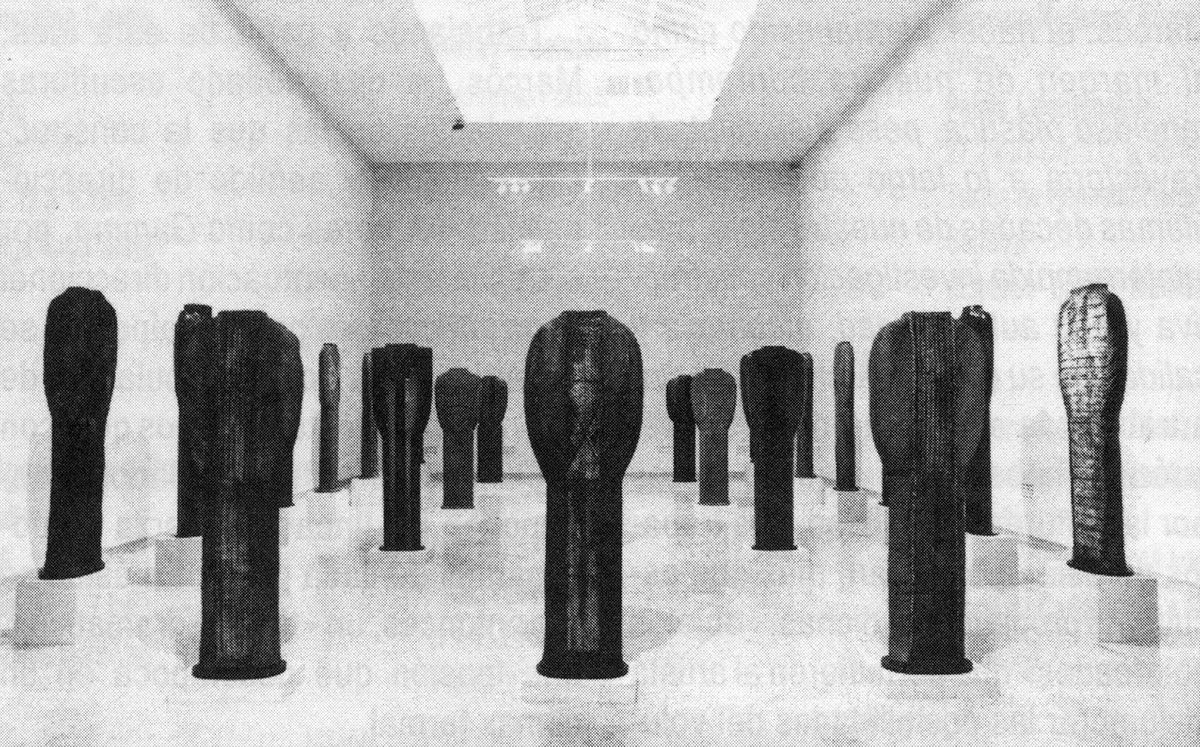
The repetition in the format of The Maccabeans highlights several interesting features about the work and the exhibition: the variations in each piece are in the materials and the way they are treated by the artist. In this sense, the versatility of Torras’s work, as emphasized in the serial repetition of these pieces, is surprising. In the Matatías series, for example, the artist delights in the contrasts in the geometrical arrangement of the compositions (the "vestments" of the figures) and the rich textural treatment which can be achieved with oxidized steel. The absolute symmetry of the work is taken up again in the geometrical ornamentation, which in turn is enriched by the dramatic textures created by Torras through the oxidation process. "The steel is intervened with characteristic forms, and acids are scattered over the surface: the result is surprising, since the reaction of the acids with the steel is unpredictable."1 In the Judas Makabí, handsome pieces in iron or soldered iron, Torras achieves an almost constructive perfection: these works are the most synthetic, the most hieratic of the Maccabeans, and take us into the world of science fiction and futurist imagery. The artist, surprising us once again by using a new material within her work, exploits the constructive possibilities of iron—its strength, shine, and capacity to express perfection, in works of great formal, decanted beauty. The carved reliefs establish a dialogue with polished wood in Simón Thursi. Perhaps it is in these carved pieces that we can detect certain technical weaknesses: in some pieces, the carving loses originality and texture. In such cases, the artist, in her wisdom, introduces variations to the forceful mass of the Maccabeans to create some works which are perforated, almost "winged," through the introduction of pointed forms on the "shoulders." The artist’s mastery of weaving is once again evident in the pieces entitled Jonathan Japhos, where the sisal acquires its full textural richness in a harmonious succession of woven stitches. "The 'sisal' does not allow her to make major changes in the weaving because of the form of its structure. It is therefore the surface which becomes the protagonist, with the contrasts in textures as the sisal is intervened with materials such as wax, painted paraffin, and burns."2
Another noteworthy aspect is the marked sense of restraint, the concentration imposed by these figures with their hieratic stance and reiterated forms. The Maccabeans are, by their rigid beauty and silent presence, the stark exponents of some deep human drama.
NOTES
1. Graziana La Roca, María Teresa Torras, Macabeos, 1990-1994 in National Art Gallery, María Teresa Torras, Caracas, February-May, 1995, p.5.
2. Op.cit. p.6.
KATHERINE CHACÓN