
In a further step towards Colombo-Venezuelan integration, the third edition of the National Plastic Arts Biennial of Merida was realized; it was also the first Colombo-Venezuelan edition. It was organized by the Cultural Department of the Government of the state of Merida, in association with the National Council of Culture (CONAC) and the Museum of Modern Art of Merida, and with the support of the Department of Plastic Arts of the Colombian Institute of Culture (COLCULTURA). This third edition was dedicated to the Venezuelan master Juan Félix Sánchez, and several exhibition areas in the city were "taken over" and used for the setting of this visual and creative confrontation.
Forty-five Venezuelan artists and twenty-six Colombians presented their work, grouped into the traditional categories of analysis and approximation to the study of visual arts: painting, sculpture, graphic arts, photography, drawing, and non-conventional art. The selection and prize-awarding jury was made up of the critic Víctor Guédez, the sculptor Cornelis Zitman, and the painter Antonio Moya, on behalf of Venezuela, and by the art critic and professor Germán Rubiano Caballero and the master artist Eduardo Ramírez Villamizar, for Colombia.
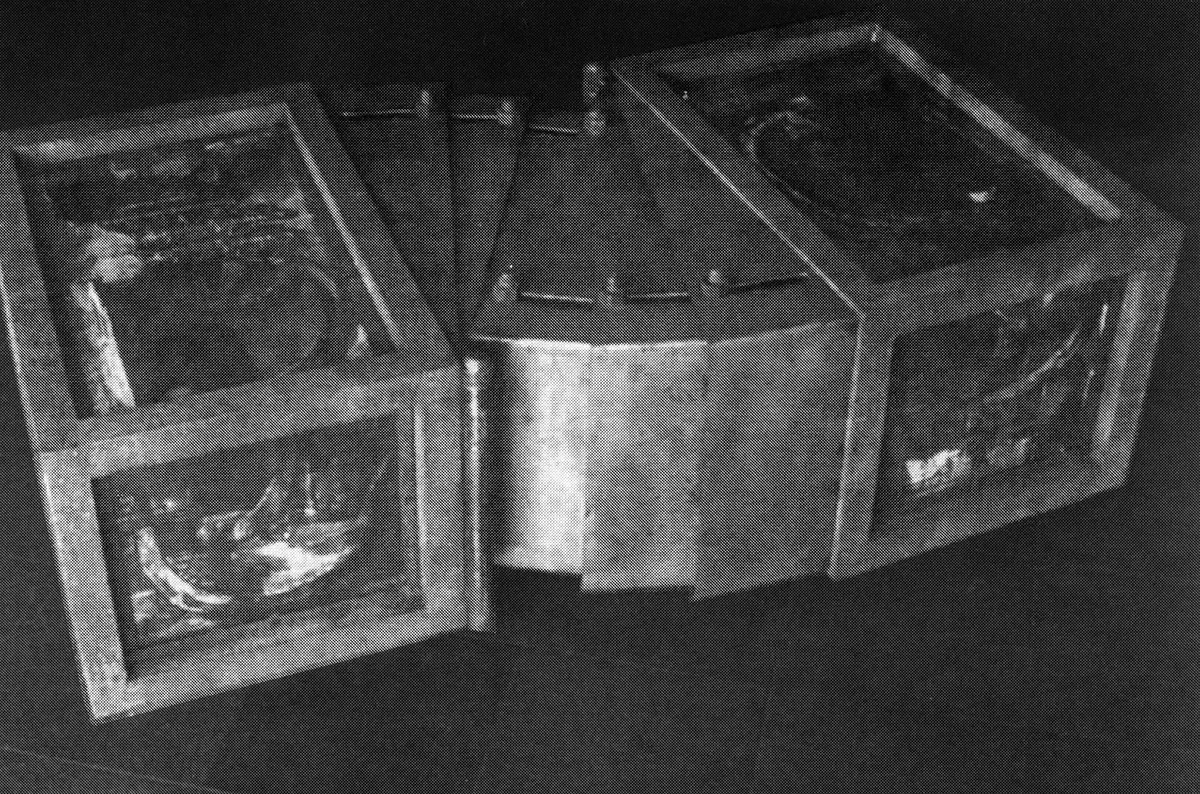
Of the works on show, special mention must be made to ST, by Lihie Talmor (Venezuela), which obtained the sculpture prize. It was a three-dimensional piece which used iron and print-making to achieve a novel effect that captured the essence and texture of iron and the softness and transparent feature of printwork. Urban Cot, by Sydia Reyes (Venezuela), which used iron, concrete, and various other materials, was awarded the Grand Prix of the Biennial. Special mention must also be made of the sculptural work by Doménica Aglialoro (Venezuela), which was awarded a mention, and the assemblage in various materials by Jorge Rodríguez Aguilar and the geometrical iron structures by Álvaro Diego Gómez (both from Colombia).
In painting, the prize went to Jesús Guerrero (Venezuela), for a work entitled From the Window, which showed a fine mastery of technique. Néstor Alí Quiñones (Venezuela) was awarded a mention; also worthy of note were the works by Mary Carmen Pérez (Venezuela), Marylee Coll (Venezuela), José Omar Valbuena (Colombia), Miguel Bohmer (Colombia), and Fernando Rubio Ahumada (Colombia).
In the graphic arts section, the prize went to Ricardo Benaím (Venezuela), an artist with a long career in the visual arts, and Jesús Matheus (Venezuela), who obtained a mention; both these artists have a solid language and structured artistic discourse.
In drawing, it was Lucas Ospina (Colombia) who won the prize, with a work entitled 23 Drawings (Animals), in which he demonstrated his mastery of the techniques of this discipline; the mention went to Ismael Mundaray (Venezuela) for his Maloca Series.
The photography prize was awarded to Eduardo Pradilla (Colombia) for an excellent work based on a confrontation of images. In the non-conventional art section, the honors went to Harry López for an installation entitled The Pond, and to Ana Claudia Múnera for a novel work entitled Plastic Objects (both artists from Colombia).
In this category, mention must also be made to the work of Jennifer Hackshaw (Yeni) (Venezuela), an artist with a long and important career, who presented an installation entitled Expansion of the Conscience.
The results of the Biennial are there for all to see, and they mark the consolidation of the multiple visions of the artist as an interlocutor of contemporary society.
ANTONIO RODRÍGUEZ