
In January 1995, the Luis Ángel Arango Library, continuing the series of New Names exhibitions which it has been holding for a number of years to promote young artists in the country, presented the work of Ana Claudia Múnera (Medellín, 1966) and Elías Heim (Cali, 1966). Although young, these artists are not "new names" in the strict sense, since they are not recent graduates and were not presenting their work to the public for the first time. Elías Heim has had one-man shows before, and both artists have won prizes at the Bogota Biennial: Heim in 1992 and Múnera in 1994.
Elías Heim’s work adopts a forceful position towards the way foreign curators designate and stigmatize Latin American art. Being Latin American is synonymous with a series of stereotypes ranging from feathers to totems, and including all kinds of altars, as new forms of segregation. The art of women, the art of the blacks, the Jews, or the Colombians are all attempts to tranquilize consciences with a universal vision, but without any attempt to transform sensibilities. It would appear that we are witnessing the construction, I do not know how ingenious, of some new utopia which is attempting to make human interests and desires converge towards a single point of view, in order to keep society under control. Elías Heim believes that if a person visits an exhibition and does not see any difference between the work of a German artist and his own, then he has achieved his goal, since his work should be judged within a single context, that of art.
It is important to remember here that Colombian artists have presented their works in museums throughout the world (for example, Negret, Botero, Ramírez, Beatriz González, Miguel Ángel Rojas), and they too are interested in the single context of art; however, their works also have certain linguistic features, to give it a name, which makes them refer to universal art, to themselves, and to a specific place at the same time. Perhaps today, the Latin American ingredient has become too banal, and we now need a more belligerent attitude, such as that of Elías Heim, which at all events implies reflection by someone concerned with the problem and who has much potential for development.
Elías Heim works with unstable structures in museums, such as air conditioning units, electrical installations, and the attitudes and interests that are concentrated, and captures them in strange forms with functions that attempt to revitalize space. Extractor of Accumulated Atmospheres was a piece of apparatus made up of three orange metallic cones (of the same height as a spectator, but corpulent, "inflated and occupying all the space"), and connected by plastic tubes to the places in which artworks are generally placed in a museum, i.e. on the walls, on the floor, and in space, and each reacting in its own way. The cone on the floor functioned as a brush, the one on the wall gave off beams of light, and a third made noises like an air extractor. All this simulated "high technology" was supposed to be extracting all the tensions from the room; for example, the tensions generated between the spectator and the work, the curator and the artist, the work and the space, the museum and art. This emotional charge was sent outside through a white and orange striped chimney, a "genial" and amusing device which turned it into white smoke smelling of coconut. As a work specially designed for a place, the piece made more sense in La Tertulia Museum in Cali, where it was also presented, than in the impersonal setting of the Library, but in any case, these servos full of movement and with such festive colors, confirmed that Heim is an artist who has surmounted many complexes and that he is prepared to take on the challenge of international debate with irony and confidence in his handling of color and drawing.
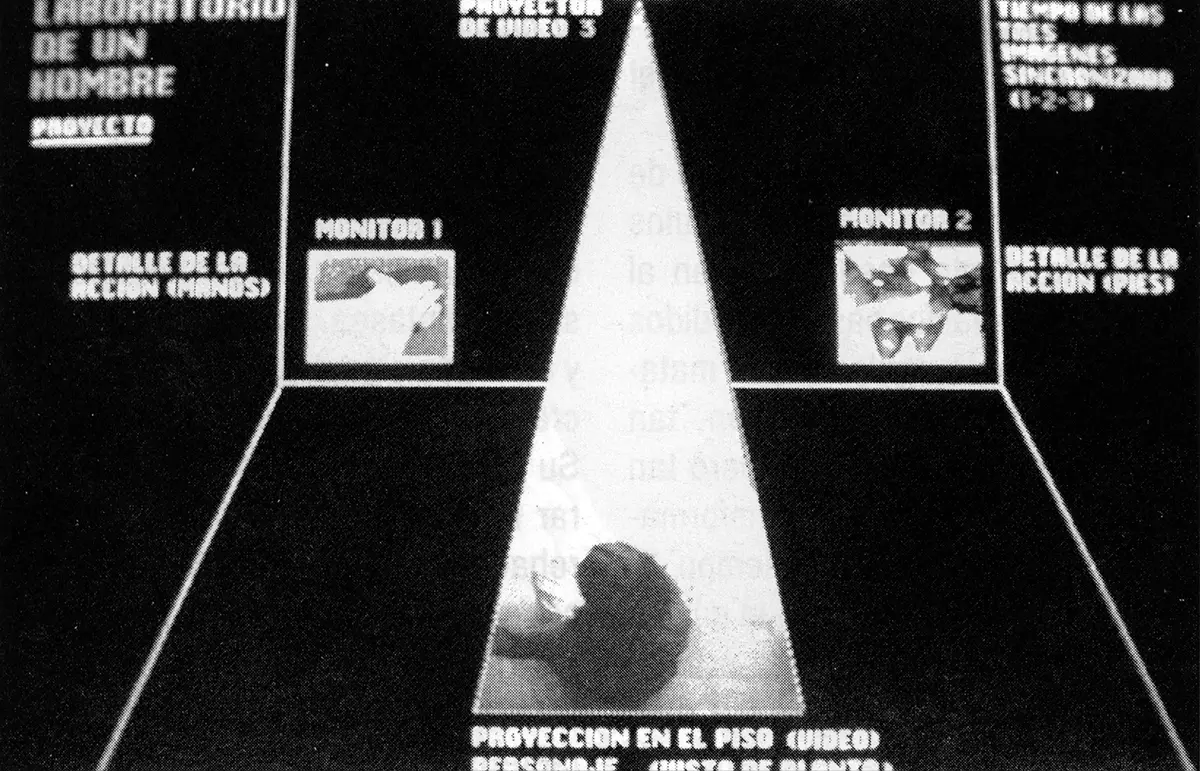
Ana Claudia Múnera has worked with video installations in a very original manner, in an attempt to integrate projection mechanisms into her subject. For example, she has used organic screens such as flour or as in this case, in the work entitled Laboratory of a Man, a washbasin with a milky liquid. The image in the video camera is a conventional rectangle, but the artist makes it circular, like its support, to show a man, within a small space, performing in slow motion everyday movements. The video has traditionally been called "guerrilla television," since it attacks the passivity of the spectator watching television. Ana Claudia Múnera’s video installations could be called Everyday life-traps, because they try to identify networks of everyday events which, when related to one another, highlight the meaning or lack of meaning of the structure we call "everyday life." Someone once said that life is what happens every day while we are waiting for something to happen which is worth experiencing; through sections of these 24 hours, Laboratory of a Man takes us towards the only time and space which we have, that which is within ourselves, coupled with the idea that it is essential for each of us to take the decision for reconstruction ourselves, rather than allow it to be imposed from outside.
NATALIA GUTIÉRREZ