
Priscilla Monge is one of the most promising art figures of this decade in Costa Rica. Although she is still very young (she was born in 1968), she won a prize at the last edition of the Lachnner & Sáenz Painting Biennial, the most important event of its kind in Costa Rica, and more recently, her work was seen at ARCO'95 and in the Biennials of Valparaiso in Chile and of Central America and the Caribbean in Santo Domingo.
Her recent one-woman show at the Jacob Karpio Gallery revealed an artist of surprising maturity, with a personal discourse full of conceptual clarity and elaborate finish. This is the art of the 90s and more particularly, of a post-modernist aesthetic in the way in which it deconstructs and selects visual signs, which we discover in a new relationship that contradicts their origin.
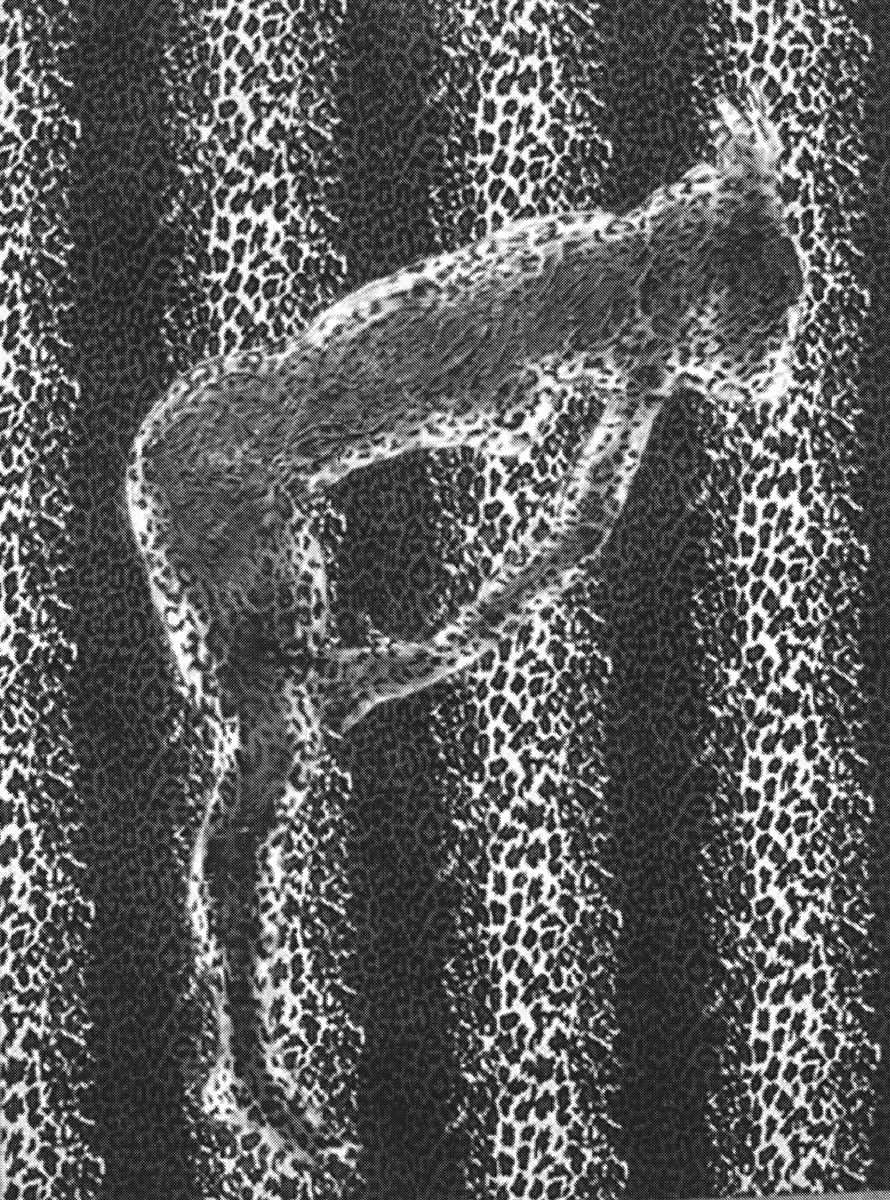
The game of transferring objects and forms from one context or func-tion to another, subverting meanings within the space of the artwork and at the same time taking the latter out of its artistic frame of reference and into real life, allows the artist to establish new codes of communication and construct a system whose daily life subjects are reflected in the rather ironical appearance of her fabrics for covering furniture, which form the support for her works and have the evocative name of damask.
The use of this material is directly related to women, since it is traditionally women who have used it to decorate the most visible rooms in their homes. To use it is like "invading something which already has a meaning," a color, a suggestion—rather than a white space waiting for meaning. Extended over the walls of the gallery, the pieces of damask cut and joined into fringes, like flags, revealed recognizable figures that were repeated and made banal.
Embroidery and all the manual arts which she uses are associated in our minds with the world of women, everyday activities which have for centuries been part of women’s lives. This is not an exaggerated kind of feminism, but a perception of things through handicraft materials and work without any artistic content, a little kitsch, which Monge raises to the level of art and which is a reference to her sex, which she "takes advantage of" to tell her own story. I dreamed that I was a Painter who was Embroidering is the work that best synthesizes this idea. It shows the silhouette of a woman against a profusely decorated background of floral motifs painted on the fabric in a superimposition that is not fully integrated. In this way, she expresses her desire to be like other women and the impossibility of being so because of her critical eye.
The artist simulates a refined taste, whereas in reality her "presentation outfit" is nothing more than something carried out with a machine, in which she has merely mediated in the selection of the design or repeated pattern, the fabric, and the motifs in one of those anonymous stores where they print fabrics and prepare bridal apparel.
This attitude proves destabilizing and leaves us without the "aura" of "original" craftwork, and although it is not difficult to classify it at the international level, it is nevertheless hard to set within the context of Costa Rica, where traditionally the "personal stamp" remains important.
Monge renders banal the symbols and signs of society and culture through this ironic tension in the apparent refinement and the mechanization of the media, the repetition, and the simulacrum, the tension between the forms and the material. There is, without doubt, violence here.
But the violence is not only a matter of form: it is a constant presence in her work. The toy pistols, which she initially covered with little flowers to hide their real meaning as death objects, now appear clearly but falsely, like something about which one cannot say "this is a pistol."
In a similar way, in her exquisitely embroidered texts on linen, she works fragments extracted from the different death sentences against criminals of the last century, which show an almost naive cruelty because of the beliefs and superstitions implicit in them.
Monge thus inverts the meanings, leaving them empty of content as she takes them from one context to another —that of her works—in which they lose their original meaning and acquire a new sense. In this cold and Intellectual attitude, she tries to hide, or rather camouflage, what is happening or what is before our eyes and what we do not see, through metaphors such as those of the death sentences of the past.
In the presence of her work, we feel a sensation similar to that which she feels about her environment: we feel solitude, the danger of dying in the street, in history, the lack of communication, violence in everyday acts, in human and social relations... but everything lies between the lines.
Perhaps the artist wanted to hide a certain kind of fragility which is not evident when we first see her work, but which is there, hidden away, like the fear or helplessness we often feel when faced with something we do not even dare to confess to ourselves. It will remain camouflaged to the spectator, although it is there if we become alert and are able to discover it.
DERMIS PÉREZ LEÓN